


A tongue tie rarely causes a speech delay. It can sometimes make certain sounds harder to produce, but a child who is late to talk, or who has a small vocabulary, almost always has another explanation. The best next step is usually an evaluation by a speech-language pathologist (SLP), not a procedure. This guide explains where a tongue tie does matter for speech, where it does not, and how to decide with your pediatrician and your care team.
TL;DR
- The scientific consensus is that there is no clear evidence of a direct link between tongue tie and global speech delay. Late talking and a tongue tie often coexist by chance.
- A tight frenulum may affect specific sounds, such as “l” and “th”, and sometimes how clearly a child is understood. That is different from a delay in language.
- Start with a hearing check and an SLP evaluation. Release for speech reasons should come only after that assessment points to the tongue tie.
- Tongue posture, mouth breathing and swallowing patterns can also affect speech. A team approach often works better than looking only at the frenulum.
- We evaluate function, not appearance, and we do not recommend a release “just in case”.
Table of Contents
- Speech delay and tongue tie are not the same problem
- What the research says
- What else can sit behind a speech delay
- When a tongue tie can affect speech
- Tongue posture, mouth breathing and speech
- A sensible order of steps for parents
- Our perspective
- If you want a second opinion on tongue function
- FAQ
- Sources
Speech delay and tongue tie are not the same problem
Parents often use “speech delay” for several different things, and the distinction decides whether a tongue tie could be involved.
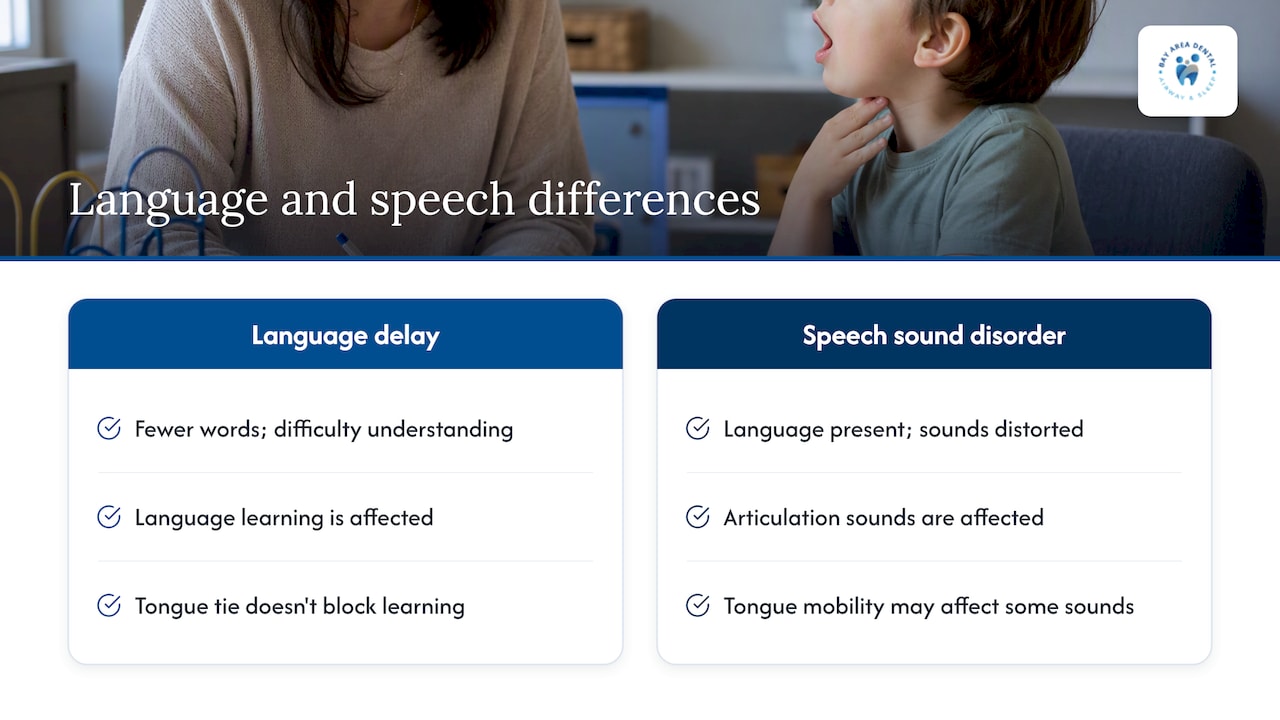
Language delay means a child says fewer words than expected, does not combine words, or struggles to understand and follow directions. This is about learning language. A band of tissue under the tongue does not stop a child from understanding words or learning them.
Speech sound disorder means a child has the language but the sounds come out wrong, so people have trouble understanding them. This is where a tongue tie could, in some children, play a role, because certain sounds need the tongue tip to lift and move freely.
So if your two-year-old has only a handful of words, a tongue tie is an unlikely explanation. If your five-year-old understands everything and speaks in full sentences but distorts “l”, “r”, “s” or “th”, the tongue is worth a closer look, along with several other things.
What the research says
The honest summary is that the evidence is thin and mixed.
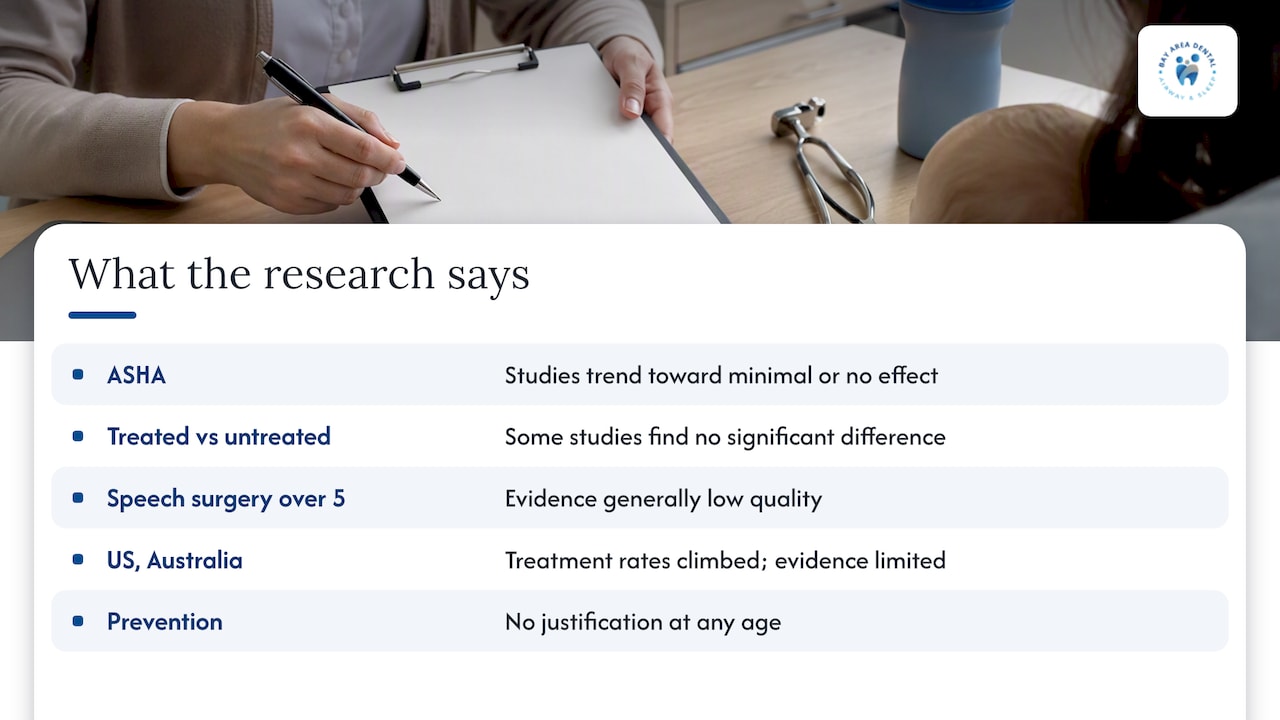
The American Speech-Language-Hearing Association (ASHA) notes that studies trend toward minimal or no effect of ankyloglossia on speech, and some find no significant difference in speech outcomes between treated and untreated groups. Where tongue tie may matter is articulation, specifically sounds that need the tongue tip to reach the ridge behind the upper teeth (like “l”) and the interdental “th” sounds.
A systematic review of treatment for reasons other than breastfeeding found that the evidence supporting surgery for speech in children over 5 is generally low quality, with many small studies and inconsistent definitions of how severe a tongue tie is. A separate study of speech in young children with tongue tie points out that treatment rates have climbed sharply in the United States and Australia despite limited evidence.
A 2024 study of children referred for tongue tie release is also worth knowing about, though check the abstract for exact details. For a plain-language view, the Johns Hopkins Medicine overview says tongue tie may, rarely, cause mechanical difficulties with speech.
The Royal College of Speech and Language Therapists goes further: there is no justification for a preventative release to ward off future speech disorders at any age.
What does that mean for you? A tongue tie is not a diagnosis of a speech problem, and a speech problem is not proof of a tongue tie.
Why the two so often show up together
ASHA cautions against assuming a tongue tie is the root cause just because both are present. Both tongue tie and speech sound disorders are fairly common, so they frequently occur together by chance. Other factors, such as motor planning or oral-motor difficulty, need to be identified by an assessment that includes more than one professional.
There is also no universally accepted way to diagnose tongue tie, and it is often considered overdiagnosed. The same handout says only a small share of babies are born with one, and that about half of babies with a tongue tie have no breastfeeding difficulty at all.
What else can sit behind a speech delay
Before anyone looks under the tongue, these are the usual suspects:
- Hearing. Even mild or fluctuating hearing loss, such as from repeated ear infections, can slow speech. Guidelines for older children say hearing impairment must be excluded before surgery is considered.
- Motor planning. Some children know what they want to say but struggle to sequence the movements. Only an SLP can sort this out.
- Language exposure and interaction. Talking, reading and singing every day matter more than most parents realize. The RCSLT suggests that for a child waiting for formal therapy, simply reading and listening to books together is the most helpful thing to do.
- Developmental differences. Some toddlers are simply late talkers who catch up. Others have a broader developmental pattern that deserves early attention.
- Tongue posture and breathing. Resting the tongue low, breathing through the mouth or pushing the tongue forward when swallowing can distort sounds like “s”. We come back to this below.
If you want a practical checklist for spotting which kinds of speech delays call for professional input, this parent’s guide to recognizing speech delays is a useful companion. And if your child is a late talker and you are waiting for an evaluation, these short music activities for late talkers give you something easy to do at home.
When a tongue tie can affect speech
A tongue tie is more likely to be relevant when several things line up:
- Your child is old enough that speech sounds are expected to be developed, and specific sounds (for example “l”, “t”, “d”, “s”, “th”) are consistently distorted or substituted.
- An SLP has assessed the child and judged the tongue restriction a likely contributor, and that conservative therapy alone is unlikely to fix it.
- Hearing and other causes have been checked.
- The tongue visibly or functionally cannot lift, extend or move side to side as needed. Appearance alone does not tell you this; movement does.
That sequence matches what the medical literature describes. For older children, a release should be considered only after an SLP confirms the difficulties are likely caused by the tongue tie, are unlikely to resolve with therapy, and other causes are excluded. Many pediatricians suggest waiting until around age 5 when speech is the only concern. If no feeding problems appear in infancy, the AAP handout says it is reasonable to wait until about age 4 to reassess, since the tissue can loosen as a child grows.
Tongue posture, mouth breathing and speech
This is the part many parents never hear about. Speech distortions such as a lisp frequently occur alongside orofacial myofunctional disorders (OMDs): a tongue that rests low or pushes forward, or habitual mouth breathing. ASHA explains that these patterns involve incorrect tongue positioning at rest and during swallowing, breathing and speech.
If the resting posture is off, traditional speech therapy can stall because the child keeps practicing sounds from the wrong foundation. In those cases ASHA describes a team approach, with an SLP for the motor patterns and an orthodontist when the bite is involved, as often more effective than focusing only on the frenulum.
SLPs also warn against relying on non-speech exercises alone, such as tube chewing or tongue-strengthening apps. The RCSLT notes there is no robust research supporting them as stand-alone treatment for speech sound disorders. Posture work helps most when paired with targeted speech therapy.
If you suspect posture is part of the picture, our pages on pediatric myofunctional therapy, tongue thrust therapy and tongue posture training explain what to look for and what realistic results look like.
A sensible order of steps for parents
- Talk to your pediatrician about your concerns and ask for a hearing test if there has not been one recently.
- Book a speech-language evaluation. Ask the SLP specifically whether tongue mobility seems to be limiting any sounds.
- Get a function-based oral exam. A dentist or other clinician trained in oral function can look at how the tongue lifts, extends and rests, and at breathing and sleep. See our pediatric airway evaluation page for the possible outcomes.
- Decide together. If the SLP, your pediatrician and the oral exam agree a release could help, weigh it against the realistic benefit. If they do not, continue therapy and revisit later.
- If you proceed, plan the aftercare. Release is not a one-step fix. Therapy and stretches or exercises support healing and function, which is why we explain the day-after stretching routine in detail.
Our perspective
We see families who arrive worried that a tongue tie is the reason their child is not talking yet. Our honest answer is usually that a speech delay needs a speech and hearing evaluation first, and that a tongue tie is one possible piece, not the default answer.
We look at the whole system: how the tongue moves, where it rests, how the child breathes, how they swallow and how they sleep. A frenulum that looks tight on a photo may work fine, and one that looks modest may restrict real movement. That is why we put function ahead of appearance, as we describe in our guidance on infant tongue tie and posterior tongue tie.
We also believe a release should earn its place. When it is the right call, a laser frenectomy can be a minimally invasive step, but it works best as part of a plan that includes speech therapy, myofunctional work where needed and follow-up. When it is not the right call, we say so and point you back to your SLP and pediatrician. Our page on when tongue tie revision helps lays out how we think about that decision.
— Admin
If you want a second opinion on tongue function
Bay Area Dental, Airway & Sleep in Fremont, CA offers laser frenectomy for infants, children and adults, as well as pediatric dental care and myofunctional therapy under one roof. If your SLP or pediatrician has raised tongue mobility, or you want a function-first exam before making any decision, you can learn more about laser frenectomy and tongue and lip ties or our pediatric dental care. Contact the practice through our site to book an evaluation.
FAQ
Can a tongue tie cause a speech delay?
There is no clear evidence that it causes a global speech delay, meaning late words or limited vocabulary. It may affect how some sounds are made, especially “l” and “th”. Because both are common, they often appear together by coincidence, so a speech-language evaluation is the first step.
Should I release my toddler’s tongue tie to prevent speech problems?
Experts do not support a preventative release. The RCSLT states there is no justification for doing it at any age to ward off future speech disorders. If your child is not having trouble feeding, many guidelines suggest watching and reassessing around age 4 or 5.
What age is best to consider a release for speech?
There is no single age. Pediatricians often suggest waiting until around age 5 when speech is the only concern, and only after an SLP assessment suggests the tongue tie is a likely cause. Evidence for surgery in children over 5 is still of generally low quality, so the decision should be individual.
Who should I see first if my child is not talking much?
Start with your pediatrician and a hearing test, then a speech-language pathologist. They can tell whether the issue is language, speech sounds or motor planning. A dentist trained in oral function can then add a view on tongue mobility, posture and airway.
Can myofunctional therapy help instead of surgery?
It can help when the problem involves tongue resting posture, tongue thrust or mouth breathing. It is not a substitute for speech therapy, and SLPs caution that exercises alone are not enough for speech sound disorders. It tends to work best alongside targeted speech therapy.
Sources
- AAP handout: Tongue-tie (ankyloglossia)
- ASHA: Orofacial Myofunctional Disorders
- RCSLT: Clinical information on speech sound disorders
- Treatment of Ankyloglossia for Reasons Other Than Breastfeeding: A Systematic Review
- Speech production in young children with tongue-tie
- The effect of ankyloglossia and tongue-tie division on speech articulation: A systematic review
- Johns Hopkins Medicine: Tongue-Tie (Ankyloglossia)