

A pediatric dental airway evaluation is a targeted dental exam that checks how the mouth, tongue, jaw, and oral muscles affect breathing, sleep, and feeding. Schedule one if your child snores regularly, breathes through the mouth during the day, or has ongoing feeding or tongue-tie concerns. The AAPD’s screening framework and clinics like Bay Area Dental, Airway & Sleep are built for exactly this kind of early check.
TL;DR:
- Most airway concerns can be identified early through clinical signs like loud snoring, mouth-breathing, or feeding issues, and should trigger a scheduled pediatric airway evaluation.
- The exam includes history-taking, assessment of oral and facial structure, and scoring tools like HATLFF to evaluate tongue function, guiding further intervention decisions.
- Family history, sleep recordings, and functional assessments are key in determining whether conservative treatments or procedures like frenotomy are appropriate.
- Follow-up focuses on improving function through therapy, with procedures reserved for persistent issues, and requires coordinated care across multiple specialists when necessary.
- Immediate emergency signs such as difficulty breathing or turning blue require urgent medical attention, while non-emergency concerns benefit from a thorough evaluation first.
Table of Contents
- Signs and symptoms that should prompt a pediatric airway evaluation
- What a dental airway-focused exam actually includes
- What typically happens after the evaluation
- How Bay Area Dental, Airway & Sleep approaches pediatric airway care
- Why the “wait and see” default deserves more scrutiny
- Scheduling your child’s evaluation: what to bring and expect
- Sources
Signs and symptoms that should prompt a pediatric airway evaluation
Parents usually notice the nighttime signs first. Loud, habitual snoring, gasping, choking sounds, or actual pauses in breathing during sleep are the ones that deserve the fastest response. If you’ve ever watched your child’s chest work harder than it should while they sleep, that’s not something to wait out.
Daytime clues are easier to dismiss because they look like ordinary kid behavior. Chronic mouth-breathing, unusual sleepiness during the day, or attention and mood swings can all trace back to fragmented sleep caused by airway restriction. A child who seems “wired but tired” by mid-afternoon may be dealing with poor sleep quality rather than a behavior problem.
Feeding issues tell their own story, especially in infants. Persistent nipple pain for a breastfeeding mother, a shallow or clicking latch, slow weight gain, or a visibly tight band under the tongue are all reasons to ask about tongue-tie. According to a clinical review on ankyloglossia, tongue-tie can impair breastfeeding in ways that aren’t always obvious just from looking in the mouth. Functional assessment, not appearance alone, is what actually matters.
Dentists also catch developmental red flags during routine checks that parents rarely notice on their own:
- A narrow, high palate that suggests the tongue isn’t resting where it should
- An open bite from chronic mouth-breathing or thumb-sucking habits
- Forward tongue posture that pushes against the teeth instead of the roof of the mouth
When it’s urgent versus routine: Call your pediatrician or head to the ER if your child is turning blue, working hard to breathe, or has a witnessed apnea episode. Persistent snoring, mouth-breathing, or feeding struggles without emergency signs are exactly what a scheduled dental airway screening is for.
Pro Tip: Record your child sleeping for two or three nights on your phone. A short clip of loud snoring or a breathing pause gives the dentist or physician far more useful information than a verbal description ever will.

What a dental airway-focused exam actually includes
The visit starts with history, not instruments. Expect questions about feeding patterns as an infant, current sleep behaviors, prior medical or surgical history, and any lactation consultant notes if breastfeeding was ever a struggle. This history often points the exam in a specific direction before any tools come out.
The physical exam follows a checklist that closely tracks the AAPD’s screening form:
- Head and body posture at rest, including whether the head tilts forward
- Lip competence (can your child hold their lips closed without effort?)
- Palate shape and width
- Tonsil size, graded on a standard scale
- Modified Mallampati score, which rates how much of the airway is visible when the mouth opens
- Jaw relationship and how the upper and lower teeth line up
- Maximum oral opening
- Nasal patency, since a blocked nose changes everything about how a child breathes at night
For suspected tongue-tie, many dentists use a functional scoring method rather than judging by looks alone. The Hazelbaker Assessment Tool for Lingual Frenulum Function (HATLFF) scores both appearance and actual tongue movement, which is important because a tongue that looks only mildly restricted can still cause real feeding problems if it doesn’t move correctly.
Depending on what turns up, the dentist may add intraoral photos, 3D imaging or digital scans, a home pulse-ox screening, or a referral for a formal sleep study. Findings from that visit typically lead to one of four paths: continued monitoring, a myofunctional therapy referral, consideration of a frenotomy, or a referral to ENT or sleep medicine for further workup.
What typically happens after the evaluation
Most families start with conservative options before anything procedural. Lactation support, latch adjustments, and simple watchful waiting resolve a good number of feeding concerns without further intervention. Myofunctional therapy is often layered in here too. It retrains oral muscle patterns so the tongue rests correctly and swallowing improves, and a peer-reviewed review found it helps prevent relapse after orthodontic or surgical work by reinforcing the muscle habits that keep the airway open.
Frenotomy is the more debated path. It has strong evidence for improving breastfeeding when a tight lingual frenulum is genuinely restricting tongue movement, but evidence for its benefit on other long-term outcomes, like speech or long-term airway development, is thinner and inconsistent across studies. According to the Cleveland Clinic, many infants with tongue-tie improve with lactation support alone, and frenotomy is usually reserved for cases where feeding problems persist despite those conservative measures.
A few situations call for extra caution before releasing a frenulum, including certain neuromuscular conditions or a notably small lower jaw, since altering tongue attachment in those cases can occasionally worsen airway positioning rather than help it.
Coordinated care matters here more than in almost any other pediatric dental scenario. Depending on findings, appropriate referrals might include:
- An ENT for tonsil or adenoid evaluation
- A sleep medicine specialist for confirmed or suspected sleep-disordered breathing
- A speech-language pathologist for feeding or articulation concerns
- An orthodontist when palate width or bite alignment needs long-term correction
Clinicians increasingly lean on function scores like HATLFF and real-world symptoms, not anatomy photos alone, to decide whether a procedure is warranted. Follow-up typically tracks feeding improvement, reduced snoring or witnessed pauses, and functional tongue movement gains over the following weeks.
How Bay Area Dental, Airway & Sleep approaches pediatric airway care
Bay Area Dental, Airway & Sleep built its pediatric airway evaluation around the same screening logic outlined above, but keeps every next step under one coordinated roof. The practice performs airway-focused dental exams, laser frenectomy for tongue and lip-tie, myofunctional therapy, and 3D imaging, so a child rarely bounces between five different offices to get answers.
That matters most in the weeks right after an evaluation, when parents are juggling referrals and trying to remember which specialist said what. The clinic works directly with lactation consultants when feeding is the primary concern, and it has built specific communication and educational accommodations for Deaf patients and families, an area most dental practices never address at all.
Laser technology keeps procedures like frenotomy minimally invasive, which matters enormously when the patient is a newborn. A first visit typically includes the history intake, the physical screening checklist, and a clear conversation about what, if anything, needs to happen next. Parents leave with a plan, not just a diagnosis.
Why the “wait and see” default deserves more scrutiny
The conventional advice on tongue-tie and airway concerns still leans heavily toward “give it time, kids grow out of it.” Sometimes that’s the right call. But the research on ankyloglossia is explicit that decisions should be function-driven, not appearance-driven, and a lot of pediatric visits still rely on a quick visual check rather than an actual functional assessment like HATLFF.
What gets underestimated is how much a narrow palate or forward tongue posture at age three predicts sleep and breathing patterns at age ten. Airway problems don’t announce themselves loudly in toddlers. They show up as a kid who’s cranky by 3pm, breathes through their mouth in every school photo, and snores through a stuffy nose every winter, and nobody connects the dots.
If your child has any combination of snoring, mouth-breathing, or feeding struggles, the highest-value move isn’t researching frenotomy risks online. It’s getting the functional screening done first, then letting the findings, not a generic default, decide the next step.
— Admin
Scheduling your child’s evaluation: what to bring and expect
Bay Area Dental, Airway & Sleep offers pediatric airway-focused evaluations as one solid path toward answers when snoring, mouth-breathing, or feeding struggles have you worried, with imaging, laser frenectomy, and myofunctional therapy coordinated under the same practice instead of scattered across referrals.
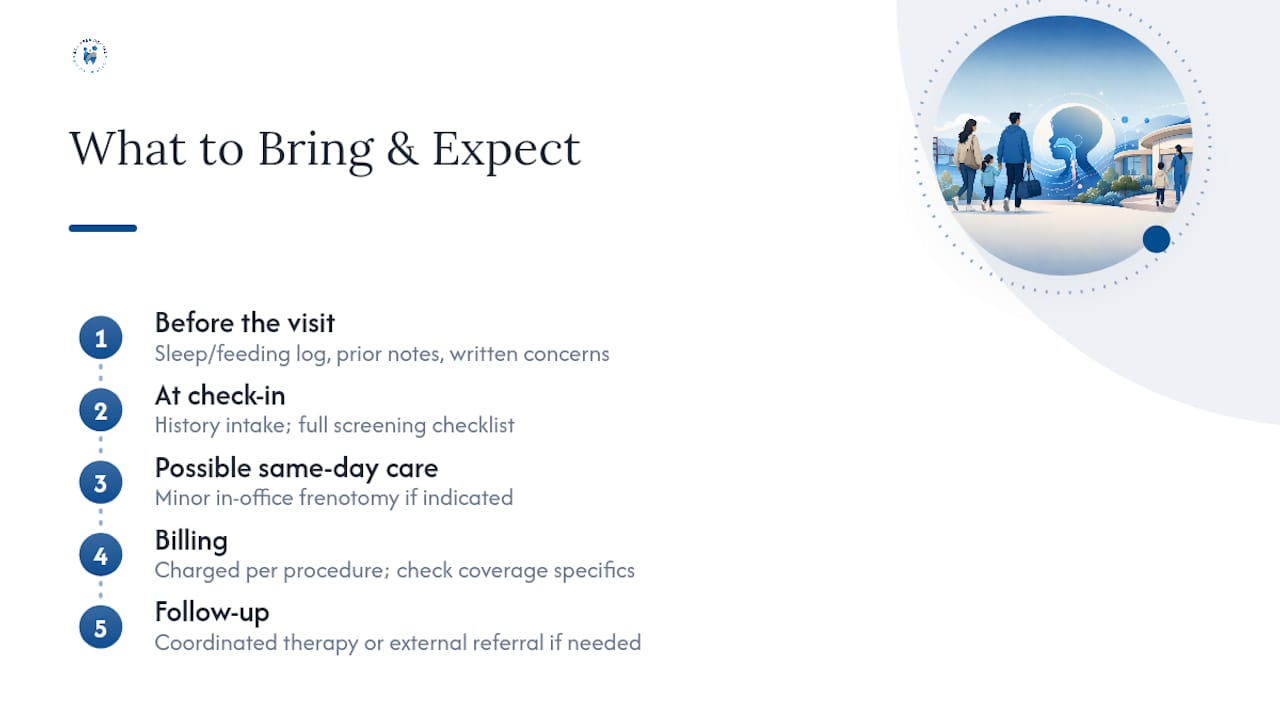
Before your visit, gather a few things that make the exam faster and more accurate: a rough log of feeding or sleep behaviors over the past week or two, any prior referral notes or imaging from a pediatrician or ENT, and a written list of the specific behaviors that worried you, since it’s easy to forget details once you’re in the chair. If your toddler is still exploring objects by mouth, this guide to safe sensory play is a useful read for telling normal oral exploration apart from feeding dysfunction.
A first appointment generally includes the history intake and full screening checklist, and in some cases a minor in-office procedure like frenotomy can happen the same day if findings support it. Billing runs per procedure rather than through any membership or subscription model, so ask about coverage specifics for your child’s situation. To get started, book a pediatric airway evaluation and bring your questions. This is one appropriate route to airway-focused dental care and coordinated follow-up, and the team will tell you plainly if your child needs a specialist they don’t provide in-house.
This article is general information, not a substitute for advice from a qualified doctor. Consult a qualified healthcare professional about your own circumstances before acting on anything here.