


Tongue thrust is treatable, and the best outcomes come from coordinated myofunctional therapy paired with fixing whatever is driving the habit in the first place, whether that is an airway obstruction, a dental problem, or a restricted tongue. The American Speech-Language-Hearing Association recommends an interprofessional approach rather than a single fix, and supervised home practice between sessions is what determines whether the new swallow pattern actually sticks.
TL;DR:
- Coordinated therapy combining myofunctional treatment, orthodontics, and addressing structural issues offers the best chance for long-term success in correcting tongue thrust.
- The treatment plan typically involves an evaluation of oral structure, swallow pattern, and airway, with therapy focusing on establishing proper tongue posture, nasal breathing, and correct swallow mechanics.
- Home exercises like tongue tip holds, saliva swallowing drills, and lip sealing are crucial for reinforcing treatment, especially when performed consistently two to three times daily.
- Early intervention before age eight speeds up progress, but adults and older children can achieve durable results with dedicated, full participation in therapy.
- Effective treatment depends on a qualified, interprofessional team that measures progress through specific targets and communicates throughout the process, rather than relying on quick fixes or isolated procedures.
Table of Contents
- What Is Tongue Thrust Therapy and Why Does the Habit Happen?
- How Do Clinicians Diagnose Tongue Thrust?
- What Are the Treatment Options for Tongue Thrust?
- What Does a Myofunctional Therapy Program Actually Look Like?
- Which Tongue Thrust Exercises Can You Practice at Home?
- What Does the Research Actually Support?
- When Should You Treat Tongue Thrust, and What’s the Realistic Outcome?
- How Do You Choose a Qualified Tongue Thrust Provider?
- An Editorial Perspective on Coordinated Airway and Dental Care
- Getting a Tongue Thrust Evaluation at Bay Area Dental, Airway & Sleep
- Sources
- FAQ
What Is Tongue Thrust Therapy and Why Does the Habit Happen?
Tongue thrust therapy retrains a swallowing and resting pattern most people outgrow in early childhood but some carry into later years. Babies swallow with the tongue pushing forward against the lips, a reflex called the infantile swallow. By around age six, most kids shift to an adult pattern where the tongue rests against the roof of the mouth and the tip lands behind the upper front teeth. When that shift never happens, the tongue keeps pushing forward during swallowing and often at rest, and it can gradually reshape the bite.
Cleveland Clinic identifies several telltale signs that show up long before anyone calls it a diagnosis. Watch for:
- A tongue that rests low and forward, often visible resting between or against the teeth
- Speech distortions, especially a lisp on “s” and “z” sounds
- An open mouth posture at rest, frequently paired with mouth breathing
- Difficulty keeping the lips sealed while chewing or swallowing
- An anterior open bite, where the front teeth don’t meet even when the back teeth do
The causes usually cluster into a few categories. Prolonged thumb-sucking or pacifier use past toddlerhood trains the tongue to sit low and push forward. Enlarged adenoids or tonsils block the nasal airway, forcing the tongue down and forward just to make room to breathe. A tongue-tie, medically a restricted lingual frenulum, can physically prevent the tongue from lifting to the palate no matter how hard someone tries. And existing dental malocclusion, like a narrow palate or an open bite, can lock the tongue into a forward posture simply because there’s nowhere else for it to go. Most cases involve two or three of these factors reinforcing each other, which is exactly why a single quick fix rarely holds.
How Do Clinicians Diagnose Tongue Thrust?
Diagnosis is never a single test. It’s a layered look at structure, function, and history, usually split across a speech-language pathologist and a dentist or orthodontist, sometimes with an ENT added in.
- Oral structure exam. The clinician checks the frenulum for restriction, the tonsils and adenoids for size, the palate for width, and the lips for tone and seal at rest.
- Swallow observation. The SLP watches how the person handles saliva, then liquids, then solids, looking for forward tongue movement, facial straining, or head tilting during the swallow.
- Feeding and habit history. Parents get asked about thumb-sucking duration, bottle or pacifier use, picky eating, and any history of noisy or mouth breathing at night.
- Dental and orthodontic evaluation. This measures occlusion (how the teeth meet), checks for an open bite, and assesses resting freeway space, the small gap between upper and lower teeth when the jaw is relaxed and lips are closed. Distorted freeway space is a strong clinical signal that tongue posture is off, not just the swallow itself.
- Airway and sleep referral, when indicated. If mouth breathing, snoring, or restless sleep show up in the history, an ENT evaluation or a pediatric sleep assessment may follow, sometimes including imaging of the adenoids and tonsils.
Families should leave that first round of appointments with a written summary of findings, not just a verbal impression. A credible provider documents tongue posture, swallow pattern, and any structural findings so progress can actually be measured later against a baseline, not against memory.
What Are the Treatment Options for Tongue Thrust?
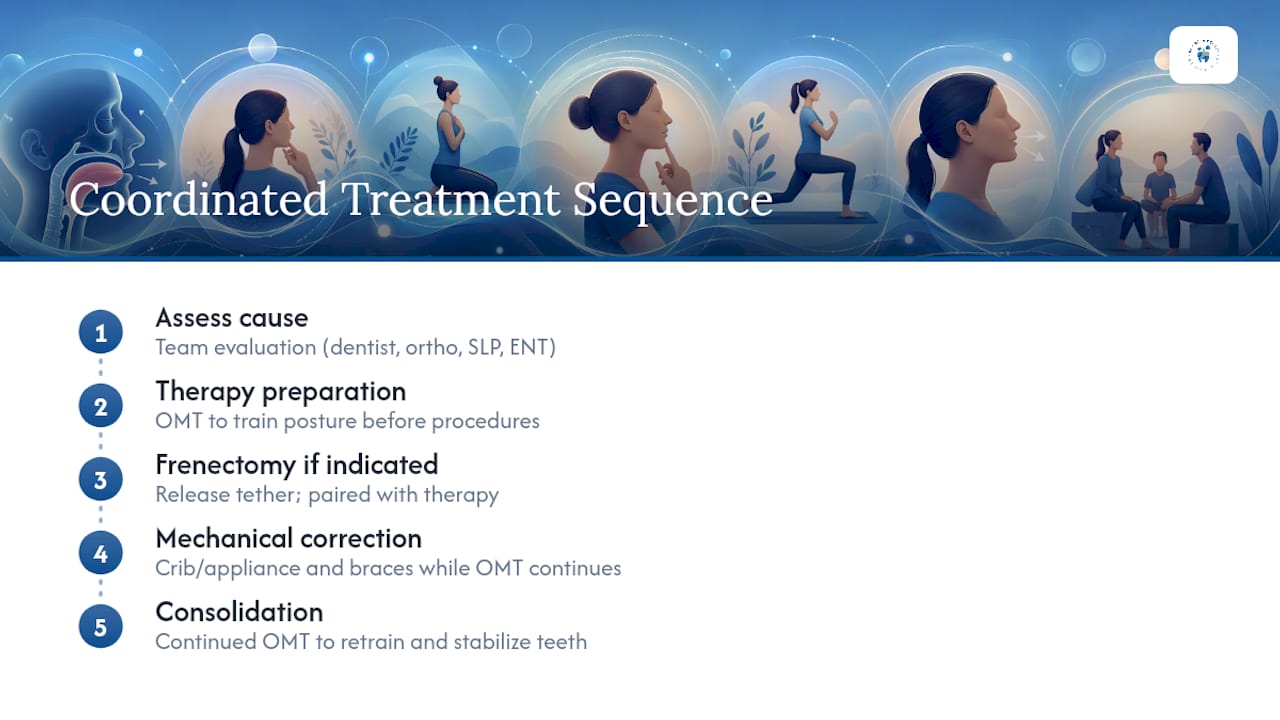
No single treatment fixes tongue thrust in isolation. The strongest results come from combining approaches that address the habit, the mechanics, and any structural roadblock at the same time.
Orofacial myofunctional therapy (OMT) is the core of most treatment plans. It’s a structured program targeting tongue posture, lip seal, and swallow pattern through repeated, supervised practice, and it’s distinct from a handout of random “oral exercises.” A 2021 narrative review found that myofunctional therapy helps correct tongue posture and works best when paired with orthodontic treatment or habit removal to prevent relapse. The distinction matters: OMT is a progressive skill-building process with measurable targets, not a set of exercises done once and forgotten.
Speech therapy overlaps with OMT but has its own lane, mainly correcting the articulation errors tongue thrust causes, particularly sibilant sounds like “s,” “z,” and “sh.” Clinical reviews caution that practicing tongue exercises in isolation, disconnected from actual speech tasks, has weak evidence as a standalone fix for speech sound disorders. The exercises work better woven into real speech practice rather than treated as isolated gym reps for the tongue.
Orthodontic appliances address the mechanical side. A tongue crib is a small-fixed appliance that physically blocks the tongue from pushing between the teeth, often used alongside therapy rather than instead of it. Braces or clear aligners correct the resulting open bite or malocclusion once the muscle pattern starts to normalize. Using an appliance without therapy tends to relapse once the appliance comes off, because the underlying muscle habit never changed.
Frenectomy, a minor procedure to release a restricted tongue-tie, is indicated when the frenulum demonstrably limits tongue elevation to the palate. It’s not a stand-alone cure. Therapy before and after the procedure gets the best functional results, since the tongue needs to learn how to use its new range of motion.
Sequencing depends on the case. A frenectomy candidate typically works with a therapist beforehand to prep the tongue and immediately after to build new movement patterns. Orthodontic correction generally follows or runs parallel to myofunctional therapy, since moving teeth into a stable position while the tongue is still pushing against them from the wrong angle tends to undo the orthodontic work. Coordinated teams, meaning the dentist, orthodontist, SLP, and sometimes an ENT, actually communicate about sequencing rather than each running an independent track.
What Does a Myofunctional Therapy Program Actually Look Like?
Most programs follow a predictable arc, even though the exact pacing varies by provider and by how entrenched the habit is.
- Evaluation and baseline. The therapist documents resting tongue posture, swallow pattern, lip seal strength, and any structural limitations, creating the benchmark everything else gets measured against.
- Learning phase. This is the intensive stretch, often built around roughly ten structured sessions, where new movement patterns get introduced and drilled weekly.
- Skill integration. Exercises shift from isolated drills to functional tasks: swallowing solid food correctly, holding lip seal while talking, keeping the tongue at rest without cueing.
- Monitoring and spacing. Sessions taper from weekly to biweekly to monthly as the new pattern becomes automatic rather than effortful.
- Maintenance and discharge. The therapist confirms the pattern holds under distraction, fatigue, and normal daily activity before discharging or shifting to occasional check-ins.
Session length usually runs 30 to 45 minutes, and the learning phase’s compliance and caregiver support predict success more reliably than raw session count. A kid who does five minutes of home practice daily tends to outpace one who does a perfect weekly session and nothing else.
Four targets show up in nearly every program:
- Resting tongue posture. Getting the tongue to sit against the palate at rest, not on the floor of the mouth, for most of the waking day.
- Nasal breathing. Retraining lip seal and airflow so breathing happens through the nose rather than an open mouth, which also supports proper tongue posture.
- The spot. Therapists teach a specific point just behind the upper front teeth, often called “the spot,” as the tongue tip’s home base for swallowing and rest.
- Swallow pattern. Replacing the forward push with a controlled, palate driven swallow across saliva, liquids, and solids in that order of difficulty.
Exercises typically start simple, like holding the tongue tip on the spot for ten seconds, and build toward complex, functional tasks like swallowing a cracker with lips sealed and no forward tongue movement. Progress gets measured less by “tongue strength” and more by concrete markers: does the lingual palatal seal hold during a saliva swallow, has the resting freeway space normalized, and has articulation accuracy improved on the sounds affected by the thrust.
Pro Tip: Track home practice with a simple daily checkmark chart rather than trying to remember at the next appointment. Therapists rely on that log to tell whether a plateau is a compliance problem or a plan problem, and guessing wastes a session either way.
Caregivers carry more weight in this process than most parents expect going in. A therapist can teach a five-year-old the mechanics in session, but it’s the parent who catches the tongue drifting forward during breakfast and offers a quiet reminder. That daily reinforcement, not the clinic visit, is usually what separates a six-month success story from a program that stalls at month three.
Which Tongue Thrust Exercises Can You Practice at Home?
These exercises mirror what clinics use, but they work best as a supplement to supervised therapy, not a replacement for it. Always confirm exercise selection with your treating clinician, since the wrong exercise done confidently is worse than no exercise at all.
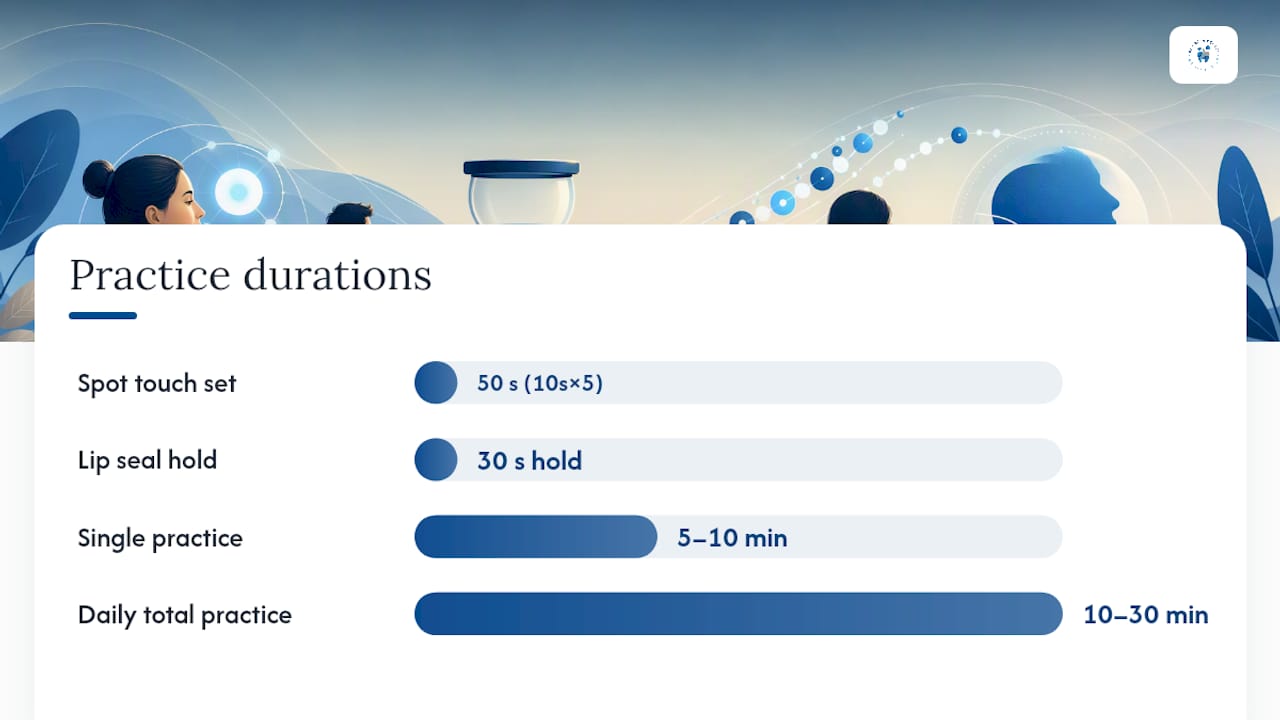
- Spot touch: Rest the tongue tip on the spot just behind the upper front teeth and hold for ten seconds, five repetitions, several times a day.
- Tongue click: Suction the tongue flat against the palate, then release it with a clicking sound. This builds the same muscle pattern used for a proper swallow.
- Saliva swallow drill: Place the tongue tip on the spot, then swallow saliva without letting the tongue push forward or the lips flare open.
- Lip seal hold: Close the lips gently, no straining, and hold for 30 seconds while breathing through the nose, building the seal needed to stop mouth breathing.
- Straw sip and swallow: Sip water through a straw, hold it briefly on the spot, and swallow with a controlled palate driven motion.
- Cracker chew and swallow: Chew a small piece of cracker with lips sealed, then swallow using the same controlled pattern as the liquid drills.
- Button pull (for older kids and adults): Loop dental floss through a button, place the button behind the lips, and gently pull while the lips resist, building lip strength.
- Yawn and swallow: Yawn naturally, then immediately swallow with the tongue on the spot, useful for resetting posture after long stretches of mouth breathing.
Preschoolers generally manage the spot touch, tongue click, and lip seal hold, while cracker chewing and the button pull suit school-age kids and adults with more motor control. A narrative review of tongue thrust habit reported meaningful improvement in swallow pattern and posture among patients who completed structured therapy programs, reinforcing that consistency across weeks matters more than any single exercise.
Schedule practice in short, predictable blocks, five to ten minutes, two to three times daily, tied to existing routines like brushing teeth or right after meals. Trying to cram twenty minutes into one evening session rarely sticks. Track progress by watching for the tongue resting on the palate without prompting, fewer lisped sounds during normal conversation, and less visible strain during swallowing, not by how “tired” the tongue feels after a session.
What Does the Research Actually Support?
The evidence base for myofunctional therapy is genuinely encouraging, but it comes with real caveats worth taking seriously rather than glossing over.
ASHA’s practice portal is clear that orofacial myofunctional therapy works best as one piece of an interprofessional plan, not a stand-alone treatment, particularly when structural or airway issues contribute to the thrust. That framing matters because it shifts the question from “does OMT work” to “does OMT work for this specific combination of causes,” which is a more honest and more useful question.
The narrative review by Shah and colleagues found supportive evidence for myofunctional therapy correcting tongue posture, especially when combined with orthodontic treatment or removal of contributing habits like thumb-sucking. But the review also notes that study quality across the field varies quite a bit. Some studies are small, some lack long-term follow-up, and outcome measures aren’t always standardized across clinics.
The sharpest point of debate concerns nonspeech oral motor exercises used in isolation. A separate clinical review found limited evidence that these drills, done on their own without connection to actual speech or swallowing tasks, reliably improve speech sound production. The review recommends embedding exercises into functional speech or swallow tasks rather than treating them as generic tongue workouts.
Long-term follow-up data offers one of the more reassuring findings in this space: a majority of patients who completed a full therapy program maintained a normal swallow pattern years later when compared against those who never received treatment. That durability, when therapy is completed rather than abandoned partway, is the strongest argument for sticking with a full program instead of stopping once symptoms visibly improve.
The practical takeaway is straightforward. Favor programs built around measurable targets, resting posture, freeway space, swallow pattern, articulation accuracy, over programs that promise fast results without ever explaining how they’ll track whether the tongue habit has actually changed.
When Should You Treat Tongue Thrust, and What’s the Realistic Outcome?
Most clinics treat tongue thrust starting around age eight, once permanent teeth are erupting and the child has the attention span for structured practice, though case-by-case treatment can start younger when airway or feeding concerns are urgent.
- Younger children (under 8): Often benefit more from addressing the root cause, like removing a pacifier habit or treating enlarged tonsils, before formal OMT, since the muscle system is still developing.
- School-age children (8 to 12): Tend to respond fastest to therapy, partly because permanent teeth haven’t fully settled and partly because motivation and follow-through are usually stronger at this age than in early childhood.
- Teens and adults: Can absolutely succeed with therapy, but progress is typically slower since the habit has had years to become automatic; expect a longer learning phase and more deliberate practice.
- Untreated cases: Risk ongoing speech distortion, continued anterior open bite, and orthodontic relapse, where braces straighten the teeth but the tongue eventually pushes them back out of alignment.
- Watchful waiting: Reasonable for very young children with mild signs and no airway concerns, since some infantile swallow patterns resolve on their own by age six without intervention.
The core point for anyone weighing timing: earlier treatment tends to be faster, but “too late” is rare. Adults who commit to a full program can and do retrain the pattern, it just takes patience and consistency the whole way through.
How Do You Choose a Qualified Tongue Thrust Provider?
Not every provider who offers “tongue exercises” is actually qualified to run a full myofunctional therapy program, so a short screening process saves months of frustration.
- Check credentials specifically. Look for a speech-language pathologist with orofacial myofunctional disorder (OMD) training, plus a dentist or orthodontist experienced in airway and myofunctional cases. If airway concerns exist, confirm there’s an ENT in the referral network.
- Ask about team coordination. A qualified provider should be able to explain, without hesitation, how they communicate with the other specialists on the case, whether that’s a shared chart, regular calls, or joint appointments.
- Ask how progress gets measured. Expect specifics like freeway space measurements, swallow pattern observation, or articulation scoring, not a vague “we’ll know when the tongue feels stronger.”
- Clarify the home program and cost upfront. Ask how many sessions the learning phase typically runs, how much daily home practice is expected, and get a clear sense of cost and insurance coverage before starting.
Pro Tip: Treat any provider who promises a quick, guaranteed fix, or who recommends a device without a full evaluation first, as a red flag. Tongue thrust correction is a skill-building process, and any plan that skips assessment is skipping the part that actually determines what will work.
An Editorial Perspective on Coordinated Airway and Dental Care
Isolated fixes are the most common failure point in tongue thrust cases, and it’s rarely for lack of effort. A tongue crib without therapy relapses. Speech drills without addressing an obstructed airway plateau. A frenectomy without follow-up therapy leaves the tongue newly capable but poorly trained. The research consistently points toward the same conclusion: treating the root cause, not just the visible symptom, is what makes results hold.
Technology helps here mainly by making the diagnostic picture sharper. 3D imaging and careful airway evaluation let a team see whether a narrow palate, enlarged tonsils, or a restricted frenulum is actually driving the posture problem, rather than guessing from surface symptoms alone. Patients who go through genuinely coordinated care tend to report the same cluster of improvements: easier nasal breathing, clearer speech, a more stable bite after orthodontics, and noticeably better sleep. None of that comes from one appointment. It comes from a team that actually talks to each other about the same patient.
— Admin
Getting a Tongue Thrust Evaluation at Bay Area Dental, Airway & Sleep
Bay Area Dental, Airway & Sleep treats tongue thrust the way the evidence says it should be treated: as a whole-mouth, whole-airway problem, not an isolated habit to drill away. The practice combines myofunctional therapy, frenectomy procedures, and airway-focused dental care under one coordinated plan, so multiple contributing factors can be addressed together rather than in isolation.
An evaluation starts with a full look at oral structure, resting tongue posture, and airway function, sometimes using imaging tools to help spot problems beyond a visual exam. From there, the team maps out sequencing, whether that means therapy first, a frenectomy followed by guided practice, or orthodontic coordination alongside myofunctional work, so nothing gets undone by a step taken out of order. If you’ve noticed a lisp, an open bite, mouth breathing, or restless sleep in yourself or your child, the next move is straightforward: schedule an evaluation with Bay Area Dental, Airway & Sleep and get a real baseline instead of another guess.
Sources
The clinical guidance in this article draws on established practice standards and peer-reviewed literature, including:
- Orofacial myofunctional disorders — ASHA practice portal
- Orofacial myofunctional therapy in tongue thrust habit: a narrative review — Shah et al., 2021
- Article on orofacial myology and freeway space — MDPI
For age-appropriate sensory activities that support oral awareness in young children, taste-safe sensory play ideas offer a practical starting point for parents building home routines around therapy goals.
This article is general information, not a substitute for advice from a qualified doctor. Consult a qualified healthcare professional about your own circumstances before acting on anything here.
FAQ
Can you fix tongue thrust as an adult?
Yes. Adults can retrain tongue posture and swallow pattern through myofunctional therapy, though progress is typically slower than in children since the habit has had more time to become automatic.
At what age should tongue thrust be treated?
Most clinics begin structured therapy around age eight, when permanent teeth are erupting and attention span supports consistent practice, though airway or feeding concerns can justify earlier, case-by-case treatment.
What are the long-term effects of untreated tongue thrust?
Untreated tongue thrust can cause persistent speech distortion, an anterior open bite, and orthodontic relapse, where teeth drift back out of alignment even after braces correct them.
How can I perform tongue thrust therapy at home?
Home practice works as a supplement to supervised therapy, using exercises like resting the tongue tip on “the spot,” tongue clicks, and controlled swallow drills for five to ten minutes several times daily, ideally guided by a treating clinician.
Does insurance cover tongue thrust therapy?
Coverage varies by plan and provider; ask any clinic directly about cost and insurance basics for myofunctional therapy, frenectomy, or orthodontic components before starting treatment.