


Infant tongue tie, medically called ankyloglossia, happens when the band of tissue under the tongue restricts its movement. It does not automatically need treatment. What matters most is function: whether it causes maternal nipple pain or poor milk transfer during feeding. The right first step is a hands-on breastfeeding assessment with a lactation consultant or pediatrician, not a rush to surgery.
TL;DR:
- Visual appearance alone of the frenulum is not enough to diagnose problematic tongue tie, as many babies with restricted tissue still feed well.
- Feeding difficulties such as shallow latch, prolonged feeding sessions, and slow weight gain are key indicators, especially if maternal nipple pain is present.
- Diagnosis should involve observing the baby’s actual feed to assess tongue mobility and real milk transfer, not just static mouth exams.
- Conservative measures like lactation support are recommended first, reserving frenotomy for persistent feeding issues after other causes are ruled out.
- Frenotomy carries low risks but only offers consistent relief for maternal nipple pain, with inconsistent improvements in infant feeding measures across studies.
Table of Contents
- What Is Infant Tongue Tie and How Does It Affect Feeding?
- Signs and Red Flags Parents Should Watch For
- How Clinicians Diagnose Tongue Tie
- Treatment Options: Conservative Care First, Surgery if Needed
- Risks, Recovery, and Realistic Outcomes
- Timing: A Practical Decision Guide for Parents
- What the Research Actually Shows, and Where It Falls Short
- How Bay Area Dental, Airway & Sleep Approaches Tongue Tie Evaluation
- Getting an Evidence-Based Evaluation for Your Baby
- Sources
- FAQ
What Is Infant Tongue Tie and How Does It Affect Feeding?
The lingual frenulum is the thin strip of tissue connecting the underside of the tongue to the floor of the mouth. In tongue tie, that band is shorter, thicker, or positioned farther forward than usual, limiting how far the tongue can extend or lift.
That restriction matters because of what the tongue actually does during a feed. A baby needs to cup the nipple, press it against the roof of the mouth, and create a rhythmic vacuum that draws milk out. When the tongue can’t lift or extend fully, that seal breaks down.
A visible restriction alone doesn’t mean a baby has symptomatic tongue tie. Estimates of how common the anatomic finding is range from 4% to 10% of newborns, and many of those babies feed just fine.
What actually happens during feeding tells you more than what the frenulum looks like:
- Some babies with a visibly tight frenulum latch well and gain weight on schedule.
- Others with a subtler restriction struggle to maintain a seal and fall off the breast repeatedly.
- The tongue’s mobility during an active feed, not its appearance at rest, is what clinicians need to see.
Signs and Red Flags Parents Should Watch For
Feeding problems tend to show up on both sides of the breastfeeding relationship, and it helps to separate infant symptoms from maternal ones.
- Infant signs. Watch for a shallow or clicking latch, feeding sessions that stretch past 30 to 40 minutes without your baby seeming satisfied, frequent slipping off the breast, and slow weight gain despite frequent feeding.
- Maternal signs. Cracked, blistered, or misshapen nipples after feeds, pain that doesn’t ease after the first week, and a sense that milk isn’t being removed effectively (engorgement that doesn’t resolve) all point toward a transfer problem worth investigating.
- Other causes to rule out first. Positioning and latch technique cause a huge share of early feeding pain, and a low milk supply or an oversupply can produce similar symptoms. A lactation consultant can often resolve these without ever touching the frenulum.
Jumping straight to “it’s tongue tie” skips a step. The Academy of Breastfeeding Medicine protocol calls for ruling out latch and positioning issues before attributing pain or poor transfer to anatomy alone.
How Clinicians Diagnose Tongue Tie
A thorough infant tongue tie diagnosis starts at the breast, not on an exam table. Clinicians trained in lactation watch an actual feed: how the baby latches, whether the jaw and tongue move in a coordinated wave, and whether audible swallowing follows a suck. Pre and post feeding weights, taken on a precise scale, give an objective read on how many milliliters the baby actually transferred, which matters more than any visual score.
- Direct feeding observation catches problems that a static mouth exam misses entirely.
- Visual grading systems that rate frenulum length or attachment point are common but tell you little about function on their own.
- Relying on appearance alone is one reason frenotomy rates have climbed. The AAP has flagged concerns about overdiagnoses tied to visual-only assessments.
- When feeding problems persist, pediatricians typically loop in a lactation consultant first, then an ENT, pediatric dentist, or speech-language pathologist trained in infant oral function.
The CHOP clinical pathway for ankyloglossia lays out exactly this sequence: history, physical exam, feeding observation, objective weight checks, then escalation only if feeding stays impaired.
Treatment Options: Conservative Care First, Surgery if Needed
Most infant tongue tie treatment plans start without a scalpel or laser anywhere near the baby’s mouth.
- Lactation support. A consultant can adjust positioning, hold, and timing in ways that resolve pain and improve transfer without any procedure.
- Nipple care and observation. Many mild cases improve on their own as the baby grows and feeding coordination matures.
- Frenotomy. This is a quick outpatient snip of the frenulum, usually performed by a pediatrician, ENT, or dentist. In young infants it’s often done without general anesthesia, and babies can typically feed right afterward.
- Frenuloplasty. A more involved surgical revision, reserved for thicker or more complex tissue that a simple snip won’t adequately release, sometimes requiring stitches and a longer healing window.
- Scissors vs. laser. Both instruments are used for frenotomy, but there’s no strong evidence that one produces better outcomes than the other.
The AAP recommends multidisciplinary assessment and lactation support first, reserving frenotomy for cases where feeding stays impaired despite that support. That sequence protects families from an unnecessary infant frenotomy procedure while still offering a fast path to relief when it’s genuinely needed.
Risks, Recovery, and Realistic Outcomes
Frenotomy is a low-risk procedure, but “low-risk” doesn’t mean “risk-free,” and it’s worth knowing what the evidence actually shows before you decide.
What the numbers say: Pooled results from five randomized trials covering 302 mother-infant pairs found a reduction in maternal nipple pain after frenotomy, but effects on objective infant feeding measures were inconsistent across studies.
That gap matters. Mothers often feel real relief, but whether the baby’s latch efficiency or weight gain improves in a measurable way varies from trial to trial, partly because the studies are small and some control groups received partial treatment anyway.
- Reported complications include minor bleeding, localized infection, and rarely, injury to nearby salivary ducts or sublingual tissue.
- Serious complications are uncommon when the procedure is performed by an experienced clinician.
- Recovery is typically fast: brief crying during the snip, then feeding within minutes, with a follow-up check to confirm healing and feeding improvement.
- Routine stretching of the wound site afterward isn’t supported by current guidance and can do more harm than good.
Timing: A Practical Decision Guide for Parents
Deciding when to treat tongue tie comes down to how much feeding is actually suffering, and whether conservative measures have had a real chance to work.
- Consider early frenotomy when nipple pain or poor milk transfer persists despite genuine lactation support, positioning changes, and time. If your baby isn’t gaining weight well and a consultant has ruled out other causes, that’s a signal to move forward.
- Consider watchful waiting for mild findings with a comfortable latch and steady weight gain. Some frenulums loosen or stretch naturally as an infant grows, and many babies never need intervention at all.
- Follow the referral chain. Start with your pediatrician, bring in a lactation consultant for a functional assessment, and only escalate to an ENT, pediatric dentist, or speech-language pathologist if feeding problems don’t resolve.
What the Research Actually Shows, and Where It Falls Short
The strongest infant tongue tie evidence comes from systematic reviews pooling randomized trials, and the picture they paint is more measured than most parenting forums suggest.
- Maternal nipple pain reliably improves after frenotomy in multiple randomized trials.
- Infant feeding metrics, like weight gain trajectory or latch scores, show inconsistent improvement across the same trials.
- Sample sizes are small, some control groups weren’t cleanly separated from treatment groups, and follow-up periods rarely extend beyond a few weeks.
- Claims that releasing a tongue tie prevents future speech delays or sleep apnea are not backed by strong evidence and shouldn’t drive a surgical decision.
Professional guidance consistently lands in the same place: diagnose by function, support breastfeeding first, and reserve surgery for cases where that support isn’t enough. The ABM protocol and AAP clinical guidance both frame frenotomy as a tool for confirmed impairment, not a default fix for every visible restriction.
— Admin
How Bay Area Dental, Airway & Sleep Approaches Tongue Tie Evaluation
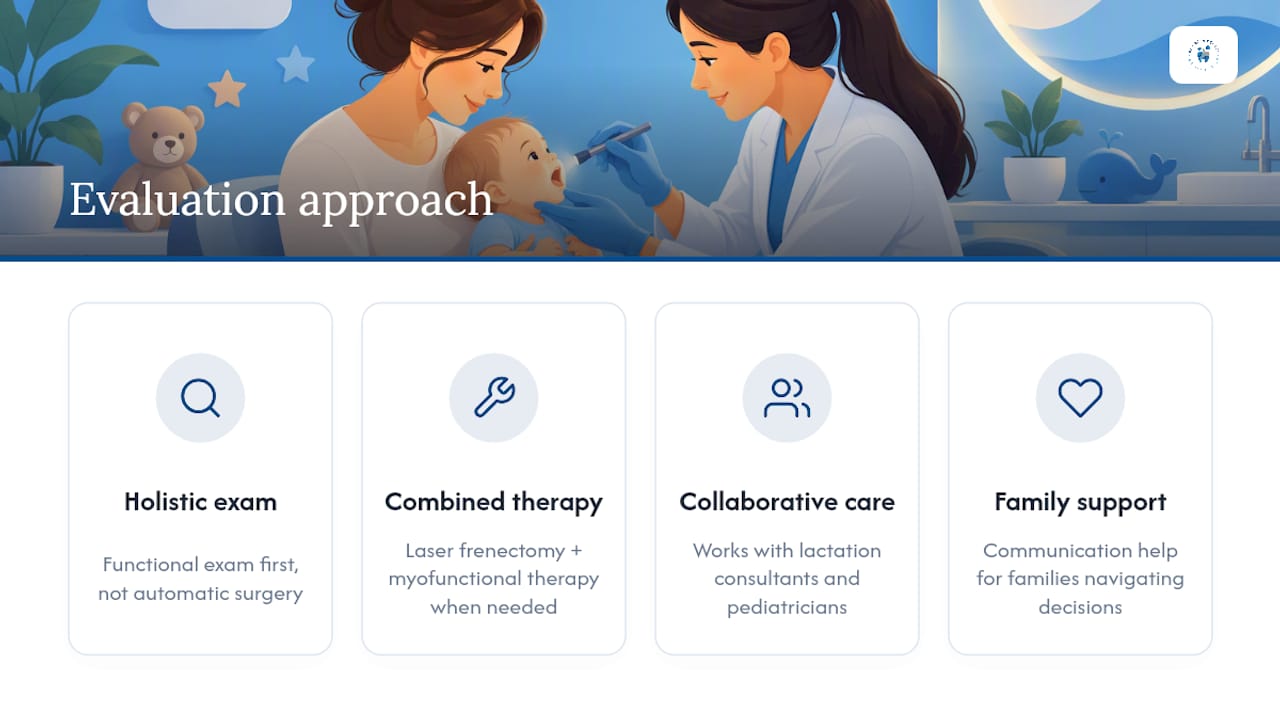
The practice treats tongue and lip tie release as one piece of a bigger airway and feeding picture, pairing laser frenectomy with myofunctional therapy when tongue function needs retraining after release. The team works alongside lactation consultants and pediatricians rather than around them, and offers communication support for families navigating the same decisions. Families considering an evaluation can expect a functional exam first, not an automatic referral to surgery.
Getting an Evidence-Based Evaluation for Your Baby
If lactation support hasn’t resolved painful or ineffective feeds, a functional exam is the next real step, not a guess based on how the frenulum looks. The practice offers laser frenectomy for infants, children, and adults, built around the same functional-first approach that pediatric guidance recommends: assess feeding directly, support breastfeeding first, and treat only when the anatomy is genuinely getting in the way.

That approach also means honest conversations about when a frenotomy isn’t the answer. If your baby’s feeding challenges turn out to be about latch or supply rather than anatomy, the practice’s broader pediatric dental care team can help track oral development over time, and a second opinion is always a reasonable thing to ask for before any procedure. If a functional assessment points toward a tongue or lip tie that’s genuinely limiting feeding, you can request an evaluation directly through them to discuss laser frenectomy and what recovery would look like for your baby.
This article is general information, not a substitute for advice from a qualified doctor. Consult a qualified healthcare professional about your own circumstances before acting on anything here.
Sources
- Frenotomy for tongue-tie in infants — Systematic review (PMC)
- Academy of Breastfeeding Medicine position statement on ankyloglossia (2021)
- Infants with Ankyloglossia — CHOP clinical pathway
- Frenotomy — Cleveland Clinic
FAQ
Should I Worry if My Baby Is Tongue Tied?
Not automatically. Many babies with a visible tongue tie feed and gain weight normally, so the finding alone isn’t a cause for alarm. What warrants attention is a pattern of feeding difficulty, like persistent nipple pain, poor latch, or slow weight gain, which calls for a functional assessment.
What Age Is Best to Treat a Tongue Tie?
There’s no single ideal age. Frenotomy is most often done in the first weeks to months of life when feeding problems are significant and haven’t improved with lactation support, since outpatient release is typically simplest in very young infants.
Can a Newborn With a Tongue Tie Still Breastfeed?
Yes, many newborns with tongue tie breastfeed successfully without any intervention. Whether treatment helps depends on function: if latch is shallow and milk transfer is poor despite good positioning, a frenotomy may improve things, but plenty of babies nurse fine as is.
Is Tongue Tie Surgery Painful for Newborns?
Frenotomy causes brief crying during the snip itself, similar to a heel prick, and most infants calm quickly once put back to the breast. It’s generally considered a low-risk, low-pain procedure, and serious complications are uncommon when performed by an experienced clinician.
How Do Doctors Diagnose Infant Tongue Tie Accurately?
Accurate infant tongue tie diagnosis relies on watching an actual feed rather than just examining the mouth at rest. Clinicians look at latch quality, tongue movement during sucking, and sometimes pre and post feeding weights to measure milk transfer objectively.