


Not every tongue tie needs revision. It’s recommended when the restriction causes documented problems: a breastfeeding relationship that isn’t working, persistent maternal nipple pain, or, in older kids, speech and mechanical limitations that don’t resolve on their own. The two main procedures, frenotomy and frenuloplasty, differ by age and complexity. When surgery is the right call, the appointment itself is usually brief and recovery is typically measured in days. Start with an IBCLC or pediatric evaluation before assuming surgery is the answer.
TL;DR:
- A proper evaluation of function, including feeding sessions and a functional scoring system, is essential before choosing surgery for tongue tie.
- Conservative measures like lactation support and positioning adjustments should be tried for two to four weeks before considering revision unless there is significant weight loss or maternal pain.
- Frenotomy is a quick in-office procedure for infants, while frenuloplasty is more invasive, often requiring anesthesia for older children with thicker or fibrous ties.
- Reattachment of the tissue after revision is common and linked to inadequate follow-up exercises during healing, making post-procedure care vital for long-term success.
- Surgery tends to improve breastfeeding and tongue mobility, but speech outcomes are less predictable and often require additional therapy afterward.
Table of Contents
- What Symptoms Suggest a Tongue Tie Revision Is Needed?
- What Happens Before Tongue Tie Revision Is Considered?
- Frenotomy vs. Frenuloplasty: What Actually Happens
- Recovery, Wound Care, and Spotting Reattachment
- How Well Does Tongue Tie Revision Actually Work?
- Who Should I Call First: IBCLC, Speech Therapist, or ENT?
- Is the Tongue Tie Anatomical, or Is It Actually Functional?
- Who Actually Needs Revision vs. Continued Conservative Care?
- What Are the Long-Term Outcomes After Tongue Tie Revision?
- Do Nonsurgical Alternatives to Tongue Tie Revision Work?
- How Does a Tongue Tie Diagnosis Affect Parents and Older Kids Emotionally?
- A Function-First Approach to Tongue Tie Care
- Ready to Have Your Child’s Tongue Tie Evaluated?
- Sources
- FAQ
What Symptoms Suggest a Tongue Tie Revision Is Needed?
Appearance alone doesn’t tell you much. A tongue tie that looks dramatic on exam can function just fine, and one that looks minor can still restrict movement enough to cause real feeding trouble. That’s why clinicians lean on function, not looks, when deciding whether revision helps.
In infants, watch for:
- Shallow, clicking, or slipping latch that never quite settles
- Feeding sessions that stretch past 30 to 40 minutes without satisfaction
- Sharp or persistent nipple pain for the breastfeeding parent, especially pain that doesn’t improve with a lactation consultant’s positioning adjustments
- Slow weight gain or a baby who seems to fall asleep at the breast out of exhaustion rather than fullness
In older children, the signs shift toward mechanics and speech:
- Limited tongue elevation, so the tongue can’t reach the roof of the mouth or move side to side well
- Trouble with sounds like “t,” “d,” “l,” “n,” or “r”
- Difficulty licking an ice cream cone, sweeping food from the teeth, or sticking the tongue out past the lower lip
Because anatomy alone is unreliable, many providers use a validated functional scoring system such as the Hazelbaker Assessment Tool for Lingual Frenulum Function (HATLFF), which scores both appearance and actual tongue movement. A tie that scores poorly on function, not just on how tethered it looks, is the one worth discussing with a specialist.
What Happens Before Tongue Tie Revision Is Considered?
A proper workup starts with observation, not a scalpel. A lactation consultant typically watches an actual feeding session, checking latch depth, suck pattern, and how the baby’s tongue moves during a feed rather than at rest. That gets paired with a functional score and, often, a weight check against your baby’s growth curve. Some providers ask for a short phone video of a typical feed if they can’t observe one live.
Before jumping to surgery, most reasonable care plans try conservative steps first:
- Two to four weeks of hands-on lactation support, adjusting positioning and latch technique.
- A trial of a nipple shield or paced-bottle feeding if the baby is struggling to transfer milk efficiently.
- Reassessment of weight gain and maternal pain at the end of that trial window.
Breastfeeding problems are frequently multifactorial. A tongue tie is only one variable among oversupply, undersupply, tongue and lip posture, or an inefficient suck unrelated to any tie at all, and providers generally hold off on frenotomy until conservative measures have had a fair shot.
That said, some situations don’t warrant waiting. A baby losing significant weight, showing signs of dehydration, or a maternal pain level that’s making breastfeeding unsustainable can justify moving to a procedure sooner rather than running the full trial period.
Pro Tip: Keep a simple feeding log for a week before your evaluation: time at breast, audible clicking, and a 1 to 10 pain score for the parent. That log turns a vague “it’s not going well” into data your provider can actually score.
Frenotomy vs. Frenuloplasty: What Actually Happens
The two procedures aren’t interchangeable, and which one applies depends heavily on age and how thick the frenulum is.
Frenotomy is the quick option. A provider makes a small, precise cut to release the tissue, usually with scissors or a laser. For a young infant, this is often done right in the office with no anesthesia at all, since the frenulum in early infancy tends to have relatively few nerve endings and little blood supply. Bleeding is typically minimal, and many babies go straight to the breast within minutes to nurse and self-soothe.
Frenuloplasty is a more involved repair, used when the tie is thicker, more fibrous, or when a child is past the newborn stage. It typically involves sutures and, for older infants and children, general anesthesia delivered in an operating room rather than a clinic chair.
A few practical distinctions:
- Pediatric dentists trained in laser frenectomy and ENTs both perform these procedures, and which one you see often depends on age, complexity, and local referral patterns.
- Office settings suit simple, quick frenotomies in infants; OR settings suit cases needing sedation, precise suturing, or a child who can’t safely stay still.
- Laser tools tend to cauterize as they cut, which can mean less bleeding compared to scissor techniques.
Recovery, Wound Care, and Spotting Reattachment
Most infants handle frenotomy remarkably well. Expect a few drops of blood, a brief cry, and then a feeding within the hour that often feels noticeably different to a parent who’s been struggling for weeks. Some fussiness in the first 24 to 48 hours is normal, particularly around feeding times when the wound is fresh.
Aftercare that actually matters:
- Feed as soon as possible after the procedure. It’s both nutrition and the best form of pain relief.
- Keep the wound area clean; most providers don’t want anything applied beyond breast milk or a rinse.
- Perform prescribed stretching exercises on the wound site several times a day, usually for one to two weeks, since this is what keeps the tissue from healing back down.
- Loop in a myofunctional therapist if one is part of your care plan. Exercises that retrain tongue posture and swallowing pattern reduce the odds of the tie mattering again later.
Reattachment is the complication parents ask about most. The wound heals through a white or yellowish diamond-shaped patch, which is normal granulation tissue and not a sign of trouble on its own. What’s worth flagging is that healing diamond combined with tongue mobility that hasn’t actually improved, or feeding problems that crept back after an initial good stretch. Prescribed range-of-motion exercises and prompt follow-up are the main lever for keeping scar tissue after frenectomy from reforming a functional restriction, and a planned secondary procedure is sometimes needed if it does.
How Well Does Tongue Tie Revision Actually Work?
Evidence supports frenotomy for improving breastfeeding, but the picture isn’t uniform across every measurement tool researchers use. A structured review found meaningful gains in maternal pain and self-reported breastfeeding success after frenotomy, while some standardized latch scoring scales showed changes that weren’t statistically significant. Translation for parents: the procedure helps a lot of families, but it’s not a guaranteed fix for every single feeding metric a lactation consultant might track.
Speech is a separate question with thinner evidence:
- Speech outcomes after infant frenotomy have less robust research support than breastfeeding outcomes.
- Many children with corrected ties still benefit from working with a speech-language pathologist afterward, since a released tongue still needs to relearn efficient movement patterns.
- Timing matters: simple frenotomy in early infancy tends to be favored for breastfeeding-related ties, while frenuloplasty performed later, under anesthesia, tends to produce better long-term mobility and fewer repeat procedures for more complex ties.
Who Should I Call First: IBCLC, Speech Therapist, or ENT?
The order matters more than parents expect. For infant feeding concerns, start with an International Board Certified Lactation Consultant (IBCLC). They’ll observe an actual feed, score function, and often resolve the problem without surgery at all through positioning changes alone.
For older children with articulation trouble or visible tongue restriction, a speech-language pathologist evaluates which sounds are affected and whether the limitation traces back to tongue mobility or something unrelated. Therapy often runs in parallel with, not instead of, a procedure.
ENTs and pediatric dentists handle the surgical side, and OR-based care becomes appropriate once a case needs general anesthesia or a more complex repair.
- IBCLC: feeding observation, latch coaching, functional scoring
- Speech-language pathologist: articulation testing, oral motor exercises, post-surgical therapy
- ENT or pediatric dentist: frenotomy or frenuloplasty, anesthesia decisions, surgical follow-up
Pro Tip: Ask your IBCLC or pediatric dentist directly whether they coordinate with a speech-language pathologist or myofunctional therapist. A collaborative multidisciplinary pathway tends to catch problems a single specialist working alone would miss.
Is the Tongue Tie Anatomical, or Is It Actually Functional?
This distinction trips up a lot of parents, and honestly, some clinicians too. An anatomical tongue tie just describes what a provider sees on exam: a visible band of tissue connecting the tongue to the floor of the mouth. A functional tongue tie describes what that tissue actually does to movement, feeding, or speech. The two don’t always match.
A baby can have a frenulum that looks short and taut and still latch, transfer milk, and gain weight normally. That’s an anatomical tie without functional impairment, and it generally doesn’t need revision. Flip it around: a frenulum that looks unremarkable on a quick glance can still tether the tongue tip enough to cause clicking, poor latch, or slow weight gain when tested against a functional scoring tool. That’s why a five-second visual check in a pediatrician’s office sometimes misses ties that a hands-on functional exam catches, and vice versa.

Reassessment matters at multiple points, not just at diagnosis. A tie that seemed mild at two weeks can look different at four months once solid foods and more complex tongue movements enter the picture. Similarly, a child cleared as “fine” as an infant might show functional limitations later when speech sounds requiring fine tongue-tip control start developing around ages 2 to 4. Because there’s no single accepted classification system, ongoing functional reassessment, rather than a one-time anatomical verdict, is what most current clinical guidance recommends.
Who Actually Needs Revision vs. Continued Conservative Care?
Selecting candidates for surgery comes down to a few converging factors rather than one deciding test. Consider these together, not in isolation:
Severity of functional impairment. Documented weight loss, dehydration risk, or breastfeeding that’s failed entirely despite lactation support points toward revision sooner. Mild clicking with otherwise fine weight gain points toward continued monitoring.
Response to conservative trial. A baby who improves substantially after two to three weeks of positioning and latch work may not need a procedure at all. One who shows no meaningful change despite consistent lactation support is a stronger revision candidate.
Age and frenulum thickness. A thin, anterior tie in a newborn is a straightforward frenotomy candidate. A thick, posterior, or fibrous tie discovered later often needs frenuloplasty, which changes the risk and anesthesia conversation entirely.
Functional score, not just appearance. A HATLFF-type functional score that falls in the impaired range, combined with real-world symptoms, carries more weight than how the tie looks in a photo.
Caregiver and clinical judgment together. A parent who reports unsustainable pain or exhaustion is providing clinically relevant data, not just an anecdote. That report belongs in the decision alongside the scoring tools.
The candidates who benefit least from revision tend to be children with a visually obvious tie but no functional complaints. Cutting tissue that isn’t causing a problem doesn’t produce a benefit worth the procedure’s risk.
What Are the Long-Term Outcomes After Tongue Tie Revision?
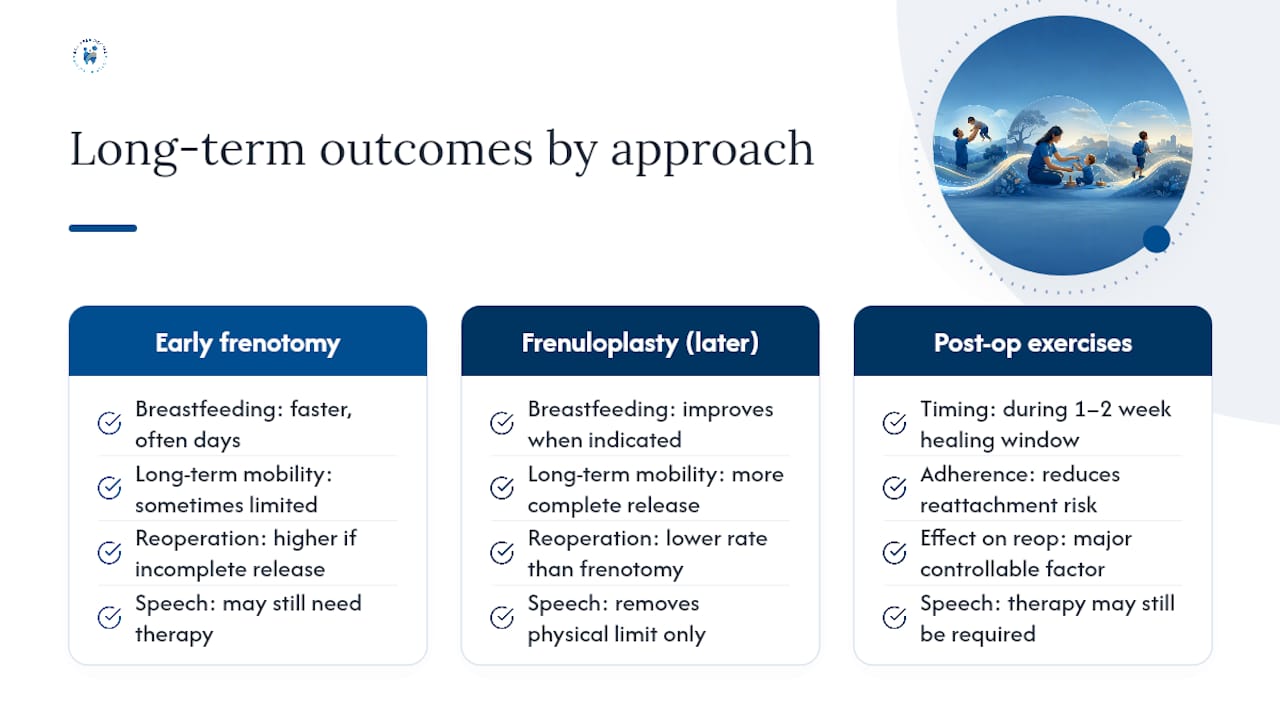
Most families see the improvement they came for, and it tends to show up fast. For breastfeeding-motivated frenotomies performed in early infancy, parents commonly report better latch and less pain within days, and that improvement generally holds. The evidence base backs this pattern at a population level, even though not every standardized breastfeeding measurement tool shows the same size of effect.
Long-term mobility outcomes look different depending on which procedure was used and when. Simple frenotomies done in early infancy handle the breastfeeding problem well but occasionally leave a thicker or posterior tie under-addressed, since the goal at that stage is usually just enough release to enable feeding. Frenuloplasty performed later, with more complete tissue removal and suturing, tends to produce better long-term tongue mobility and a lower rate of needing a second procedure.
Reoperation isn’t rare enough to ignore. Reattachment, discussed earlier, is the main reason a family ends up back in the clinic. Consistent post-procedure exercises during the healing window are the single most controllable factor in whether that happens. Kids who get a frenotomy as infants and never do the follow-up stretching are more likely to need a second look later than those whose parents stuck with the exercise routine for the full one to two weeks.
Speech outcomes are the murkiest long-term category. Some children show clear articulation improvement once tongue mobility increases; others need speech-language therapy regardless of the surgery to unlearn compensatory speech patterns built up over months or years of restricted movement. Revision removes a physical limitation. It doesn’t automatically retrain a tongue that’s spent two years working around that limitation.
Do Nonsurgical Alternatives to Tongue Tie Revision Work?
Surgery isn’t the only path, and for a meaningful share of families it isn’t the right one at all. Lactation support is the most evidence-backed alternative, and it’s genuinely effective for a lot of feeding problems that get blamed on tongue tie by default. Positioning changes, addressing oversupply or undersupply, and correcting a shallow latch resolve plenty of cases without ever touching the frenulum.
Myofunctional therapy is the other major nonsurgical route, particularly for older children. Targeted exercises can improve tongue strength, resting posture, and swallowing pattern even without a release, and for mild functional ties, this can be enough. Where myofunctional therapy tends to fall short on its own is with more severe anatomical restriction. You can strengthen a tongue all you want, but if the tissue physically won’t reach the roof of the mouth, exercise alone won’t create range of motion that doesn’t exist.
Speech therapy addresses articulation directly and is often necessary whether or not a child has surgery, since compensatory speech habits don’t disappear the moment mobility improves.
The honest limitation of every nonsurgical option: none of them change the anatomy. For a genuinely restrictive tie causing documented functional impairment, conservative measures manage symptoms around the restriction rather than removing it. That’s a reasonable choice for a mild case. It’s a less reasonable long-term plan for a severe one.
How Does a Tongue Tie Diagnosis Affect Parents and Older Kids Emotionally?
Nobody talks about this part enough. Parents of a struggling newborn are usually running on very little sleep, dealing with real physical pain if they’re breastfeeding, and often fielding conflicting advice from a pediatrician, a lactation consultant, and a well-meaning relative who all say something different. That’s a genuinely stressful position, and the guilt many parents feel wondering if they caused the feeding problem or waited too long to get it checked is common and misplaced.
For older children, the experience is different but not lighter. A five-year-old who’s been told his speech “sounds funny” or a seven-year-old who’s self-conscious about not being able to lick an ice cream cone the way friends can is carrying something real. Some kids feel relief once a name gets attached to what’s been happening. Others feel singled out by the procedure itself, especially if it involves anesthesia and a hospital visit that friends don’t have to go through.
None of this means the medical decision should be driven by emotion instead of evidence. It means the conversation with a child old enough to understand should be simple and calm, and that parents deserve the same reassurance: a functional problem identified and addressed is a solved problem, not a parenting failure.
A Function-First Approach to Tongue Tie Care
The clinical consensus is clear on one point that’s easy to miss: the tie itself isn’t the diagnosis worth treating. Function is. Tongue and lip tie evaluation should be considered as one piece of a broader airway and myofunctional picture, not an isolated snip. Coordinating frenectomy with myofunctional therapy and airway assessment tends to produce results that hold up better over time than a procedure done in isolation. Laser tools and 3D imaging support a more precise, minimally invasive release when surgery is the right call, which matters for comfort and healing, but the harder work, and the part families sometimes skip, is the follow-up therapy that actually retrains the tongue.
— Admin
Ready to Have Your Child’s Tongue Tie Evaluated?
Bay Area Dental, Airway & Sleep offers something a lot of families struggle to find in one place: a tongue and lip tie evaluation that does not stop at the snip. If your pediatrician or IBCLC has flagged a possible tie, or you’re seeing the feeding and speech signs covered above, an evaluation here pulls together a functional assessment, laser frenectomy when it’s actually indicated, and coordinated myofunctional therapy so the release has a real shot at sticking.

Bring what you’ve got: a feeding log if you’ve kept one, notes from your lactation consultant, and recent weight data if your baby’s pediatrician has been tracking it. That history speeds up the functional scoring and helps determine whether revision, continued conservative care, or both together make sense for your child. The practice also maintains accessible services for Deaf patients and families, with tailored communication support built into the visit. If you’re ready to get a clear answer instead of more guessing, schedule an evaluation with Bay Area Dental, Airway & Sleep and bring your questions with you.
This article is general information, not a substitute for advice from a qualified doctor. Consult a qualified healthcare professional about your own circumstances before acting on anything here.
Sources
- Ankyloglossia (Tongue-Tie) – StatPearls – NCBI Bookshelf
- Tongue-tie (ankyloglossia) – Diagnosis and treatment – Mayo Clinic
- How to Treat a Tongue-tie: An Evidence-based Algorithm of Care – PMC
- Tongue-Tie (Ankyloglossia) Symptoms, Causes & Treatment – Cleveland Clinic
- Ankyloglossia (Tongue-Tie) | Children’s Hospital of Philadelphia
FAQ
Are Tongue Tie Revisions Painful?
Frenotomy in infants involves minimal discomfort, usually a brief cry and a few drops of blood, and most babies feed within minutes afterward. Frenuloplasty, done under general anesthesia in older children, involves more tissue work and a longer recovery with mild soreness for a few days.
Do All Tongue Ties Need Revision?
No. Revision is indicated only when the tie causes documented functional problems like breastfeeding failure, persistent maternal pain, or clear speech and mechanical limitations, not based on appearance alone.
What Age Is Best to Fix a Tongue Tie?
For feeding-related ties, early infancy (often the first few months) favors simple in-office frenotomy without anesthesia. Older infants and children with thicker or more complex ties typically need frenuloplasty under general anesthesia, which tends to produce better long-term mobility.
How Can I Tell If a Tongue Tie Is Reattaching?
Watch for a white or yellow healing patch at the release site combined with tongue mobility that hasn’t actually improved, or feeding and speech problems that return after initially getting better. That combination, not the healing tissue alone, is what warrants re-evaluation with your provider.
Can Speech Therapy Replace the Need for Tongue Tie Revision?
For a genuinely restrictive tie, speech therapy alone can’t create tongue mobility that the tissue physically prevents. It works well alongside revision, and can be sufficient on its own for milder functional limitations where anatomy isn’t the main barrier.