

Pediatric myofunctional therapy trains the muscles of the mouth and face to support nasal breathing, swallowing, speech, and sleep. It is worth an evaluation when your child mouth breathes, thrusts the tongue, or snores, and a trained clinician must assess first. ASHA guides this field, and our team at Bay Area Dental, Airway & Sleep applies it.
TL;DR:
- Children around age 4 or older who can follow multistep directions are usual candidates; mouth breathing, snoring, tongue thrust, or persistent speech errors warrant evaluation.
- A trained clinician checks lip seal, tongue position, swallowing, and speech; suspected airway problems may require ENT assessment or a sleep study before therapy.
- Progress depends on short daily home practice with a parent’s coaching; appliances may support tongue posture but do not replace active exercises.
- One meta analysis found a mean reduction of 1.54 events per hour on the apnea hypopnea index in children, but evidence remains small and varied.
- Adherence below 80% was linked to weaker or nonsignificant sleep apnea improvements; therapy should not delay medical or surgical treatment.
Table of Contents
- What is pediatric myofunctional therapy and who is it for?
- Which signs suggest your child might benefit?
- Who evaluates your child, and what happens at the assessment?
- What does therapy look like at the clinic and at home?
- What does the research say about benefits and limits?
- How do you choose a qualified provider?
- What can you do right now?
- How we weave airway care, therapy, and referrals together
- How we can support your family
- FAQ
- Sources
What is pediatric myofunctional therapy and who is it for?
Myofunctional therapy is active neuromuscular re-education. Your child learns to place the tongue, close the lips at rest, and swallow with the right pattern, while building awareness of where the muscles are and what they are doing. Cleveland Clinic describes it as exercises that strengthen the mouth and facial muscles and refine proprioception.
That is different from generic oral-motor play such as blowing or sucking tasks. Passive exercises like these are considered inappropriate for treating speech problems, because effective therapy is tailored to your child after a full assessment.
The goals are practical: a closed-lip resting posture, a tongue-to-spot swallow, easier nasal breathing, better chewing, and cleaner speech placement.
Age matters too. Therapy takes real self-monitoring, so it is generally not appropriate for children under about 4 who cannot follow multi-step directions. School-aged children are the usual candidates.
Which signs suggest your child might benefit?
No single sign confirms a problem, but a pattern is worth raising with a clinician. M Health Fairview Pediatrics lists the behaviors that most often prompt an evaluation:
- Chronic mouth breathing or a resting posture with the mouth hanging open
- Frequent snoring, restless sleep, or tiredness during the day
- Tongue thrust when swallowing, or speech errors that persist
- Drooling beyond age 2
- Thumb or pacifier use that continues past age 2
- Trouble chewing or swallowing certain foods
Open-mouth breathing in small children deserves particular attention. This parent guide on toddler mouth breathing explains when an ENT visit or therapy makes sense, and it is a good read if your child is young.
Sleep clues matter most. If snoring comes with pauses, gasping, or bedwetting, mention it early. We cover that connection in our piece on mouth breathing and sleep.
Who evaluates your child, and what happens at the assessment?
Evaluations are done by speech-language pathologists with myofunctional training, pediatric dentists with airway experience, and trained dental hygienists. When airway or medical concerns appear, the ENT, pediatrician, and orthodontist join the picture. Our pediatric airway evaluation considers your child’s airway.
Lurie Children’s notes that a thorough assessment looks at resting posture and at the strength and coordination of the lips, tongue, jaw, and cheeks. Here is what you can usually expect:
- A review of your child’s feeding, sleep, and snoring history
- An observation of resting posture, including lip seal and tongue position
- A check of tongue strength, placement, and range of motion
- A swallowing test with food and drink, sometimes brought from home
- A short speech sample to hear how sounds are formed
- A plan that names next steps, including any referral
A referral for a sleep study or ENT exam is common when a clinician suspects enlarged tonsils or adenoids, or when snoring and daytime sleepiness point toward a sleep-related breathing problem. Therapy never replaces that medical workup.
What does therapy look like at the clinic and at home?
Sessions are hands-on and playful. The clinician teaches an exercise, watches your child perform it, and coaches you so you can repeat it at home. Typical active work includes:
- Tongue placement drills, where the tip rests on the spot behind the front teeth
- Tongue clicks that build strength and control
- Lip resistance tasks, such as holding a button with the lips
- Awareness games that teach the child to feel posture and notice mouth breathing
Our page on clinician-vetted myofunctional exercises walks through a starter set, and our tongue thrust therapy page explains what realistic results look like.
Appliances sometimes play a supporting role. A night-time appliance can encourage better tongue posture in selected cases, but it is an adjunct. It trains position passively, while exercises build the habit your child needs during the day.
Home practice is where progress is made. Short daily sessions work best, and a parent who coaches and cheers on the routine tends to see better follow-through.
Pro Tip: Attach practice to something that already happens every day, like toothbrushing, and keep it to a few minutes. Our tongue posture training page shows a short routine.
What does the research say about benefits and limits?
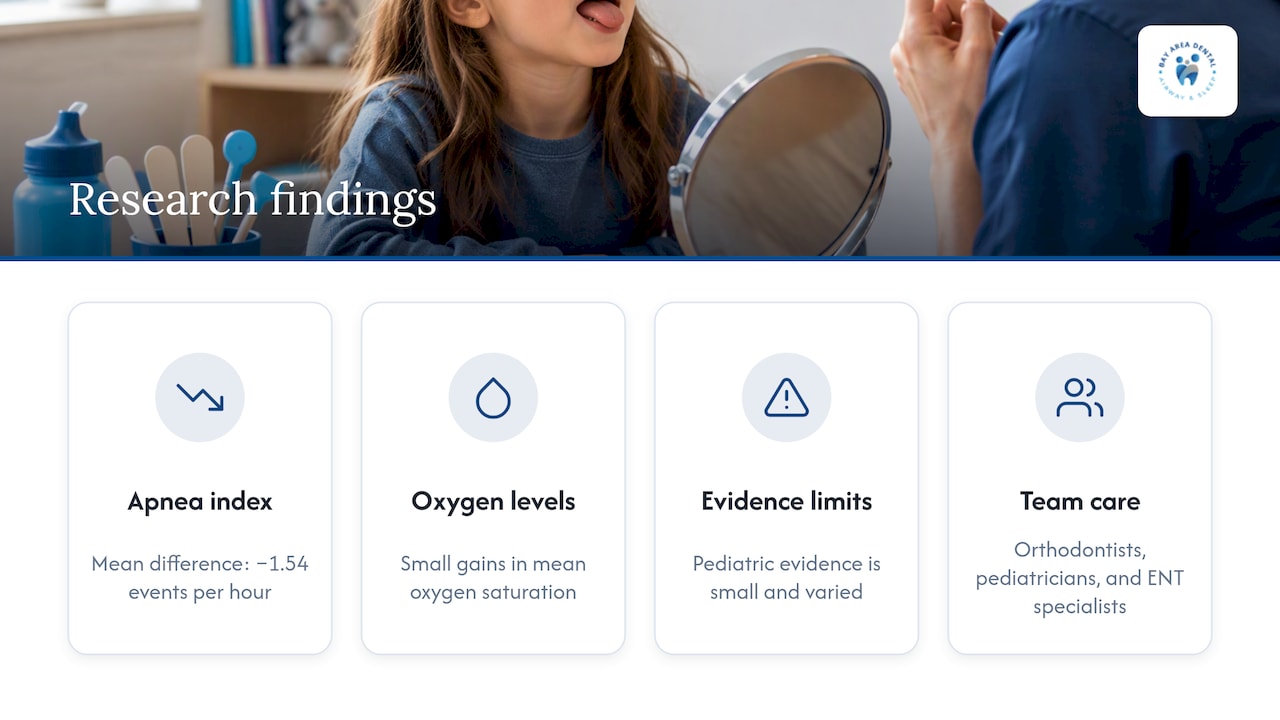
The evidence is encouraging but still young. A meta-analysis of myofunctional therapy in children with sleep apnea reported a drop in the apnea-hypopnea index, which counts breathing pauses per hour of sleep, with a mean difference of -1.54 events per hour, plus small gains in mean oxygen saturation. The authors also noted that the pediatric evidence is small and varied.
A scoping review found therapy promising for orofacial function and oral habits, yet high-level randomized trials are still lacking across uses. It works best inside a team that includes orthodontists, pediatricians, and ENT specialists. A systematic review pairing therapy with orthodontic care points the same way, with improved tongue position and swallowing in some studies but a need for better long-term research.
Compliance shapes results. A systematic review and meta-analysis found that low pediatric compliance, below 80%, was linked to weaker or non-significant improvements in sleep apnea outcomes.
The takeaway: therapy can be a useful adjunct for milder cases, but it should never delay medical or surgical treatment that your child’s clinicians say is needed.
How do you choose a qualified provider?
Look for a speech-language pathologist with myofunctional training or a pediatric dentist experienced in airway and myofunctional care, then verify their scope and background. At the first visit, consider asking:
- What does your assessment include, and how will you measure progress?
- How long does a typical program last, and how often are sessions?
- Which specialists do you work with when airway or medical issues come up?
- What will home practice look like, and what short-term goals should we expect?
A good provider gives you a clear practice plan and measurable milestones. Be cautious of anyone who promises an instant fix, because muscle habits take steady repetition to change.
What can you do right now?
You can start preparing today, before any appointment.
- Keep a simple log: snoring, breathing at rest, chewing and feeding, and speech changes.
- Tie a few minutes of practice to a daily routine, such as toothbrushing or bedtime, and keep it playful.
- Bring the log to your first visit so the clinician sees patterns, not guesses.
Pro Tip: Praise effort rather than perfection. Children stick with exercises when they feel successful, and a sticker chart costs almost nothing.
Seek an ENT or sleep evaluation promptly if you see labored breathing, choking during sleep, loud and persistent snoring, or heavy daytime sleepiness.
How we weave airway care, therapy, and referrals together
In our practice, we look at the whole airway first. We evaluate how your child breathes, rests, and swallows, then build a plan that links myofunctional exercise guidance with referrals to ENT, speech therapy, or orthodontics when they are needed. We bring that care together under one roof. We also tailor how we communicate to each family.
— Admin
How we can support your family
We offer pediatric airway evaluations, myofunctional therapy support, and coordination with ENT and orthodontic care. If you have noticed mouth breathing, snoring, or tongue thrust, we would be glad to see your child. Learn about our pediatric dental care or book an evaluation at our Fremont practice.
This article is general information, not a substitute for advice from a qualified doctor. Consult a qualified healthcare professional about your own circumstances before acting on anything here.
FAQ
What age can kids start myofunctional therapy?
Most children are ready at age 4 or older, once they can follow multi-step directions. Younger children usually cannot do the self-monitoring that therapy requires.
How can I do myofunctional therapy at home?
Follow the plan your clinician gives you, using short daily sessions tied to a routine. Our myofunctional exercises page shows a starter set, but an evaluation should come first so the exercises fit your child.
Can tongue thrusting be corrected?
Often it can improve with active therapy that retrains the swallow and tongue posture, along with consistent practice. Results depend on your child’s age, habits, and effort, as we explain in our tongue thrust therapy guide.
What does an orofacial myofunctional therapist do?
A therapist assesses resting posture, tongue and lip strength, swallowing, and speech, then teaches exercises that retrain those patterns. They also coach parents on home practice and refer to other specialists when needed.
Sources
- Orofacial Myofunctional Therapy ‘OMT’ (Myofunctional Therapy) – Conditions We Treat | M Health Fairview Pediatrics
- Effect of myofunctional therapy on children with obstructive sleep apnea: a meta-analysis
- Orofacial Myofunctional Disorders