
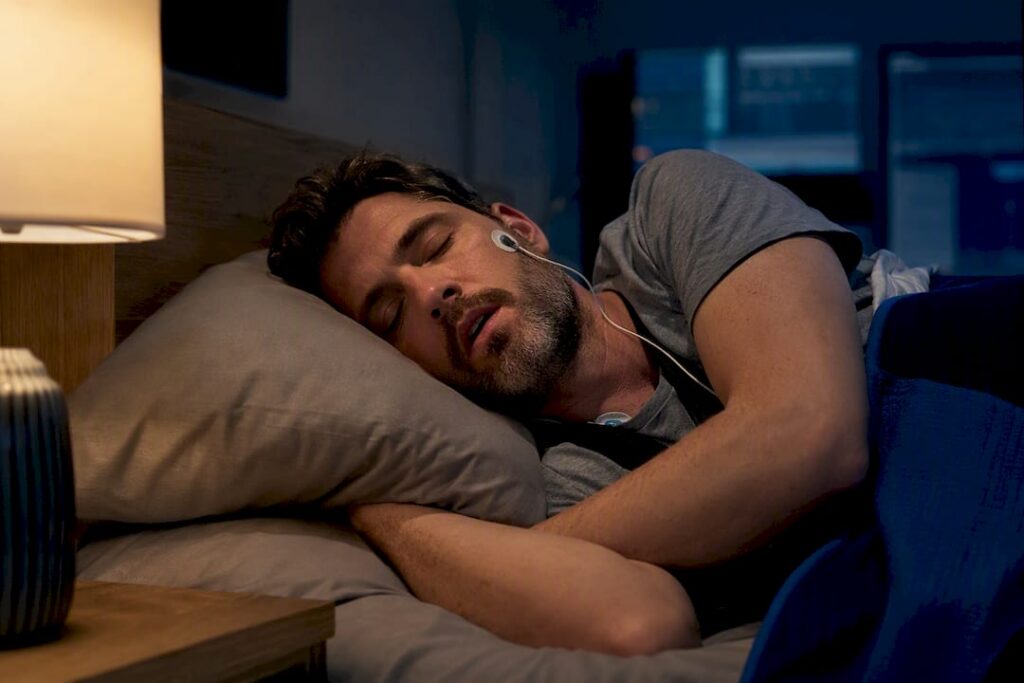
Chronic mouth breathing during sleep usually signals a nasal or airway problem, not a harmless habit, and it can fragment sleep and raise the risk of sleep-disordered breathing. If it happens most nights, or comes with snoring, morning headaches, or daytime sleepiness, track it for a week and get evaluated by an ENT, dentist trained in airway health, or sleep physician. Kids with these signs deserve an earlier look, since jaw growth and behavior can be at stake.
TL;DR:
- Mouth breathing during sleep significantly increases airway resistance and the risk of sleep-disordered breathing, especially in individuals with underlying nasal obstructions.
- Common causes include nasal blockages from structural issues, allergies, enlarged tonsils, or sleep apnea, with habits and sleep position exacerbating the problem.
- Children with mouth breathing are at a higher risk of altered facial development and should be evaluated early, especially if behavioral or growth issues are present.
- Diagnosis often involves clinical observation, sleep logs, and specialist testing like sleep studies or ENT assessments, depending on severity and age.
- Treatment requires a personalized approach combining nasal, orthodontic, or surgical interventions, and should involve coordinated care among ENT, dental, and sleep medicine professionals.
Table of Contents
- Why Nasal Breathing Matters More Than Most People Realize
- What Causes Mouth Breathing During Sleep
- What the Research Actually Shows About Mouth Breathing and Sleep
- How to Tell If You’re Mouth Breathing at Night
- Getting a Diagnosis: Who to See and What Tests Reveal
- Treatment Options, Matched to Cause and Severity
- What an Airway-Focused Dental Evaluation Actually Involves
- A Simple Path Forward If You Suspect Mouth Breathing
- How Bay Area Dental, Airway & Sleep Can Help
- Where to Read the Original Research
- Sources
Why Nasal Breathing Matters More Than Most People Realize
The nose does far more than let air in. It humidifies and warms incoming air, filters particles, and produces nitric oxide, a molecule that helps relax blood vessels and improves oxygen uptake in the lungs. None of that happens when air bypasses the nose and goes straight through the mouth.
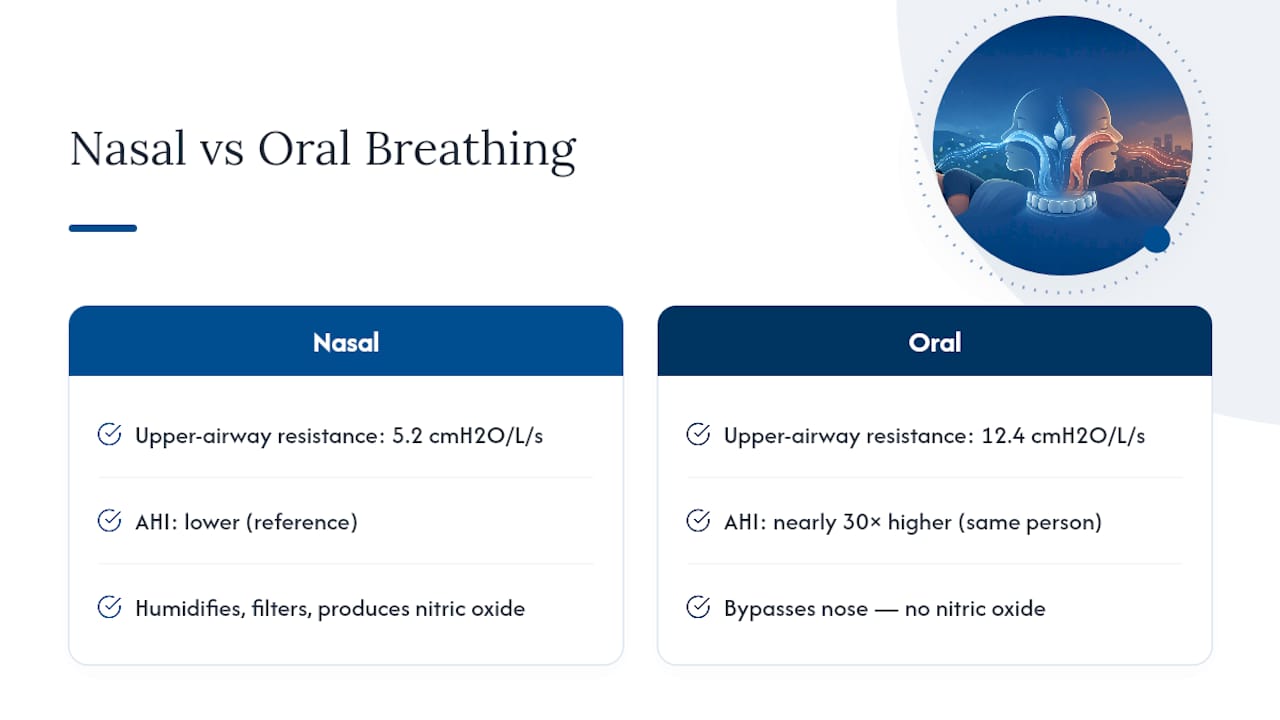
The physical difference shows up clearly in lab measurements. One clinical study found upper-airway resistance during sleep was roughly 12.4 cmH2O per liter per second during oral breathing, compared with just 5.2 during nasal breathing, more than double. The same study recorded an apnea-hypopnea index that is considerably higher during oral breathing compared to nasal breathing in the same patients.
Statistic Callout: Switching from nasal to oral breathing in that study raised the apnea-hypopnea index nearly thirty-fold, in the same person, on the same night.
One clarification matters here: mouth breathing is a sign your airway is working around an obstruction, not a diagnosis by itself. Figuring out why the mouth stays open at night is the real task.
What Causes Mouth Breathing During Sleep
Most people fall open-mouthed at night for a mechanical reason. The nasal passage is blocked, narrowed, or inflamed, and the body reroutes airflow through the path of least resistance.
Common structural and medical causes include:
- Deviated septum or nasal valve collapse, which physically narrows the airway.
- Allergic rhinitis or chronic sinusitis, causing swelling that closes off nasal passages, especially seasonally.
- Enlarged tonsils or adenoids, a leading cause in children and a factor in some adults.
- Obstructive sleep apnea (OSA), where the throat collapses repeatedly and the mouth opens as a reflex to keep air moving.
- Nasal polyps, which block airflow mechanically and often accompany chronic sinus disease.
Beyond anatomy, several habits and situational factors make mouth breathing worse. Alcohol relaxes throat muscles and increases the odds of the jaw dropping open. Sedating antihistamines and muscle relaxants do something similar. Sleeping flat on your back lets the tongue fall backward, partially blocking the throat and pushing the body toward mouth breathing as a workaround. A stuffy environment, whether from dry heating in winter or low indoor humidity, thickens nasal mucus and makes nose breathing harder to sustain all night.
Children face an added layer of concern. A narrow palate, a tongue-tie, or long-term mouth breathing during the growth years can alter facial development, leading to a longer face, a recessed chin, and crowded teeth, a pattern airway-focused dentists sometimes call “long face syndrome.” That’s part of why pediatric dentists and orthodontists increasingly screen for mouth breathing in checkups rather than treating it as background noise.
What the Research Actually Shows About Mouth Breathing and Sleep
The evidence connecting mouth breathing to poor sleep isn’t a single study. It’s a pattern that shows up across age groups and research designs, though the story isn’t identical for every patient.
In children, the association is strong. A 2025 cross-sectional study of 343 school-aged children in Bandung, Indonesia found mouth-breathing kids had 4.24 times the risk of sleep-disordered breathing compared to nose breathers. Among the mouth breathers, 41.1% were identified with sleep-disordered breathing, versus 9.7% of children who breathed through their nose.
The physiological mechanism behind that gap comes from adult data. The oral versus nasal resistance study cited above didn’t just show higher resistance with mouth breathing, it showed the downstream effect: apneas and hypopneas spiked dramatically when the same airway had to work through an open mouth instead of the nose.
| Study focus | Population | Key finding |
|---|---|---|
| Pediatric cross-sectional study | 343 school-aged children | Mouth breathers had 4.24x the risk of sleep-disordered breathing; 41.1% had SDB vs. 9.7% of nasal breathers |
| Upper-airway resistance study | Adults, within-subject comparison | Resistance roughly doubled (12.4 vs. 5.2 cmH2O·L⁻¹·s⁻¹) and AHI rose from 1.5 to 43 with oral breathing |
| Mouth closure trial | 54 adults with OSA | Closing the mouth increased inspiratory flow for most but worsened airflow in some patients with high baseline mouth breathing |
That third row is where things get nuanced. A 2024 trial of 54 OSA patients found that closing the mouth during sleep increased inspiratory flow for most but worsened airflow in some patients who had high baseline mouth breathing. Their mouths were open for a reason, likely a nasal obstruction or specific airway anatomy, and forcing closure removed their workaround without fixing the underlying blockage. That’s the core argument for getting an individual evaluation instead of assuming one fix works for everyone.
How to Tell If You’re Mouth Breathing at Night
You can gather useful clues before ever stepping into a clinic. None of this replaces formal testing, but it tells you whether that testing is worth pursuing sooner rather than later.
- Ask a bed partner or record yourself. A partner can watch for an open mouth, gasping, or long pauses in breathing; if you sleep alone, a smartphone set to record audio or video overnight works nearly as well.
- Check your mouth and throat first thing in the morning. Persistent dryness, a sore throat, or noticeably bad breath on waking are classic signs air spent the night moving through your mouth instead of your nose.
- Track daytime symptoms for a week. Note grogginess, trouble concentrating, or needing caffeine just to function by midmorning, then look for a pattern tied to how you slept.
- Look at your pillow and sheets. Drool stains or a consistently dry mouth on one side can hint at a habitual sleep position that encourages mouth breathing.
Pro Tip: Keep a simple sleep log for seven nights, rating morning dryness, snoring reported by a partner, and daytime alertness on a 1 to 5 scale. A consistent pattern of low scores is more useful to a clinician than a single bad night, and it takes the guesswork out of your first appointment.
If your notes show frequent gasping, loud snoring, or daytime sleepiness that doesn’t improve with more sleep, that combination is a strong enough signal to move straight to formal testing rather than waiting it out.
Getting a Diagnosis: Who to See and What Tests Reveal
Start with whoever already knows your health history. A primary care doctor or pediatrician can screen for obvious red flags and refer you onward, usually to an ENT for structural nasal issues, a dentist trained in airway assessment for jaw and oral posture concerns, or a sleep physician when the pattern points toward OSA.
An ENT evaluation typically includes nasal endoscopy, a quick in-office scope that shows swelling, polyps, or a deviated septum directly. Imaging, including CT scans or 3D cone-beam imaging used in some dental airway practices, maps the nasal passages and upper airway in more detail than a physical exam alone. For more complex or ambiguous cases, drug-induced sleep endoscopy lets a specialist watch exactly where the airway collapses while a patient is sedated to mimic natural sleep.
On the sleep-testing side, the choice usually comes down to two options:
- Home sleep apnea testing works well for adults with a straightforward suspicion of OSA and no major complicating conditions.
- In-lab polysomnography remains the gold standard, especially for children, complex cases, or anyone whose home test results don’t match their symptoms.
A few signs warrant urgent referral rather than a wait-and-see approach: witnessed pauses in breathing, choking or gasping awakenings, high blood pressure that resists treatment, or a child who’s falling behind on growth curves alongside loud snoring. Those combinations point toward airway compromise serious enough that delay carries real cost.
Treatment Options, Matched to Cause and Severity
There’s no single fix for mouth breathing because there’s no single cause, which is exactly why treatment has to start with the diagnosis, not the symptom.
Conservative measures come first for most people. Nasal corticosteroid sprays reduce inflammation from allergies or chronic rhinitis. Daily saline rinses clear mucus and improve airflow without medication. Identifying and controlling specific allergens, whether dust mites, pet dander, or seasonal pollen, often reduces nighttime congestion within weeks. Simple positional changes, like sleeping on your side instead of your back, reduce the tongue’s tendency to fall backward and block the airway.
Device-based treatments target moderate to severe cases, particularly confirmed OSA. CPAP remains the most studied option for moderate to severe apnea, delivering steady air pressure that keeps the airway open regardless of breathing route. Oral appliances, custom-fitted by a dentist, reposition the lower jaw forward to open the airway and work well for mild to moderate OSA or for patients who can’t tolerate CPAP. Chin straps and mouth shields aim to encourage nasal breathing mechanically, but research on oral appliances shows outcomes vary significantly depending on a patient’s specific mouth-breathing phenotype, reinforcing that a device that helps one patient can underperform in another.
Therapeutic approaches address the muscles and structures behind the habit. Myofunctional therapy retrains tongue posture and oral muscle function through targeted exercises, often used alongside other treatments rather than as a standalone fix. Dental and orthodontic interventions, including palate expansion in children, can widen a narrow airway and correct the bite issues that come with long-term mouth breathing. Laser frenectomy releases a tongue-tie or lip-tie that’s restricting normal tongue posture and function, relevant across ages from infants to adults.
Surgery addresses fixed structural problems that conservative care can’t touch. Septoplasty straightens a deviated septum. Turbinate reduction shrinks swollen nasal tissue that’s narrowing the airway. Tonsillectomy and adenoidectomy remain common and often highly effective for children whose enlarged tissue is the primary obstruction.
Mouth taping deserves a specific caution. Some small studies suggest it reduces snoring in select patients, but health-system guidance warns that forcing the mouth closed can worsen breathing in people whose mouth breathing is compensating for a nasal blockage. The 2024 mouth-closure trial backs this up directly: patients with the highest baseline mouth breathing saw airflow get worse, not better, when their mouths were closed.
Pro Tip: Never start mouth taping or a chin strap on your own if you snore heavily or suspect sleep apnea. Get evaluated first. Taping shut the workaround your body built for a blocked airway can turn a manageable problem into a dangerous one.
What an Airway-Focused Dental Evaluation Actually Involves
A dental airway exam looks past cavities and gum health to ask a different question: is this person’s mouth, jaw, and tongue positioned in a way that supports healthy nighttime breathing? At Bay Area Dental, Airway & Sleep, that evaluation typically includes 3D imaging to map airway dimensions, an assessment of resting tongue and lip posture, a myofunctional screening to check tongue strength and mobility, and an evaluation for tongue-tie or lip-tie in patients of any age.
Oral appliances and myofunctional therapy don’t replace ENT or sleep medicine, they work alongside it. A patient with confirmed OSA might use a dentist-fitted oral appliance while an ENT addresses a structural nasal issue in parallel, with a sleep physician monitoring overall progress through follow-up testing.
The realistic goal of airway dentistry isn’t a single device that fixes everyone. It’s identifying which combination of structural, muscular, and behavioral factors is keeping a specific patient’s airway compromised, then coordinating care around that individual picture rather than a generic protocol.
Outcomes vary by cause and severity, and no dental treatment substitutes for a full sleep evaluation when apnea is suspected.
A Simple Path Forward If You Suspect Mouth Breathing
Move through this in order rather than jumping straight to a fix. Self-check for a week using the tracking method above, then book a primary care, ENT, or dental airway consult if the pattern holds. If red flags show up, witnessed breathing pauses, loud persistent snoring, or a child falling behind developmentally, push straight to sleep testing rather than waiting out another few weeks.
Timelines vary by path. A trial of nasal steroids or allergy control typically shows results within two to four weeks. CPAP titration usually takes a few visits over one to two months to get pressure settings right. Dental appliance adjustments often need several follow-ups across two to three months as the jaw position gets fine-tuned. Surgical recovery for procedures like septoplasty or tonsillectomy generally runs two to four weeks before full benefits are clear.
The biggest mistake is treating this as one specialist’s problem. Coordinated care, where your ENT, dentist, and sleep physician are actually talking to each other, gets better results than any single provider working in isolation.
How Bay Area Dental, Airway & Sleep Can Help
If you’ve read this far because a nightly dry mouth or a partner’s complaints about your snoring have you wondering what’s actually going on, an airway-focused dental evaluation is a practical next step that most general dentists don’t offer. A local dental practice provides airway and sleep dentistry built around 3D imaging, myofunctional therapy, and laser frenectomy for tongue and lip ties, alongside general, restorative, and cosmetic dental care.
An initial consult typically includes a review of your sleep symptoms, an oral and airway exam, and imaging when structural issues are suspected, giving you a clearer picture of whether the airway, the jaw, or a tongue restriction is driving your nighttime mouth breathing. The practice also runs tailored communication and educational programs for Deaf patients, reflecting a broader commitment to accessible care in its community. If mouth breathing, snoring, or unrefreshing sleep have become a regular pattern in your house, schedule an airway and sleep evaluation with Bay Area Dental, Airway & Sleep to find out what’s actually driving it.
Where to Read the Original Research
- Mouth Breathing and Its Impact on Sleep Breathing Disorders in Children: the 2025 pediatric cross-sectional study behind the 4.24 relative risk figure.
- Effect of Nasal or Oral Breathing Route on Upper Airway Resistance During Sleep: the classic resistance comparison study.
- Mouth Closure and Airflow in Patients With Obstructive Sleep Apnea: the 2024 trial on individualized responses to mouth closure.
- Mouth Breathing: Cleveland Clinic’s patient guide on causes and treatment.
This article is general information, not a substitute for advice from a qualified doctor. Consult a qualified healthcare professional about your own circumstances before acting on anything here.