


If your baby struggles to latch and someone has mentioned a tongue tie, start with a lactation consultant, then bring in a clinician who can examine the mouth and diagnose. A lactation consultant (IBCLC) watches a full feed, works on position and latch, and can tell you whether the tongue looks like part of the problem. The diagnosis and any release belong to a healthcare provider such as a pediatrician, ENT or a dentist trained in infant oral function. This guide explains how the two roles fit together, what to expect, and how to avoid a procedure your baby may not need.
TL;DR
- An IBCLC assesses feeding function and helps you optimize latch. An IBCLC cannot diagnose a tongue tie, but can evaluate and refer to a provider who can.
- The American Academy of Pediatrics says a tongue tie counts as symptomatic when feeding problems persist despite skilled lactation support. Nipple pain alone is not enough to decide.
- Look for a team: lactation consultant, pediatrician and, when needed, ENT or a feeding therapist. Be wary of anyone who offers the same quick fix for every baby.
- If a release is recommended, ask who will manage aftercare and how feeding will be rechecked.
Table of Contents
- What a tongue tie is, and why feeding is the real question
- What a lactation consultant can and cannot do
- The care sequence we recommend
- Signs that a tongue tie may be involved
- Lip ties, posterior ties and other terms to question
- Questions to ask before agreeing to a release
- Our perspective: function first, and a team around the baby
- When a Fremont practice can help
- Finding a lactation consultant near you
- FAQ
- Sources
What a tongue tie is, and why feeding is the real question
Tongue tie (ankyloglossia) is a congenitally tight lingual frenulum, the thin band of tissue under the tongue, that limits tongue movement. The Academy of Breastfeeding Medicine cites roughly 3.2% to 4.8% of term infants at birth, and 12.8% of infants who have breastfeeding problems. Other estimates span a much wider range, which tells you how much the definition varies from one examiner to the next.
That variation is why experts keep repeating one phrase: form does not equal function. A baby can have a visible frenulum and feed well. Another can have a less obvious one and struggle. The AAP clinical report notes that whether releasing a tight frenulum in newborns improves breastfeeding is not clear, and that research rarely follows the natural course of the condition beyond two weeks of age.
The French National Academy of Medicine goes further. It states that a short or thick frenulum, without breastfeeding difficulties, is not by itself a reason for frenotomy. For a parent, the takeaway is practical. The question is never “does my baby have a tie?” alone. It is “is the tie causing a problem we can measure, after the other causes have been looked at?”
What a lactation consultant can and cannot do
An IBCLC (International Board Certified Lactation Consultant) is trained in infant anatomy, including oral anatomy and ankyloglossia, as part of certification. A review of IBCLC scope of practice describes the role as spotting a possible tie, explaining how it may affect lactation, and educating families about options to explore with the child’s primary healthcare provider.
An IBCLC can:
- Observe a whole feed and see how your baby latches, sucks and swallows
- Check milk transfer, often with a weighted feed, and review your baby’s weight trend
- Adjust positioning, latch depth and skin-to-skin routines
- Look at the mother’s side too: nipple damage, breast drainage, supply
- Tell you whether the tongue’s movement looks like it fits the feeding pattern
- Refer you to a provider who can diagnose and, if needed, treat
An IBCLC cannot:
- Diagnose ankyloglossia as a medical condition
- Perform a release
- Rule out reflux, oral-motor discoordination or neuromuscular issues on their own
The Children’s Wisconsin physicians behind our research describe a multidisciplinary review of the baby before surgery is considered, covering lactation consultants, pediatricians and ENT specialists, and looking at reflux and other contributors.
Why the first visit should be lactation, not surgery
Pain is the symptom that sends most parents searching. But pain is common early on: the AAP report states that 34% to 96% of breastfeeding mothers experience nipple pain in the immediate postpartum period, typically peaking around day 3 and easing to mild within 7 to 10 days. A lactation consultant helps sort normal early soreness from a feeding problem that is not improving.
The same report recommends that pediatricians work with nurses or refer to lactation professionals to assess latch using a standardized tool. In many cases, as the AAP clinical report describes, conservative steps such as improving latch, position or skin-to-skin contact resolve feeding difficulties without surgery.
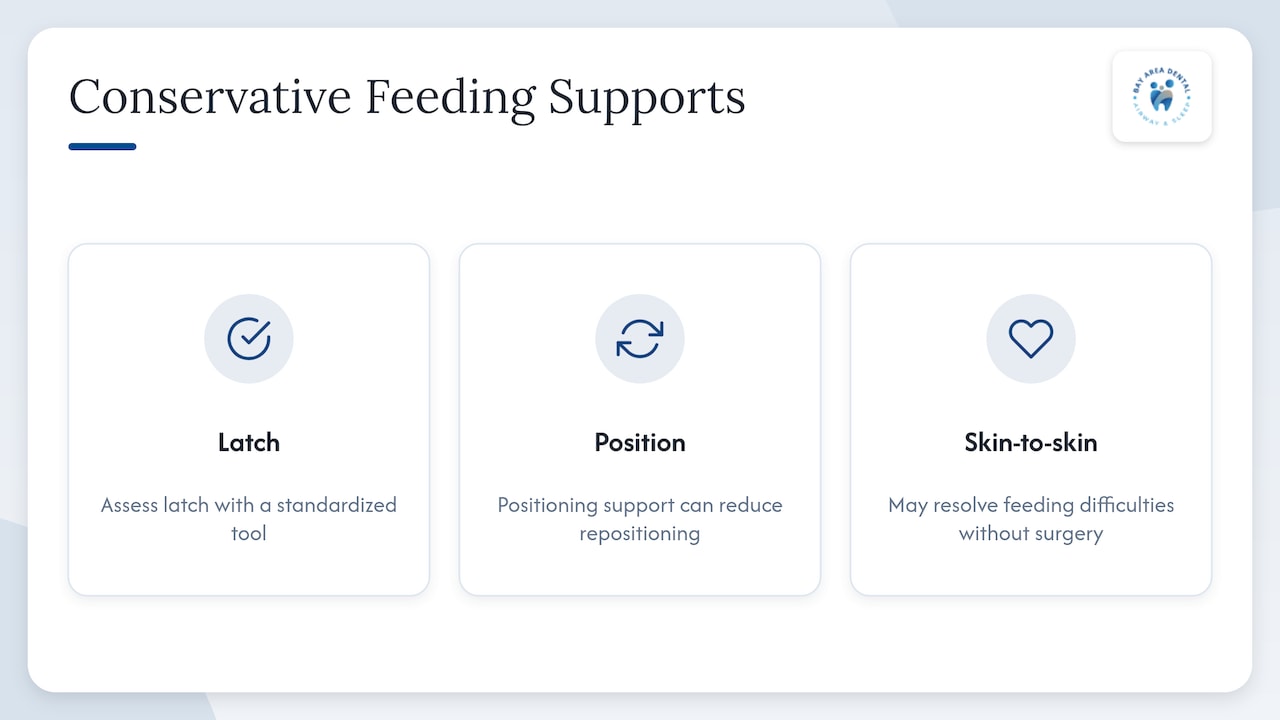
A good session also looks at the mechanics you can change at home. If you want a plain-language primer before your appointment, this guide on how to improve your baby’s latch covers positioning basics and how support while feeding can reduce repositioning.
The care sequence we recommend
Here is the order that most pediatric and lactation bodies point to. Your own pediatrician may adjust it for your baby.
- Feeding assessment with an IBCLC. Bring a baby who is due to feed, and plan for the full feed. Ask for a weighted feed if milk transfer is in question.
- Pediatrician visit. Weight gain, hydration, jaundice, reflux and general health come first. The pediatrician can also examine the mouth.
- Conservative changes. Try the latch, position and pacing adjustments for a few days, with a follow-up.
- Oral function exam. If problems persist, a provider experienced in infant oral function examines tongue lift, extension and movement during sucking, and checks other contributing factors.
- Team decision. Lactation consultant, pediatrician and the releasing provider agree on whether a release is likely to help.
- Release, if indicated, with a follow-up plan. Feeding is rechecked afterward, and the lactation consultant stays involved.
The AAO-HNS Bulletin frames the same idea for ENTs: the answer to whether a baby needs a frenotomy begins with function, not form, and speech-language pathologists can help identify other contributors.
Signs that a tongue tie may be involved
No single sign confirms it. Providers look at a pattern. Things worth telling your lactation consultant and pediatrician:
- Baby slips off the breast or cannot hold a latch, despite adjustments
- Clicking sounds during feeds, or milk leaking from the corners of the mouth
- Long, tiring feeds with poor weight gain
- Ongoing nipple damage after the first two weeks, not only early soreness
- Bottle feeding trouble that mirrors breast feeding trouble (see our notes on bottle feeding and tongue tie)
- A mother who has low supply or recurring blocked ducts with no other explanation
The Cleveland Clinic notes that some babies have difficulty latching or taking in enough milk, and that lactation support can often help you adjust position and latch. Our own overview of infant tongue tie guidance for parents walks through this in more detail.
Lip ties, posterior ties and other terms to question
Two phrases come up often in parent groups and on marketing pages.
Posterior tongue tie. The ENT statement on tongue tie calls this a poorly defined term without expert consensus, and says it should not be the primary justification for surgery in infants. If a provider uses it, ask what specific feeding problem they are treating and what they observed.
Lip tie. The same statement says labial and buccal frenae are normal anatomy and are not considered causes of breastfeeding difficulty, so releasing them is rarely if ever indicated. Our page on baby lip tie takes the same function-first view, and our posterior tongue tie checklist helps you spot claims that go beyond the evidence.
Questions to ask before agreeing to a release
A release (frenotomy, with scissors or a laser) is a short procedure, and for the right baby it can help. But commercialization worries medical societies. The Children’s Wisconsin physicians in our research advise being cautious of practices that market laser frenectomy as a universal answer to feeding, sleep or speech concerns, because those claims lack evidence. Ask the provider:
| Question | What a good answer sounds like |
|---|---|
| Who has assessed feeding? | An IBCLC or feeding specialist has watched a full feed, and you have notes from them. |
| Were other causes considered? | Reflux, oral-motor coordination and latch were reviewed. |
| What function is limited? | The provider names specific movements, not just how the tissue looks. |
| Why this method? | An honest comparison of scissors and laser, including cost and experience. |
| What happens after? | A written aftercare plan and a feeding recheck with your lactation consultant. |
| What if it doesn’t help? | They acknowledge that a release does not always fix feeding and have a next step. |
Laser or scissors?
The research we reviewed reports no clinical evidence that laser is superior to scissor frenotomy. Children’s Wisconsin also notes that scissor frenotomy is often covered by insurance when medically indicated, while laser procedures are frequently an out-of-pocket expense, often around $500, and carry higher risk when performed by an inexperienced provider. We bring this up because you deserve to hear it before you choose. The deciding factor should be the examiner’s experience and the baby’s function, not the device.
A word on stretching
Aftercare advice varies between providers. Some clinicians prescribe wound exercises, while the ENT statement cautions that stretching is not evidence-based and may cause oral aversion or delay healing by reopening the wound. Do not improvise. Follow the written instructions from the provider who treated your baby, and call them with any questions. Our pages on breastfeeding after frenectomy and frenectomy aftercare explain what we tell families to watch for and when to call.
Our perspective: function first, and a team around the baby
We are a dental practice in Fremont that treats tongue and lip ties with a laser, so you might expect us to say every fussy feeder needs a release. We don’t. Our approach is built around the whole-body picture: airway, feeding, sleep and development, treated at the root cause rather than the symptom.
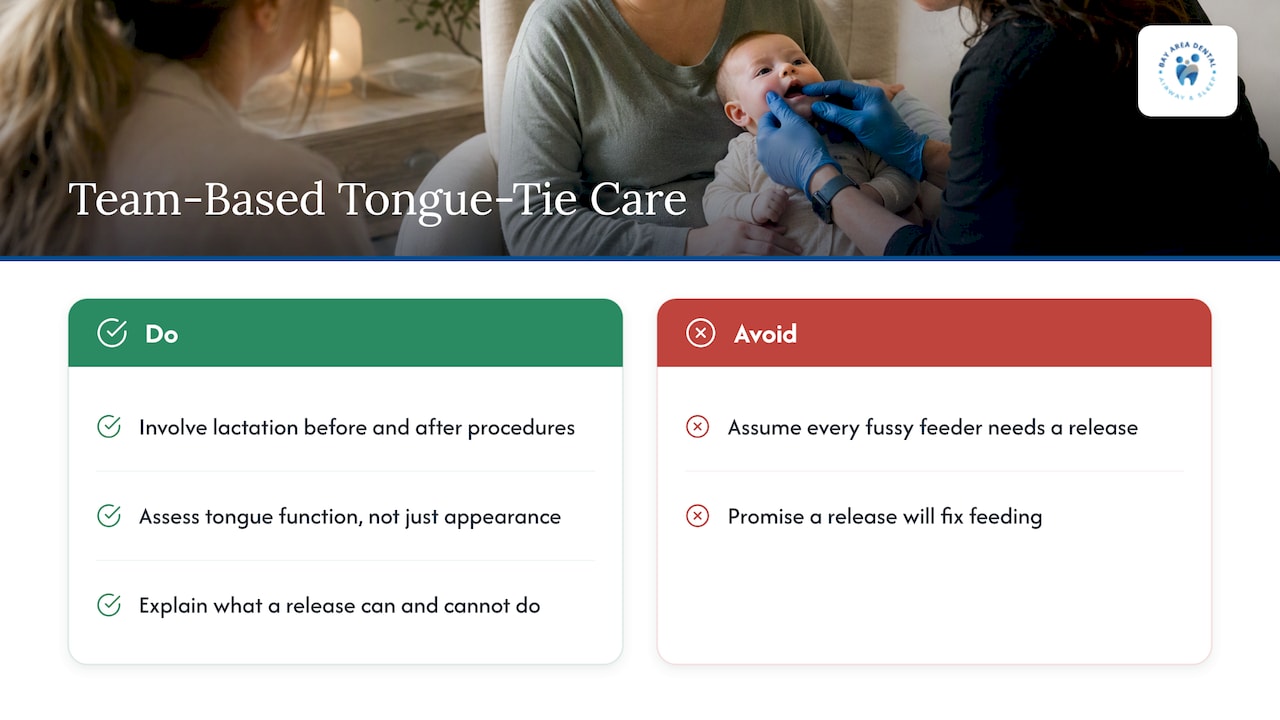
In practice, that means a few things. We welcome referrals from pediatricians, lactation consultants and other healthcare providers, and we want the lactation consultant involved before and after any procedure. We look at how the tongue works, not only how it looks. When the evidence says a release is unlikely to help, we say so and point back to feeding support. When function is clearly limited and conservative help has not been enough, we explain what a release can and cannot do, including that it is not a guaranteed fix.
We also believe parents deserve plain language. A frenectomy is one part of a plan, not the whole plan. If you want to read how we frame the decision, see when tongue tie revision helps.
— Admin
When a Fremont practice can help
If your lactation consultant and pediatrician agree that your baby’s tongue movement is limiting feeding, we can examine your child and talk through whether a release makes sense. We perform laser frenectomy for infants, children and adults and see families from across the Bay Area. We do not publish prices online, so call the office to ask about costs and insurance for your situation. For older children, our pediatric dental care team can also look at the bigger picture of airway and oral development.
Finding a lactation consultant near you
In the Bay Area, many IBCLCs offer home visits or telehealth, which helps when you are a few days postpartum. Your hospital’s lactation department, your pediatrician’s office and your insurer’s directory are all good starting points. Check that the person holds the IBCLC credential, since the title “lactation consultant” is used loosely. The Academy of Breastfeeding Medicine also publishes guidelines for managing neonatal ankyloglossia, which your consultant may reference.
When you book, say that tongue tie is a concern and ask whether they do weighted feeds. If they can work with your pediatrician and a releasing provider, you get the team approach experts recommend.
FAQ
Can an IBCLC diagnose tongue tie?
No. An IBCLC can assess how your baby feeds and notice whether tongue movement looks restricted, but diagnosis is a medical decision. They refer you to a pediatrician, ENT or another qualified provider for that.
Can a tongue tie affect milk supply?
It can contribute. If a baby cannot remove milk well, the breast may be drained less effectively, which can lower supply over time. That is why a lactation consultant checks milk transfer and the mother’s side as well as the baby’s mouth. The ABM protocol covers the connection between ankyloglossia and its complications for the feeding pair.
Is 4 months too late for a tongue tie release?
There is no hard cutoff in the sources we reviewed. The better question is whether feeding problems persist despite skilled support and whether tongue function is limited. Talk with your pediatrician and lactation consultant about your baby’s weight gain and feeding history first.
Can a pediatrician see if a baby has a tongue tie?
Yes. A pediatrician can examine the mouth and review feeding and weight. The AAP report advises working with lactation professionals to assess latch, so the two visits complement each other.
Sources
- Identification and Management of Ankyloglossia and Its Effect on Breastfeeding in Infants (AAP clinical report, 2024)
- AAP clinical report, full text in Pediatrics
- ENT statement on tongue tie and the AAP report
- Children’s Wisconsin: tongue ties, to clip or not to clip
- Academy of Breastfeeding Medicine Protocol #11
- French National Academy of Medicine on lingual frenotomy
- AAO-HNS Bulletin: pediatric otolaryngology pearls
- Cleveland Clinic: tongue tie
- IBCLC scope of practice for tongue-tie assessment