


Tongue-tie causes bottle feeding trouble only when it limits actual tongue function, not just when the frenulum looks tight. Check diaper output and weight gain first, then try a slower-flow nipple and paced feeding for a few days. If gulping, choking, or poor weight persist after those changes, get an evaluation. Frenotomy helps some babies but plenty of tied tongues feed just fine without it.
TL;DR:
- Not all visible tongue ties impair feeding; issues primarily occur if the tie restricts tongue movement needed for effective suction.
- Conservative measures like changing nipple type, position, and pacing often resolve feeding issues caused by tongue-tie within a week.
- Frenotomy shows mixed results, improving maternal confidence and some objective feeding metrics mainly in posterior ties, but rarely fixes all feeding problems.
- Proper evaluation by a multidisciplinary team is essential to distinguish functional impairment from normal tissue appearance, especially for posterior tongue ties.
- Long-term speech or feeding issues are rare with mild ties, but severe restrictions may warrant assessment and treatment to prevent future oral developmental challenges.
Table of Contents
- Symptoms of Tongue-Tie That Affect Bottle Feeding
- How Tongue-Tie Affects Bottle Feeding: The Mechanics
- Who Should Evaluate a Tongue-Tied Baby’s Feeding?
- Non-Surgical Fixes to Try Before Considering Surgery
- Frenotomy: What the Research Actually Shows
- Feeding After Frenotomy: What to Expect
- When to Get Urgent Care or a Re-Evaluation
- Choosing the Right Bottle and Nipple for a Tongue-Tied Baby
- Bottle Feeding Techniques by Tie Severity and Type
- Common Bottle Feeding Challenges and How to Troubleshoot Them
- Long-Term Effects on Feeding, Eating, and Speech
- How Bay Area Dental, Airway & Sleep Approaches Tongue-Tie Evaluation
- Sources
- FAQ
Symptoms of Tongue-Tie That Affect Bottle Feeding
A tongue that can’t lift, cup, or wave properly against a bottle nipple shows up in specific, watchable ways. You don’t need a medical degree to spot the pattern. You need to know what counts as a signal versus normal newborn chaos.
Watch for these during and after bottle feeds:
- Milk leaking out of the corners of the mouth instead of being sealed in
- Loud clicking, gulping, or choking sounds while sucking
- Feeds that are unusually short (under 5 minutes, gulping fast) or unusually long (30+ minutes with little intake)
- Falling asleep at the bottle before finishing a reasonable volume
- Persistent fussiness, arching, or gassiness after most feeds
- Slow weight gain or fewer wet and dirty diapers than expected for age
The last item is the one that matters most clinically. A baby can look uncomfortable at the bottle and still be gaining weight fine, which usually means the issue is manageable with technique changes. A baby who is quietly efficient at the bottle but tracking flat on the growth curve needs an evaluation regardless of how the frenulum looks.
How Tongue-Tie Affects Bottle Feeding: The Mechanics
Bottle feeding asks the tongue to do specific work: lift up, press against the nipple, and move in a wave from front to back to push milk toward the throat. That motion creates the seal and suction that keeps milk moving steadily instead of pooling or spilling. A tongue anchored too tightly to the floor of the mouth can’t complete that full range of motion.
Anterior ties, the kind visible right at the tip of the tongue, are often what parents notice first. Posterior ties sit farther back, hidden under a thicker fold of tissue, and can be easy to miss on a quick look. According to Mayo Clinic Health System, posterior ties are linked to more subtle coordination problems because they restrict the mid-tongue movement needed for a sustained, efficient suck rather than blocking motion outright.
When the seal breaks down, air gets swallowed along with milk. That aerophagia is a common, underappreciated driver of what looks like reflux: the spit-up, the grimacing, the arched back after a bottle. It’s worth ruling out before assuming a baby has true reflux disease, since the fix for a seal problem is completely different from the fix for reflux.
Who Should Evaluate a Tongue-Tied Baby’s Feeding?
Start with your pediatrician. They can check weight trends against your baby’s own growth curve, which tells you more than any single office visit ever could. A lactation consultant, even for bottle-only babies, brings a trained eye for oral mechanics that most pediatric visits don’t have time to cover in depth.
If problems persist after conservative changes, ask for a referral to one of these:
- A pediatric ENT or pediatric dentist trained in frenulum assessment
- A speech-language pathologist or feeding therapist for coordination issues
- A multidisciplinary feeding team if your area has one
A thorough evaluation goes beyond a quick look in the mouth. It typically includes an observed feed from start to finish, sometimes weighing the baby before and after to measure actual intake, and a structured functional assessment using tools like the Hazelbaker Assessment or the Coryllos classification system rather than eyeballing the frenulum alone. The American Academy of Pediatrics has flagged that tongue-tie diagnoses have risen sharply in recent years, and cautions that not every visible frenulum is actually causing the feeding problem in front of you. That’s the exact reasoning a team-based evaluation is built to sort out.
Non-Surgical Fixes to Try Before Considering Surgery
Most bottle feeding problems attributed to tongue-tie respond to changes you can make at home this week, no referral required. The Sheffield Children’s NHS Foundation Trust recommends working through nipple choice and technique before assuming surgery is the answer, and that order of operations holds up well in practice.
- Switch to a slow-flow, longer, softer nipple. A firmer or faster nipple demands more compression than a compromised tongue can deliver, which is exactly when milk starts leaking out the sides.
- Feed with the bottle nearly horizontal, not tipped up. Tilting the bottle too far lets gravity do the work instead of the baby’s tongue, which trains exactly the wrong pattern and can worsen air swallowing.
- Use paced bottle feeding. Let your baby suck a few times, then tip the bottle down to pause the flow, giving them a chance to catch up and swallow properly instead of gulping.
- Feed upright and take burp breaks every ounce or so. This cuts down on the air that gets trapped when the seal isn’t tight.
- Break longer feeds into shorter bursts if your baby tires quickly, rather than pushing through one long, exhausting session.
If you’re also pumping or nursing, keep expressing on a regular schedule to protect your supply while you sort out the bottle side, and loop in a lactation consultant so the two feeding methods don’t work against each other.
Pro Tip: Give any single change 48 to 72 hours before judging it. Tongue and jaw muscles need a few tries to adapt to a new nipple flow, so a bottle that seems worse on day one can look completely different by day three. Track weight over one to two weeks; if the numbers still aren’t moving, that’s your signal to escalate.
Frenotomy: What the Research Actually Shows
Frenotomy is a short office procedure where a clinician snips the lingual frenulum with sterile scissors or a laser. Most pediatric dentists and pediatric ENTs who do this can complete it in under a minute, often with the baby fed and settled again within moments.
The evidence behind it is more mixed than marketing pages tend to suggest.
- A randomized controlled trial of 107 infants found no objective improvement in breastfeeding measures at 5 days or 8 weeks after early frenotomy, though mothers reported higher confidence in their ability to feed.
- A separate prospective randomized study focused on posterior tongue-tie found real, measurable improvement in objective bottle-feeding metrics 10 days after release, suggesting posterior ties may be the subgroup where surgery has the clearest payoff.
- A 2024 scoping review of studies linking tongue-tie to reflux-like symptoms found the underlying evidence is mixed in quality, and that reflux symptoms often improve on their own regardless of any procedure.
Across these trials, one pattern holds: frenotomy tends to help maternal confidence and, in posterior-tie subgroups, objective feeding measures, but it doesn’t reliably fix breastfeeding or bottle-feeding outcomes across every baby with a visible tie.
Risks are generally low but not zero: minor bleeding, rare infection, and in a small number of cases, scar tissue that reforms or an aversion to oral touch afterward. Evidence for routine post-op tongue stretching exercises is thin, and the AAP’s own handout doesn’t endorse it as a blanket recommendation. The most defensible approach is reserving frenotomy for babies with documented functional impairment after conservative measures have genuinely been tried, decided on with input from more than one clinician.
Feeding After Frenotomy: What to Expect
Some babies latch and feed noticeably better within the same feed. Others need several days for the tongue to learn a movement pattern it’s never had access to before, so don’t panic if day one looks unchanged.
- Keep tracking wet and dirty diapers and weight the same way you did before the procedure
- Offer shorter, more frequent feeds if your baby seems tired or unsettled at the bottle
- Book a follow-up with a lactation consultant if progress feels slow after the first week
- Call the clinic right away for heavy or persistent bleeding, refusal to feed at all, fever, or any sign of infection at the site
Most recoveries are uneventful, but this is not the moment to guess. A quick call to whoever performed the procedure costs you nothing and rules out the rare complication early.
When to Get Urgent Care or a Re-Evaluation
Some signs skip the wait-and-see phase entirely. Get medical attention the same day for very few wet diapers, lethargy, sunken eyes, or any other sign of dehydration, and for poor weight gain that a pediatrician hasn’t already cleared. Breathing problems, choking spells, or bleeding after a frenectomy that doesn’t stop within a few minutes also warrant an urgent call.
If you’ve genuinely worked through nipple changes, pacing, and positioning for one to two weeks and feeding is still a struggle, that’s not a reason to wait longer. It’s the cue to get back in front of the team that evaluated your baby.
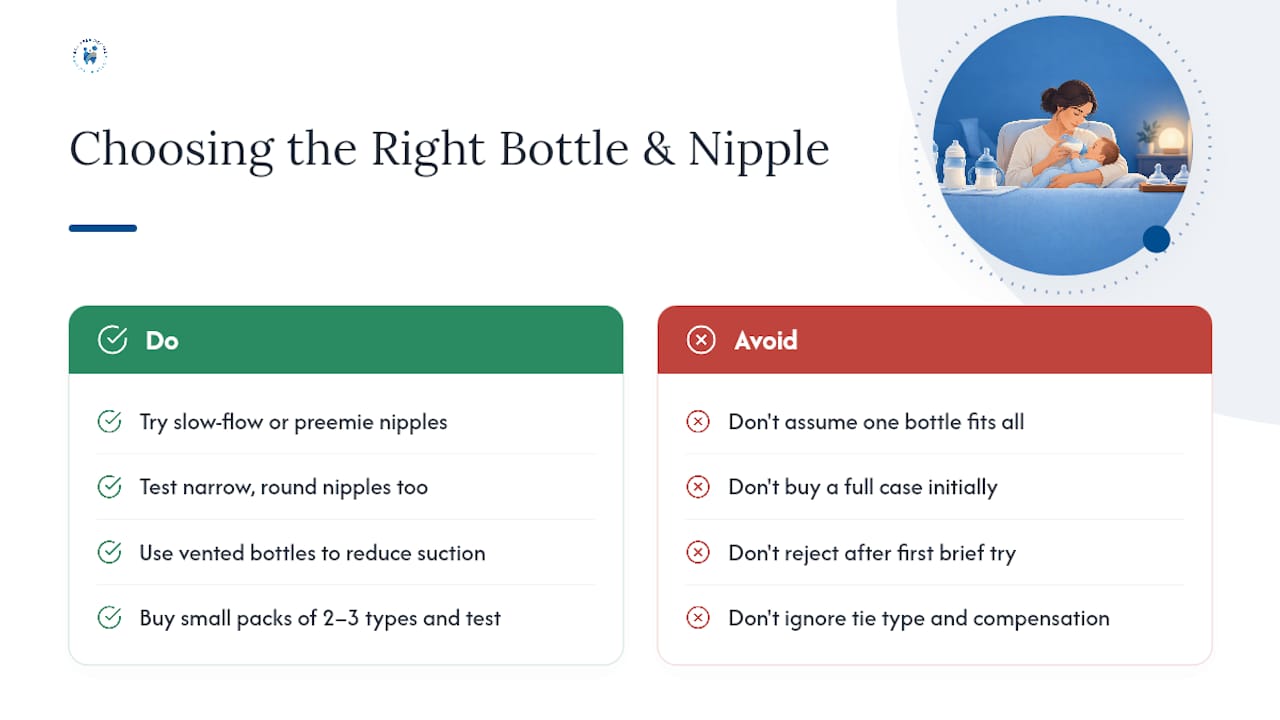
Choosing the Right Bottle and Nipple for a Tongue-Tied Baby
Nipple shape changes how much work a compromised tongue has to do, and that’s often the single biggest lever parents have before any medical decision gets made.
Wide-based, orthodontic-style nipples tend to require a broader tongue motion that some tied babies can’t produce, so a narrower, rounder nipple sometimes performs better despite being less “anatomically correct” on paper. Flow rate matters more than shape in most cases: a slow-flow or preemie-flow nipple gives a weak or restricted tongue more time to keep pace instead of getting flooded. Vented bottles, which reduce the vacuum a baby has to fight to draw milk, can also lower the effort a compromised seal has to overcome.
There’s no single best bottle for every tongue-tied baby, and that’s worth saying plainly because so many product pages claim otherwise. What works depends on whether the tie is anterior or posterior, how tight it is, and how your particular baby compensates. A baby with a mild anterior tie might do fine with almost any slow-flow nipple. A baby with a posterior tie affecting mid-tongue coordination might need the softest, most flexible nipple you can find, paired with a bottle that requires minimal suction effort.
The practical approach is to buy two or three different nipple shapes and flow rates in small packs rather than committing to a full case of one brand. Test each for a full day before ruling it out, since a baby’s response to a new nipple often changes after the first few tries as they adjust their tongue and jaw pattern.
Bottle Feeding Techniques by Tie Severity and Type
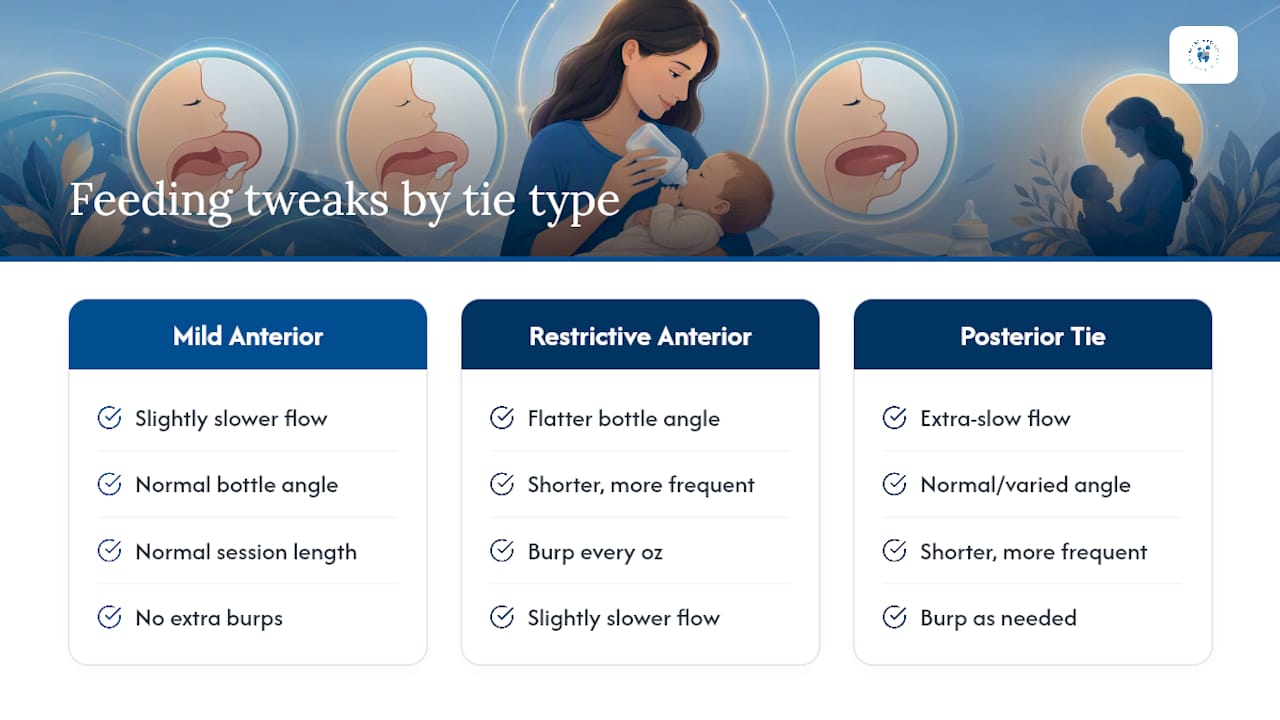
A mild anterior tie with good tongue elevation often needs almost no technique change beyond a slightly slower flow nipple and normal paced feeding. The tongue can still mostly do its job; you’re just smoothing out minor inefficiency.
A more restrictive anterior tie, where the tongue tip can barely lift past the lower gum line, usually benefits from a flatter bottle angle and shorter, more frequent feeding sessions with deliberate burp breaks every ounce. The goal is reducing how hard the tongue has to work per swallow.
Posterior ties are the trickiest because the restriction sits in tissue you can’t easily see, which means technique adjustments have to compensate for a coordination problem rather than a visible range-of-motion limit. Extra-slow flow, a softer nipple material, and more frequent but shorter feeds tend to help most. Some babies with posterior ties do better with a side-lying or semi-reclined position that reduces the strength needed to control flow, though this should be tried under guidance rather than as a blanket recommendation, since position also affects aspiration risk.
Whatever the type, the through-line is patience with the trial. Give any technique change several days, not one bottle, before deciding it isn’t working.
Common Bottle Feeding Challenges and How to Troubleshoot Them
Milk leaking from the mouth almost always points to a seal problem rather than a flow problem, so the fix is usually nipple shape and softness, not necessarily a slower flow. Try a rounder, more flexible nipple before assuming you need to go slower.
Choking or gagging mid-feed often means the flow is outpacing the tongue’s ability to control it, even on a nipple labeled “slow flow.” Pacing the bottle, tipping it down every few sucks to let the baby catch a breath, solves this more often than switching products entirely.
A baby who falls asleep partway through every feed may be working harder than they can sustain, which burns through their limited newborn energy fast. Unswaddling, a gentle foot tickle, or breaking the feed into two shorter sessions with a break in between usually keeps them awake long enough to finish.
Excess gas and spit-up after bottles, absent other red flags, is frequently the aerophagia pattern described earlier rather than reflux disease. Upright positioning during and for 20 to 30 minutes after the feed, along with more frequent burping, addresses the actual cause instead of just managing the symptom.
Long-Term Effects on Feeding, Eating, and Speech
Most infants with mild ties, treated or not, go on to eat and speak normally. The concern isn’t universal; it’s concentrated in babies whose tongue restriction is severe enough to limit range of motion well beyond infancy.
As babies move to solids, a restricted tongue can make it harder to move food around the mouth, clear it from the cheeks, or manage textures that need more tongue lateralization. Some children with unaddressed significant ties show mild articulation differences later, particularly with sounds like “L,” “R,” “T,” and “D” that require precise tongue tip placement, though speech outcomes depend on far more than tongue mobility alone. This is one reason myofunctional therapy exists as a distinct discipline: it retrains oral muscle patterns that a tie, or years of compensating around one, can leave behind even after the tissue itself is released.
The takeaway for bottle-feeding parents isn’t that every tie needs urgent correction to protect future speech. It’s that a documented, functionally significant tie is worth addressing with input from a team who can weigh feeding, growth, and developmental factors together, rather than treating the frenulum in isolation from everything else going on with your baby.
How Bay Area Dental, Airway & Sleep Approaches Tongue-Tie Evaluation
A functional problem deserves more than one set of eyes. Coordinated input from a lactation consultant, pediatric clinician, and a dentist or ENT trained in frenulum assessment is what keeps frenotomy reserved for babies who actually need it, rather than every baby with a visible fold of tissue.
Bay Area Dental, Airway & Sleep evaluates tongue and lip ties as part of a broader airway and feeding picture, offering laser frenectomy alongside myofunctional therapy and pediatric dental care for families who want an integrated look at how feeding, oral development, and sleep connect over time.
— Admin
Sources
For deeper reading beyond this guide, consult the AAP’s clinical report on tongue-tie diagnoses, the NHS Best Start guidance on bottle feeding challenges, Mayo Clinic’s overview of tongue-tie, and the PMC scoping review of ankyloglossia and reflux outcomes.
This article is general information, not a substitute for advice from a qualified doctor. Consult a qualified healthcare professional about your own circumstances before acting on anything here.
- Healthychildren
- Randomised controlled trial of early frenotomy in breastfed infants with mild-moderate tongue-tie (PubMed)
- Prospective RCT measuring objective feeding metrics after posterior tongue‑tie release (PubMed)
- Scoping review on ankyloglossia and GI signs with outcomes after frenotomy (PMC)
FAQ
What Is the Best Bottle for a Baby With Tongue-Tie?
There’s no single best bottle for every tongue-tied baby since it depends on whether the tie is anterior or posterior and how the baby compensates. A slow-flow, soft, rounded nipple paired with a vented bottle is a reasonable starting point, but plan to test two or three options.
Can I Still Breastfeed if My Baby Has Tongue-Tie?
Yes, many babies with tongue-tie breastfeed successfully, sometimes with help from a lactation consultant on positioning and latch. A randomized controlled trial found frenotomy didn’t objectively improve breastfeeding measures at 5 days or 8 weeks, though it did improve maternal confidence, so surgery isn’t automatically required to keep nursing.
How Do I Feed My Baby After Tongue-Tie Surgery?
Most babies can feed right after a frenotomy, though some take a few days to adjust to their new range of tongue motion. Keep tracking weight and diaper output, offer shorter and more frequent feeds if your baby seems tired, and call the clinic for persistent bleeding, feeding refusal, or signs of infection.
Is 4 Months Too Late for Tongue-Tie Release?
No, frenotomy can be performed well beyond the newborn period when a functional problem is documented, and some posterior ties aren’t identified until later anyway. What matters is evidence of an ongoing feeding or growth problem tied to tongue function, not the baby’s age at the time of evaluation.