

In Fremont, published 2026 estimates put a single veneer at roughly $1,464 to $2,440 per tooth, while another local estimate runs $1,332 to $3,600 for porcelain. Your own number depends on how many teeth you treat, which material you choose, and what your mouth needs before any veneer goes on. We don’t publish fixed veneer prices, because a fair quote starts with an exam. Below is how to read the ranges, what changes them, and what to ask for in writing.
TL;DR
- Fremont estimates for one veneer run from about $1,332 to $3,600, depending on the source and material. They are educational averages, not our fees.
- A “full set” has no standard definition. Six, eight or ten teeth can all be called one, so compare quotes by tooth count.
- Porcelain costs more than composite up front. Both have published survival data, and neither is a guarantee for you.
- Cosmetic veneers are usually not covered by dental insurance. Verify your plan before you schedule.
- A very low quote is a warning sign if it skips diagnosis. Decay, gum disease and grinding should be addressed first.
Table of Contents
- What veneers cost per tooth in Fremont
- What a full set of veneers costs
- Porcelain vs. composite: why the prices differ
- What changes your total
- Why the cheapest quote can cost you more
- Questions to ask before you accept a quote
- Does insurance cover veneers?
- Can you get veneers on just one tooth?
- Who should wait or consider another option
- What the process and recovery feel like
- Our perspective: price the whole mouth, not just the smile
- See a Fremont dentist for a written veneer plan
- FAQ
- Sources
What veneers cost per tooth in Fremont
Two local estimates frame the range. Pearl’s 2026 Fremont page, based on ADA fee survey data, lands at about $1,464 to $2,440 per veneer. A separate Fremont estimate for porcelain runs $1,332 to $3,600. The two differ because they use different methods and assume different materials, complexity, lab fees and provider fees.
Widen the view and the spread grows. A statewide 2026 guide puts porcelain in California at $1,100 to $3,000 per tooth. Search results for the wider Bay Area show everything from deeply discounted promotions to $2,500 to $3,000 per tooth. Treat those as marketing ranges. They tell you the market is wide. They don’t tell you what your plan will cost.
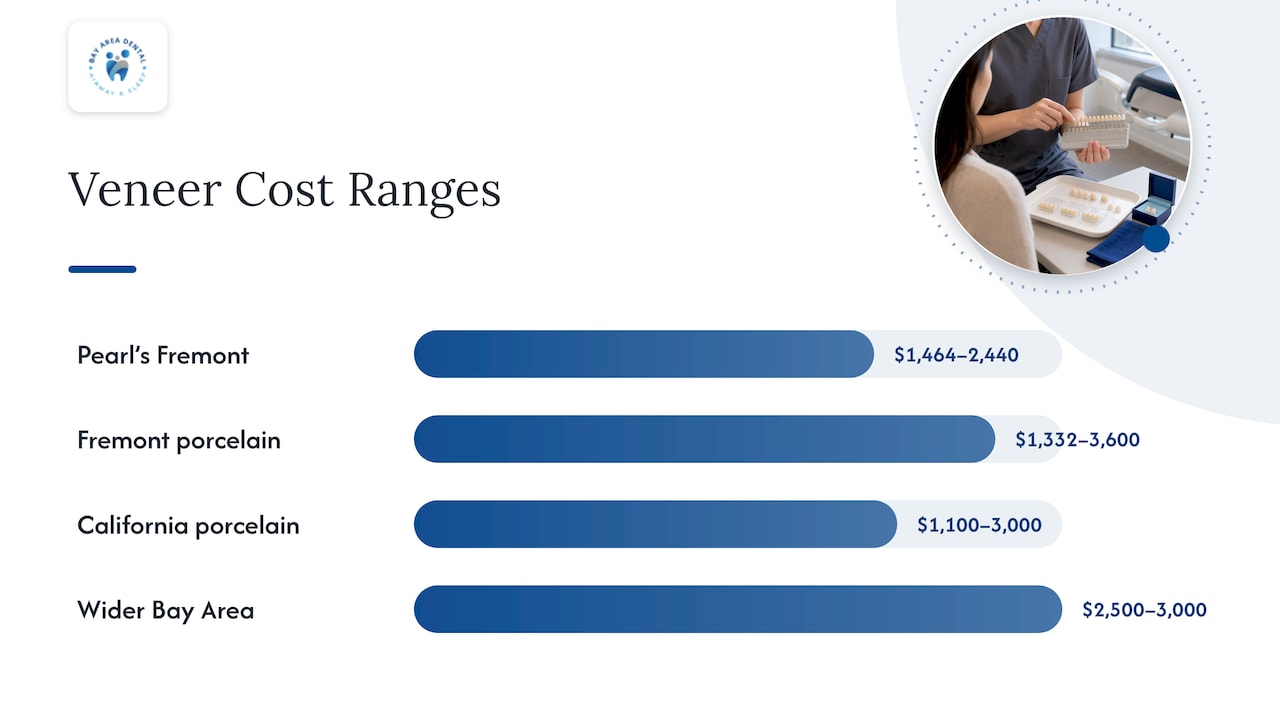
None of these figures are Bay Area Dental, Airway & Sleep prices. They can’t replace a dentist’s written treatment plan.
What a full set of veneers costs
People search for a “full set” as if it were a product, but it isn’t. It might mean:
| What “full set” means | Teeth | Rough total at published ranges |
|---|---|---|
| Social six (canine to canine) | 6 | $6,600 to $18,000 |
| Wider smile (premolar to premolar) | 8 | Scales with the per-tooth fee |
| Full upper arch | 10 | $11,000 to $30,000 |
The six-tooth and ten-tooth figures come from the California guide’s statewide range. The eight-tooth row follows the same per-tooth math, so multiply your quoted fee by eight. Our own page on Bay Area veneer costs covers how a full set often spans 8 to 10 teeth.
Per-tooth pricing multiplies fast. Treating fewer teeth can be the more conservative choice, and it may mean less enamel removed. Ask your dentist which teeth truly need veneers and which could be handled with whitening, bonding or alignment.
Porcelain vs. composite: why the prices differ
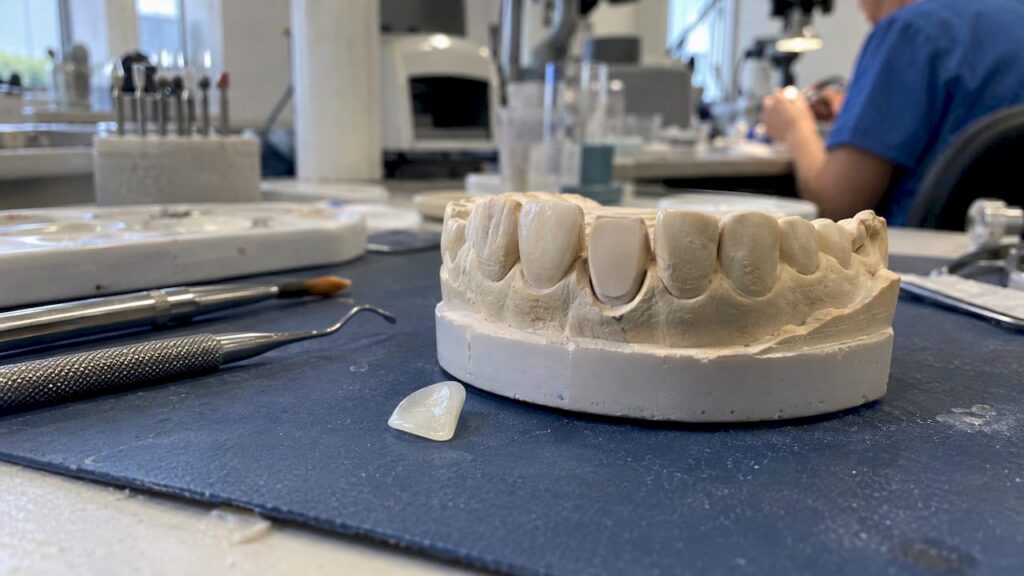
Porcelain veneers are custom fabricated, usually in a lab, and usually take more than one visit. The ADA describes the steps as preparation, an impression or 3D scan, lab fabrication, try-in, bonding and adjustment. Composite is sculpted directly on the tooth, light-cured and polished in the chair, and can often be finished in one appointment. Composite is easier to repair, but it resists stains and wear less well.
Long-term value is where the cheaper option can change. Two published reviews give study-level figures:
- A systematic review of 6,500 porcelain laminate veneers estimated 95.5% cumulative survival at 10 years.
- A meta-analysis of resin composite veneers found a pooled survival rate of 88%, with follow-up from 24 to 97 months.
These are averages across studies, not promises for one patient. A 2024 narrative review adds that preserved enamel is a major factor in success, and that fracture is the leading failure mechanism. If you want to know how long each option tends to last in practice, see our pages on porcelain veneer lifespan and bonding longevity.
What changes your total
The per-tooth fee is only one line of the plan. These factors move the final number.
- Number of teeth. The biggest driver by far.
- Material. Porcelain or composite, and the lab used for porcelain.
- How much correction is needed. Closing gaps, reshaping, or changing tooth color takes more design work than a light refresh.
- Preparation level. Some cases qualify for little or no enamel removal. Our guides on minimally invasive veneers and no-prep veneers explain who tends to qualify.
- Work that comes first. Fillings, gum treatment, or whitening for neighboring teeth are often separate line items.
- Bite protection. If you clench or grind, you may need a night guard, which is another cost.
Why the cheapest quote can cost you more
Very low quotes often skip the part that keeps veneers safe: diagnosis. The ADA notes that veneers must go on healthy teeth, and that decay and active gum disease should be treated first. Enamel removal is not reversible.
In May 2024 the ADA also warned about unlicensed “veneer technicians”. It said unsupervised treatment can put veneers over cavities or unhealthy teeth, and may cause infection, nerve damage or irreversible harm. A mail-order or pop-up offer at a fraction of the local price may save money on day one and create a larger bill later.
Questions to ask before you accept a quote
Ask the office to itemize in writing. A useful quote states:
- How many teeth, and the fee per tooth.
- Material and lab, if porcelain.
- Whether the consultation, digital scan or mock-up, and shade selection are included.
- Whether temporary veneers, bonding and bite adjustment are included.
- Which follow-up visits are covered.
- What is not included: whitening, fillings, gum treatment or a night guard.
Then compare quotes by total and by tooth count, not by the per-tooth headline.
Does insurance cover veneers?
Usually not, when they are purely cosmetic. Coverage can differ if treatment is medically necessary, and contract rules for noncovered services vary by state and plan. The ADA’s guidance on noncovered services notes that a denial doesn’t automatically let an office charge any amount. Before you schedule, check your deductible, annual maximum, waiting periods and network status with your plan. Ask about any portion that could count as restorative, such as a damaged tooth that needs a crown or filling regardless.
Can you get veneers on just one tooth?
Yes. A veneer covers the front surface of an individual tooth, and composite can be done in one visit. The hard part is matching shade, translucency and contour. A dentist may suggest whitening first, or treating neighbors, so the repaired tooth doesn’t look isolated.
Who should wait or consider another option
There is no single universal disqualification list. The ADA lists reasons to treat first or reconsider: untreated decay, active gum disease, uncontrolled clenching or grinding, and in some cases a deep overbite. Depending on the cause, your dentist may recommend fillings, gum treatment, orthodontics, bonding, crowns or a night guard instead.
Grinding deserves special attention, since it is the leading way to break a veneer. If you suspect you grind, read this practical guide to stopping teeth grinding and raise it at your consult. Snoring and poor sleep can also wear teeth, which is why we look at the airway too. Our page on snoring and tooth damage explains the link.
What the process and recovery feel like
Expect an exam and treatment planning first. Then comes tooth preparation and an impression or 3D scan, lab fabrication with possible temporaries, and finally try-in, bonding and a bite check. Porcelain needs at least a preparation visit and a later placement visit, and the timing depends on the lab. Bring your dental and medical history, your medication list, insurance information, and photos of looks you like that are realistic for your teeth.
Placement is usually done with local anesthetic when needed, and only a small amount of enamel is removed. Sensitivity can follow. The ADA says it may take a few days to get used to a veneer. Persistent sensitivity or a bite that feels wrong should be reported so it can be checked, since it can also signal decay, a fracture or gum problems.
Our perspective: price the whole mouth, not just the smile
We see veneers as a decision about function first and looks second. A smile that looks perfect but sits on a bite that grinds, or on gums that are inflamed, won’t hold up. That is why our cosmetic work starts with the same questions as the rest of our care: how you chew, how you breathe and sleep, whether you clench, how your gums look, and what restorations you already have.
That approach often makes a plan smaller and more honest. Sometimes the answer is composite bonding on two teeth. Sometimes it is whitening plus laser gum contouring. Sometimes it is aligners first. And sometimes veneers are exactly right. We would rather give you a plan you can afford and that lasts than sell a package.
Comfort is part of the plan, too. Tell us about dental anxiety, past sensitivity, jaw symptoms, and how you prefer to communicate. We design scanning, mock-ups, anesthesia and bite checks around you, and we welcome Deaf patients with communication tailored to their needs.
— Admin
See a Fremont dentist for a written veneer plan
Our Fremont practice offers dental veneers, smile makeovers and composite bonding, with 3D imaging to plan the work. We don’t list veneer fees online because the right plan depends on your exam. Book a consultation and ask for an itemized estimate you can compare with any other quote.
FAQ
What is the cost of a full set of veneers in Fremont?
There is no fixed price, because “full set” can mean 6, 8 or 10 teeth. At a California guide’s statewide ranges, six porcelain veneers would be $6,600 to $18,000 and ten would be $11,000 to $30,000. Your total depends on the exam, the material and any work needed first.
What disqualifies you from getting veneers?
Untreated decay, active gum disease, uncontrolled clenching or grinding, and sometimes a deep overbite are reasons to treat first or choose another option. Veneers are not reversible once enamel is removed, so your dentist should check your teeth, gums and bite before quoting.
How painful is getting porcelain veneers?
Placement is usually done with local anesthetic when needed, and only a little enamel is removed. Some sensitivity afterward is possible. If it persists, or your bite feels off after a few days, call your dentist so it can be evaluated and adjusted.
Can you veneer just one tooth?
Yes, and composite can often be done in a single visit. The challenge is matching the neighboring teeth. Your dentist may recommend whitening or treating nearby teeth so the result looks natural.
Sources
- Dental Veneers Cost in Fremont, CA | 2026 Average Prices (Pearl)
- Porcelain Veneers Cost in Fremont (True Dental Costs)
- Veneers in California | 2026 Costs by City
- Veneers (MouthHealthy, ADA)
- Sensitive Teeth (MouthHealthy, ADA)
- Improving your smile with dental veneers (JADA)
- Long-Term Survival and Complication Rates of Porcelain Laminate Veneers (PMC)
- Survival and Complication Rates of Resin Composite Laminate Veneers (PubMed)
- Clinical Survival Rate and Laboratory Failure of Dental Veneers (PMC)
- Statement on Recent Reports of Veneer Technicians (ADA)
- Dear ADA: Noncovered Services (ADA News)