

Minimally invasive veneers are thin porcelain or composite coverings placed on the front of your teeth with little or no removal of enamel. They are a real option for some smiles. They are not right for everyone, and the deciding factors are your bite, your enamel and your gums, not the marketing name on the brochure. This guide explains the types, the evidence, the cost, and the questions to ask before you commit.
TL;DR
- “Minimally invasive” covers no-prep veneers (little to no enamel removed), minimal-prep veneers (a thin layer removed) and additive composite work.
- A 2023 systematic review and a 2026 review of randomized trials compare them with conventional veneers. Both are worth reading with your dentist, because results depend on patient selection.
- Clenching, grinding and deep overbites can make thin veneers a poor choice. Your bite needs to be assessed first.
- In the US, veneers are usually elective and rarely covered by insurance. Ask for a written, per-tooth estimate.
- Insist on a licensed dentist, a full exam and a mock-up before any veneer is made.
Table of Contents
- What “minimally invasive” means for veneers
- How the types compare
- What the research says about durability
- Who is a good candidate
- Why we look at airway and bite before veneers
- What it costs in the US
- What to expect, step by step
- How long they last and how to protect them
- How to avoid a bad provider
- Alternatives to veneers
- Planning veneers in Fremont
- FAQ
- Sources
What “minimally invasive” means for veneers
In dentistry, minimally invasive means preserving as much healthy tooth structure as possible. The goal is simple: enamel does not grow back, so every bit you keep is a bit you never have to replace.
Traditional porcelain veneers usually involve shaving a layer of enamel from the front of the tooth so the shell sits flush. Minimally invasive approaches reduce or skip that step. You will hear several terms used loosely:
- No-prep veneers: ultra-thin shells bonded to the tooth surface with little or no enamel removal. The Cleveland Clinic describes no-prep and minimal-prep veneers as a less invasive option that still needs custom fabrication.
- Minimal-prep veneers: the dentist removes a small amount of enamel, often a fraction of a millimeter, to improve fit and contour.
- Composite bonding or composite veneers: tooth-colored resin built up directly on the tooth, usually with very little enamel removal.
There is no single regulated definition. One office’s “no-prep” may be another’s “minimal-prep.” Ask exactly how much enamel, if any, will be removed on your teeth, and why.
How the types compare
| Conventional porcelain | Minimal-prep porcelain | No-prep porcelain | Composite | |
|---|---|---|---|---|
| Enamel removed | Moderate | Small | Little to none | Little to none |
| Visits | Usually 2 or more | Usually 2 or more | Usually 2 or more | Often 1 |
| Best for | Color change, shape and alignment changes | Gaps, minor shape changes | Small teeth, gaps, mild wear | Chips, small gaps, trial run |
| Main risk | Irreversible enamel loss | Same as no-prep, less so | Bulky look if teeth need more reshaping | Staining, shorter lifespan |
The visit count and use cases vary by dentist and case. Treat the table as a framework for your consultation, not a promise.
What the research says about durability
Patients often assume less drilling means weaker results. The published evidence is more encouraging, with caveats.
A systematic review comparing conventional and minimal or no-prep veneers synthesized studies in prosthodontics to compare how the two approaches perform. A 2026 systematic review of randomized clinical trials compared survival rates and complications of no-prep and conventional veneers for esthetic correction. A prospective study of 186 veneers followed conventional and no-prep or minimally invasive veneers for a mean of nine years. A retrospective evaluation of a no-prep porcelain protocol examined a conservative option for front teeth while noting that controversy exists around its predictability.
The takeaway: in carefully chosen cases, minimally invasive veneers can hold up as well as conventional ones. The words “carefully chosen” carry the weight. The studies describe selected patients treated by trained clinicians, not every mouth in every office.
Who is a good candidate
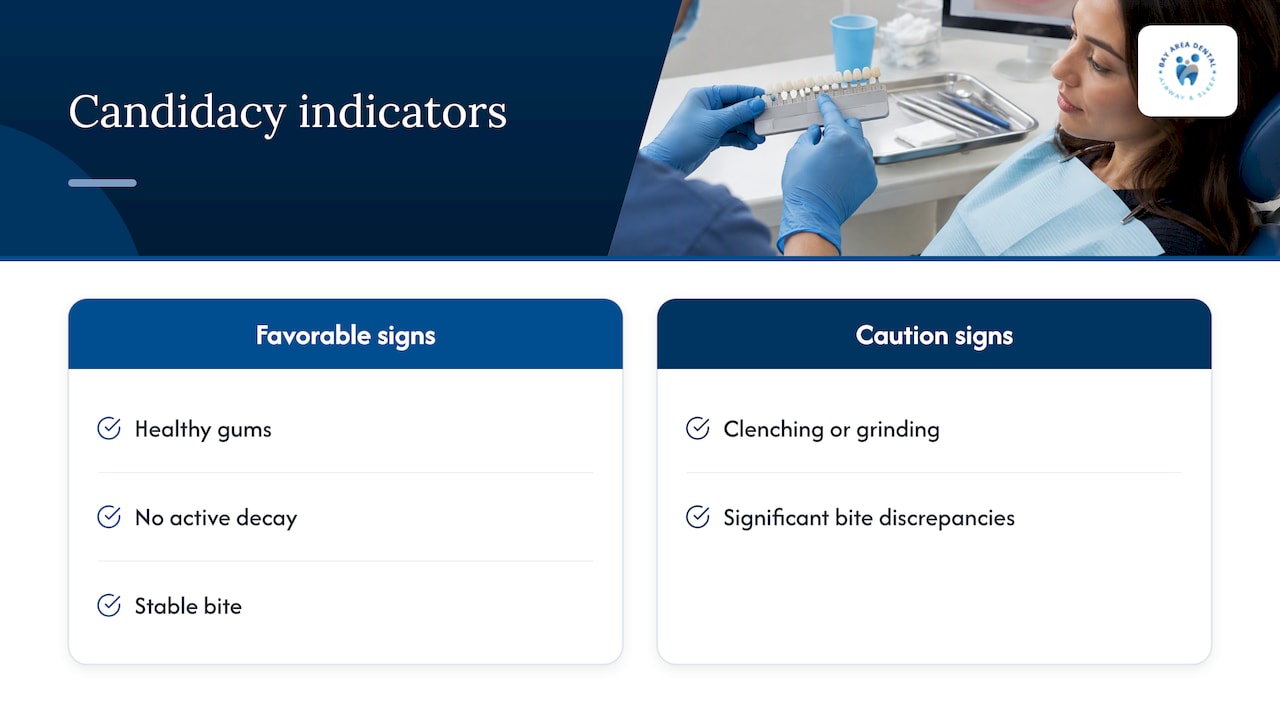
The best candidates usually have healthy gums, no active decay and a stable bite. Typical goals include closing small gaps, evening out slightly short or small teeth, and refreshing the look of worn edges.
The American Dental Association’s MouthHealthy page cautions that people who clench or grind their teeth, or who have significant bite discrepancies, can be poor candidates, because the force can cause early debonding or fracture of thin shells. That is why a clinical assessment comes first.
No-prep veneers also add thickness to the tooth, because nothing was removed to make room. If your teeth are already prominent, crooked or rotated, they can look bulky. In those cases a dentist might suggest clear aligners first, or a small amount of preparation, or composite bonding instead of porcelain.
When veneers are the wrong first step
- Active decay or gum disease: these must be treated first. Veneers should never cover an undiagnosed problem.
- Untreated grinding: a night guard or a deeper look at why you grind often has to come before cosmetic work.
- Crowding or a deep overbite: orthodontic correction may give a better, longer-lasting result.
- Very dark stains: thin, translucent shells may not mask them fully.
Why we look at airway and bite before veneers
This is where our practice approaches the topic differently from a purely cosmetic office.
We are a Fremont practice built around whole-body health, with airway therapy, myofunctional therapy and restorative and cosmetic dentistry under one roof. Worn, chipped or flattened front teeth are often a symptom, not the problem. Grinding can be linked to how a person breathes and sleeps. We cannot promise a particular cause in your case, but we think it is worth asking before you invest in porcelain.
Our view, in plain terms:
- Treat the cause, then the cosmetics. If the forces that wore your teeth are still there, new veneers face the same forces.
- Keep enamel whenever the case allows it. We favor conservative options and explain on our pages on minimally invasive dentistry and biomimetic dentistry why preserving tooth structure matters.
- See it before you commit. A mock-up lets you judge shape, size and thickness on your own teeth. We explain how that decision works in our guide to no-prep veneers and mock-ups.
- Use data, not guesswork. Digital imaging and bite analysis help us check how your teeth meet before we plan anything.
Sometimes the honest answer is that you do not need veneers at all, or that composite bonding, whitening or aligners will do the job with less cost and less commitment.
— Admin
What it costs in the US
Prices vary widely by region, material and provider. Verywell Health reports that, as of early 2026, porcelain veneers typically run $500 to $2,500 per tooth and no-prep veneers $800 to $2,500 per tooth. Composite veneers are estimated at $400 to $2,000 per tooth. The same source notes that insurance rarely covers veneers because they are classed as elective cosmetic care.
Bay Area fees often sit toward the upper part of national ranges, but we do not publish a price list for veneers, and we will not quote you a figure without examining your teeth. What to ask any office for:
- A written estimate per tooth, with the material named.
- Whether the quote includes the mock-up, temporaries (if any), follow-up visits and a night guard.
- What happens if a veneer chips or debonds, and for how long.
- Whether preparatory work, such as treating gum disease or fixing your bite, is billed separately.
Flexible payment options such as health savings accounts may apply for some patients. Ask the office and your plan administrator.
What to expect, step by step
- Consultation and exam. The dentist reviews your history, checks teeth and gums, takes photos and imaging, and examines your bite.
- Diagnosis before design. Decay, gum problems and grinding habits are addressed or planned for.
- Mock-up. You preview the shape on your own teeth. This is the stage to say “too big” or “too bright.”
- Minimal or no preparation. Little or no enamel is removed. Local anesthesia is used if any is needed.
- Bonding. The dentist bonds the shells in place and checks your bite carefully.
- Follow-up. Expect a visit to check comfort, the bite and the edges.
Does it hurt?
No-prep veneers often involve little or no drilling, so many patients need little anesthesia. When preparation is done, the Cleveland Clinic explains that comfort comes from proper anesthesia. Expect some tooth sensitivity afterward, and call your dentist if it persists or worsens. A surprising adjustment for many people is the bulky feel of the new teeth. It usually fades as your tongue and lips adapt, though tell your dentist if it does not.
How long they last and how to protect them
Longevity depends less on the label than on your bite, hygiene, habits and the skill of the clinician. The practical steps are the same for any veneer:
- Wear a night guard if you grind.
- Do not bite nails, ice or hard packaging.
- Keep up with brushing, flossing and professional cleanings.
- Treat the reason your teeth wore down in the first place.
For more detail on porcelain, see our article on how dentists make porcelain veneers last. If composite appeals to you, our piece on bonding longevity covers what to expect.
How to avoid a bad provider
Cheap veneers are heavily advertised, and not every seller is a dentist. The AP reported on unlicensed providers selling veneers, and health professionals warn that this can be misleading and harmful. Before you book:
- Confirm the provider is a licensed dentist through your state dental board’s online license lookup. In California, that means the Dental Board of California.
- Make sure you get a full exam, with X-rays when appropriate, before any treatment is planned.
- Be wary of anyone who skips the exam and goes straight to “same-day smile.”
- Ask to see before-and-after cases on teeth like yours.
Covering a tooth that has hidden decay or gum disease can lead to problems that are harder to fix later. A responsible dentist will refuse to proceed until those are treated.
Alternatives to veneers
If your exam shows veneers are not ideal, you have other choices:
- Composite bonding: conservative and often reversible in practice. Good for chips and small gaps.
- Whitening: if color is your only concern.
- Clear aligners: if crowding or spacing is the real issue. Our airway-friendly aligners are described on our orthodontics page.
- Gum contouring: if your teeth look short because of gum tissue. See our guide to laser gum contouring.
- Crowns: when a tooth needs full coverage because of structural damage.
Planning veneers in Fremont
If you are considering veneers, we offer dental veneers, smile makeovers and composite bonding at our Fremont practice, with a whole-health approach that looks at your bite and breathing before anything cosmetic. You can see the range on our restorative and cosmetic dentistry page or start from our home page. Bring your questions, and your photos of smiles you like.
FAQ
Are prepless veneers worth it?
They can be, for the right patient. Keeping your enamel is a real long-term benefit, and the research on carefully selected cases is encouraging. They are less suitable if your teeth are crowded, prominent or you grind heavily. A mock-up is the best way to find out.
What does minimally invasive mean in dentistry?
It means the dentist removes as little healthy tooth structure as possible while still solving the problem. The ADA’s MouthHealthy overview of veneers explains how veneers cover only the front surface of the tooth, unlike crowns. In veneer work, minimally invasive means thin shells or composite with little to no enamel reduction.
What are some alternatives to veneers?
Composite bonding, whitening, clear aligners, gum contouring and crowns are the common ones. The right choice depends on whether your concern is color, shape, spacing, gum line or structural damage. Your dentist should walk you through each with costs.
How painful is veneer placement?
Most patients report little pain, and no-prep cases often need little or no anesthesia. When enamel is removed, local anesthesia keeps you comfortable. Mild sensitivity afterward is common, but persistent or severe pain should prompt a call to your dentist.
Sources
- Conventional Versus Minimally Invasive Veneers: A Systematic Review (PMC)
- Clinical Outcomes of No-prep Veneers and Conventional Veneers: A Systematic Review
- Prospective comparative analysis of conventional vs no-prep veneers over 9 years (PMC)
- Retrospective clinical evaluation of a no-prep porcelain veneer protocol (PubMed)
- Veneers, MouthHealthy (ADA)
- Veneers, MouthHealthy (ADA), overview page
- Dental Veneers: Cost, Procedure, Risks (Verywell Health)
- Veneers: Cost, Procedure and Advantages (Cleveland Clinic)
- Watch out for fake dentists selling cheap veneers (AP News)