

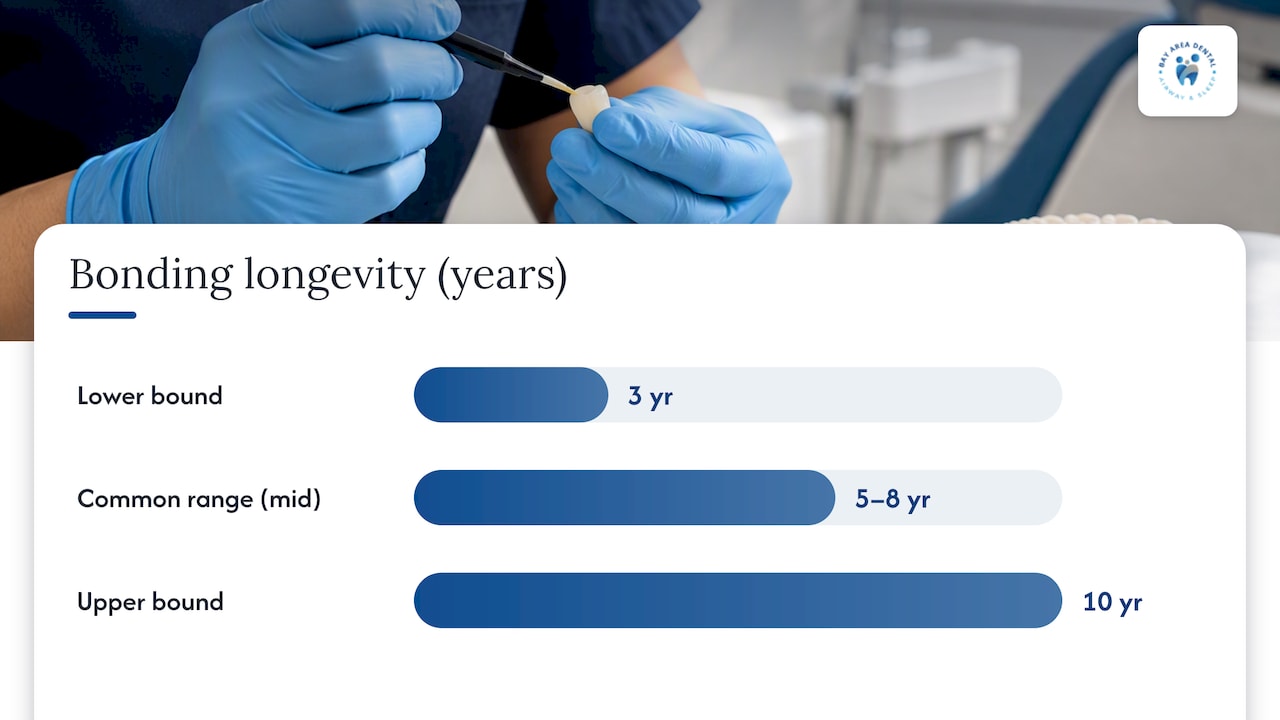
Cosmetic bonding typically lasts between three and ten years, and many well-placed restorations hold up well past the five-year mark. Repairs along the way are common rather than a sign of failure. A 7-year clinical trial and several systematic reviews back up that range, but your own outcome depends heavily on your bite, habits, and how well the bonding is maintained. The next sections explain why the numbers vary so much from patient to patient.
TL;DR:
- Bonding longevity varies widely, typically lasting between three and ten years, with many cases reaching five to eight years depending on habits and maintenance.
- Larger restorations, areas with high bite forces, and poor oral habits like clenching can significantly reduce bonding lifespan due to mechanical stress and material wear.
- Inspection every six to twelve months helps catch minor damage or staining early, and repairs are often simple and preserve natural tooth structure.
- Repair is generally preferable to replacement for small chips or marginal stains, as it maintains more tooth material and often yields comparable long-term results.
- Consistent care habits, such as avoiding hard objects and routine professional polishing, can extend bonding life, but individual factors always influence the overall outcome.
Table of Contents
- What cosmetic bonding is and how it compares to veneers or crowns
- Typical lifespan: what the clinical evidence actually shows
- Factors that shorten or lengthen bonding longevity
- How to extend the life of your bonding
- Repair versus replace: the conservative approach
- When to see your dentist about bonded teeth
- Our approach to bonding longevity at Bay Area Dental, Airway & Sleep
- Get a longevity estimate specific to your smile
- FAQ
- Sources
What cosmetic bonding is and how it compares to veneers or crowns
Cosmetic bonding uses a tooth-colored composite resin that a dentist shapes directly onto your tooth to fix chips, close small gaps, or reshape an uneven edge. It is applied in a single visit and bonds chemically to the enamel surface.
Porcelain veneers and crowns involve removing some tooth structure and sending an impression to a lab, which makes them more invasive up front but generally more resistant to staining and wear over time. Bonding skips that step entirely, so it is often reversible and leaves more of your natural tooth untouched. That matters later: because bonding does not commit you to a permanent restoration, it is easier to repair, adjust, or eventually upgrade to porcelain if your needs change.
Typical lifespan: what the clinical evidence actually shows
The ranges you see quoted across dental resources are fairly consistent. Cleveland Clinic puts typical bonding life at three to ten years depending on the number of teeth treated, their location, and your oral habits. A 7-year prospective split-mouth trial following 107 direct composite restorations found about 85% of individual restorations survived the full seven years, though only around 53% of patients had every single restoration survive intact. Marginal breakdown, where the edge of the bonding separates slightly from the tooth, was the most frequent complication.
A broader picture emerges once you look at pooled research:
- A systematic review of anterior composite restorations found wide variation in survival rates between studies, with fracture and marginal breakdown as the leading causes of failure.
- A scoping review on composite restorations for worn teeth reported short-term survival of about 95.6% at two years and medium-term survival of about 88.6% at five years.
- Both reviews note high heterogeneity, meaning study design, tooth location, and patient selection all shift the numbers.
One finding worth remembering: a 7-year trial found 85% of restorations survived, but only about half of patients kept every restoration intact. That gap between restoration-level and patient-level survival is the clearest evidence that longevity is case-specific, not a fixed number you can bank on.
Read together, the data supports treating three to ten years as a realistic window, with many cases landing comfortably in the five-to-eight-year range when the bite and maintenance cooperate.
Factors that shorten or lengthen bonding longevity
Some risks are mechanical. Bruxism and clenching put repeated, concentrated force on bonded edges, and a single hard bite on ice or a pen cap can chip a restoration that would otherwise have lasted years. Incisal edges, the thin biting surfaces of front teeth, tend to fail faster than bonding placed on a flatter, less-loaded surface.
Others come down to the restoration itself. Larger bonded areas and multiple treated teeth carry more failure risk than a small, single-tooth repair, and the materials and technique used, including isolation during placement and the adhesive protocol, affect how well the bonding holds at the margin.
Lifestyle plays a role too:
- Staining foods and drinks like coffee, tea, and red wine dull composite faster than natural enamel.
- An acidic diet or frequent soda consumption can soften the resin surface over time.
- Smoking contributes to surface staining and can mask early warning signs of wear.
Procedural quality matters as much as anything you do at home. Careful finishing and polishing at placement, proper moisture control, and an experienced hand all show up in how the margins hold years later.
Pro Tip: If you grind your teeth at night, ask about a nightguard before bonding treatment, not after the first chip.
How to extend the life of your bonding
A few consistent habits make a measurable difference in how long bonded teeth last.
- Brush with a nonabrasive, fluoride toothpaste and avoid scrubbing hard, since abrasive pastes dull the composite surface faster than plain wear.
- Floss daily to keep the margins around each restoration free of plaque buildup.
- Rinse with water after coffee, tea, red wine, or other staining foods and drinks to limit surface discoloration.
- Keep routine professional visits for polishing, which restores shine and smooths small surface imperfections before they trap stain.
- Ask your dentist to check your bite and fit a nightguard if clenching or grinding shows up as a pattern of wear.
- Avoid biting into ice, fingernails, pens, or other hard objects that concentrate force on a bonded edge.
- Coordinate any tooth whitening with your dentist first, since whitening natural enamel without updating the bonding can leave a visible shade mismatch.
Pro Tip: Small issues caught at a routine polish are almost always cheaper and faster to fix than damage that has spread to the margin.
Repair versus replace: the conservative approach
Not every chip or stain means starting over. Small chips, localized marginal staining, and limited marginal breakdown are usually repairable in a single short visit, often by roughening the affected area, adding fresh composite, and reshaping and polishing it to match.
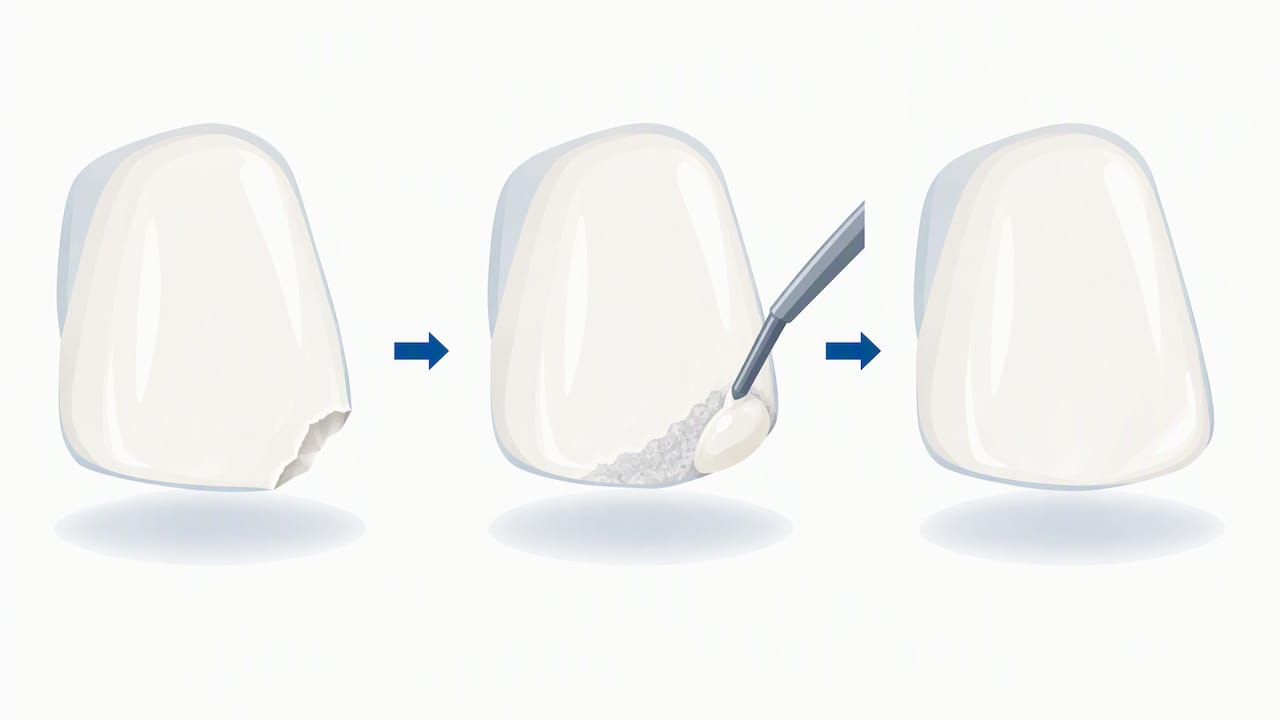
A systematic review and meta-analysis on repair versus replacement found that repairing partially fractured composite restorations can produce comparable outcomes to full replacement while preserving considerably more of the natural tooth. That evidence supports a repair-first approach whenever the damage is localized rather than structural.
Dentists generally apply a few practical decision rules:
- If the damage is confined to a small area and the rest of the bonding is intact, repair is favored over replacement.
- If staining or breakdown has spread across most of the restoration, full replacement is usually more predictable.
- If the underlying bite or wear pattern caused the failure, that cause gets addressed before any repair or replacement, since otherwise the same damage tends to recur.
When to see your dentist about bonded teeth
A few warning signs are worth a prompt call rather than waiting for your next scheduled visit: new sensitivity to hot or cold, a visible chip or rough edge you can feel with your tongue, a color mismatch that appeared after whitening, sudden staining right at the margin, or a change in how your bite feels.
Routine checkups every six to twelve months are enough for most bonded teeth, but anyone with bruxism or larger restorations benefits from shorter intervals. At a review visit, a dentist typically polishes the surface, repairs a small localized chip or stained margin, checks and adjusts your bite if needed, or discusses replacement if the restoration has reached the end of its reasonable service life.
Our approach to bonding longevity at Bay Area Dental, Airway & Sleep
We treat bonding longevity as a case-specific question, not a fixed number. Before predicting how long a restoration will hold up, we assess your bite and clenching habits, and the size of the area being treated. We use advanced imaging and technology to plan conservative, minimally invasive bonding and repairs, and we aim to provide accessible communication and tailored support for all patients.
— Admin
Get a longevity estimate specific to your smile
A bonding estimate based on averages only goes so far. We offer composite bonding and conservative repair as part of our restorative and cosmetic dentistry services, and we consider individual factors that influence how long a restoration will hold up for you.

A consult with us typically includes:
- An assessment of your bite, clenching habits, and the condition of any existing restorations.
- Photos or 3D imaging when a closer look at wear patterns is useful.
- A personalized longevity estimate and a treatment plan built around repair-first options where appropriate.
Visit our restorative and cosmetic dentistry page to see our bonding and smile makeover options and schedule a visit.
This article is general information, not a substitute for advice from a qualified doctor. Consult a qualified healthcare professional about your own circumstances before acting on anything here.
FAQ
How long can cosmetic bonding last?
Cosmetic bonding typically lasts between three and ten years, with many restorations holding up well in the five-to-eight-year range. Your bite force, oral hygiene, and the size of the bonded area all affect where you land in that range.
What happens after 7 years with composite bonding?
In a 7-year clinical trial, approximately 85% of individual restorations survived at 7 years, though around 53% of patients had all their restorations survive intact. Marginal breakdown was the most frequent complication, often repaired locally rather than replaced.
What are the downsides of composite bonding?
Composite bonding stains more easily than porcelain and generally does not last as long as crowns or veneers, according to Colgate. It can also chip under hard bites, and whitening your natural teeth later can leave a visible mismatch that needs professional attention.
Is cosmetic dental bonding worth it?
For small chips, gaps, or reshaping, bonding offers a quick, reversible, and relatively low-cost option compared with veneers or crowns. Whether it is worth it for you depends on how much bite force your teeth handle and whether you are willing to keep up with periodic polishing or small repairs over its lifespan.
How often should I see my dentist about bonded teeth?
Routine checkups every six to twelve months are generally enough, but shorter intervals make sense if you grind your teeth or have larger restorations. Earlier visits are also worth scheduling if you notice sensitivity, a rough edge, or a change in your bite.
Sources
- Direct composite restorations for the worn mandibular anterior dentition: a 7‑year follow‑up of a prospective randomised controlled split‑mouth clinical trial – Al‑Khayatt – 2013 – Journal of Oral Rehabilitation – Wiley Online Library
- Long-term survival and reasons for failure in direct anterior composite restorations: A systematic review
- Dental bonding — Cleveland Clinic
- How long does tooth bonding last? — Colgate
- Longevity of Anterior Composite Restorations for Localized Tooth Wear: A Scoping Review