

Myofunctional therapy in California is almost always a self-pay or partly reimbursed service, and the total depends on three things: who provides it (a speech-language pathologist, a dentist’s team, or a trained myofunctional therapist), how many visits your case needs, and whether a plan will pay for any of it. Prices vary a lot from practice to practice, so the most useful number is the one you get in writing after an evaluation. This guide shows how the bill is built, what changes it, how coverage really works in California, and what to ask before you commit.
We are a dental practice in Fremont that offers myofunctional therapy alongside airway, pediatric and general dentistry. We do not publish a price list for therapy, and we will not quote you a figure in an article. What we can do is explain the structure, so no quote surprises you.
TL;DR
- Expect a bill built from an initial evaluation, a series of short sessions (often weekly or every other week), and sometimes a home-practice kit. Total cost scales with the number of sessions, not with a flat fee.
- Coverage is plan- and diagnosis-dependent. Some dental plans exclude it outright, and Medi-Cal and medical plans decide case by case, so get a written benefits determination before you start.
- Therapy is not a standalone cure for sleep apnea. Sleep apnea is a medical diagnosis, and therapy should sit inside a coordinated plan.
- The cheapest quote is not the best value if the clinician is not appropriately trained or licensed, or if an untreated airway problem will block progress.
- Ask for the evaluation fee, session length, expected session count, and what happens if you need fewer or more visits.
Table of Contents
- What you are paying for
- What moves the total up or down
- Insurance, Medi-Cal and HSA/FSA in California
- When therapy is not the first step
- How to vet a California provider before you pay
- Our perspective on cost and value
- Booking an evaluation with us
- Ways to keep the cost reasonable
- FAQ
- Sources
What you are paying for
Orofacial myofunctional therapy (OMT) trains the muscles and habits of the tongue, lips, jaw and face. ASHA’s clinical guidance describes it as evaluating and treating patterns involving the tongue, lips, jaw, breathing, chewing, swallowing and speech, usually delivered in private practices, clinics or hospitals.
That description tells you where the cost comes from. You are paying for a clinician’s time, one-on-one, repeated over weeks or months. It is closer to physical therapy than to a one-time procedure like a filling.
The evaluation
The first visit usually covers your history, a functional examination, photos or video, and an assessment of breathing, resting tongue and lip posture, chewing, swallowing and speech. ASHA notes that visit length and what the written report includes vary by provider. That is the first line to clarify: does the evaluation fee include a written report you can share with your dentist, doctor or sleep physician?
The sessions
Most programs are built on short, frequent sessions. Early visits teach the exercises; later ones check your technique, add steps and change habits such as resting posture and swallowing. Because the work happens mostly at home between visits, a good clinician will tell you honestly whether you are practicing enough to justify the next appointment.
The extras
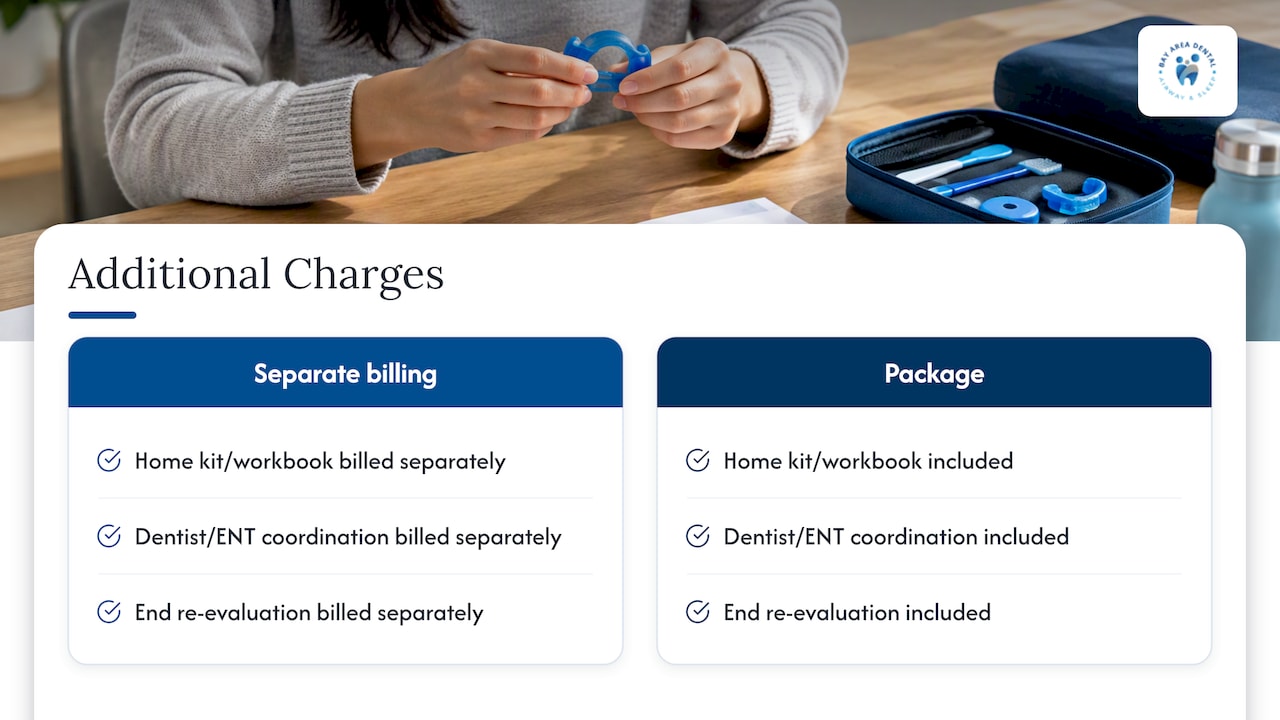
Some providers charge separately for a home kit or workbook, for coordination with your dentist or ENT, or for a re-evaluation at the end. Others fold these into a package. Neither approach is wrong, but you should compare total cost, not per-session rates alone.
What moves the total up or down
Two patients can start on the same day and finish with very different bills. These are the usual reasons.
| Factor | Why it changes the cost |
|---|---|
| Number of sessions | The biggest driver. Mild habit problems may need fewer visits than a complex case with feeding, speech and sleep concerns together. |
| Age of the patient | Younger children need parent coaching and may not be ready for therapy yet. ASHA says OMT may be inappropriate for children under 4 or those who cannot follow directions and self-monitor. |
| Who provides it | A licensed speech-language pathologist, a dental team or a trained myofunctional therapist may price and bill differently. |
| Related procedures | If a tongue or lip tie release is planned, therapy is often scheduled before and after it, which lengthens the program. |
| Airway findings | If nasal obstruction needs ENT or allergy care first, therapy may be delayed or coordinated, changing the timeline. |
| Format | In-person, virtual or hybrid visits can differ in price and in how well your technique can be checked. |
| Your consistency | Patients who practice daily often need fewer corrective visits. |
A worked way to estimate your own total
You can build a realistic budget with simple arithmetic, using the numbers a provider gives you:
- Evaluation fee (one time).
- Per-session fee multiplied by the number of sessions the clinician expects.
- Kit or materials, if charged separately.
- Any procedure-related visits, such as a pre- or post-release session.
- Subtract anything your plan will confirm in writing.
Then ask the clinician for a low and a high session count, so you see the range rather than one optimistic number. If a package is offered, divide the package price by the sessions included and compare it with the pay-as-you-go rate.
Insurance, Medi-Cal and HSA/FSA in California
This is where most families get confused, and where a phone call saves real money.
Why answers differ
Coverage disputes usually reflect how a benefit is designed and billed, not whether therapy is clinically useful. A California family may get one answer from a dental plan, another from a medical plan and a third from a Medi-Cal managed-care plan. Some commercial dental plans explicitly exclude myofunctional therapy. Blue Shield of California’s dental plan document, for example, warns that a dentist may charge usual and customary rates for services the plan does not cover, which is why a written determination matters before treatment.
Medi-Cal
Medi-Cal materials recognize covered speech therapy and medical services related to dental services in qualifying circumstances, and its scope-of-benefits rules say authorization may be granted only for the lowest-cost covered item or service that meets the beneficiary’s medical needs. In practice, that means approval depends on the diagnosis, the provider type and a referral. Do not assume myofunctional therapy is covered, and do not assume it is excluded. Ask the plan.
Questions that get a real answer
Before you book, ask the provider and your plan:
- Does the clinician bill as a speech-language pathologist or as a dentist?
- Which diagnosis and procedure code will be submitted?
- Is a physician or dentist referral required?
- Can you get a superbill for out-of-network reimbursement?
- Is HSA or FSA payment accepted? This is provider-specific.
ASHA also notes that specific billing codes for sleep-disordered breathing are limited when services are provided by an SLP, so coverage for a sleep-related reason can be harder to obtain than for a documented feeding, speech or swallowing problem. Ask for the exact written exclusion or authorization rationale, so you are not surprised by a self-pay bill later.
Paying with pre-tax dollars
If your plan does not cover therapy, a health savings or flexible spending account may still help, depending on the provider’s documentation and your plan’s rules. Our partner-free reading list is short on this topic, but HSA/FSA and predetermination strategies for U.S. families lays out how predetermination and pre-tax accounts work for dental-related care, and the same habit of asking for a written benefit decision first applies here. Confirm eligibility with your plan administrator before you pay.
When therapy is not the first step
A lower bill is not a better outcome if the therapy is the wrong tool. Two situations deserve care.
Sleep apnea
Obstructive sleep apnea is a medical diagnosis. ASHA states that more research is needed on long-term OMT outcomes in sleep apnea, and the AASM clinical guideline supports prescribed PAP therapy or, for appropriate adults who prefer alternatives or cannot tolerate CPAP, a custom titratable oral appliance made by a qualified dentist. Myofunctional therapy can be a useful part of a coordinated plan, but it should follow a diagnosis and not be sold as a guaranteed replacement for CPAP or an oral appliance. If a provider promises that exercises alone will resolve your apnea, get a second opinion from a sleep physician.
If you want to understand what the exercises look like, our page on myofunctional exercises for sleep walks through them, and our overview of sleep apnea dentistry in Fremont explains how oral appliances fit alongside it.
Blocked nasal airflow
ASHA says nasal obstruction should be evaluated or corrected by appropriate medical professionals before a consistent closed-mouth nasal posture can be established. If your child or you cannot breathe through the nose, therapy may be delayed or run alongside ENT, allergy, orthodontic or dental care. Paying for weeks of sessions before that is sorted out is a common way to waste money. Our guide on what orthodontics can and cannot fix for mouth breathing covers the same point from the dental side.
Tongue and lip ties
For infants and children, the question is function: feeding, swallowing, speech and resting posture, not just how the tissue looks. Therapy often wraps around a release, which is why it affects the total. Parents can start with our guides to function-first tongue tie revision and adult tongue tie symptoms.
How to vet a California provider before you pay
Price is easier to judge when you know the clinician is qualified.
- Check licensure. To work as a speech-language pathologist in California, an applicant must meet the state board’s licensure requirements, which include 300 supervised clinical-practicum hours in three settings and the national SLP examination. Other professionals, such as dentists and hygienists, hold their own licenses.
- Ask about myofunctional training. Orofacial myofunctional training is an additional competency, not a replacement for state licensure. ASHA recommends that clinicians serving these patients be specifically educated and appropriately trained.
- Look for teamwork. ASHA describes OMD treatment as interprofessional care involving the patient, caregivers and relevant medical, dental and orthodontic professionals. A provider who never talks to your dentist or doctor is a red flag.
- Ask what success looks like. A good answer names specific functional goals (nasal breathing at rest, a normal swallow pattern, comfortable chewing) and a point at which you reassess.
- Get the fee structure in writing, including cancellations and what happens if you stop early.
Our perspective on cost and value
We see therapy cost conversations go wrong in the same two ways. Some families choose purely on the lowest per-session rate and end up with a program that never addressed the airway. Others are told a long, expensive package is the only option before anyone has examined the child or adult properly.
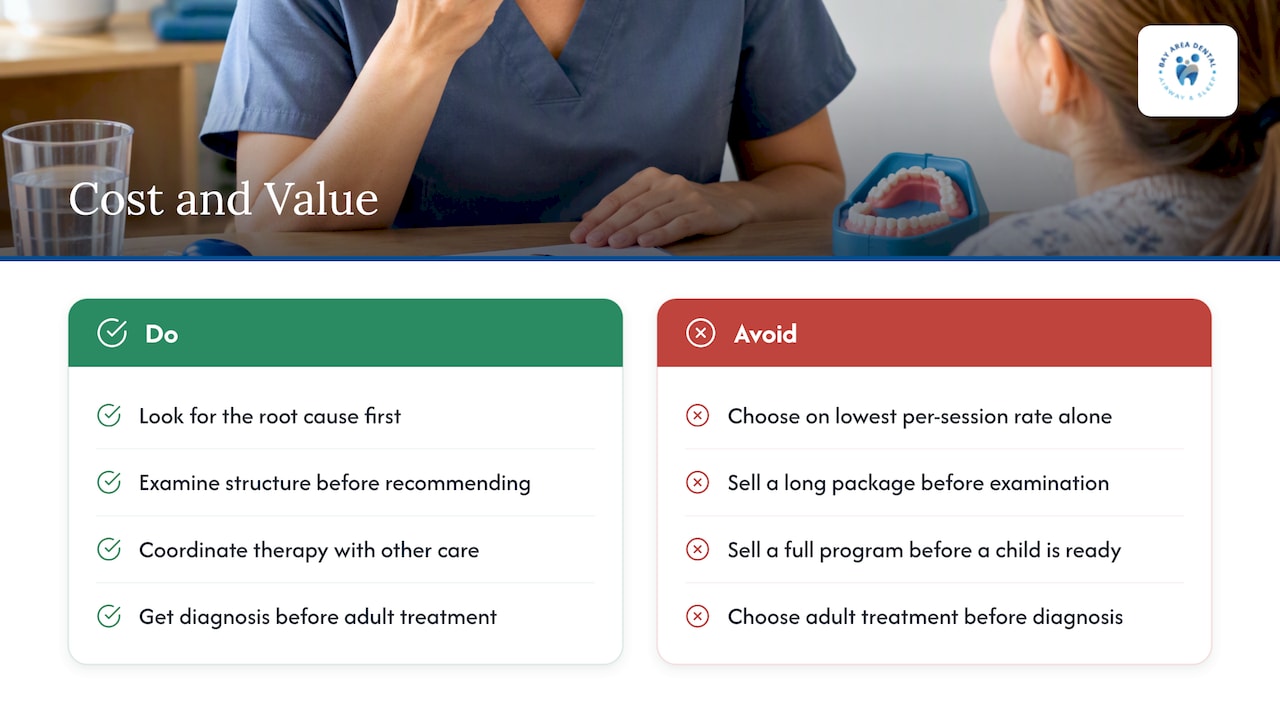
Our approach is to look for the root cause first. Our practice focuses on whole-body health, which means we treat breathing, sleep, jaw development and dental health as connected. With tools such as 3D imaging, we can look at structure before recommending anything, and when therapy is appropriate we coordinate it with the rest of care, whether that is a tongue or lip tie release, orthodontics, an oral appliance or a referral for a sleep study. We would rather tell you therapy is not the right first step than sell sessions that cannot work yet.
For parents, we also care about what you are asked to pay for. A child under four may benefit more from parent coaching and monitoring than from formal exercises, and you should not be sold a full program before your child is ready. For adults with sleep symptoms, we want a diagnosis in hand before treatment choices are made.
— Admin
Booking an evaluation with us
If you are in Fremont, Union City or elsewhere in the Bay Area and want a clear picture of what therapy, a tie release or an airway-focused plan would involve for you or your child, we can start with an examination and explain the options, the sequence and the costs before you decide. You can see our tongue and lip tie care and sleep and breathing services, or contact us through our main site. Our myofunctional therapy fees are not published online, so we will give you a written estimate after we have seen you.
Ways to keep the cost reasonable
- Start with the evaluation, then decide. You can usually judge the provider and the plan from the first visit before buying a package.
- Ask about fewer, better-targeted sessions. If your case is simple, individual sessions may cost less than a prepaid program.
- Practice daily. Consistency between visits is the cheapest part of therapy.
- Use a free or low-cost first step. Our tongue posture training guide shows what basic practice looks like, so you know what you would be paying a clinician to refine.
- Fix the airway first when needed. Treat obstruction before paying for sessions that depend on nasal breathing.
- Bundle sensibly. If a release or orthodontic step is planned, ask for a sequence that avoids duplicate evaluations.
FAQ
How long does myofunctional therapy take?
It depends on age, goals and how consistently you practice. Programs are commonly measured in months rather than weeks, with short sessions spaced weekly or every other week at first. Your clinician should give you a low and a high estimate after the evaluation and a point to reassess.
Is myofunctional therapy covered by insurance in California?
Sometimes, but not reliably. Some dental plans exclude it, and medical plans and Medi-Cal decide based on diagnosis, provider type and referral. Request a written preauthorization or benefits determination before you begin, and ask whether a superbill can be used for out-of-network reimbursement.
Can myofunctional therapy be done at home?
The daily exercises are done at home, but the technique needs to be assessed by a trained clinician, in person or by video, so errors do not become habits. Self-guided practice can be a reasonable way to learn the basics while you decide on a provider. It is not a substitute for evaluation if you have sleep apnea, feeding problems or suspected ties.
Will it cure my sleep apnea?
No one should promise that. Sleep apnea is a medical diagnosis, and the evidence for long-term therapy outcomes is still limited. Therapy can support a plan that also includes CPAP, a custom oral appliance or other medical care, guided by your sleep physician.
Sources
- ASHA: Orofacial Myofunctional Disorders
- AASM clinical guideline on oral appliance therapy for obstructive sleep apnea
- Medi-Cal scope of benefits, general and dental (CDSS)
- Blue Shield of California Dental PPO 1000 evidence of coverage
- California Speech-Language Pathology and Audiology Board