

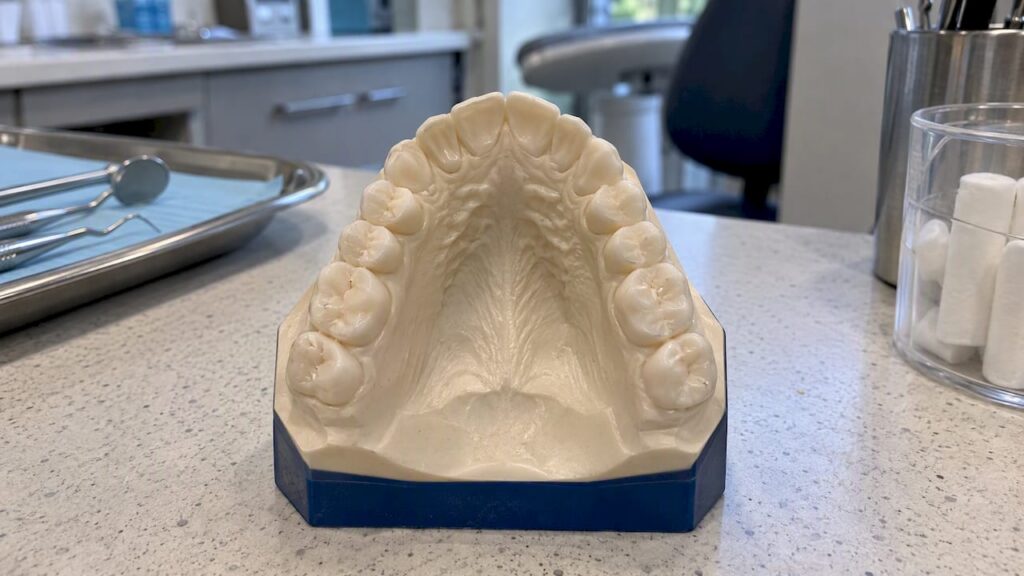
Orthodontic treatment can help mouth breathing when the cause is structural, such as a narrow palate or a retruded jaw, but it is not a universal fix. The main tools are rapid maxillary expansion, functional appliances, braces or aligners, and myofunctional therapy, often used together. Before starting any of them, a multidisciplinary evaluation should confirm whether the real obstruction is in the nose, the tonsils, or the jaw itself.
TL;DR:
- Palatal expansion works best before the mid teens, while growth plates remain active; afterward, treatment generally manages the bite rather than guiding jaw development.
- Expansion widens the nasal cavity on imaging within months, but reviews find inconsistent evidence that this change resolves chronic mouth breathing or lasts.
- Snoring, witnessed breathing pauses, or daytime sleepiness warrant evaluation; clinicians should rule out nasal or tonsil obstruction and consider a sleep study before orthodontic appliances.
- Rapid expansion usually requires two to four weeks of widening, then six to twelve months of retention; skipping retention can erase the gain.
- Functional appliances and muscle retraining often take a year or longer, and inconsistent wear or daily exercises can slow progress and reduce results.
Table of Contents
- How jaw and palate shape affect breathing
- Orthodontic approaches used when breathing is a concern
- What the evidence shows: systematic reviews and clinical guidance
- How providers evaluate mouth breathing and the multidisciplinary care pathway
- When to seek care: age windows, red flags, and how early to act
- Treatment process and realistic outcomes
- How Bay Area Dental, Airway & Sleep approaches mouth breathing and airway care
- A cautious, evidence-aware view on treating mouth breathing
- If you want an evaluation, here’s how we can help
- FAQ
- Sources
How jaw and palate shape affect breathing
A narrow upper jaw, known as maxillary constriction, raises nasal resistance because the nasal floor sits on the roof of the mouth. When the palate is high and narrow, the nasal passages above it are also narrow, which makes nasal breathing harder work than mouth breathing. A retruded lower jaw, or retrognathia, can push the tongue backward into the airway, encouraging a child or adult to breathe through an open mouth instead.
These dentofacial patterns are well documented. A comprehensive review of oral breathing effects on malocclusion and jaw posture found that mouth breathing in children is linked to increased lower facial height, a narrow maxilla, and a retruded mandible, and that catching these patterns early can reduce the need for more invasive procedures later.
Not every case of mouth breathing starts with the jaw, though. Some of the most common causes sit outside orthodontic reach entirely:
- Enlarged tonsils or adenoids that physically block nasal airflow
- A deviated nasal septum or chronic nasal congestion from allergies
- A narrow palate or retruded jaw that reduces the space available for nasal breathing
The distinction matters because nasal breathing supports normal jaw development during childhood growth. Skeletal changes, like widening a palate, are only possible while growth plates remain active, generally before the mid-teens. After that window closes, orthodontic options shift from guiding growth to managing the bite with braces, aligners, or surgery.
Orthodontic approaches used when breathing is a concern
Several distinct methods get grouped under “orthodontics for mouth breathing,” and each targets a different part of the problem.
- Rapid maxillary expansion (RME) widens the upper jaw transversely using a fixed or removable expander, with the goal of increasing nasal cavity volume. Treatment typically involves a few weeks of active widening followed by several months of retention to let the bone stabilize, and it works best in children whose palatal suture has not yet fused.
- Functional or mandibular advancement appliances reposition a retruded lower jaw forward, which has been associated with increases in upper airway volume in several pediatric studies using three-dimensional imaging.
- Braces and clear aligners correct crowding, crossbites, and open bites. Fixing the bite can support better tongue posture and a more complete lip seal, which helps some patients transition back toward nasal breathing once the structural blockage is resolved.
- Oral appliance therapy (OAT) serves a different purpose in adults with suspected sleep-disordered breathing: rather than guiding jaw growth, it holds the lower jaw in a forward position during sleep to keep the airway open. Our sleep and breathing services cover this option for patients who no longer have active growth to work with.
- Myofunctional therapy retrains the muscles of the tongue, lips, and cheeks to support nasal breathing and proper swallowing patterns. It depends heavily on daily adherence, and results tend to lag without consistent practice.
Pro Tip: Ask whether a proposed appliance is meant to change bone structure, reposition soft tissue, or retrain muscle function, because each has a different timeline and a different definition of success.
What the evidence shows: systematic reviews and clinical guidance
The research on orthodontics and airway outcomes is genuinely mixed, and the biggest gap is between short-term anatomical change and long-term functional improvement.
RME reliably widens the nasal cavity on imaging within months of treatment. A systematic review of rapid maxillary expansion confirms a significant short-term increase in nasal cavity volume, but finds the evidence inconsistent for sustained improvement in nasopharyngeal or oropharyngeal airway volume, and inconsistent for resolving chronic mouth breathing itself. A wider nasal floor does not automatically translate into a child who stops breathing through their mouth at night.
Functional appliances fare somewhat better on airway-specific imaging. A CBCT-based systematic review of orthodontic airway changes found that these appliances are associated with measurable increases in upper airway volume and minimum cross-sectional area in children. The same review flags a problem that runs through most of this literature:
Most CBCT-based orthodontic airway studies carry a moderate-to-high risk of bias and limited follow-up, according to the CBCT systematic review, which means imaging gains cannot be assumed to predict lasting symptom relief.
A few patterns stand out across the literature:
- Imaging change (nasal or airway volume) is a surrogate marker, not proof that breathing symptoms have resolved.
- Studies rarely follow patients long enough to confirm that gains hold into adulthood.
- Most trials lack a comparison group, which makes it hard to separate treatment effect from normal growth.
A 2025 article in the American Journal of Orthodontics and Dentofacial Orthopedics addressed this directly. The AJODO review on mouth breathing and orthodontic intervention cautions that routine expansion or growth modification is not an evidence-based way to cure childhood mouth breathing on its own, and that orthodontic assessment belongs inside a broader multidisciplinary evaluation rather than standing in for one.
How providers evaluate mouth breathing and the multidisciplinary care pathway
A proper airway-focused evaluation starts well before any appliance gets discussed.
- History taking covers habitual snoring, witnessed pauses in breathing, daytime sleepiness, and any history of feeding or speech delay.
- Clinical exam includes a look at tonsil size, palate shape, and jaw relationship, often alongside a Modified Mallampati score to estimate how much space is available at the back of the throat.
- Imaging, such as CBCT, gets ordered selectively when skeletal factors are suspected, not as a routine first step.
- Referral to an ear, nose, and throat specialist or to sleep medicine follows when the history or exam suggests a primary airway obstruction rather than a dentofacial one.
- Coordination between the orthodontist, myofunctional therapist, and medical team shapes the final treatment plan, since no single provider can address every contributing factor alone.
Our airway orthodontics approach follows this same sequence, prioritizing a sleep study before any expansion or functional appliance when sleep-disordered breathing is suspected.
When to seek care: age windows, red flags, and how early to act
The American Association of Orthodontists recommends an initial screening by age 7, a point at which enough permanent teeth have erupted to spot jaw-growth problems while bone is still growing fast enough for interceptive treatment to work.
Some signs warrant a sooner look rather than routine monitoring:
- Habitual snoring or any observed pause in breathing during sleep
- Noticeable daytime sleepiness, hyperactivity, or trouble concentrating
- Feeding difficulty in infants or speech delay in toddlers
- A rapidly worsening open bite or crossbite between dental visits
Early interceptive care focuses on guiding jaw growth while it is still active, using expanders or functional appliances to create space before all permanent teeth erupt. Adult intervention, by contrast, works with the bone structure as it already is, relying on braces, aligners, oral appliances, or surgery rather than growth guidance. Our page on signs that warrant interceptive orthodontics walks through specific indicators parents can watch for around age 7.
Treatment process and realistic outcomes
RME typically involves two to four weeks of active widening followed by several months, often six to twelve, of retention with a passive appliance to let new bone fill in and stabilize. Skipping retention risks relapse, which can erase the transverse gain entirely.
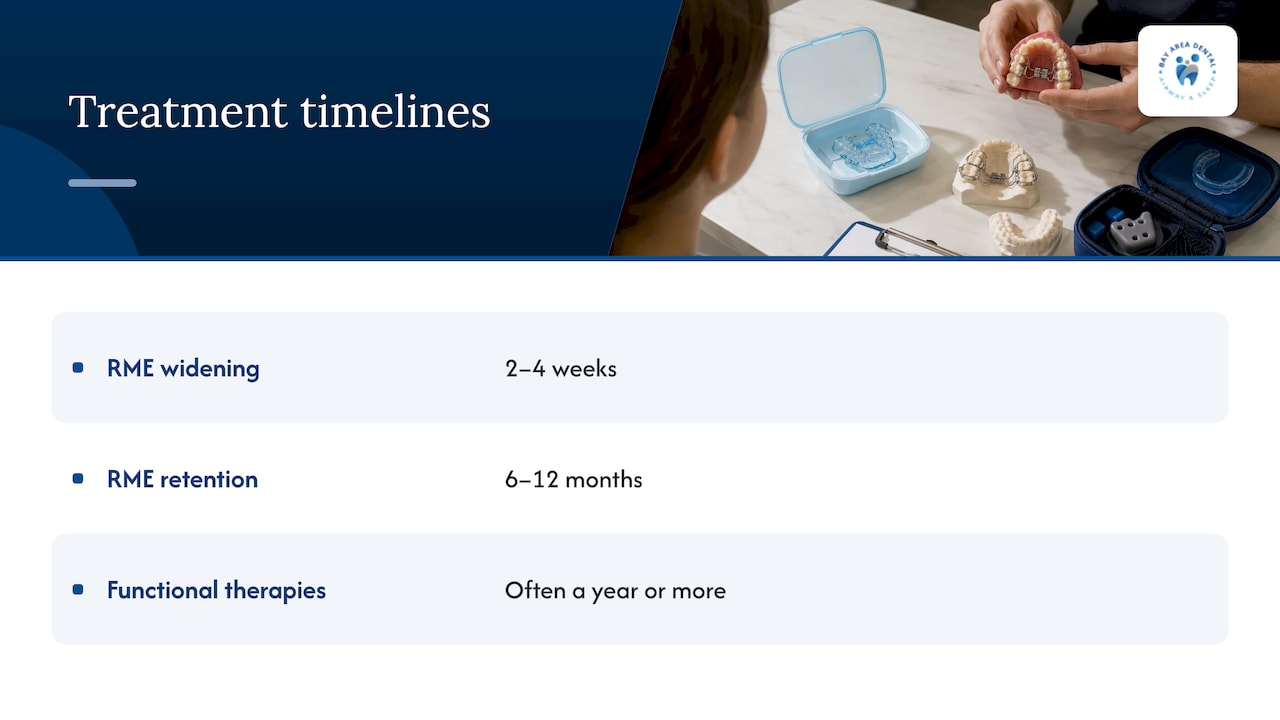
Functional appliances and myofunctional therapy run on longer timelines, frequently a year or more, and both depend heavily on how consistently the patient wears the appliance or performs the exercises. A child who wears a functional appliance only at night, or skips myofunctional exercises most days, should expect slower and smaller results than the published studies suggest.
Clinicians judge success using a mix of measures: whether snoring or mouth breathing symptoms have actually changed, whether follow-up imaging shows stable airway or nasal volume, and, for suspected sleep apnea, repeat sleep-study metrics. Because orthodontic airway changes can relapse and growth continues to shift the picture through adolescence, long-term monitoring matters as much as the initial treatment.
How Bay Area Dental, Airway & Sleep approaches mouth breathing and airway care
Mouth breathing is treated as a symptom with several possible causes, not a single diagnosis with one fix. Airway evaluations combine clinical screening with imaging when indicated, and treatment options include palatal expansion, myofunctional therapy, oral appliance therapy, and laser frenectomy for tongue or lip ties that restrict tongue posture.
Objective screening is favored over assumption. Rather than starting expansion or a functional appliance based on symptoms alone, coordination with ENT and sleep medicine, including a sleep study before airway orthodontics when sleep-disordered breathing is suspected, ensures the treatment plan matches the actual cause. Our pediatric airway evaluation page outlines what that process looks like in practice, and we encourage readers to use the same sequence, history, exam, imaging where needed, and specialist referral, as a model for working through shared decisions with their own providers.
A cautious, evidence-aware view on treating mouth breathing
Orthodontics can genuinely help a subset of mouth breathers, the ones whose jaw or palate shape is part of the problem. What troubles me is how often expansion gets sold as a stand-alone cure before anyone has ruled out tonsils, adenoids, or a blocked nasal passage. A widened palate on an x-ray is not the same as a child who sleeps with their mouth closed.
The honest position is to set measurable goals, involve the right specialists before treatment starts, and keep checking in years later, not months.
— Admin
If you want an evaluation, here’s how we can help
If mouth breathing has you wondering whether your child’s jaw, your own bite, or something else entirely is behind it, a coordinated evaluation beats guessing. We start with a screening exam, add imaging only when the clinical picture calls for it, bring in ENT or sleep medicine through coordinated referrals, and build a treatment plan around what we actually find rather than a one-size-fits-all expander.
- Request a consult through our orthodontics and palatal expansion services
- Ask about pediatric airway screening through our pediatric dental care page
- Reach out through our main site to schedule the first step
This article is general information, not a substitute for advice from a qualified doctor. Consult a qualified healthcare professional about your own circumstances before acting on anything here.
FAQ
Can orthodontics fix mouth breathing?
Orthodontics can help when a narrow palate or a retruded jaw is contributing to mouth breathing, but it rarely resolves it alone. A systematic review of RME found consistent short-term nasal cavity widening but inconsistent long-term resolution of chronic mouth breathing, so a medical evaluation should rule out tonsil, adenoid, or nasal causes first.
How do you permanently fix mouth breathing?
There is no single permanent fix, because the right approach depends on the cause. Structural dental contributors may respond to palatal expansion or functional appliances during growth, nasal or lymphoid obstructions typically need ENT treatment, and muscle-pattern habits often require ongoing myofunctional therapy to maintain any gains.
Can a dentist fix mouth breathing?
A dentist or orthodontist can screen for dentofacial contributors, such as a narrow palate or crossbite, and treat those with expansion, braces, or aligners. When the cause is tonsil or adenoid enlargement, nasal obstruction, or sleep apnea, a referral to ENT or sleep medicine is the appropriate next step rather than dental treatment alone.
Can clear aligners fix mouth breathing?
Clear aligners can correct crowding or a crossbite that affects tongue posture and lip seal, which may support a return to nasal breathing in some patients. They do not widen the nasal cavity the way palatal expansion does, so they are generally better suited to milder dental contributors than to cases involving significant transverse jaw constriction.
Sources
- Mouth breathing and orthodontic intervention: Does the evidence support keeping our mouths shut? (AJODO, 2025)
- Oral breathing effects on malocclusions and mandibular posture (systematic review, PMC)
- Rapid maxillary expansion and upper airway: systematic review (PubMed)
- Association between orthodontic treatment and upper airway changes in children assessed with CBCT (systematic review)
- When should a child first see an orthodontist? (AAO guidance)