


Chronic mouth breathing is associated with distinct jaw and facial growth patterns, so persistent mouth breathing in a child should prompt a professional look. A concise clinical review and guidance from the American Academy of Pediatric Dentistry both frame mouth breathing as a signal of an underlying problem rather than a standalone diagnosis. Genetics still shapes most of a child’s facial growth. If you notice ongoing mouth breathing, start with your pediatrician or a pediatric dentist for an evaluation, not a wait-and-see approach.
TL;DR:
- Mouth breathing is linked to narrower upper arches, higher palatal vaults, and increased lower facial height, but genetics heavily influence facial growth.
- Persistent mouth breathing beyond a few weeks warrants professional evaluation to identify causes such as enlarged tonsils, allergies, or structural obstructions like a deviated septum.
- Early treatment options include allergy management, surgical removal of tonsils or adenoids, orthodontic expansion, and myofunctional therapy, ideally during active growth years.
- Supporting nasal breathing at home involves managing allergens, avoiding smoke, and using saline rinses without resorting to unproven devices or appliances.
- Addressing mouth breathing early improves sleep, feeding, and speech development, with lasting facial changes being more limited in fully grown individuals.
Table of Contents
- Why nasal breathing matters for growth, sleep, and health
- Recognizing mouth breathing: common signs and typical causes
- What the research shows about mouth breathing and jaw and facial development
- When to get a professional evaluation and who to see first
- Common treatments: what each option addresses and typical timing
- Practical steps parents can take now at home and what to avoid
- How an airway-focused dental practice evaluates and coordinates care
- Impact of nasal breathing on speech development and swallowing function
- Setting realistic goals: airway and function first, cosmetic change secondary
- Ready for an airway-focused evaluation for your child
- Sources
- FAQ
Why nasal breathing matters for growth, sleep, and health
The nose does more than smell. It filters particles, warms and humidifies incoming air, and produces nitric oxide, a molecule tied to better oxygen uptake and immune defense. When a child breathes through the mouth instead, several of those functions are lost, and the jaw feels the difference over time.
Nasal breathing keeps the tongue resting against the roof of the mouth, which gently molds the palate as a child grows. Mouth breathing drops the tongue low and opens the lips at rest, changing the muscular forces acting on the maxilla and mandible during the years when bone is most responsive to pressure.
- The tongue acts as a natural expander when it rests against the palate during nasal breathing.
- An open-mouth posture reduces that support and can narrow the upper arch over time.
- Nitric oxide from nasal airflow supports oxygen delivery, which matters for sleep quality and daytime energy.
Vertical dentofacial growth is strongly influenced by genetics, which limits how much airway obstruction alone can explain a child’s facial shape. Breathing pattern is one input among many, not the whole story.
Recognizing mouth breathing: common signs and typical causes
Most parents notice mouth breathing before they know what caused it. The pattern usually shows up in a mix of daytime and nighttime clues.
- Open lips at rest, especially during quiet activities like watching television or reading.
- Snoring, restless sleep, or witnessed pauses in breathing, which suggest airway crowding at night.
- Dry lips or a dry mouth on waking, a simple but reliable clue.
- Frequent colds or nasal congestion that never fully clears.
- Dental signs, including a narrow-looking palate or crowded front teeth.
Common causes include enlarged adenoids or tonsils, allergies or chronic rhinitis, a deviated septum, tongue-tie, or simply low muscle tone around the mouth and jaw. A child with a stuffy nose during allergy season is different from one who breathes through the mouth year-round. Occasional mouth breathing during a cold rarely needs urgent attention, but a pattern that persists for months is worth escalating to a professional.
What the research shows about mouth breathing and jaw and facial development
Cephalometric studies consistently find differences between mouth-breathing children and nasal breathers, though the size and consistency of those differences vary across studies.
- Mouth-breathing children tend to show increased lower facial height and a steeper mandibular plane angle.
- Narrower palatal vaults are common, along with a tendency toward retrognathia, or a jaw positioned further back than typical.
- A narrative review on oral breathing links the pattern to adenoid facies, posterior crossbite, and Class II dental relationships.
Palatal height in the molar region is notably higher in mouth-breathing children compared with nasal breathers, according to research summarized in a dentofacial development review, and that same body of work reports a larger mandibular plane angle and greater lower facial height in mouth-breathers as a group.
These findings come mostly from cross-sectional studies, which capture a snapshot rather than tracking the same children over years. That design cannot prove that mouth breathing alone causes the facial pattern. Genetic predisposition and differences in how studies define and measure mouth breathing add further uncertainty. The practical takeaway holds regardless: mouth breathing is a modifiable risk factor, and a child who breathes through the mouth deserves a functional assessment rather than reassurance that they will grow out of it.
When to get a professional evaluation and who to see first
Certain signs call for prompt attention rather than a wait-and-watch approach.
- Mouth breathing that persists for more than a few weeks outside of an active cold.
- Loud, habitual snoring or breathing pauses a parent notices during sleep.
- Feeding difficulty in an infant or unclear speech in an older child.
- Daytime sleepiness, irritability, or attention problems that seem disproportionate to the child’s age.
Start with your pediatrician, who can rule out common causes and make referrals. From there, families are typically directed to an ear, nose, and throat specialist for airway obstruction, a pediatric dentist or orthodontist for jaw and bite concerns, and a myofunctional therapist for tongue and lip posture retraining. A first evaluation often includes an airway exam, a sleep questionnaire, a dental exam, and, when warranted, imaging or a formal sleep study.
Common treatments: what each option addresses and typical timing
Treatment depends on what is driving the mouth breathing, and more than one cause is often present at once.
- Medical management, such as allergy treatment or nasal steroids, is often the first step when inflammation is the main driver.
- Adenoidectomy or tonsillectomy addresses physical airway obstruction and can improve airway patency and sleep quality in children whose tonsils or adenoids are enlarged, according to a review of oral breathing’s dentofacial effects.
- Palatal expansion or orthodontic guidance widens a narrow upper arch, which can create more room for the tongue and improve nasal airway space.
- Orofacial myofunctional therapy retrains tongue and lip posture so the muscles support nasal breathing once an obstruction is resolved.
- Frenectomy releases a restrictive tongue-tie when one is limiting tongue mobility and rest posture.
Pro Tip: Ask any specialist you see how their recommended treatment fits with the others your child may need, since airway problems rarely have a single fix.
Timing matters. Early intervention during active growth years can influence how the jaw develops, but genetics sets a ceiling on how much any treatment can change a child’s underlying facial structure.
Practical steps parents can take now at home and what to avoid
While you arrange professional care, a few home habits support nasal breathing without any risk.
- Manage allergens and reduce smoke exposure at home, since both aggravate nasal congestion.
- Use a humidifier if your pediatrician recommends one for a congested child.
- Encourage saline nasal rinses for older children who can manage them, and turn nasal breathing into a game for younger kids rather than a correction.
- If feeding problems or a suspected tongue-tie show up in infancy, ask your pediatrician about an evaluation and seek lactation support if breastfeeding is affected.
Avoid unproven mouth-taping devices or orthodontic-style appliances used without professional supervision. They can create new problems without fixing the underlying cause, and they are no substitute for identifying why your child is mouth breathing in the first place.
How an airway-focused dental practice evaluates and coordinates care
An airway-focused evaluation typically looks beyond the teeth to the whole breathing and swallowing system. An airway-focused dental practice offers one example of what an integrated first visit can look like for a child showing signs of mouth breathing.
- An airway-focused exam that checks tongue posture, lip seal, and palate shape alongside the teeth.
- 3D imaging when a closer look at airway space or jaw structure is needed.
- Referral to myofunctional therapy when tongue and lip retraining would help.
- Coordination with an ENT or pediatrician when adenoid, tonsil, or allergy issues are suspected.
Bringing a simple sleep diary, a list of symptoms you have noticed, and a few recent photos of your child’s resting mouth posture helps a first visit move faster and gives the dental team a clearer starting point.
Impact of nasal breathing on speech development and swallowing function
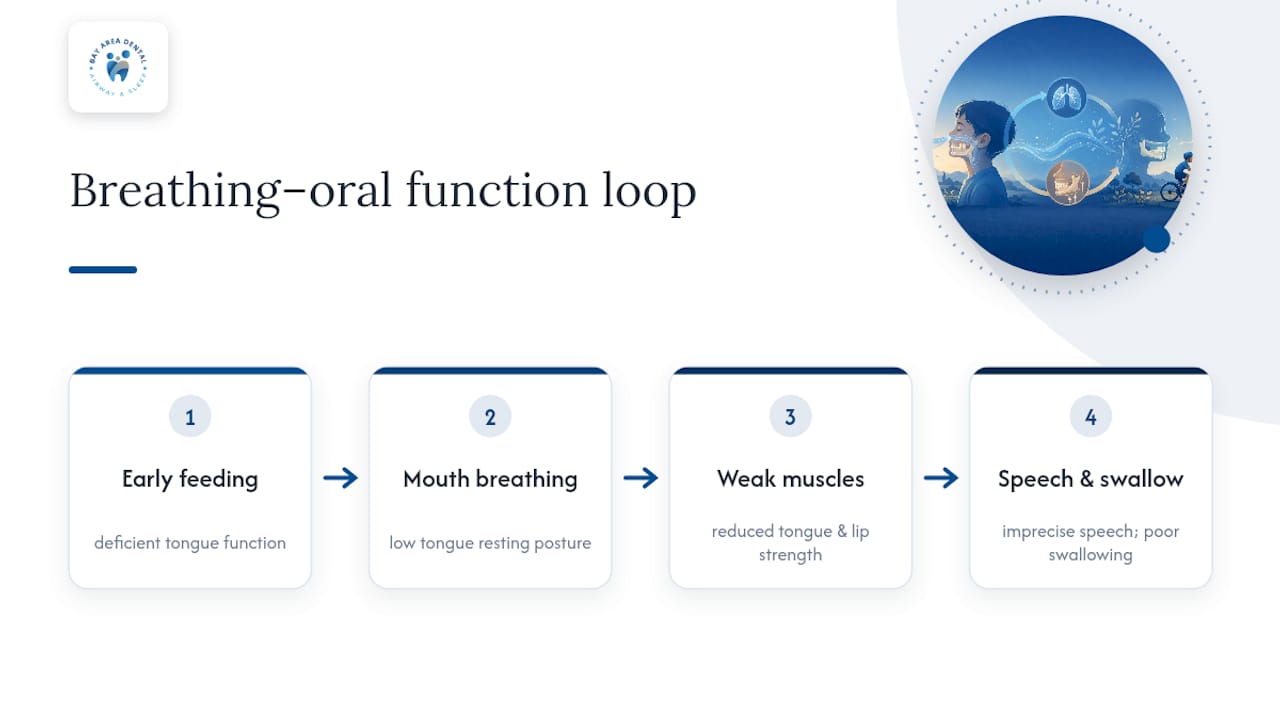
Breathing pattern and oral function develop together, not separately. A child who breathes through the mouth often rests the tongue low in the mouth instead of against the palate, and that same low tongue posture affects how sounds are formed and how swallowing works.
A 2024 cross-sectional study of mouth-breathing adolescents found a posteriorly positioned hyoid bone, a posteriorly rotated mandible, and reduced tongue and lip strength compared with nasal breathers. Weaker tongue and lip function shows up functionally as imprecise articulation of certain sounds and less efficient swallowing, since both tasks depend on the tongue moving with strength and control against the palate.
The same research points to a feedback loop that starts early: deficient tongue function during infant sucking and early chewing can predispose a child to mouth breathing, and mouth breathing then reinforces weak oral muscle patterns. That loop is part of why speech therapists and myofunctional therapists often work on the same muscles from different angles, one focused on sound production, the other on rest posture and swallowing mechanics. Addressing the breathing pattern early tends to support both goals rather than treating them as separate problems.
Setting realistic goals: airway and function first, cosmetic change secondary
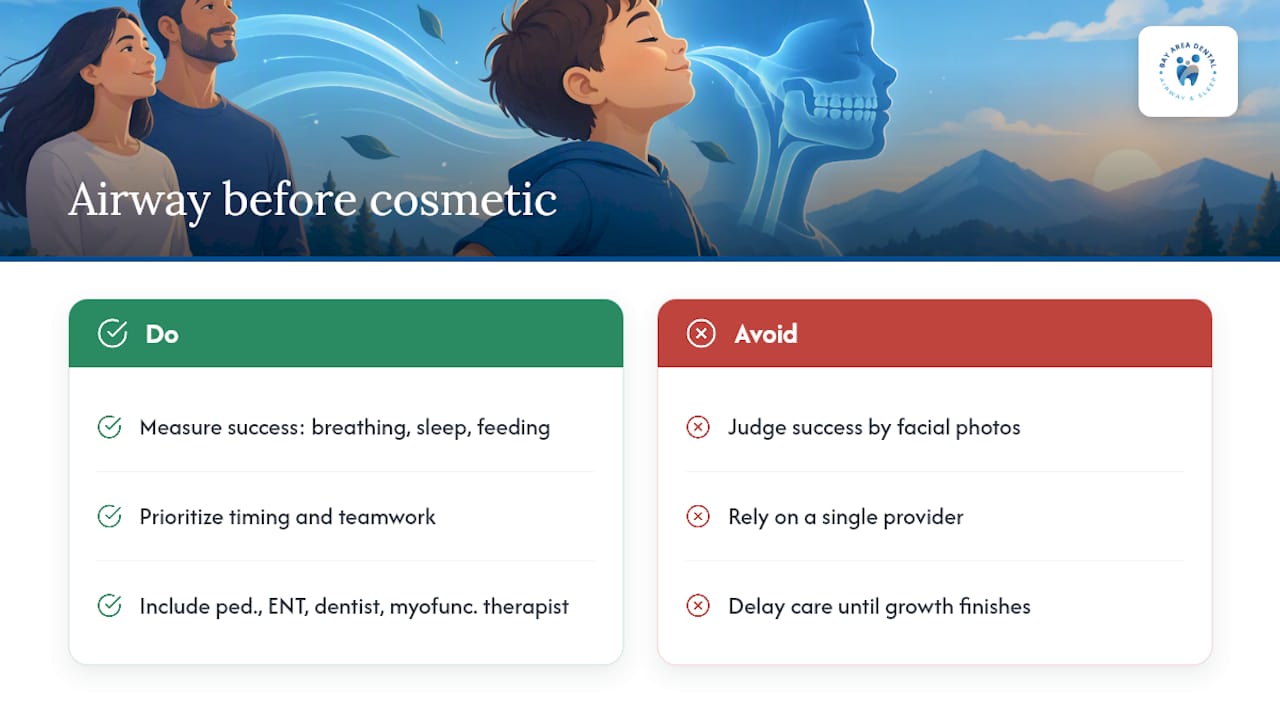
The most useful shift for parents is measuring success by breathing, sleep, and feeding rather than by how a jawline looks in photos. A child who sleeps through the night without snoring and eats and speaks with ease has made real progress, even if their facial profile does not match a marketing image.
Timing and teamwork matter more than any single treatment. A pediatrician, an ENT, a dentist, and a myofunctional therapist looking at the same child from different angles will usually catch more than any one provider working alone, and that collaboration matters more during the growth years than after.
— Admin
Ready for an airway-focused evaluation for your child
If you have noticed signs of mouth breathing, some airway-focused dental practices offer pediatric airway exams, myofunctional therapy, laser frenectomy, and palatal expansion under one roof, sometimes using 3D imaging when a closer look is needed.
Bring a short symptom list, a note on your child’s sleep patterns, and any recent photos of their resting mouth posture to your first visit. Visit the Bay Area Dental, Airway & Sleep website to learn more about scheduling a pediatric evaluation.
Sources
- The impact of mouth breathing on dentofacial development: A concise review – PMC
- Mouth breathing reduces oral function in adolescence | Scientific Reports
FAQ
Does nasal breathing improve jawline?
Nasal breathing supports normal tongue posture against the palate, which can help guide balanced jaw growth during childhood, but it does not reshape an adult jawline. Genetics plays a strong role in facial structure, so nasal breathing works best as prevention during the growth years rather than a correction later on.
Is mouth breathing linked to autism?
No reliable evidence in the sources reviewed here ties mouth breathing to autism. Mouth breathing is associated with airway obstruction, allergies, and oral muscle function, and any concern about developmental differences is best raised directly with a pediatrician.
Can I reverse my mouth breather face?
Full reversal is unlikely once facial growth is complete, since genetics sets much of the underlying structure. Addressing the cause of mouth breathing, whether allergies, enlarged tonsils, or tongue posture, can still improve airway function and stop further changes, which matters more than chasing a cosmetic result.
Will my face change if I start nose breathing?
In children who are still growing, shifting to consistent nasal breathing can support more typical jaw and palate development over time, particularly when combined with treating the underlying cause. In adults, the facial bones are set, so the main benefits shift to breathing quality, sleep, and oral function rather than visible facial change.