


Braces in the United States typically run from about $3,000 to well over $10,000, and Fremont sits in the upper half of that spread because Bay Area fees run higher than the national average. Your own number depends on the type of appliance, how complex your bite is, how long treatment lasts and who provides it. The only reliable figure is a written quote after an in-person exam. This guide explains what drives that quote, how insurance really works for orthodontics, and how to plan the payments.
One note on how we handle prices. We do not publish a fixed fee list for orthodontics, and we will not quote you a number over the phone. The reasons are the same ones the orthodontic profession gives, and we lay them out below.
TL;DR
- National ranges published by dental sites cluster around $3,000 to $10,000 for full treatment. Bay Area fees are usually higher, and clear aligners can reach the top of the range. For example, our own guide to Bay Area Invisalign costs is titled with a $4,200 to $12,400 span.
- Treatment typically lasts 12 to 24 months, and time in treatment is one of the biggest cost drivers.
- Orthodontic insurance usually has a separate lifetime maximum, often $1,000 to $3,000, covering about half the fee. It does not renew every year.
- Ask about 0% payment plans and use HSA or FSA dollars if you have them.
- Budget for retainers. Teeth move back without them.
Table of Contents
- What braces cost in Fremont, by type
- Why you cannot get an honest price over the phone
- What changes your price
- Insurance: how orthodontic coverage really works
- Medi-Cal and medical necessity
- Ways to spread the cost
- The cost people forget: retainers
- Our perspective: price the problem, not just the appliance
- Aligners, braces or a different first step?
- Book a consultation in Fremont
- A short checklist before you decide
- FAQ
- Sources
What braces cost in Fremont, by type
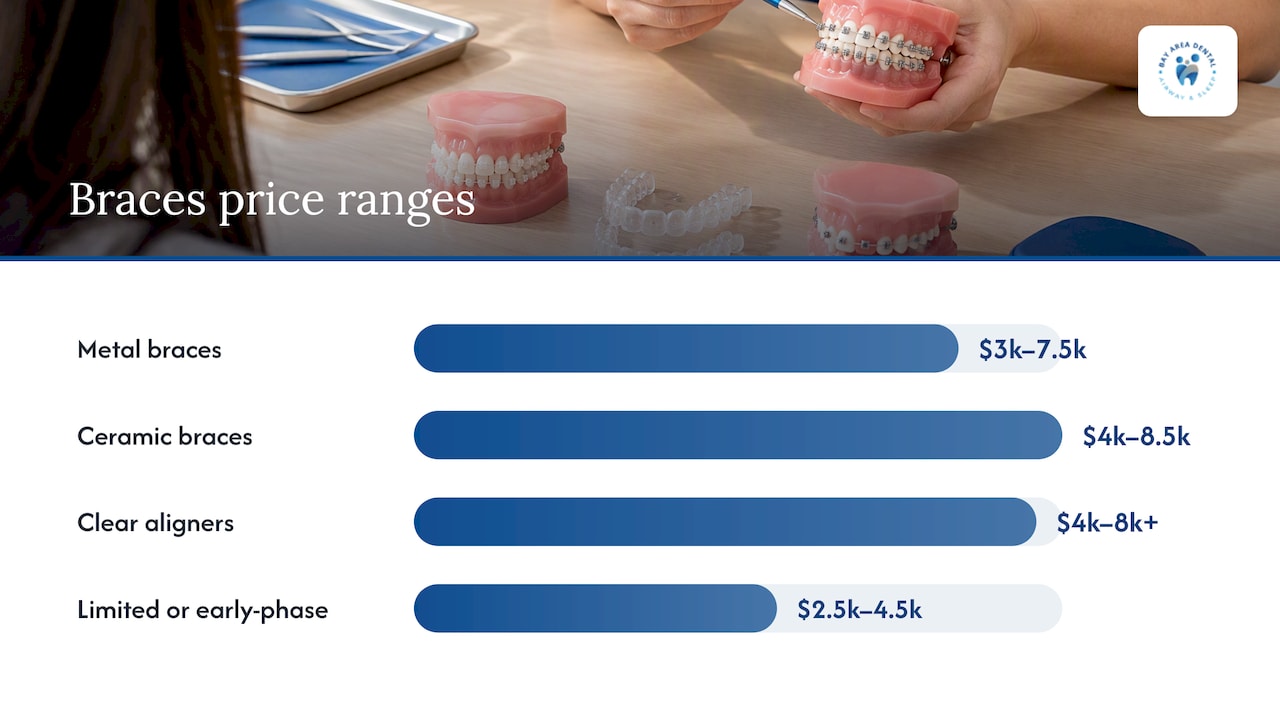
No single price applies to everyone, so think in ranges. The figures below are the ones that appear repeatedly in published national and Bay Area price guides. Treat them as a planning frame, not a quote.
| Type of treatment | Typical published range | What pushes you up or down |
|---|---|---|
| Traditional metal braces | About $3,000 to $7,500 | Treatment length, number of visits, extractions or added appliances |
| Ceramic (clear) braces | About $4,000 to $8,500 | Material cost, longer appointments |
| Lingual (behind the teeth) braces | Often the highest tier | Custom fabrication, specialist training |
| Clear aligners | Often $4,000 to $8,000 or more in the Bay Area | Case complexity, number of aligner sets, refinements |
| Limited or early-phase treatment | Roughly $2,500 to $4,500 | Short course for a specific problem in a growing child |
Two things stand out. First, metal braces are usually the least expensive route, though not always: a complicated bite treated with metal for three years can cost more than a simple case treated with aligners in one. Second, the ranges are wide because the work is wide. A few crowded lower teeth and a significant overbite with jaw involvement are not the same job.
If you are comparing Fremont quotes with ranges you see for other cities, remember that the Bay Area has high rent, high wages and high lab costs, and orthodontic fees follow. A national average is a floor to start from, not a prediction.
Why you cannot get an honest price over the phone
The American Association of Orthodontists says the best way to learn what braces will cost is an in-person consultation. That visit includes diagnostics such as 3D scans and a clinical exam, and the result is a personalized written quote that reflects the complexity of your bite and the expected duration. Phone estimates cannot reflect that, so be cautious about any office that gives you a firm number without seeing you.
When you get a quote, ask these questions so you can compare fairly:
- Does the fee include every appliance, or are expanders, TADs (small anchor screws) or elastics extra?
- How many months of treatment does the fee assume, and what happens if it runs longer?
- Are retainers included, and what does a replacement cost?
- Are the monthly adjustment visits and any broken-bracket repairs covered?
- What is the down payment, and is the payment plan interest-free?
- Will the office submit the insurance claim for you?
A lower headline fee that leaves out retainers and repairs can end up costing more than a higher one that includes them.
What changes your price
Type of appliance
Metal brackets are the baseline. Ceramic brackets blend with the tooth and cost more. Lingual braces and some aligner systems are custom-made and sit at the top. Clear aligners are not automatically cheaper, despite what advertising suggests.
Complexity of the bite
Crowding, spacing, overbites, underbites, crossbites and open bites all vary in difficulty. The more movement required, the longer and costlier the course. Cases involving jaw growth, such as a narrow upper arch, may add an expander. We cover the airway side of that in our guide to palatal expansion.
Length of treatment
Most people wear braces for 12 to 24 months, according to the AAO. Minor corrections can finish in a few months, while complex jaw or alignment problems may take years. Longer treatment means more visits and a higher fee.
Age and timing
Children sometimes need two phases: an early phase around age 7 to 10 to guide growth, then comprehensive braces as teen years approach. Phase one is usually a separate, smaller fee. If your child needs it, read our six signs at age 7 that point to interceptive orthodontics. One practical point from insurers: early-phase treatment can use up part of a lifetime orthodontic maximum, so check what is left before planning later braces.
Who provides treatment
Some general dentists with additional training provide braces or aligners, and specialist orthodontists provide them as their full-time practice. Fees and case selection can differ. Ask who will actually plan and supervise your treatment, and what their training is.
Insurance: how orthodontic coverage really works
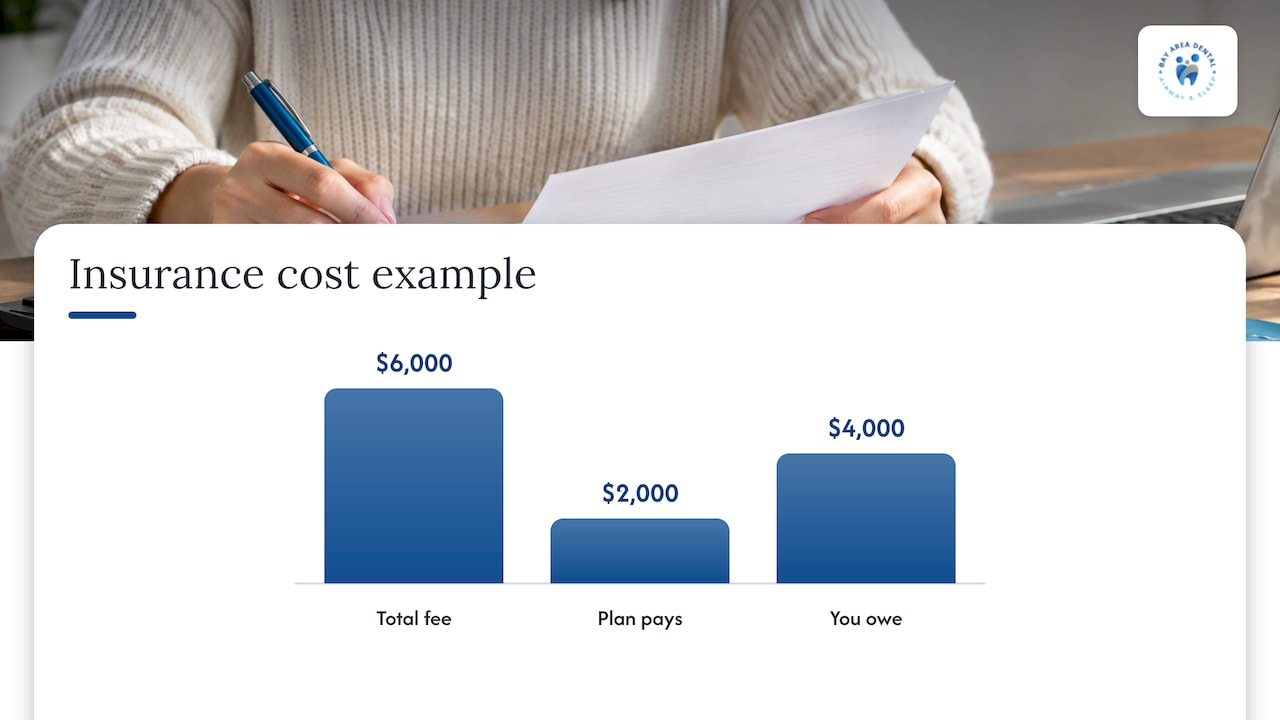
Most people assume orthodontic insurance behaves like cleaning-and-filling coverage that resets every January. It does not. Orthodontic benefits typically have a separate lifetime maximum. In common PPO plans it often falls between $1,000 and $3,000 per person, covering about 50% of the fee up to that cap. Once you hit it, it is gone for good.
A worked example, using round numbers only to show the arithmetic: if a plan pays 50% up to a $2,000 lifetime maximum and your total fee is $6,000, the plan pays $2,000, not $3,000, and you owe $4,000. Check three details before you start:
- The lifetime maximum and whether any of it was used earlier.
- Age limits, since some plans cover only dependents under 19.
- Waiting periods for orthodontic benefits on new plans.
If you are comparing plans at open enrollment or shopping for coverage on your own, it helps to understand supplemental dental plans before you commit, because the orthodontic clause is where plans differ most.
Medi-Cal and medical necessity
If your child is on Medi-Cal, braces are not automatic. California covers orthodontics only for medically necessary cases, meaning a severe handicapping malocclusion with a score of 26 or higher on the HLD Index, or specific conditions such as cleft palate. According to the Medi-Cal Dental orthodontic seminar materials, providers must submit a scoring sheet with diagnostic casts and radiographs for authorization before work begins. Wanting straighter teeth for appearance alone does not qualify.
More broadly, the ADA’s research arm notes that correcting a misaligned bite has functional value for chewing, cleaning and oral health, which is why some families with severe misalignment should ask whether their situation qualifies for medical assistance rather than treating it as a purely cosmetic expense.
Ways to spread the cost
Many orthodontic offices arrange payment so treatment is not one large bill. Common options, as described by orthodontic practices that publish their financing policies, include:
- In-house 0% interest plans that spread the balance over the months of treatment, usually after a down payment.
- HSA and FSA funds, which let you pay with pre-tax dollars. If you have an FSA, check your plan year deadline so you do not lose unspent money.
- Insurance paid directly to the office, so you only handle your portion.
Ask the treatment coordinator about all three at the first consultation. It is a routine question and nobody will be surprised by it.
The cost people forget: retainers
Braces coming off is not the finish line. The AAO explains that teeth tend to drift toward their original positions without consistent retainer wear, full-time at first and later at night. Most plans include the first set of retainers in the initial package, so replacements come out of pocket. They cost far less than a second round of treatment, but they are a lasting responsibility. Put a small line for retainers in your long-term budget.
Our perspective: price the problem, not just the appliance
We are a dental practice in Fremont that looks at the whole system: teeth, jaws, tongue posture and breathing. That shapes how we think about braces cost.
A low fee for straight teeth is not a bargain if the underlying issue stays. A narrow palate, chronic mouth breathing or a tongue that rests low can pull teeth back out of line or leave a child with a cramped airway. We would rather identify the cause first. For many families that means a conversation about mouth breathing and what orthodontics can and cannot fix, and in some adult and teen cases a sleep study before any tooth movement, which we explain in why airway orthodontics starts with a sleep study.
We also think the honest way to talk about cost is to refuse to guess. Your bite is not an average. We evaluate with 3D imaging, explain what we see in plain language, and give you options in writing so you can compare them. For Deaf patients, we plan communication in advance so the money conversation is as clear as the clinical one.
— Admin
Aligners, braces or a different first step?
The right choice is a clinical decision, but some patterns help you prepare:
- Mild crowding or spacing in an adult: clear aligners are often considered, and cost is often comparable to braces.
- Significant bite or jaw problems: fixed braces, sometimes with an expander, tend to give the orthodontist more control.
- A child with a narrow arch or crowding while baby teeth remain: early guidance can make later treatment simpler.
- Snoring, mouth breathing or restless sleep alongside crooked teeth: get the breathing evaluated first, because it may change the plan.
We offer airway-friendly clear aligners and palatal expansion at our orthodontics page, and the Invisalign cost breakdown explains what moves aligner pricing around the Bay Area.
Book a consultation in Fremont
If you want a written, personalized look at your options, we can start with an exam and 3D imaging, then walk through the treatment types, timeline and payment choices. Learn more about orthodontics at Bay Area Dental, Airway & Sleep or contact us through our main site. Bring your insurance card and any benefit summary, and we will help you read it.
A short checklist before you decide
- Get at least two written quotes, each with the same inclusions listed.
- Confirm your lifetime orthodontic maximum and age limit.
- Ask what is included: retainers, repairs, extra appliances.
- Compare payment plans by down payment and interest, not just monthly amount.
- Ask why the proposed appliance suits your case, and what the alternative would be.
- Confirm the expected timeline, and what happens if it runs long.
FAQ
How much are braces in Fremont?
Expect a published range of roughly $3,000 to $8,500 or more for the common types, with Bay Area fees often toward the upper end and clear aligners sometimes higher. Your real figure depends on your bite and the length of treatment, so get a written quote after an exam.
Are clear aligners cheaper than braces?
Not necessarily. Aligners and braces overlap heavily in price, and complex cases can cost more in either. Ask for both options quoted on the same basis.
Does insurance cover braces?
Some plans do, usually about 50% of the fee up to a lifetime maximum, commonly $1,000 to $3,000. The maximum does not reset each year, so confirm your balance and age limits before treatment starts.
Can I get braces if money is tight?
Sometimes. Ask about 0% in-house payment plans, HSA or FSA funds, and, for children on Medi-Cal, whether a severe bite problem qualifies as medically necessary under the HLD score of 26 or higher.
Sources
- How Do Braces Work? (American Association of Orthodontists)
- How Much Do Braces Cost? The AAO’s Expert Guide
- Will My Teeth Keep Moving Post Treatment? (AAO)
- An Introduction to Dental Benefits (ADA)
- ADA Health Policy Institute brief on orthodontic care
- Medi-Cal Dental orthodontic seminar packet
- Orthodontic insurance and financing options