

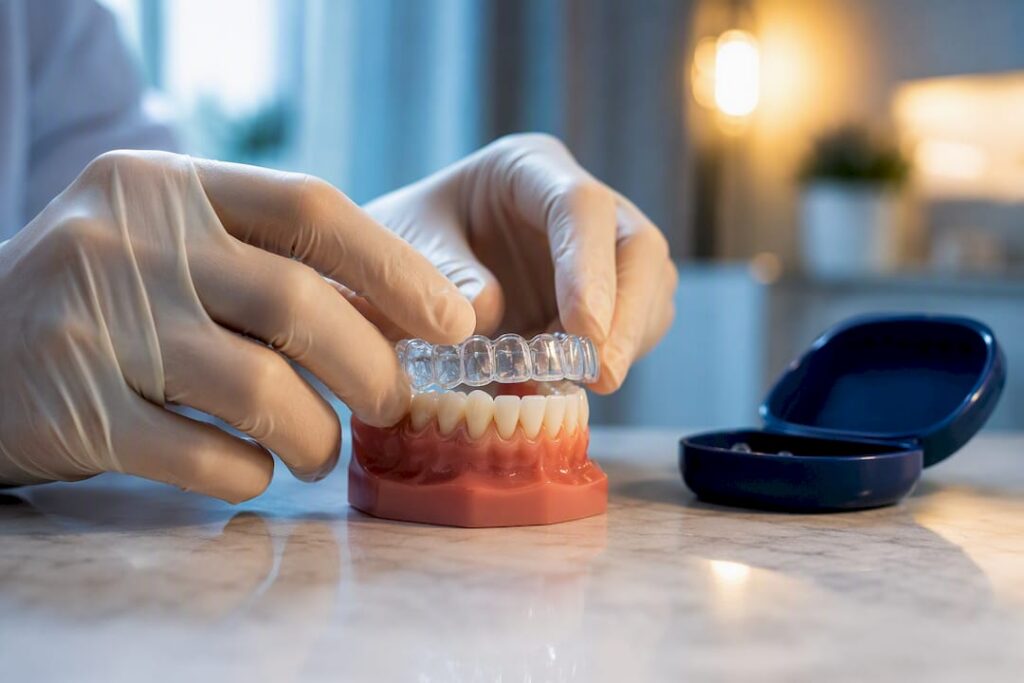
Invisalign in the Bay Area typically runs $4,200 to $12,400, with most patients landing between $4,800 and $8,500 depending on case complexity and what the provider bundles into that number. The final figure hinges on a written, itemized treatment plan, not the headline range a website quotes you. Start with an exam and ask for that itemized estimate before comparing anything else.
TL;DR:
- Case complexity and additional allowances for refinements and retainers can increase the total Invisalign cost by $3,000 or more from the initial quote.
- Provider location, experience, and overhead contribute significantly to Bay Area Invisalign prices, often exceeding the national average.
- Detailed, written estimates with ADA CDT codes are essential for accurate comparison and to prevent surprise charges during treatment.
- Insurance typically covers Invisalign similarly to traditional braces, but preauthorization and benefit limits vary widely by plan.
- Payment options like HSA, FSA, and interest-free financing can reduce out-of-pocket costs, but verifying coverage for refinements and retainers is crucial.
Table of Contents
- How Much Does Invisalign Cost in the Bay Area?
- What Affects Your Invisalign Cost?
- Does Insurance or FSA Cover Invisalign in the Bay Area?
- Getting an Itemized Estimate That Actually Compares
- How Treatment Length Changes Your Total Bill
- Invisalign vs. Traditional Braces vs. Other Clear Aligners in the Bay Area
- What Your Total Out-of-Pocket Cost Actually Includes
- Bay Area Dental, Airway & Sleep on Transparent Invisalign Pricing
- Ready to Get Your Itemized Invisalign Estimate?
- Sources
- FAQ
How Much Does Invisalign Cost in the Bay Area?
San Francisco averages around $7,750 for Invisalign, with reported local ranges stretching from just under five thousand on the low end to over twelve thousand for complex cases. That’s a wide spread, and the reason comes down to two things: how complicated your bite correction is, and how much a given practice folds into its base fee versus billing separately.
ToothPrice pegs the San Francisco cash-pay range at roughly between four thousand two hundred and eleven thousand two hundred dollars, while Bay Area clinics more commonly quote between about four thousand eight hundred and eight thousand five hundred for typical adult cases with moderate crowding or spacing. Severe crowding, bite corrections, or cases requiring extended aligner series push toward the top of the range.
- Low end ($4,200 to $5,500): Minor crowding or spacing, shorter treatment, fewer aligners
- Typical ($4,800 to $8,500): Moderate correction, standard 12 to 24 month timelines
- High end ($9,000 to $12,400): Complex bite issues, longer treatment, more refinement rounds
San Francisco Invisalign pricing runs significantly above the national average, driven mostly by higher clinical overhead and provider labor costs specific to the Bay Area market.
Here’s the catch that trips up a lot of people comparing quotes online: headline prices frequently exclude retainers, refinement aligners, or the follow-up monitoring visits that come later in treatment. A number that looks like a bargain compared to another office might just be missing line items the other quote included upfront.
What Affects Your Invisalign Cost?
Two patients with the same insurance and the same zip code can get quotes $3,000 apart, and it’s rarely random. Case complexity drives most of the variance. Someone needing 15 aligner trays over eight months pays less than someone needing 40 trays with attachments over two years, because more trays mean more lab production and more monitoring visits.
Provider experience and overhead matter too. A practice in a high-rent commercial corridor in San Francisco carries different costs than one in Fremont or Union City, and that shows up in the fee. Neither is inherently better, but it’s worth knowing why two reputable offices might land on different numbers for a similar case.
What gets bundled versus billed separately changes the math as well:
- Initial records (X-rays, photos, 3D scans) are sometimes included, sometimes a separate line item
- Retainers after treatment can be bundled into the total or billed at completion
- Refinement aligners (extra trays needed to fine-tune results) may be free within a set number of rounds or charged per round
- Monitoring visits during active treatment vary in frequency and whether they’re included in the base fee
Advanced tech like 3D intraoral scanning tends to add value rather than cost. It usually replaces messier, less accurate physical impressions rather than adding a fee on top.
Pro Tip: Ask specifically whether refinements are included and how many rounds are covered. This single question separates a genuinely competitive quote from one that looks cheap until month ten.
Does Insurance or FSA Cover Invisalign in the Bay Area?
Most dental insurance plans that cover orthodontics apply a lifetime maximum benefit that applies once per person regardless of treatment type, though the specific amount varies by plan. That maximum typically covers Invisalign the same way it covers traditional braces, but you need to confirm preauthorization requirements and remaining benefits with your insurer before committing, since coordination details vary significantly by plan.
Beyond insurance, three routes cover most of what’s left:
- HSA or FSA funds. Invisalign qualifies as an eligible orthodontic expense under most health savings and flexible spending accounts, which effectively gives you a pretax discount on the out-of-pocket balance.
- In-office payment plans. Many Bay Area practices offer interest-free monthly plans split over the treatment period, sometimes with family discounts for multiple patients in one household.
- Third-party financing. Outside lenders offer longer repayment terms, but check the APR carefully. A plan advertised as low monthly payments can cost more in total than a cash-pay discount if it stretches out with interest.
Cash-pay discounts are common and worth asking about directly. A 5% to 10% reduction for paying in full upfront can beat a financed plan’s total cost once interest is factored in, even though the monthly number looks less friendly on paper.
Getting an Itemized Estimate That Actually Compares
A real estimate is a written treatment plan, not a verbal ballpark. Ask for the itemized breakdown with ADA CDT codes, such as D8090 for comprehensive orthodontic treatment, so you can line up quotes from different offices apples to apples rather than guessing what each number includes.
- Request the total number of aligners and expected treatment length in writing
- Ask what happens with lost or damaged trays: replacement fee or included?
- Confirm whether retainers are part of the total or billed after treatment ends
- Clarify how many refinement rounds are covered before extra charges kick in
Pro Tip: If a quote won’t break down into ADA codes or won’t specify refinement policy, treat that as a red flag. Vague pricing usually means surprise billing later, not a genuine deal.
How Treatment Length Changes Your Total Bill
Invisalign moves through four phases: records and scanning, the active aligner phase where you swap trays every one to two weeks, refinements if your teeth need extra adjustment, and retention once treatment wraps up.
- Records visit: Initial scans and treatment planning, usually a flat fee or bundled into the total
- Active phase: The bulk of treatment, typically 12 to 24 months depending on complexity
- Refinements: Additional trays if teeth need fine-tuning beyond the original plan
- Retention: Retainers to hold the result, worn nightly for years afterward
Longer treatment means more lab-produced trays and more monitoring visits, both of which add cost if they fall outside your original bundle. Retainer replacement, if you lose or crack one two years down the road, typically runs separately from the original treatment fee, so ask what that costs before you’re the one calling in a panic.
Invisalign vs. Traditional Braces vs. Other Clear Aligners in the Bay Area
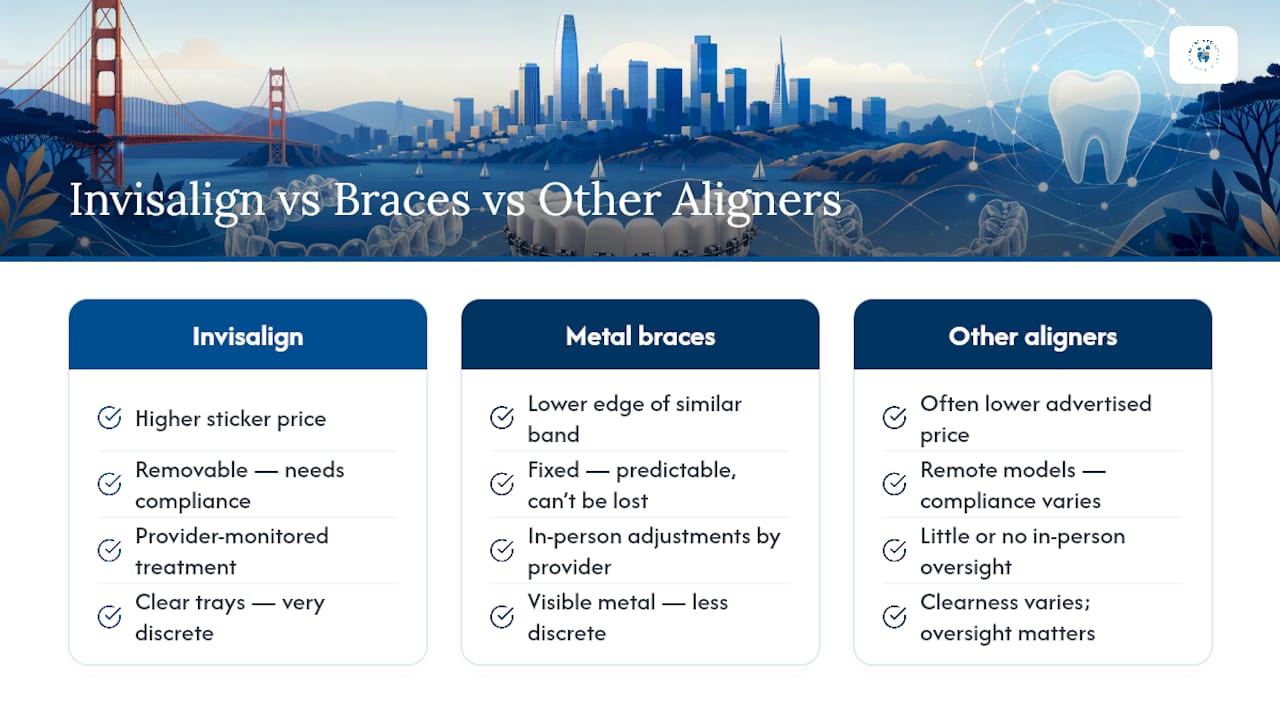
Traditional metal braces in the Bay Area generally cost somewhat less than Invisalign for comparable complexity, often landing in a similar band but at the lower edge, since bracket and wire materials cost less than custom-manufactured aligner trays. Braces also don’t require patient compliance in the same way. You can’t lose them or forget to wear them, which sometimes makes them the more predictable option for complex bite corrections in kids and teens.
Other clear aligner brands sometimes advertise lower prices, particularly mail-order or direct-to-consumer models that skip in-person provider visits entirely. That lower price usually reflects less oversight, not better value. Invisalign’s SmartTrack material and provider-monitored process mean a dentist or orthodontist is checking progress throughout treatment, catching problems a fully remote model would miss.
For adults specifically weighing discretion, Invisalign holds an edge that’s hard to price into a spreadsheet: clear trays versus visible metal matters a lot for people in client-facing jobs across San Francisco and the wider Bay Area. Whether that discretion is worth the price gap over braces is a personal calculation, but it explains why so many working professionals choose it despite the higher sticker price.
The real comparison isn’t Invisalign versus braces in the abstract. It’s your specific case complexity against each option’s fee for that complexity, which is exactly why an itemized, case-specific estimate matters more than any general price comparison.
What Your Total Out-of-Pocket Cost Actually Includes
Beyond the headline aligner fee, a realistic budget includes several line items that rarely make it into marketing copy.
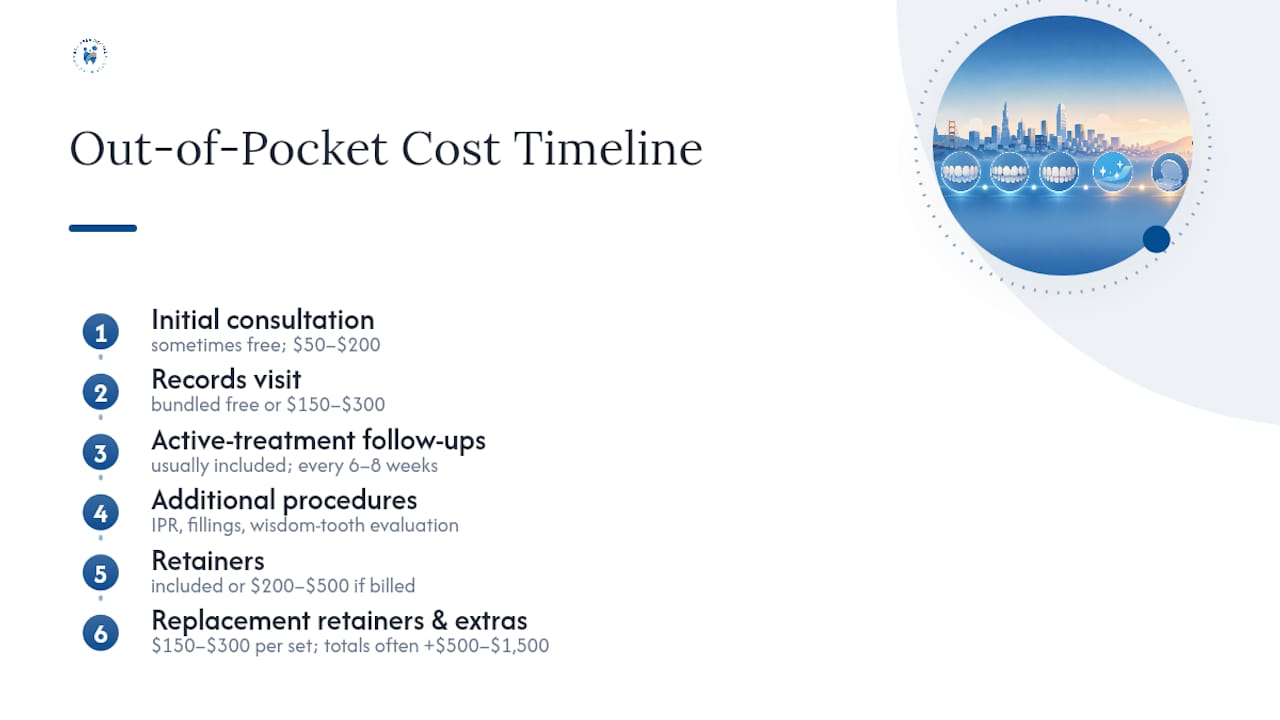
The initial consultation is sometimes free, sometimes $50 to $200, and usually includes a preliminary exam and discussion of whether you’re a candidate. The records visit, including 3D scans and photos, ranges from bundled-in-free to a separate $150 to $300 charge. Follow-up visits during active treatment, typically every six to eight weeks, are usually included in the base fee but confirm this upfront.
Additional treatments can add real cost before Invisalign even starts. Some patients need interproximal reduction (slight enamel filing to create space), a filling replaced, or a wisdom tooth evaluated first. Others need attachments, small tooth-colored bumps that help aligners grip certain teeth, which don’t usually cost extra but do signal a more complex case.
Post-treatment, retainers run anywhere from included-in-total to $200 to $500 if billed separately, and replacement retainers down the road typically cost $150 to $300 per set. Add up the full picture, consultation through retention, and the number you land on will usually run higher than the aligner-only figure quoted online, sometimes by $500 to $1,500 depending on how much your specific case needs.
Bay Area Dental, Airway & Sleep on Transparent Invisalign Pricing
Bay Area Dental, Airway & Sleep in Fremont approaches orthodontic pricing the same way it approaches airway and sleep care: root causes and full disclosure over guesswork. The practice uses 3D imaging and minimally invasive treatment methods to build treatment plans that account for airway health alongside straightening, which matters if crowding or bite issues connect to sleep or breathing patterns.
Some practices coordinate with dental insurance where orthodontic benefits apply and work with HSA and FSA accounts for eligible expenses. Patients often receive a written estimate before committing, and follow-up communication may include tailored support for patients who need clear, adapted explanations of their treatment plan and costs.
— Admin
Ready to Get Your Itemized Invisalign Estimate?
If you’re past the research phase and want a number specific to your teeth, not a citywide average, the next move is a consultation. Some Bay Area practices build itemized estimates around a written treatment plan, not a ballpark figure pulled from a price chart.

If you schedule a consultation, bring your dental insurance card, any recent X-rays or scans from a prior dentist, and a written list of questions, especially about refinement policy and retainer costs, since those are common points of surprise for patients. At the first visit, expect a clinical exam, possibly a 3D scan if you’re a candidate for Invisalign, and discussion about payment options, including HSA/FSA eligibility and financing.
You’ll walk out with a real number tied to your case, not a range pulled from a website. Schedule your consultation with Bay Area Dental, Airway & Sleep and get a plan that accounts for your teeth, your budget, and your timeline.
This article is general information, not a substitute for advice from a qualified doctor. Consult a qualified healthcare professional about your own circumstances before acting on anything here.
Sources
- Invisalign / Clear Aligners Cost in San Francisco, CA (2026) — Compare Local Quotes | CostWhale
- Invisalign Cost in San Francisco, CA: $4,200–$11,200 (2026) | ToothPrice
FAQ
How much does Invisalign cost in the Bay Area?
Most Bay Area patients pay between $4,800 and $8,500, though the full range runs from about $4,200 to $12,400 depending on case complexity and what the quote includes.
Does insurance cover Invisalign in San Francisco?
Most dental insurance plans that cover orthodontics apply a lifetime maximum benefit that applies once per person regardless of treatment type, though the specific amount varies by plan. You need to confirm preauthorization and remaining benefits with your specific insurer.
Can I use HSA or FSA funds for Invisalign?
Yes, Invisalign qualifies as an eligible expense under most health savings and flexible spending accounts, which reduces your effective out-of-pocket cost using pretax dollars.
What should an itemized Invisalign estimate include?
It should list ADA CDT codes such as D8090, the total number of aligners, refinement policy, retainer fees, and whether follow-up visits are bundled into the base price.
Is Invisalign more expensive than braces in the Bay Area?
Traditional braces often cost somewhat less than Invisalign for comparable complexity, but the gap narrows for straightforward cases and Invisalign offers discretion braces can’t match.
Does Bay Area Dental, Airway & Sleep offer payment plans for Invisalign?
The Fremont practice coordinates with dental insurance and HSA/FSA accounts and provides written itemized estimates before treatment begins, so ask about specific payment options during your consultation.