

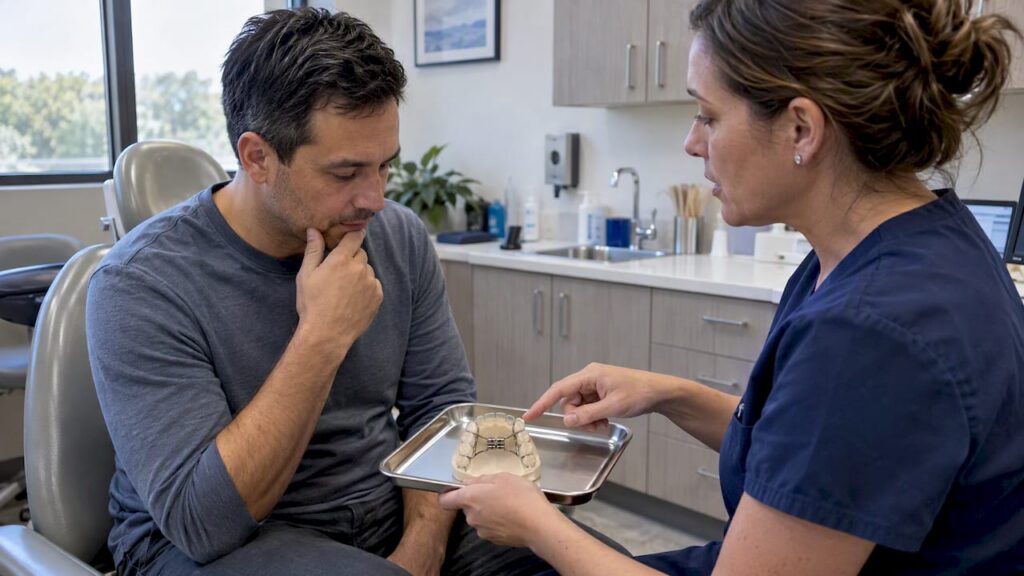
Palate expansion reliably increases nasal cavity volume and often reduces nasal airway resistance, which can make nasal breathing noticeably easier. It is not a guaranteed fix for obstructive sleep apnea, especially in adults, because the airway changes that matter most for sleep happen lower in the throat and respond less predictably. The sensible next step is a multidisciplinary evaluation with an orthodontist and an ENT or sleep specialist before expecting expansion alone to solve a breathing problem.
TL;DR:
- Palate expansion reliably increases nasal cavity volume and often reduces nasal airway resistance, but it does not consistently improve the lower airway or sleep apnea symptoms.
- Skeletal expansion through appliances like RME or MARPE produces true bone widening, which is most effective in children and early adolescents before the sutures fuse.
- Evidence shows nasal volume generally increases with expansion, but large individual variability limits its use as a standalone treatment for sleep-disordered breathing.
- Adults require surgical methods like SARPE or DOME for effective skeletal expansion, as their sutures are fully fused and less responsive to mechanical forces.
- A multidisciplinary approach, including imaging, functional testing, and specialist evaluation, is essential since structural changes do not automatically translate to sleep or breathing improvements.
Table of Contents
- How Palate Expansion Works to Change Airway Anatomy
- Types of Expanders and Who Each One Suits
- What the Evidence Says About Airway and Sleep Outcomes
- Who Is a Good Candidate for Palate Expansion
- What to Expect From Evaluation Through Retention
- Risks, Downsides, and Realistic Expectations
- Building a Multidisciplinary Care Team
- How We Approach Airway-Focused Palate Expansion
- A Balanced Take for Parents and Adults Weighing Expansion
- Getting an Airway Evaluation With Us
- FAQ
- Sources
How Palate Expansion Works to Change Airway Anatomy
A palatal expander widens the upper jaw by applying steady outward pressure across the midpalatal suture, the seam of tissue running down the center of the roof of the mouth. In children and younger adolescents, that suture has not fused, so the pressure gradually separates it and new bone fills the gap as the halves of the maxilla spread apart. This is skeletal expansion: an actual widening of the bony arch, not just a shift in tooth position.
In older teens and adults, the suture is more interlocked and partly fused, so a standard appliance tends to tip the teeth outward instead of moving bone. That distinction between skeletal expansion and dental tipping matters for the airway because only the skeletal change reliably reshapes the nasal floor and the walls of the nasal cavity. Tipping teeth makes the dental arch look wider without doing much for the space behind the nose.
The anatomical space most consistently affected is the nasal cavity itself. A systematic review of rapid palatal expansion found that RME produces measurable increases in nasal cavity volume and often lowers nasal airway resistance, widening the floor of the nose as the palate spreads. Changes further back, in the nasopharynx and oropharynx, are far less consistent from patient to patient. That inconsistency is the central reason expansion cannot be sold as a universal airway fix: the nose often gets bigger, but the throat does not always follow suit.
Clinicians track these changes with a few standard tools:
- CBCT imaging (cone-beam computed tomography) measures three-dimensional volume changes in the nasal cavity and pharynx before and after treatment.
- Rhinomanometry quantifies nasal airway resistance directly, showing whether air actually moves through the nose more easily.
- Acoustic rhinometry and clinical breathing assessments supplement imaging when resistance measures alone do not explain a patient’s symptoms.
None of these measures tracks sleep quality directly. A wider nasal cavity on a CBCT scan is a structural finding, not proof that someone’s apnea has resolved, which is why airway-focused teams pair imaging with functional testing before declaring success.
Types of Expanders and Who Each One Suits
Device choice depends heavily on age, skeletal maturity, and the specific transverse problem being corrected. The four main categories serve different patients and carry different airway implications.
- RME/RPE (rapid or slow maxillary expansion): The standard pediatric appliance, usually a tooth-borne jackscrew cemented to the molars and turned on a set schedule. Because children’s sutures are still open, RME produces genuine skeletal widening and the nasal cavity volume gains that reviews consistently report.
- MARPE (miniscrew-assisted rapid palatal expansion): A hybrid device anchored partly to the palate’s bone with mini-implants, designed for late adolescents and young adults whose sutures are beginning to fuse. It allows a meaningful skeletal response without a surgical cut, making it a middle option between pediatric RME and full surgical expansion.
- SARPE (surgically assisted rapid palatal expansion) and DOME: Reserved for adults with fully fused sutures, these combine a surgical release of the bone with an expansion appliance, since mechanical pressure alone cannot separate a mature suture. DOME (distraction osteogenesis maxillary expansion) is a related technique that anchors expansion directly to the palatal bone and is sometimes used specifically to address adult nasal obstruction and sleep-disordered breathing.
- Slow or removable expanders: Used in very young children, these apply gentler, gradual force and are easier to tolerate, but produce smaller and slower skeletal changes. They suit early intervention when a narrow palate is identified before all baby teeth have been lost, though the trade-off is a longer timeline and less certainty about how much the nasal cavity will ultimately change.
The practical rule of thumb: the earlier a true skeletal deficiency is treated, the more predictable the bony and nasal response. By the time a patient reaches adulthood, the choice narrows to MARPE for a less invasive route or SARPE/DOME when the suture is fully fused and a surgical assist is unavoidable. Facial growth stage, not age in years alone, ultimately decides which category fits.
What the Evidence Says About Airway and Sleep Outcomes
The research base on palate expansion and airway health is more mature on structure than on function, and that gap matters for anyone weighing the treatment primarily for sleep.
On nasal volume, the evidence is consistent. A systematic review of RME’s effects on the upper airway found significant increases in nasal cavity volume and reduced nasal airway resistance across the studies examined, while changes in the nasopharynx and oropharynx were considerably less uniform. That pattern repeats across the broader literature: the space right behind the nose expands reliably, and the space behind the tongue and soft palate does not always follow.
On sleep apnea specifically, results are promising but inconsistent. A case-control study of RME in children with obstructive sleep apnea reported short-term improvements in upper-airway space and symptoms after treatment, but noted that most available studies lack long-term polysomnography follow-up, meaning researchers rarely confirm whether early gains hold up months or years later. A related evidence synthesis found that combining adenotonsillectomy with maxillary expansion produced additive reductions in AHI in children who had both enlarged tonsils and a narrow maxilla, suggesting the two problems often need to be addressed together rather than expecting expansion to compensate for untreated tonsillar obstruction.
Clinical review bodies urge caution about overstating the connection. A multidisciplinary craniofacial growth roadmap recommends considering maxillary expansion as one element of an integrated plan for pediatric sleep-disordered breathing, while explicitly cautioning that expansion is not a standalone cure for pediatric OSA. AADSM consensus guidance goes further, stating that maxillary constriction should be identified as a problem in its own right, independent of any OSA diagnosis, and that expansion should not be presented as the primary treatment for curing pediatric OSA.
A reproducible gain in nasal cavity volume is not the same as a measured reduction in AHI. One review of the orthodontist’s role in managing pediatric OSA made this point directly: increased nasal cavity volume after RME does not necessarily translate into functional airway improvement unless that improvement is independently confirmed by clinical symptoms or polysomnography. Treating a CBCT scan as the endpoint, rather than the patient’s actual breathing during sleep, is the most common evidence-mismatch families and clinicians encounter.
The methodological limitations behind these mixed findings are fairly consistent across studies:
- Most trials use different outcome measures (imaging volume, nasal resistance, AHI, symptom questionnaires), making head-to-head comparison difficult.
- Follow-up periods are frequently short, often ending at the retention phase rather than tracking patients for years afterward.
- True randomized controlled trials are scarce; much of the evidence comes from case series and case-control designs.
- Adult data, particularly for MARPE, comes from small cohorts, which limits how confidently results generalize.
Stronger future research would need long-term polysomnography tracking, standardized quality-of-life measures, and larger adult samples before anyone can responsibly call palate expansion a reliable OSA treatment on its own.
Who Is a Good Candidate for Palate Expansion
Not every narrow palate needs correction, and not every case of snoring points to a transverse maxillary problem. A few clinical and anatomical signals tend to indicate expansion is worth pursuing.
- A high, narrow palate or posterior crossbite on clinical or imaging exam suggests a true transverse maxillary deficiency, the kind of structural narrowing expansion is designed to correct.
- Chronic mouth breathing, especially in a child who habitually breathes through an open mouth during the day and at night, often accompanies a constricted maxilla and warrants evaluation.
- Persistent snoring paired with visible maxillary narrowing is a stronger indication than snoring alone, since snoring has many causes unrelated to palate width.
- Pre-pubertal and early adolescent age offers the most predictable skeletal response, since the midpalatal suture is still open; MARPE becomes the more realistic option once a patient moves past that growth window, and SARPE applies once the suture has fully matured.
- Adenotonsillar hypertrophy or obesity present alongside a narrow palate change the care pathway substantially, since enlarged tonsils or excess soft tissue can drive obstruction independent of maxillary width and usually require an ENT or sleep medicine referral before or alongside orthodontic treatment.
When any of these comorbid conditions are present, expansion by itself is unlikely to resolve the breathing problem, and treating the airway as a single-cause issue tends to disappoint families who expected the appliance alone to fix snoring or witnessed apnea events.
What to Expect From Evaluation Through Retention
A full airway-oriented expansion case typically moves through a fairly predictable sequence, though timelines vary by appliance and by how much correction is needed.
- Initial evaluation includes a dental and orthodontic exam to confirm a true transverse deficiency, CBCT imaging when the case calls for three-dimensional measurement, and a sleep evaluation, pediatric or adult polysomnography, when the patient reports snoring, witnessed pauses in breathing, or daytime fatigue.
- Active expansion for a standard RME appliance usually runs two to six weeks of activation, during which the screw is turned on a set schedule to gradually widen the arch.
- Retention follows for several months while the new bone fills in and stabilizes, holding the appliance or a passive retainer in place so the gains do not collapse back.
- Full orthodontic treatment, when braces or aligners follow expansion to finish aligning the teeth, extends the overall timeline well beyond the expansion phase itself.
- Repeat imaging or polysomnography is ordered selectively, usually when the original indication was airway-related, to confirm the anatomical change produced an actual functional benefit rather than assuming it did.
Pro Tip: Ask your provider in advance which outcome they plan to re-measure after retention, nasal resistance, CBCT volume, or a repeat sleep study, so you know what “success” will actually look like for your case.
Myofunctional therapy often runs alongside or after active expansion, training tongue posture and nasal breathing habits so the new bony space gets used rather than defaulting back to old mouth-breathing patterns. Addressing separate nasal obstruction, allergies, a deviated septum, or enlarged turbinates, also matters, since a wider palate does little good if air still cannot get through the nose easily.
Risks, Downsides, and Realistic Expectations
Expansion is generally well tolerated, but it is not without friction, and the functional payoff is less guaranteed than the structural one.
- Short-term discomfort is common in the first few days after each activation: pressure or soreness across the palate, temporary difficulty with certain speech sounds, and an adjustment period for chewing and swallowing around the appliance.
- Hygiene challenges come with any fixed appliance, since food debris collects around the jackscrew and bands, raising the importance of careful brushing and follow-up cleanings.
- Tooth tipping instead of true skeletal movement is a risk in patients whose sutures are already partially fused, which produces a wider-looking smile without the airway benefit that comes from actual bone widening.
- Relapse without adequate retention can erode gains made during active expansion, since newly formed bone needs time and a stable retainer to fully mature.
- Root or periodontal concerns are uncommon but possible if an appliance is applied to a patient whose anatomy was not appropriate for that device, which is part of why imaging and a proper exam come before treatment, not after.
The most important expectation to set plainly: a wider palate and a bigger nasal cavity are structural wins, but they do not automatically equal a cured sleep apnea diagnosis. Review evidence on orthodontic management of pediatric OSA calls for more well-designed randomized trials that track functional breathing outcomes and long-term follow-up precisely because volumetric gains and clinical cure are not interchangeable. Anyone with suspected moderate to severe OSA should treat expansion as one possible piece of a larger plan, not the sole therapy, and should pursue an ENT or sleep medicine evaluation rather than waiting to see if a wider palate resolves the problem on its own.
Building a Multidisciplinary Care Team
Airway-focused palate expansion works best as a coordinated effort rather than a single provider’s call, and knowing when to loop in each specialist prevents treatment from stalling on an incomplete diagnosis.
- Bring in an ENT when there is tonsillar or adenoid hypertrophy, a deviated septum, enlarged turbinates, or any nasal obstruction that a narrow maxilla alone does not explain.
- Request sleep medicine involvement whenever snoring, witnessed apnea, or daytime fatigue raises concern, since only polysomnography can confirm whether AHI actually improves after expansion rather than assuming it from imaging alone.
- Add myofunctional therapy once the palate has reached its target width, timing the tongue-posture and breathing retraining to consolidate the new space into an actual functional habit rather than letting old patterns persist.
- Keep the orthodontist coordinating the timeline, since appliance selection, activation schedule, and retention protocol all depend on the skeletal maturity findings that start the whole process.
A short checklist worth bringing to any evaluation: ask whether the provider has confirmed a true transverse deficiency with imaging, whether a sleep evaluation is warranted given your symptoms, and who on the team will interpret the results if expansion alone does not resolve them.
How We Approach Airway-Focused Palate Expansion
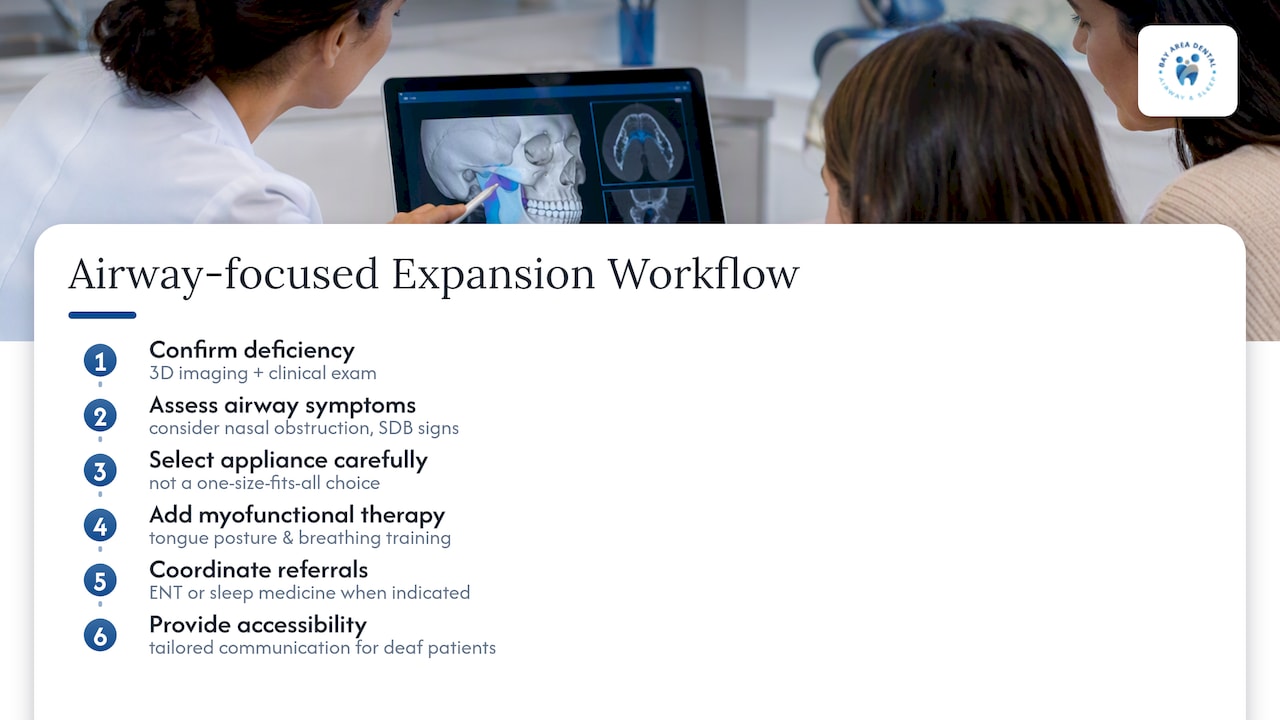
We treat palate expansion as one tool within a broader airway evaluation rather than a one-size-fits-all fix. We combine 3D imaging with a clinical exam to confirm whether a patient actually has a transverse maxillary deficiency before recommending an appliance, and we factor in airway symptoms, not just crowding or crossbite, when planning treatment.
Myofunctional therapy runs alongside orthodontic and airway services, since tongue posture and breathing habits determine whether a wider palate translates into better day-to-day breathing. When a patient’s history suggests enlarged tonsils, chronic nasal obstruction, or signs consistent with sleep-disordered breathing, referrals to ENT or sleep medicine are coordinated rather than treating expansion as a standalone answer.
Accessibility shapes how that care is delivered. Deaf patients are served with tailored communication practices and educational materials designed for their needs, extending an airway-focused, whole-body approach to communities that often face barriers in getting it elsewhere.
A Balanced Take for Parents and Adults Weighing Expansion
The honest bottom line: palate expansion is one of the more reliable ways to gain nasal cavity volume, and that structural change often makes nasal breathing easier. It is a far less reliable way to cure obstructive sleep apnea on its own, particularly once a patient reaches adulthood and the suture has fused.
Before committing to treatment, ask a provider three things: what imaging confirms the transverse deficiency, whether a sleep evaluation is appropriate given your symptoms, and how success will be measured after retention. The right answer is rarely “trust the appliance and see how you feel.” It is tracking objective change, nasal resistance, CBCT volume, or a repeat polysomnogram, against the symptoms that brought you in.
Treat anatomical change and clinical cure as two separate questions. A wider palate is good news. Whether it meaningfully changed your sleep is a question only a follow-up test can answer.
— Admin
Getting an Airway Evaluation With Us
If a narrow palate or ongoing breathing concern has you weighing expansion, we offer a direct path to find out whether it is the right move for your case. Our palatal expansion and orthodontics services include airway-friendly clear aligners alongside traditional expansion, and we pair that work with myofunctional therapy to help new anatomical space turn into better daily breathing.
A first visit with us starts with a clinical exam and imaging to confirm whether a true transverse deficiency exists, followed by a conversation about whether your symptoms warrant a sleep evaluation. When they do, we coordinate directly with ENT and sleep specialists rather than leaving you to piece referrals together on your own. If you are ready to find out where you stand, book an airway evaluation with our team.
This article is general information, not a substitute for advice from a qualified doctor. Consult a qualified healthcare professional about your own circumstances before acting on anything here.
FAQ
When is it too late to use a palate expander?
Expansion is most predictable before the midpalatal suture fuses, typically before or during early adolescence, though exact timing varies by individual growth. Adults with a fused suture are not out of options: MARPE can achieve a meaningful skeletal response without surgery, and SARPE combines a surgical release with an expander when the suture is fully mature.
How painful is a palatal expander?
Most patients describe pressure or soreness across the palate for a few days after each activation rather than sharp pain, and this typically eases between adjustments. Speech and swallowing may feel awkward at first but generally adapt within the first one to two weeks.
What are the downsides of using a palate expander?
Common downsides include short-term discomfort, hygiene challenges around the appliance, and the risk of tooth tipping rather than true skeletal movement if the device is used on a patient whose suture is already fusing. Gains can also relapse without consistent retention, and expansion alone is not a guaranteed cure for moderate to severe sleep apnea.
What age is best for palate expanders?
The pre-pubertal and early adolescent years generally offer the most predictable skeletal response, since the suture is still open and standard RME appliances work well. Once that window closes, MARPE or surgically assisted options become the more realistic path to a true skeletal change.
Can palate expansion cure sleep apnea on its own?
Expansion reliably increases nasal cavity volume and can reduce nasal airway resistance, but consensus guidance from dental sleep medicine panels cautions against presenting it as the primary cure for pediatric OSA. It works best as one part of a plan that includes ENT or sleep medicine evaluation, not a standalone treatment.