

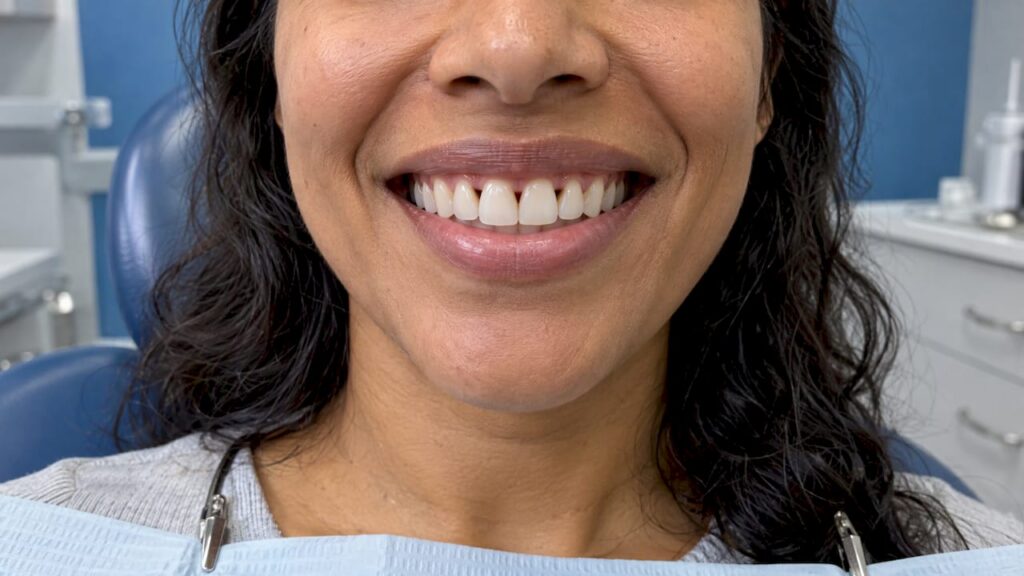
Black triangles are the small, dark, triangle-shaped gaps that show between two teeth just above the gumline. Dentists call them open gingival embrasures. They appear when the little peak of gum between two teeth, the papilla, no longer fills the space. They are common, they are usually harmless on their own, and in many cases they can be closed or softened with a conservative treatment. What matters is why yours appeared, because that decides the right fix.
TL;DR
- Black triangles are very common: a review cited by Colgate found they can occur in up to 67% of people over 20.
- Main causes: tooth shape, gum recession, bone loss from gum disease, aging, overly aggressive cleaning, and teeth straightened by braces or aligners.
- Gums do not regrow on their own. Gentle hygiene can keep things from getting worse, and in minor cases the gum may recover. Bonding, veneers, orthodontic adjustment or gum procedures close the space.
- A gap that is new, or comes with bleeding, swollen or receding gums or loose teeth, deserves a dental exam soon, because it can signal gum disease.
Table of Contents
- What black triangles are and how common they are
- What causes black triangles between teeth
- Black triangles after braces or aligners
- Can black triangles go away naturally?
- How to fix black triangles: the options compared
- Does a black triangle mean something is wrong?
- Perspective: why we start with the cause
- See us in Fremont about your black triangles
- Questions to ask before treatment
- FAQ
- Sources
What black triangles are and how common they are
Look closely at a healthy smile and you will see gum tissue tucked into the V-shaped space between each pair of teeth. When that tissue shrinks back, or never filled the space to begin with, a dark triangle shows through. The darkness is simply the shadow of the empty space.
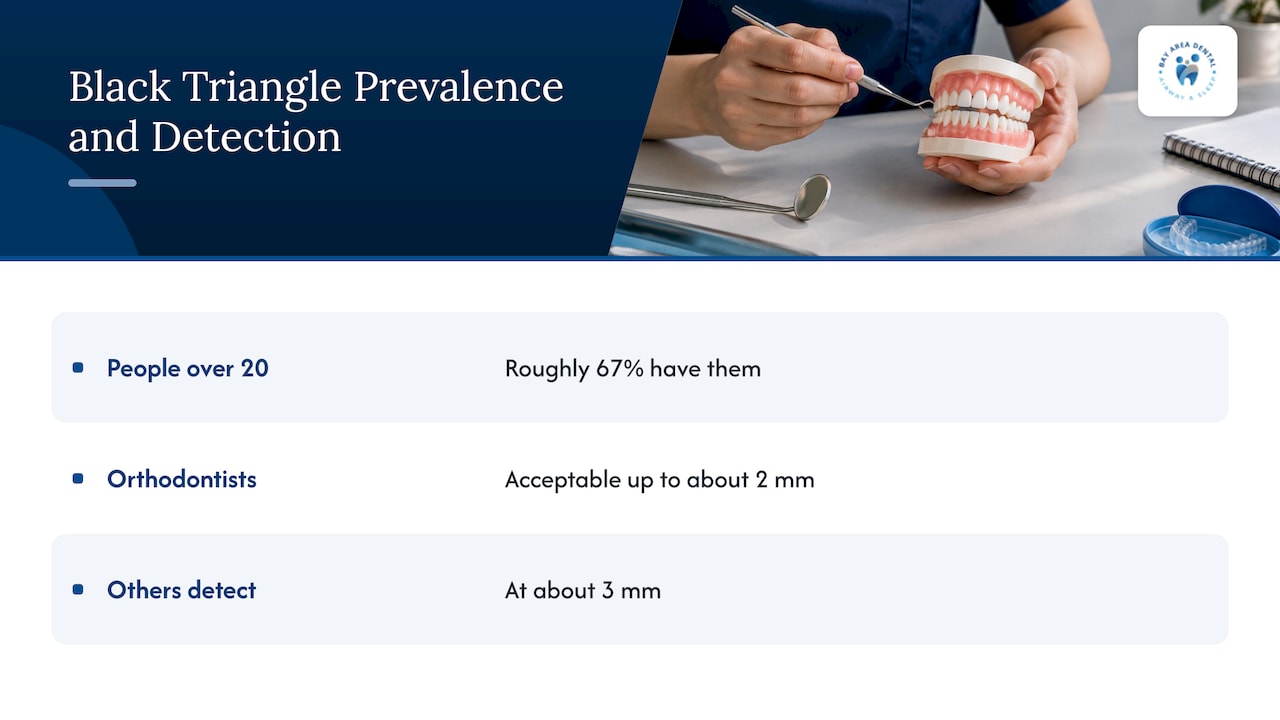
They are not rare. Healthline reports that roughly 67 percent of people over 20 have them, and a review cited by Colgate puts the figure at up to 67%. So if you have noticed one in photos or in the mirror, you are in very large company.
They also vary in how much they matter. A dental publication from Marquette University reports that orthodontists considered an open gingival embrasure acceptable up to about 2 mm, while general dentists and lay people generally could not detect one until it reached about 3 mm. In other words, you may notice a small gap far more than anyone else does.
What causes black triangles between teeth
There is rarely one cause. Most cases combine two or three of the following.
Tooth shape
Teeth that are very triangular, wider at the biting edge and narrow near the gum, touch each other high up and leave a bigger space below the contact. Gum tissue has less room to fill. This is a built-in trait, which is why some people have black triangles even with perfect gum health.
Gum recession and gum disease
When gums pull back, the papilla goes with them. WebMD lists tooth shape, receding gums, aggressive dental hygiene, orthodontic treatment, and bone loss from osteoporosis or severe gum disease among the causes. Mayo Clinic also names new spaces between the teeth that look like black triangles as a symptom of periodontitis, alongside receding gums, bleeding gums and loose teeth.
Bone loss
The papilla is held up by the bone underneath it. When bone is lost to gum disease, the gum loses its support and drops. This is the cause that most needs a professional look, because the bone loss itself needs treatment, not just the cosmetic gap.
Aging
A 2025 peer-reviewed literature review in PMC notes that papilla deficiency increases with age and in people with periodontal disease. It reports that the chance of finding open embrasures rises with age at about 0.012 mm per year, with thinner oral lining, less keratinization, lower papilla height and bone loss as part of the picture. That is a slow change, not a sudden one.
Rough brushing and flossing
Snapping floss down into the gum or scrubbing hard with a stiff brush can injure the papilla over time. The same PMC review says that papilla recession caused by traumatic hygiene habits may be treated by first stopping the injurious cleaning so the tissue can heal, then changing technique.
Braces and clear aligners
See the next section: this is the cause people most often ask about.
Black triangles after braces or aligners
Straightening teeth can reveal black triangles that were already there. The Marquette publication explains that triangular incisor crowns usually overlap before treatment, so once the teeth are straightened, spaces that crooked teeth had been hiding can become apparent. Its authors, citing Burke and colleagues, say the issue should be discussed with the patient before orthodontic treatment begins.
The numbers are not small. A 2018 study cited by Healthline found that adults with braces had a 22 percent likelihood of black triangles between the upper incisors and 36 percent between the lower incisors.
Will they go away on their own? Sometimes the gum tissue adapts and fills in over months, especially in younger patients with healthy gums. Do not count on it. The PMC review says orthodontic treatment can encourage vertical growth of existing soft tissue between the teeth to eliminate a black triangle, but that teeth should not be moved too close together, since close roots may increase bone loss and jeopardize the papilla. A thoughtful treatment plan weighs this before the first aligner is made. If you already finished treatment and see a gap, mention it at your next visit: the answer may be a small refinement rather than a restoration.
If you are considering aligners, our page on airway-friendly clear aligners explains how we approach tooth movement, and our orthodontics cost guide covers what to expect in the Bay Area.
Can black triangles go away naturally?
Gum tissue that has been lost does not simply regrow. But there are two real exceptions worth knowing.
- Injured papilla can calm down. If the gap is minimal and your gums are healthy, Healthline notes that changing your hygiene habits may allow the gums to return to normal. It also says the American Dental Association emphasizes flossing with care to avoid hurting the gums.
- Gums can adapt after tooth movement. As described above, soft tissue sometimes fills in after orthodontic changes.
What helps in the meantime, according to WebMD: floss gently without pressing hard on the gums, use a soft-bristle toothbrush, and avoid gum disease risk factors such as smoking and poor oral hygiene.
A simple daily routine that protects the papilla:
- Slide floss between the teeth and curve it against each tooth, rather than snapping it down onto the gum.
- Brush with a soft brush using light pressure, angled toward the gumline.
- If your gaps are wide, ask us about interdental brushes sized to your spaces, since a brush that is too big can irritate the tissue.
- Keep up with cleanings, so that plaque and early gum inflammation are caught before they cost you more tissue.
How to fix black triangles: the options compared
The PMC review makes an important distinction. Restorative techniques and prosthetic work do not rebuild the lost papilla. They mask the black triangle by lengthening the contact between the teeth. Gum surgery aims at rebuilding, though the review notes that no gold standard has been set yet for surgical reconstruction. Knowing that, you can match the treatment to your goal.
| Approach | How it works | Best suited for | Things to know |
|---|---|---|---|
| Better hygiene habits | Lets an irritated papilla heal | Minimal gaps with healthy gums | No procedure, but results are not guaranteed |
| Composite bonding | Tooth-colored resin added to the sides of the teeth to close the space | Small to moderate gaps | Usually no surgery; masks the gap rather than regrowing gum |
| Orthodontic adjustment | Moves teeth and roots so the contacts sit in a better position | Gaps caused by crowding, tooth position or relapse | Needs a careful plan so the roots are not crowded |
| Porcelain veneers | Reshapes the tooth so the contact point moves toward the gum | Cases where shape, color or alignment also bother you | Cosmetic masking, often combined with other steps |
| Gum procedures | Periodontal treatment aimed at gum health or papilla | Gum recession or bone loss | Directed by gum health, and the review notes no gold standard for papilla reconstruction |
| Hyaluronic acid injections | Aims to regenerate gum tissue | Small gaps, for patients wanting a non-surgical route | Healthline says it is relatively new with little research on how long effects last |
Composite bonding
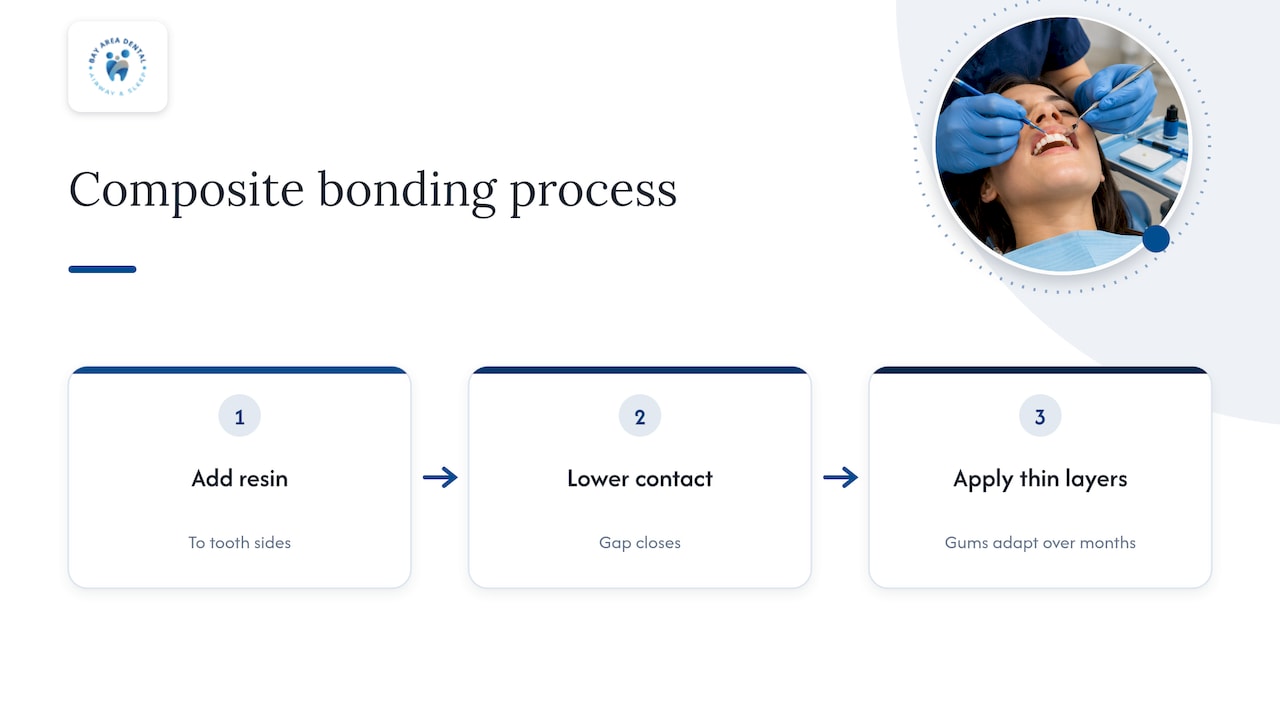
This is the most common starting point for minor black triangles. A dentist adds tooth-colored resin to the sides of the teeth so the contact moves down and the gap closes. Healthline describes it as a process that does not require surgery and unfolds over a period of months, because the resin is applied in thin layers so the gums can adapt.
Bonding is conservative: it adds material instead of removing healthy tooth structure, which fits the way we practice. Read more in our guide to how long cosmetic bonding lasts and on our composite bonding and cosmetic dentistry page.
Orthodontics and veneers together
Sometimes the best result combines both. A 2024 Compendium case report describes a 28-year-old whose teen orthodontic treatment had relapsed, leaving a black triangle between the two upper front teeth. It was corrected with short-term clear aligner treatment plus veneer restorations. The report presents it as a way to align the gum margins, close the embrasure and improve tooth proportion while limiting tooth movement and the number of aligners.
The point for you: when the gap is part of a bigger picture, such as uneven tooth proportions, a small relapse or worn edges, a plan that sequences movement first and restoration second can look better than either step alone.
Gum tissue and periodontal care
If the underlying issue is gum disease or notable recession, the gums come first, since no cosmetic fix lasts on inflamed tissue. Wikipedia’s overview notes that treating the condition often takes an interdisciplinary approach involving periodontal, orthodontic and restorative care, and is generally guided by the patient’s aesthetic preference, with serious recession possibly calling for periodontal treatment. If gum shape is part of what you see in the mirror, our overview of laser gum contouring and the week-by-week recovery shows what that kind of procedure involves.
Does a black triangle mean something is wrong?
Not necessarily. Many are a matter of tooth shape and alignment. Still, they have practical effects. The 2025 PMC review lists phonetic problems (air whistling through the gap when you speak), food impaction, plaque accumulation and increased risk of root cavities as consequences of gingival black triangles. So even if you do not mind how they look, a persistent food trap deserves attention.
When to have a dentist take a look
Book an exam if any of these apply:
- The gap is new. WebMD advises talking to your dentist if you notice new gaps, as they may signal gum disease or bone loss.
- You see other signs of periodontitis. Mayo Clinic lists receding gums, bleeding gums, and loose teeth along with the new spaces.
- Food keeps catching in the same spot, or the gum there is tender or puffy.
- You are about to start braces or aligners and already have triangular teeth or thin gums. Raise it up front, as the Marquette authors recommend.
- You have had treatment and the gap appeared afterward. Mention it so your dentist can tell whether it is a simple tissue adaptation or something to correct.
An exam usually includes checking gum pocket depths and, when needed, X-rays or 3D imaging of the bone, so the cause is known before any cosmetic decision is made.
Perspective: why we start with the cause
We see black triangles often, and the question we hear most is “Can you just fill it in?” Sometimes yes. But we would rather ask why the gap formed first. A triangle from tooth shape is a cosmetic question. A triangle that showed up this year may be a gum health question, and that deserves attention before any material is placed.
Our approach is built around whole-body health and treating root causes instead of only the visible symptom. In practice that means checking gum health, looking at how your teeth and bite fit together, and then choosing the most conservative option that serves your goals. For many patients that is composite bonding, which adds to the tooth instead of removing it. For others it is a short phase of tooth movement with airway-friendly clear aligners, followed by finishing touches.
We also use 3D imaging and lasers where they help us plan precisely and keep treatment comfortable. If you are a parent, a Deaf patient who wants clear communication, or someone who simply wants a calm, unhurried conversation about your options, we build the visit around that.
Bay Area Dental, Airway & Sleep
See us in Fremont about your black triangles
If you want to know what is behind your gaps and which fix suits them, we can examine your gums, teeth and bite and talk through the choices, from composite bonding and veneers to smile makeovers and aligners. We see patients in Fremont and serve families across the Bay Area, including Union City.
Learn more about our cosmetic and restorative services, or contact our practice to book a consultation. Our pages do not publish fixed fees, so we will go through the specifics with you at the visit.
Questions to ask before treatment
Whichever route you choose, a short list of questions helps you compare plans:
- What caused my gap? Tooth shape, gum loss and orthodontic change each point to a different fix.
- Is my gum and bone health stable? Treat disease first.
- How much of this is masking and how much is rebuilding? Bonding and veneers hide the space. They do not regrow the papilla.
- How will I maintain it? Bonded surfaces need good cleaning habits and regular checkups.
- What is the most conservative option? Our guide to minimally invasive dentistry explains why we favor preserving natural tooth structure when we can.
FAQ
Can black triangles be reversed naturally?
Only in limited cases. If the gap is minimal and your gums are healthy, gentler flossing and brushing may let an irritated papilla recover. Lost gum tissue and bone do not regrow on their own, so larger gaps usually need a dental treatment to close or disguise them.
Will black triangles go away after Invisalign or braces?
Sometimes the gum fills in gradually, but many do not close by themselves. Straightening can reveal triangles that crowding had hidden. Tell your dentist if a gap appears, since a small adjustment or bonding can often resolve it.
How common are black triangles?
Very common. Healthline reports roughly 67 percent of people over 20 have them, and a review cited by Colgate gives up to 67%. Many people never notice them, since a gap generally has to reach around 3 mm before most non-specialists can see it.
Are black triangles a sign of bone loss?
They can be, especially when they are new or come with bleeding, receding gums or loose teeth. Many others come simply from tooth shape. A dental exam with gum measurements and imaging can tell the two apart.
Sources
- What Are Black Triangles Between Your Teeth? (Healthline)
- Causes and Treatments of a Dental Black Triangle (Colgate)
- What Causes Black Triangles? (WebMD)
- Periodontitis: Symptoms and causes (Mayo Clinic)
- Interdental papilla recession and reconstruction (PMC)
- The Dilemma of the Open Gingival Embrasure (Marquette University)
- Digital Platform Facilitates Successful Facially Driven Orthodontic-Restorative Treatment (Compendium)
- Angularis nigra (Wikipedia)