

Most people in the Bay Area should plan on roughly $3,000 to $8,000 for braces or clear aligners, and urban, high-cost-of-living markets like ours tend to sit toward the upper part of national ranges. Your own number depends on how complex your bite is, how long treatment takes, which appliance you choose and who treats you. The only reliable figure is a written, all-inclusive quote from an in-person exam. Below, we explain how to read those quotes, what is normally included, and where the savings are.
TL;DR
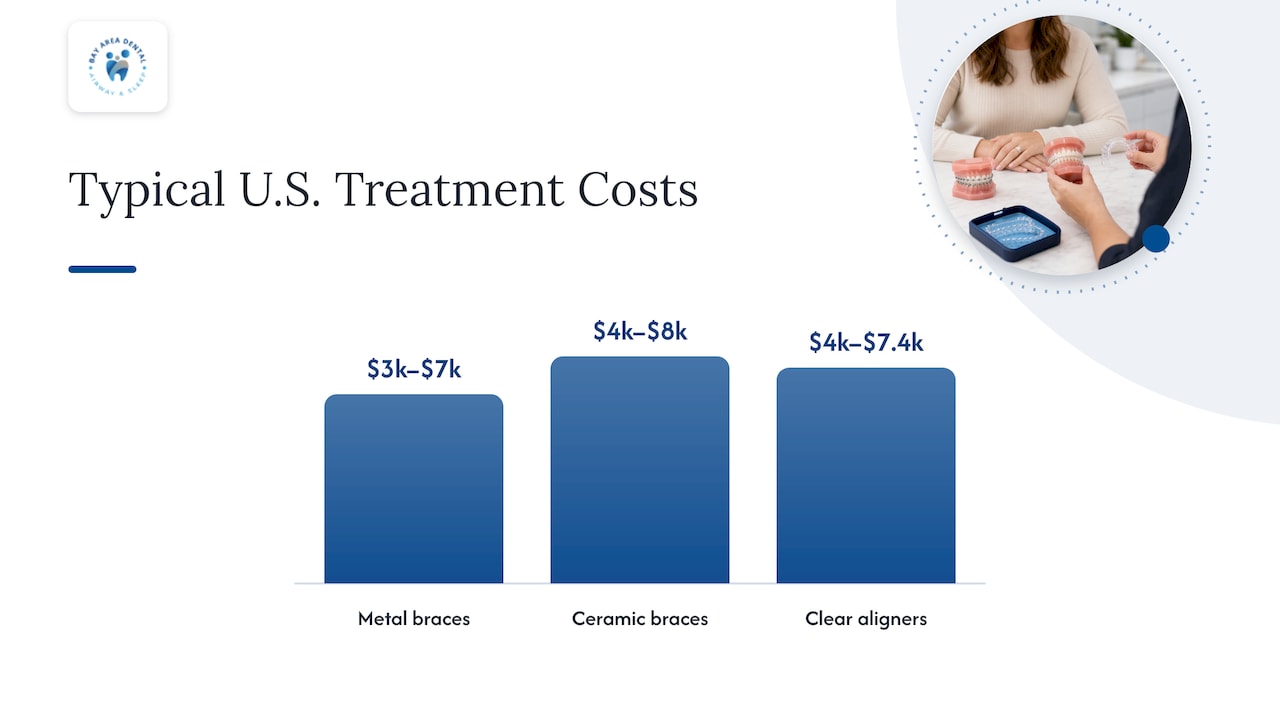
- National ranges: traditional metal braces run about $3,000 to $7,000, ceramic braces about $4,000 to $8,000, and Invisalign about $4,000 to $7,400, according to U.S. News. Expect Bay Area quotes to reflect local costs.
- Severity, treatment length, age, the provider and location set the price, and urban areas with a higher cost of living typically cost more.
- Ask for an all-inclusive fee that spells out appointments, emergency visits and retainers, so two quotes can be compared fairly.
- Insurance usually pays a limited share with a separate lifetime maximum, and HSAs, FSAs and in-house payment plans can soften the rest.
- Children can often be treated more simply and sometimes less expensively if problems are caught early.
Table of Contents
- What braces and aligners cost compared
- Why Bay Area prices run higher
- What actually drives your total
- What a good quote should include
- Does insurance cover orthodontics?
- Ways to lower what you pay
- Is it worth it at 40 or later?
- The Perspective from our team
- Orthodontic care at Bay Area Dental, Airway & Sleep
- How to compare Bay Area estimates side by side
- FAQ
- Sources
What braces and aligners cost compared
National figures are the best published anchor, because no one can honestly quote your Bay Area price without examining you. U.S. News, drawing on dental fee data and expert input, puts the typical ranges like this:
| Treatment | Typical U.S. range | Why it costs what it does |
|---|---|---|
| Traditional metal braces | $3,000 to $7,000 | Durable, widely used, the baseline price |
| Clear (ceramic) braces | $4,000 to $8,000 | Ceramic materials cost more |
| Invisalign and similar clear aligners | $4,000 to $7,400 | Digital planning, custom aligner sets, lab fees |
Those ranges come from U.S. News’s guide to invisible braces, which notes that real fees shift with misalignment severity, treatment length and geography. The same article reports an average U.S. braces cost of about $6,000, citing the ADA’s 2020 fee survey, and says the average varies by region.
Two takeaways. First, aligners and braces overlap heavily in price. Invisalign’s own U.S. comparison page says the two are generally comparable in cost, with braces possibly costing $3,000 to $7,500 without insurance. Second, choosing between them on price alone is usually a mistake. Clear aligners are not suitable for every patient, so a professional assessment should decide what is right for your teeth.
If Invisalign is what you are weighing, our breakdown of Invisalign costs in the Bay Area goes deeper, and our page on braces costs in Fremont does the same for traditional appliances.
Why Bay Area prices run higher
Orthodontic fees are not set by a national price list. They reflect what it costs to run a practice in a given place, plus the complexity of your case. The American Association of Orthodontists notes that case severity, treatment duration and location all influence cost, and that urban areas with a higher cost of living typically have higher treatment costs. San Francisco, the Peninsula, the East Bay and Silicon Valley all fit that description: commercial rent, staff wages and lab costs are high.
That does not mean every Bay Area quote is inflated. It means a $3,000 quote and an $8,000 quote can both be legitimate, because they may cover different things. Which brings us to the factors that matter most.
What actually drives your total
Case complexity and treatment length
Mild crowding or a small gap can sometimes be corrected in months. A significant overbite, crossbite or extractions-plus-space-closure cases can take two years or more. The AAO president, quoted by USA TODAY, said that cost depends on severity and expected treatment time, and that clear aligners can carry higher laboratory fees.
The type of appliance
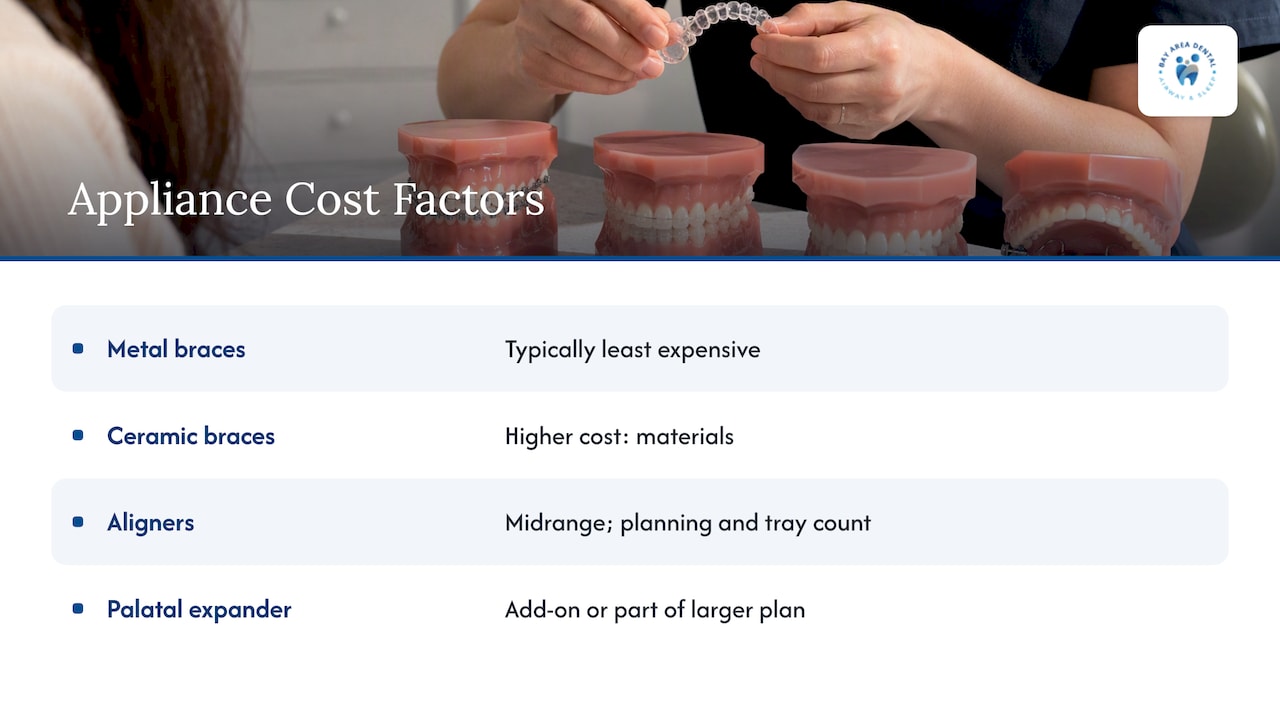
Metal braces are typically the least expensive. Ceramic braces cost more because the materials do. Aligners sit in between, with the price tied to the digital planning and the number of trays. Palatal expanders, which widen a narrow upper jaw, are a separate component some patients need, particularly children, and may be quoted as an add-on or as part of a larger plan.
Age
Age matters in two ways. Children may benefit from early, targeted treatment that reduces the work needed later. Adults often face longer treatment and more restorative coordination, for example with worn teeth or past dental work. Invisalign’s comparison page lists age alongside complexity, length, provider and location as factors that determine cost.
The provider
A specialist orthodontist, a general dentist with advanced aligner training, and a corporate or online-only program can all straighten teeth, and their pricing models differ. What matters is who diagnoses, who monitors progress in person, and who handles problems. A cheaper headline price that excludes monitoring visits or retainers is not cheaper.
What a good quote should include
The AAO advises patients to request an all-inclusive fee and confirm what it covers: the braces or aligners, regular appointments, emergency visits and retainers. Use this checklist when you compare estimates:
- Diagnostic records. Are X-rays, photos and digital scans included, or billed separately?
- Every aligner or bracket set. Does the fee cover the full treatment, including a refinement round if teeth need fine-tuning?
- Visits. Are all adjustment and check-in appointments included?
- Emergencies. Is a broken bracket or lost aligner covered, or charged per visit?
- Retainers. Are final retainers included? Teeth move back without them, so this is not optional in practice.
- Payment terms. What is the down payment, the monthly amount, and is there interest?
On the popular question of whether $3,000 is a good price for Invisalign: it can be, if the quote is complete. Invisalign’s affordability guide says a comprehensive quote generally bundles the treatment plan, digital scans, all aligners and regular check-ins, and that some practices also include final Vivera retainers and refinement aligners. A low figure that leaves out several of those items may end up costing more than a higher, fully inclusive one. Also remember the case matters: a price that fits a simple case may be unrealistic for a complex one.
Does insurance cover orthodontics?
Sometimes, partly. The AAO says dental insurance may cover a percentage of treatment or provide a fixed benefit, and coverage varies by policy. FAIR Health, a nonprofit that publishes consumer insurance guidance, explains that plans covering orthodontics often pay up to 50% of charges subject to a separate lifetime maximum, and that adult coverage is usually limited or unavailable. It also notes that orthodontia commonly has its own lifetime maximum instead of sharing the annual maximum for other dental services, though provisions vary by plan.
In practice, that means:
- Read your plan’s orthodontic section before the consultation. Look for the percentage, the lifetime cap, the age limit and any waiting period.
- Ask the practice whether it can submit a predetermination of benefits, so you know what the plan will pay before you commit.
- Do not assume a lifetime maximum of, say, $1,500 covers half of a $6,000 case. The cap is the ceiling, not a percentage.
Medi-Cal and public coverage
Public coverage is narrow. As an ADA-published analysis puts it, Medicaid orthodontic coverage is limited to people under 21 who meet specific criteria for a handicapping malocclusion, and the rules vary by state. Cosmetic alignment alone does not qualify. If your child may qualify, ask a provider that accepts the program and check California’s current criteria with the plan directly.
Ways to lower what you pay
The AAO’s financial planning guidance lists the common options: in-house payment plans, third-party financing such as CareCredit, and tax-advantaged HSAs or FSAs. It also says some practices offer discounts for paying upfront, for multiple family members starting at the same time, or for referrals.
A few practical notes for Bay Area families:
- Use pre-tax dollars. If your employer offers an FSA or you have an HSA, orthodontic fees are a classic use. This overview of HSA and FSA use for orthodontics explains how those accounts and predetermination of benefits can reduce the net cost. Check your plan year deadlines, since FSA elections are set annually.
- Ask about in-house plans. Many practices spread payments over the length of treatment, often with little or no interest when there is a down payment. Get the terms in writing.
- Time siblings together. If two children need treatment, ask whether starting both in the same period earns a discount.
- Look at charitable programs for children. The AAO points to programs including Gifted Smiles, Smiles Change Lives and Smile for a Lifetime, which provide treatment at low or no cost to qualifying children under 18.
Is it worth it at 40 or later?
A frequent search is whether braces are worth it later in life. Teeth can move at any age as long as gums and bone are healthy. The reasons adults go ahead are usually practical: easier cleaning of crowded areas, a bite that wears teeth less evenly, and comfort. The trade-offs are also practical: adult insurance benefits are usually limited, as noted above, and existing crowns, bridges or gum problems may need attention first. A thorough exam is how you find out whether treatment is a good investment for you specifically.
The Perspective from our team
We see orthodontics as part of a bigger picture, not a standalone cosmetic product. Crooked teeth, a narrow palate and a restricted airway are often connected, which is why we approach orthodontic planning with breathing, sleep and jaw development in view. That shapes how we think about cost.
First, the cheapest plan is rarely the cheapest outcome. If a narrow upper jaw contributes to mouth breathing or poor sleep, straightening the front teeth alone can leave the cause untouched. Our article on what orthodontics can and cannot fix for mouth breathing explains where that line sits, and our piece on why a sleep study should come first covers when airway concerns should be evaluated before appliances are chosen.
Second, timing matters for kids. Parents who watch for the signs described in our guide to interceptive orthodontics around age 7 often have more, and sometimes simpler, options than parents who wait until a problem is advanced.
Third, we believe a quote should be understandable. You should leave a consultation knowing what is included, what is not, and why the plan is recommended. Dental care should also be accessible: we serve Deaf patients with communication tailored to their needs, so cost conversations are as clear as clinical ones.
— Admin
Orthodontic care at Bay Area Dental, Airway & Sleep
Our Fremont practice offers airway-friendly clear aligners and palatal expansion, planned alongside general, pediatric and airway care under one roof. We do not publish a flat price list, because fees depend on the factors above, so the first step is an exam and a written estimate that explains what your plan includes.
To see how we approach treatment, visit our orthodontics page or contact the practice to book a consultation. Bring your dental insurance card so we can help you understand your benefits.
How to compare Bay Area estimates side by side
Get at least two written quotes for the same type of treatment, then line them up. A simple method:
- Ask each office for the total fee, not just the monthly payment.
- Note the estimated treatment time, since a longer plan may mean more visits and more risk of added charges.
- Confirm who will perform your adjustments and who will see you in an emergency.
- Check the retention plan and what it costs if a retainer breaks or is lost.
- Ask what happens if you need extra aligners or more time than estimated.
Then weigh the difference. A quote that is $500 lower but excludes retainers and refinements is not a bargain. A quote that is higher but fully inclusive, from a team that explains your diagnosis clearly, often is.
FAQ
How much are braces in the Bay Area?
National ranges are about $3,000 to $7,000 for metal braces and $4,000 to $8,000 for ceramic, per U.S. News. Bay Area practices operate in a higher cost-of-living market, so quotes often reflect that. Only an exam and written estimate will give you your actual figure.
Is $3,000 a good price for Invisalign?
It can be, if the quote includes the treatment plan, scans, all aligners, check-ins and ideally retainers and refinements. A simple case may fit that price; a complex case may not. Compare what is included before you compare totals.
Does insurance pay for braces?
Some dental plans pay part of orthodontic treatment, often up to about half, with a separate lifetime maximum, and adult coverage is frequently limited, according to FAIR Health. Check your policy and ask the office for a predetermination of benefits.
Can I pay for orthodontics monthly?
Yes, in most cases. Common options include in-house payment plans, third-party financing, and HSA or FSA funds, as described by the American Association of Orthodontists. Ask for the terms in writing, including any interest and the down payment.
Sources
- How Much Do Braces Cost? The AAO’s Expert Guide
- Orthodontic Financial Treatment Planning: How to Save Throughout the Year (AAO)
- How Much Do Invisible Braces Cost? (U.S. News)
- Comparing the Cost of Invisalign Treatment vs Braces
- How much does Invisalign treatment cost? Affordability guide
- Invisalign vs. braces: Why one might be better for you (USA TODAY)
- Paying for Orthodontics (FAIR Health)
- Dental Plans (FAIR Health)
- Effects of New York State’s Medicaid Orthodontic Policy (ADA)