

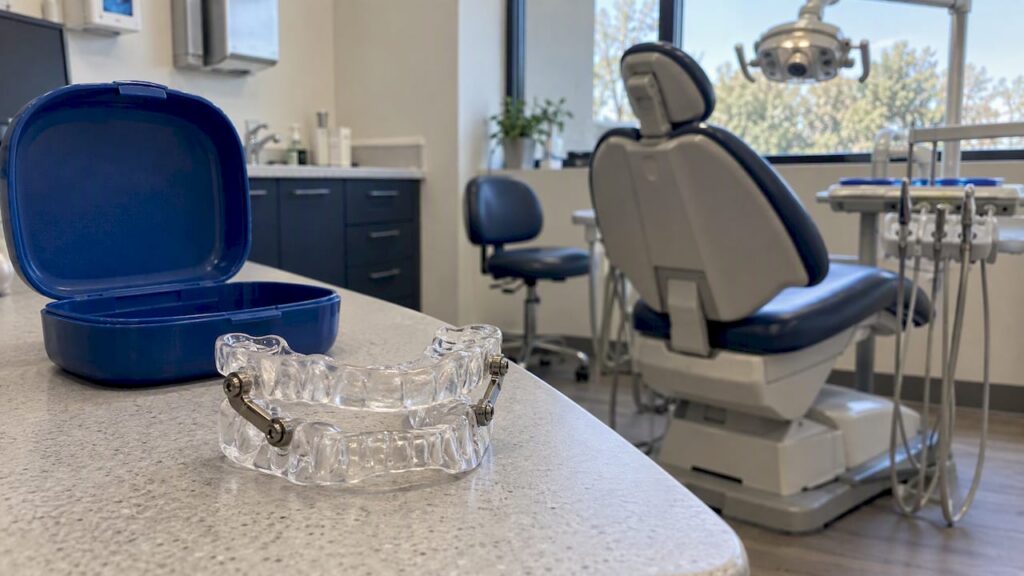
A custom sleep apnea oral appliance in California typically costs between $1,505 and $2,709, with a state average of $2,007 as of May 2026. That is the appliance and the visits around it. The sleep study that proves you need it is usually billed separately, and what you finally pay depends mostly on whether your medical insurance accepts the claim. This guide explains what sits inside the fee, what sits outside it, and how to get a quote you can trust.
TL;DR
- Expect roughly $1,500 to $2,700 for a custom appliance in California, with an average near $2,000. Offices in the Bay Area can land anywhere in that range or above it, depending on the work included.
- A complete quote covers the consultation, impressions, fabrication, fitting and follow-up visits. The diagnostic sleep study is often a separate bill.
- Medical insurance, not dental insurance, is the usual route to coverage, and it requires a physician-confirmed diagnosis.
- Custom devices typically last 3 to 5 years, so think in cost per year, not just the day-one fee.
- Ask for a written, itemized quote before you commit.
Table of Contents
- What a custom oral appliance costs in California
- What the fee should include
- Why prices vary so much
- Will insurance pay for it?
- Oral appliance versus CPAP: the cost over time
- Our perspective
- Getting an oral appliance in the Bay Area
- A step-by-step path from diagnosis to device
- Related issues that affect your bill
- FAQ
- Sources
What a custom oral appliance costs in California
The figures from a national dental cost database give a useful frame. In California, custom sleep apnea appliances range from $1,505 to $2,709, and the state average of $2,007 is about 12% above the national average of $1,800. Nationally, the typical range is $1,205 to $3,160.
| Region | Typical range | Average |
|---|---|---|
| California | $1,505 to $2,709 | $2,007 |
| United States | $1,205 to $3,160 | $1,800 |
Those are averages across many offices, not a quote. You will see offices advertise figures both below and above this band. A low advertised number may exclude follow-up visits or testing. A high number may include more titration visits, a premium device or a dentist with advanced credentials. Compare what is included, not only the total.
We do not publish a fixed price for oral appliance therapy, because the right device, the number of adjustment visits and your insurance all change the total. We give every patient an itemized estimate after the first evaluation.
What the fee should include
A “global fee” is the industry term for one price that bundles the whole course of treatment. A commonly cited insurer policy describes it as covering the initial evaluation, impressions, appliance fabrication, initial fitting and instruction, and three follow-up visits after you start wearing it.
In practice, a complete California quote should list:
- A dental sleep medicine consultation and exam
- Impressions or digital scans, plus jaw records
- Custom fabrication of the device
- Fitting and instruction on wear and care
- Follow-up visits to adjust the jaw position (titration)
- Coordination with your physician to confirm that the device works
Once you know what is bundled, the rest is easy to spot. The diagnostic sleep study and the follow-up study used to confirm efficacy are often billed separately, and they can be billed by a sleep physician or lab, not the dentist.
Costs that sit outside the appliance fee
- The diagnosis. An oral appliance needs a diagnosis of sleep apnea first. That may be a lab study or a home sleep test ordered by a physician. Our guide to what dentists can and cannot do with home sleep tests explains who orders and reads the test.
- Follow-up testing. A repeat study showing the device is working is often billed separately.
- Out-of-network charges. If your dentist is not in your medical plan’s network, your share may be higher.
- Repairs and replacement. Custom appliances typically need replacing every 3 to 5 years.
Why prices vary so much
Four things move the number most.
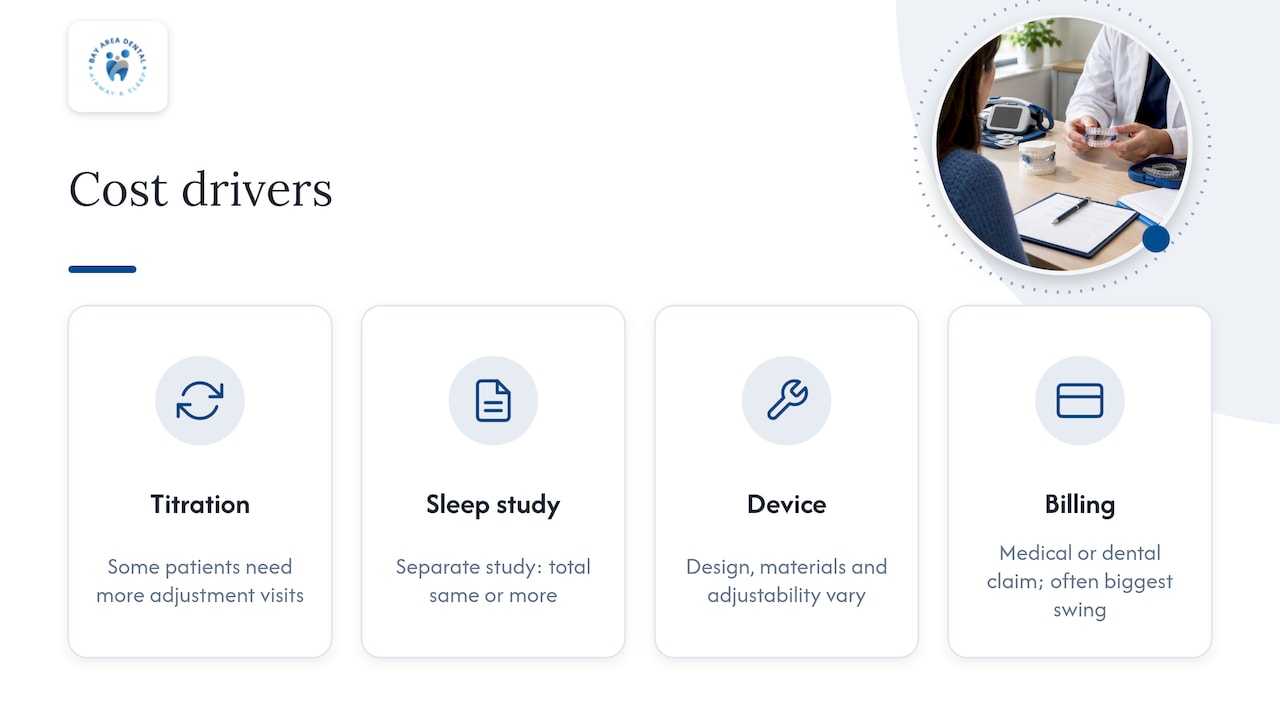
Number of titration visits. Most devices are adjusted in small steps. Some patients reach a comfortable, effective position quickly, while others need more visits.
Sleep study costs. If the study is bundled, the total looks higher. If it is separate, the appliance looks cheaper but the real total is the same or more.
Device type. Custom mandibular advancement devices differ in design, materials and adjustability. Brand names such as SomnoDent are one type of design among many. Published prices for any single brand vary office to office, so ask the practice for its own fee instead of trusting a number from another state.
Medical versus dental billing. Cost varies with whether the claim runs through medical or dental insurance, and that is often the biggest swing.
One more factor is the dentist’s training. Dentists with advanced credentials in dental sleep medicine, such as a diplomate from the American Board of Dental Sleep Medicine, are frequently cited as charging premium fees, with the possibility of better outcomes because of that specialized training. A slightly higher fee for a clinician who manages the airway, bite and jaw joints carefully can be better value than a cheaper device that never gets adjusted properly.
Will insurance pay for it?
Often, partly. Here is how it works.
Medical insurance is the usual route
Medical insurance may provide partial coverage when an oral appliance is medically necessary, and a physician-confirmed sleep apnea diagnosis is required. Dental coverage, by contrast, is limited and plan-specific. Dental insurance rarely covers these appliances, so claims typically go to your medical plan.
What you pay after that depends on your plan: deductible, coinsurance and your out-of-pocket maximum. Call your insurer and ask three things: whether a custom mandibular advancement device is covered as durable medical equipment, whether your dentist must be in network, and how much of your deductible you have met this year. Ask whether prior authorization is needed before fabrication begins.
Medicare rules, for readers 65 and over
Medicare is more specific. The Medicare policy article states that oral appliances for obstructive sleep apnea are covered under the durable medical equipment benefit, and California falls under the same regional contractor. Custom devices must meet design criteria, including a fixed mechanical hinge and the ability to hold adjustment settings, to qualify.
Two details matter for your budget. Follow-up care, adjustments and professional services during the first 90 days are included in the device payment. After that period, adjustments and follow-up visits are not eligible for coverage under the DME benefit. If you need a tune-up in year two, plan to pay for it yourself.
If you are on a Medi-Cal or a Medicare Advantage plan, confirm the specifics with the plan directly, because rules and networks differ.
What to ask before you book
- Is the quote global, and how many follow-up visits does it include?
- What happens if the first device does not fit or does not work?
- Does the office bill medical insurance for you, or do you pay and seek reimbursement?
- Who orders the diagnostic test, and who pays for the efficacy test?
- What is the fee for repairs, adjustments after the included visits and replacement?
Oral appliance versus CPAP: the cost over time
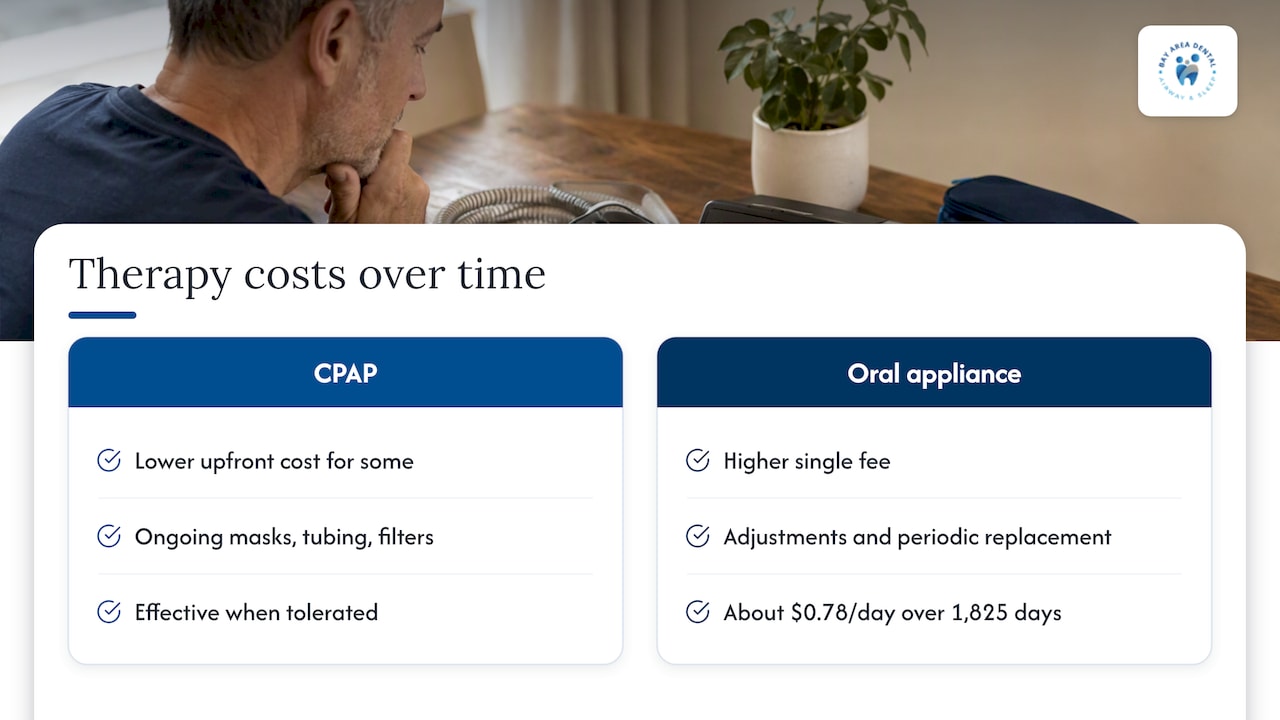
CPAP machines and oral appliances cost different amounts at different times. CPAP has a lower entry point for some patients but ongoing supplies such as masks, tubing and filters. An oral appliance has a bigger single fee and then little else, apart from adjustments and the replacement every few years. One published cost analysis of oral appliance therapy over a 1,825-day replacement schedule worked out to about $0.78 a day, though reimbursement for each therapy is structured differently.
What matters more is whether you will use it. CPAP is the first-line therapy for many people and works very well when tolerated. Oral appliances are an option for people who cannot tolerate CPAP or prefer a mask-free approach, and they suit mild to moderate sleep apnea best. Your sleep physician should decide which therapy fits your severity.
The economics of leaving it untreated also count. The American Academy of Sleep Medicine reports that treating sleep apnea is an upfront investment but more cost-effective in the long run than leaving it untreated, because of reduced risks from related conditions and accidents.
Our perspective
We see oral appliance cost questions every week, and the number on a quote is rarely the real question. The real question is whether the device will be fitted and adjusted by someone who looks at the whole airway, not only at the teeth.
At our Fremont practice, we treat sleep-disordered breathing as a root-cause problem. That means asking why the airway is narrow: jaw position, tongue posture, nasal breathing, bite and the health of the jaw joints. A device that moves the jaw forward changes how the teeth and joints work, so we watch for tooth movement and jaw discomfort over time. Our article on the link between TMJ problems and sleep apnea covers why that screening matters.
We also want a diagnosis in hand before we treat. Appliances are for confirmed sleep apnea, not for guessing. If your results are borderline, or your symptoms do not match your test, our overview of UARS symptoms alongside AHI explains why a normal-looking number does not always mean a normal night.
Our advice on cost: choose the provider you trust to follow up, ask for the itemized quote, and judge value by years of comfortable use.
— Bay Area Dental, Airway & Sleep
Getting an oral appliance in the Bay Area
If you live in Fremont, Union City or elsewhere in the Bay Area and want to find out whether an oral appliance is right for you, we offer oral appliance therapy as part of our sleep dentistry services, alongside airway evaluation, laser treatments and myofunctional therapy. We will review your diagnosis, explain your options, and give you an itemized estimate before any work begins.
Learn more about oral appliance therapy and sleep solutions or read about our sleep apnea dentist services in Fremont.
A step-by-step path from diagnosis to device
- Get tested. See your physician about a sleep study, either in a lab or at home. Without a diagnosis, insurance will not pay and treatment is guesswork.
- Confirm that an appliance fits your case. Severity, weight, jaw structure, gum health and the state of your teeth all matter. Dentists also check for jaw joint symptoms first.
- Request an itemized quote. Use the questions above. Get it in writing.
- Verify insurance. Ask your medical plan about DME coverage, network status and prior authorization.
- Fit and titrate. Expect several visits as the device is adjusted to a position that works comfortably.
- Confirm it works. A follow-up sleep test shows whether your apnea events have dropped enough.
- Plan for upkeep. Keep the device clean, bring it to checkups and budget for replacement in 3 to 5 years.
Related issues that affect your bill
Snoring can wear on teeth, and clenching often goes along with it. If you grind, your dentist may recommend managing that first or in parallel, which can add cost but protects your investment. We cover the dental side in when snoring damages your teeth.
If mouth breathing is part of the picture, an appliance alone might not be the full answer. See how mouth breathing and sleep connect for how the cause is diagnosed. Some patients also benefit from myofunctional therapy, and we explain what it costs in our California myofunctional therapy cost guide.
FAQ
How much should an oral appliance for sleep apnea cost?
In California, expect about $1,505 to $2,709, with an average near $2,007 as of May 2026. The total depends on how many follow-up visits are included and whether the sleep study is bundled. Ask for an itemized quote so you can compare offices fairly.
Will insurance pay for an oral appliance?
Medical insurance may cover part of it when the device is medically necessary and you have a physician-confirmed diagnosis. Dental insurance rarely does. Call your plan before treatment to ask about durable medical equipment coverage, network rules and prior authorization.
Where can I buy an oral appliance for sleep apnea?
Custom devices are made through a dentist trained in dental sleep medicine after a diagnosis from a physician. Over-the-counter boil-and-bite products exist, but they are not a custom-fitted device, and you should talk to your physician before relying on one for diagnosed sleep apnea.
How much does a SomnoDent cost?
SomnoDent is a brand of custom mandibular advancement device, and offices set their own fees. Typical California pricing for a custom appliance falls in the ranges above, so ask your provider for a written quote for the exact device they recommend.
How long does an oral appliance last?
Custom appliances typically need replacing every 3 to 5 years, depending on materials, wear and how well you care for them. Regular checkups help catch wear early.
Sources
- Sleep Apnea Oral Appliance Cost in California
- Sleep Apnea Oral Appliance Cost: National Average
- Medicare policy article: Oral Appliances for Obstructive Sleep Apnea
- Medical coverage policy: Oral Appliances and Medical Management for Sleep Apnea
- AASM: Hidden Health Crisis Costing America Billions