

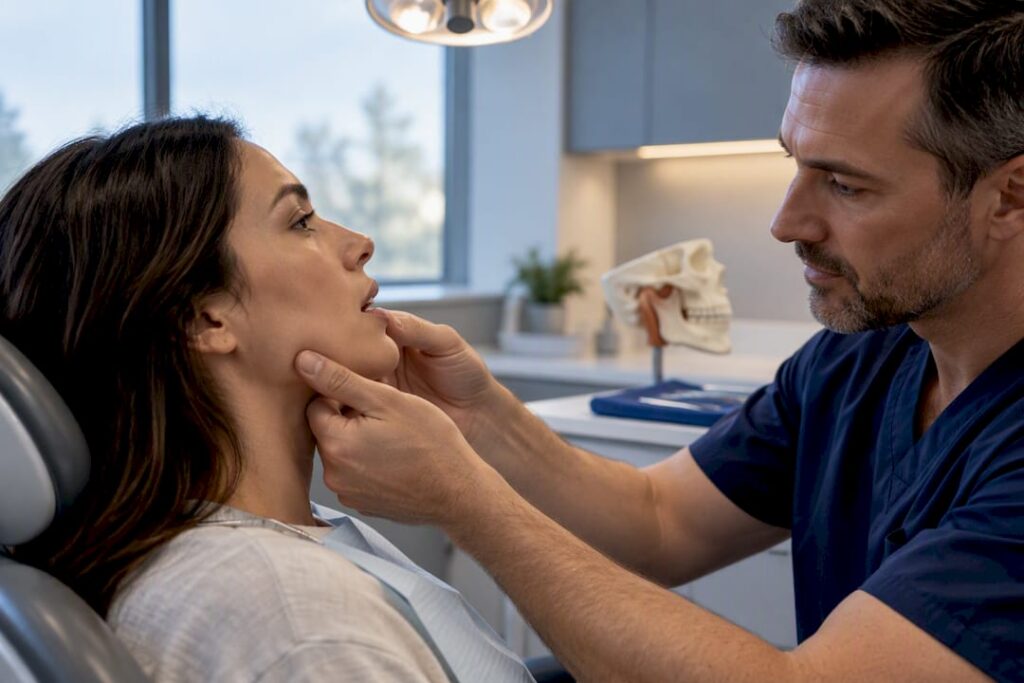
TMJ disorder and obstructive sleep apnea share a bidirectional relationship: OSA raises your risk of developing TMD, and TMD rarely causes sleep apnea outright but can worsen jaw symptoms tied to disrupted sleep. If you have signs of either condition, the practical move is getting screened for both, a sleep evaluation and a dental or TMJ exam, since cohort research and clinical guidelines support this bidirectional link.
TL;DR:
- People with obstructive sleep apnea are about 2.5 times more likely to develop temporomandibular disorder over time, indicating a significant bidirectional risk.
- Most TMJ cases are temporary and respond well to conservative care such as diet modification, heat or ice, and physical therapy, before considering irreversible procedures.
- Structural features like a retruded or undersized jaw significantly increase sleep apnea risk independent of TMJ symptoms, emphasizing the importance of jaw and airway anatomy assessment.
- Treating sleep apnea with CPAP or oral appliances may alleviate some TMJ symptoms if the airway obstruction contributes to jaw muscle tension, but addressing jaw issues alone does not prevent sleep apnea.
- Coordinated diagnosis and treatment between sleep specialists and dentists improve outcomes, especially when managing overlapping TMJ and sleep apnea symptoms, through integrated evaluations and follow-up testing.
Table of Contents
- TMJ and sleep apnea at a glance
- What temporomandibular disorder actually is
- How jaw function and airway anatomy interact
- Can TMJ actually cause sleep apnea?
- Can sleep apnea cause or worsen TMJ symptoms?
- How doctors diagnose TMJ and sleep apnea
- Treatment options for TMJ and sleep apnea
- Deciding who to see first
- What integrated airway and dental care looks like
- A clinician’s perspective on treating both conditions together
- A coordinated path forward at Bay Area Dental, Airway & Sleep
- Sources
- FAQ
TMJ and sleep apnea at a glance
Temporomandibular disorder, known as TMD, is common, often temporary, and usually responds to conservative treatment rather than surgery or permanent bite changes. Obstructive sleep apnea and TMD overlap more than most people realize, and the direction of that overlap matters for how you get treated.
- TMD affects an estimated 5% to 12% of the population, and many cases resolve with self-care.
- People with OSA face a substantially higher chance of developing TMD over time.
- CPAP remains the first-line therapy for moderate to severe OSA, while oral appliance therapy suits mild to moderate cases or patients who cannot tolerate CPAP.
- Conservative measures such as a soft diet, heat, and avoiding wide jaw movements resolve a large share of TMJ complaints without invasive care.
A large cohort study found an adjusted hazard ratio of about 2.5 for developing TMD among people with OSA, according to research tracking both conditions over time. That same body of work found TMD patients carry more than double the prevalence of intermediate or high OSA risk, a pattern that supports checking for both conditions rather than treating them as unrelated.
What temporomandibular disorder actually is
TMD is an umbrella term for problems affecting the jaw joint and the muscles that control chewing and jaw movement. It shows up as jaw pain, clicking or popping when you open your mouth, a jaw that locks or has limited range of motion, and sometimes headaches or ear pain that mimic other conditions entirely. Grinding or clenching your teeth, called bruxism, frequently accompanies TMD and can happen during the day or while you sleep.
The condition affects an estimated 5% to 12% of people, with women affected more often than men. Most cases are temporary. Jaw pain that flares for a few weeks and settles on its own is a common pattern, and clicking without pain is often benign enough that dental guidance advises against treating it at all.
Where TMD becomes complicated is in how it gets treated. The National Institute of Dental and Craniofacial Research has published guidance titled “Less Is Often Best” for a reason: irreversible procedures like occlusal adjustment or jaw surgery carry limited long-term evidence of benefit, and the recommended starting point is conservative care.
- Rest the jaw with a soft diet and avoid wide yawns or hard, chewy foods.
- Apply ice or heat to ease muscle tension around the joint.
- Try short-term physical therapy or gentle jaw stretches before considering an appliance.
Pro Tip: If a dentist recommends grinding down teeth or permanent bite adjustment as a first step for TMJ pain, get a second opinion before agreeing to anything irreversible.
How jaw function and airway anatomy interact
The link between TMJ and sleep apnea is not coincidental. Several anatomical and behavioral pathways connect the two, and understanding them helps explain why treating one condition sometimes eases the other.
Mandibular position plays a direct role in airway size. A smaller or retruded lower jaw, conditions known as micrognathia or retrognathia, reduces the cross-sectional space behind the tongue and soft palate. That narrower space makes airway collapse during sleep more likely, which is part of why oral appliances that advance the mandible forward can reduce apnea events for some patients. This is also why craniofacial structure, not just body weight, factors into OSA risk.
Bruxism sits at the intersection of both conditions. Nighttime clenching and grinding can be a symptom of TMD on its own, but it also appears to function as a response to airway strain. When the airway partially narrows during sleep, the body sometimes increases muscle activity in the jaw as part of the arousal response, which can intensify grinding. Over time, that repeated muscle strain contributes to joint pain and wear, feeding back into TMD symptoms.
Shared risk factors add another layer. Excess weight affects both soft tissue around the airway and load on the jaw joint. Craniofacial anatomy that predisposes someone to a narrow airway often overlaps with the same skeletal patterns associated with bite problems and jaw joint strain. Because these risk factors overlap so heavily, it can be hard to tell from symptoms alone which condition triggered the other.
- Airway anatomy: a narrower or more recessed jaw reduces airway space, raising OSA risk independent of TMJ symptoms.
- Bruxism: clenching linked to nighttime arousals can worsen jaw pain and contribute to a cycle that maintains TMD.
- Shared risk factors: weight and craniofacial structure influence both airway size and jaw joint stress simultaneously.
The cohort data on OSA and TMD reflects this overlap in its numbers. It is not that one condition mechanically produces the other in most cases. It is that the same anatomical and behavioral factors tend to push both conditions in the same direction, and disrupted sleep from OSA appears to intensify the muscle tension and clenching that drive TMD.
Can TMJ actually cause sleep apnea?
For most people, the answer is no. Jaw pain, clicking, or a mild reduction in how wide you can open your mouth do not, by themselves, narrow the airway enough to cause obstructive sleep apnea. TMD is primarily a joint and muscle condition, while OSA is an airway problem that occurs when soft tissue collapses during sleep. Having one does not automatically produce the other.
Where jaw structure genuinely matters is at the skeletal level rather than the joint level. Retrognathia, a lower jaw positioned further back than typical, and micrognathia, an undersized jaw, both reduce the space available behind the tongue. These are structural features that can exist independently of TMD, though a person can have both a skeletal jaw pattern and joint pain at the same time. In these cases, the skeletal pattern is the OSA risk factor, not the joint symptoms themselves.
Medications used for TMJ pain deserve attention here too. Muscle relaxants and certain sedatives prescribed for jaw tension can relax airway muscles more broadly during sleep, which may worsen airway stability in someone who already has undiagnosed or mild OSA. This is not a reason to avoid these medications outright, but it is a reason to mention any sleep symptoms, snoring, gasping, witnessed pauses in breathing, to whoever prescribes them.
The practical takeaway is that TMJ pain and clicking are not reliable predictors of sleep apnea on their own. What matters is the underlying jaw and airway anatomy, which a dentist or sleep physician can assess through a physical exam and imaging when indicated.
Can sleep apnea cause or worsen TMJ symptoms?
Here the evidence points more clearly in one direction. Sleep apnea appears to raise the risk of developing TMD, and the physiological route runs through the way OSA disrupts sleep architecture. Repeated airway narrowing during sleep triggers arousals, brief awakenings the sleeper rarely remembers, along with drops in blood oxygen and shifts in autonomic nervous system activity. These arousals are associated with increased muscle tension, and that tension frequently shows up in the jaw as clenching or grinding.
Over months and years, that repeated nighttime muscle activity can strain the temporomandibular joint and surrounding muscles, contributing to the pain, stiffness, and clicking that define TMD. This pattern is reflected in large-scale cohort data, which found an adjusted hazard ratio of about 2.5 for new TMD diagnoses among people with OSA, along with more than double the prevalence of intermediate or high OSA risk among people already diagnosed with TMD. Other peer-reviewed cross-sectional and cohort research has reported similar associations between sleep apnea symptoms and TMD incidence, reinforcing that this is not a one-off finding.
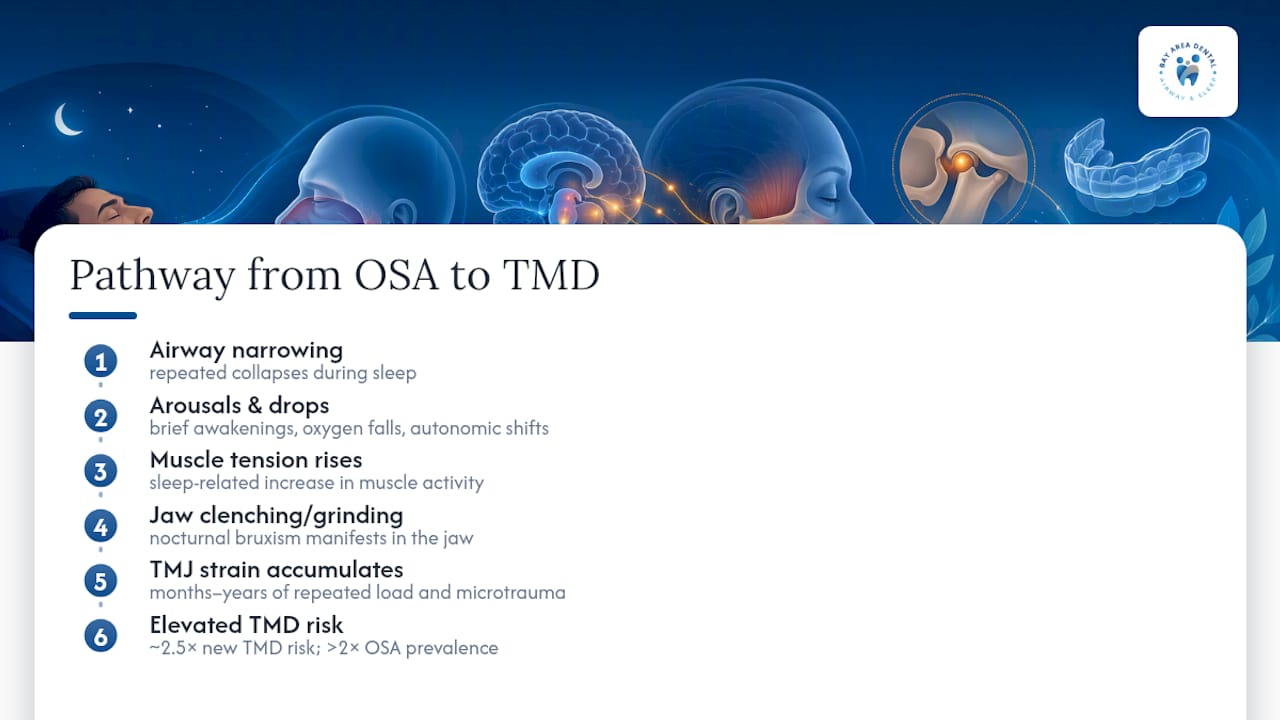
The clinical implication matters for treatment decisions. If OSA is driving nighttime bruxism and jaw tension, treating the sleep apnea, whether through CPAP or oral appliance therapy, may ease jaw symptoms as a secondary benefit for some patients. This does not mean OSA treatment replaces TMJ care, but it does mean a dentist treating jaw pain in isolation, without asking about sleep, snoring, or daytime fatigue, may be missing part of the picture.
How doctors diagnose TMJ and sleep apnea
Diagnosing either condition starts with a conversation about symptoms, but confirming what is actually happening requires specific tests. Because the two conditions overlap so often, a coordinated approach between a sleep physician and a dentist trained in dental sleep medicine tends to catch more than either specialist working alone.
- Screen for red flags first. Loud snoring, witnessed breathing pauses, gasping awake, and excessive daytime sleepiness point toward a sleep evaluation; severe or worsening jaw locking points toward urgent dental assessment.
- Get a sleep test. A home sleep apnea test measures breathing patterns, oxygen levels, and airflow in your own bed and works well for straightforward cases; in-lab polysomnography adds brain wave, muscle, and eye movement monitoring and is used when the diagnosis is unclear or other sleep disorders are suspected.
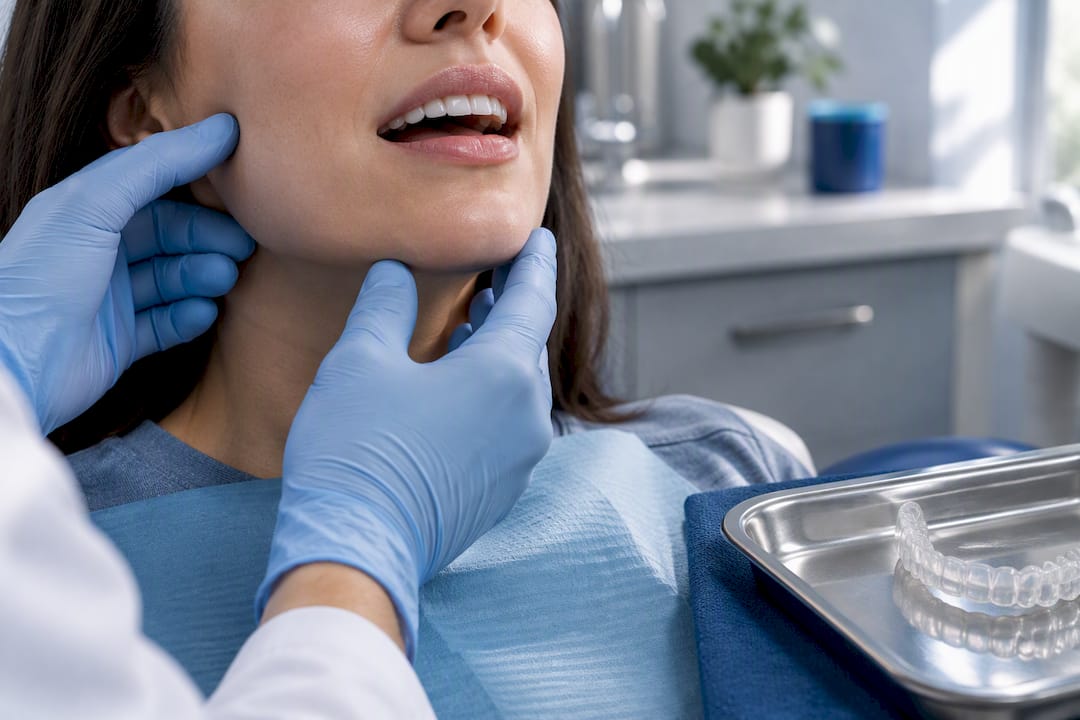
- Complete a dental and TMJ exam. A dentist checks jaw range of motion, joint sounds, muscle tenderness, tooth wear from grinding, and bite alignment, with imaging like a CBCT scan ordered when structural issues are suspected.
- Coordinate between specialists. A sleep physician typically diagnoses OSA and determines severity, then refers appropriate patients to a qualified dentist for oral appliance fitting, an approach outlined by sleep medicine guidance as the standard division of labor.
- Retest after treatment starts. Guidelines recommend follow-up sleep testing once an oral appliance is in place to confirm it is actually controlling the apnea, since comfort and symptom relief do not always mean the airway obstruction is resolved.
This sequence matters because treating perceived TMJ pain without ruling out sleep apnea, or treating snoring without checking the jaw joint, can leave half the problem unaddressed.
Treatment options for TMJ and sleep apnea
Treatment for these two conditions follows different playbooks, but the playbooks intersect more than most people expect. Getting the sequence right, and knowing which specialist to loop in when, makes a real difference in outcomes.
For obstructive sleep apnea, CPAP remains the gold-standard first-line treatment for moderate to severe cases, according to practice guidelines from sleep medicine societies. It works by delivering pressurized air that keeps the airway open all night, and it reliably reduces the number of breathing interruptions more than other options. The tradeoff is tolerance: some people find the mask, noise, or sensation of forced air hard to live with long-term.
Oral appliance therapy, or OAT, is the recommended alternative for people with mild to moderate OSA or anyone who cannot tolerate CPAP after a genuine attempt. The 2015 clinical practice guideline update on OAT specifies that appliances should be custom-made and titratable, meaning a dentist can adjust how far the appliance advances the lower jaw in small increments, and that follow-up sleep testing should confirm the appliance is actually controlling the apnea once fitted. A systematic review of OAT found that while CPAP reduces the apnea-hypopnea index more consistently, OAT delivers comparable improvements in symptoms and quality of life for many patients, and some people stick with it more consistently simply because it is easier to tolerate.
For TMJ disorder, the treatment hierarchy runs conservative to invasive:
- Start with self-care: soft diet, heat or ice, and avoiding extreme jaw movements for a few weeks.
- Add physical therapy or guided jaw exercises if pain persists beyond that initial period.
- Move to a supervised splint or nightguard only if conservative measures do not resolve symptoms.
- Reserve irreversible procedures, occlusal adjustment or jaw surgery, as a last resort, since NIDCR guidance notes the long-term evidence for these procedures remains limited.
The overlap gets practical when someone needs both an OAT device for sleep apnea and management for existing TMJ issues. A dental evaluation for OAT candidacy should include a TMJ assessment specifically because significant joint dysfunction may need to be addressed before an appliance is fitted, and an oral appliance that advances the jaw forward every night can aggravate an already strained joint if it is not managed carefully.
Pro Tip: If you already have TMJ symptoms and your sleep physician recommends an oral appliance, ask specifically whether the fitting dentist will monitor your jaw joint during titration, not just your apnea numbers.
Practical monitoring matters throughout OAT use. Occlusal changes, meaning shifts in how the teeth fit together, can begin appearing within six months of starting oral appliance therapy, so appliances need small adjustment increments and periodic dental checkups rather than a one-time fitting and no follow-up.
Deciding who to see first
Symptom pattern should guide your first call. If daytime sleepiness, loud snoring, witnessed breathing pauses, or cardiovascular risk factors like high blood pressure dominate the picture, a sleep evaluation takes priority. If severe jaw pain, locking, or limited jaw function is the main complaint, start with a dental or TMJ evaluation, but mention any sleep symptoms so the dentist can screen for OSA at the same visit.
- Identify your dominant symptom. Sleepiness and breathing issues point to a sleep physician; jaw pain and dysfunction point to a dentist trained in TMJ care.
- Ask about appliance details if OAT comes up. Request specifics on the appliance type, the titration plan for adjusting jaw advancement, and the timeline for follow-up sleep testing.
- Ask about side effects up front. Jaw soreness, bite changes, and excess salivation are common early on with oral appliances and usually settle within weeks.
- Watch for red flags that need urgent attention. Severe daytime sleepiness that affects driving safety, fainting spells, or progressively worsening jaw locking all warrant prompt evaluation rather than a wait-and-see approach.
Bringing a symptom list to the first appointment, including sleep quality, snoring, jaw pain timing, and any grinding a partner has noticed, helps whichever specialist you see first know when to loop in the other.
What integrated airway and dental care looks like
Coordinated care between sleep medicine and dentistry works best when both pieces sit under one evaluation process rather than two disconnected referrals. The practice structures its care around airway-focused dentistry, offering oral appliance therapy, myofunctional therapy, and general and restorative dental services alongside advanced imaging and laser treatments that support more precise, less invasive diagnosis and treatment planning.
An integrated evaluation means the same practice that assesses jaw function and bite can also address airway-related concerns without the reader having to explain their case twice to disconnected providers. That kind of continuity reduces the odds that an oral appliance gets fitted without anyone checking the jaw joint first, or that jaw pain gets treated for months without anyone asking about sleep quality. For patients managing both conditions at once, having a single dental team track occlusal changes and appliance fit over time, rather than juggling separate providers, simplifies the follow-up that guidelines call for.
A clinician’s perspective on treating both conditions together
The safest path for patients with overlapping TMJ and sleep apnea symptoms is conservative-first for the jaw and guideline-driven for the airway, never the reverse. Skipping straight to an irreversible bite procedure or an unmonitored appliance ignores what the evidence actually supports. Shared decision-making, paired with objective follow-up like repeat sleep testing after any therapy change, catches problems before they become permanent. When symptoms overlap, coordinated care is not optional convenience. It is what the data on this bidirectional relationship actually recommends.
— Admin
A coordinated path forward at Bay Area Dental, Airway & Sleep
If you are dealing with jaw pain, snoring, or both, sorting out which came first matters less than getting an evaluation that looks at the whole picture. The practice offers integrated sleep and airway solutions alongside general and restorative dental care, so a first visit can assess jaw function and airway risk together rather than sending you to separate offices for separate problems.
A first appointment typically involves a discussion of your symptoms, a jaw and bite exam, and a conversation about whether a sleep evaluation makes sense based on what you describe. If oral appliance therapy is appropriate, the practice fits and monitors custom appliances with follow-up built into the process. Visit the sleep and airway services page to see what a coordinated evaluation covers, or reach out through the main practice site to schedule a visit.
This article is general information, not a substitute for advice from a qualified doctor. Consult a qualified healthcare professional about your own circumstances before acting on anything here.
Sources
- Association between obstructive sleep apnea and temporomandibular disorders (cohort study)
- NIDCR: Temporomandibular disorders research and guidance
FAQ
What is the 3% rule for sleep apnea?
The 3% rule refers to a scoring criterion used during sleep studies, where a breathing event counts as a hypopnea if it is accompanied by at least a 3% drop in blood oxygen level or an arousal. It is a technical scoring detail your sleep physician applies when reading test results rather than something you need to calculate yourself.
How to fix TMJ and sleep apnea?
There is no single fix for both, since they require different treatments. TMJ disorder typically improves with conservative self-care, physical therapy, or a supervised splint, while sleep apnea is managed with CPAP or custom oral appliance therapy depending on severity, and coordinated care between a sleep physician and dentist works best when both conditions overlap.
What are the worst symptoms of TMJ?
Severe TMJ symptoms include a jaw that locks open or closed, intense pain that limits eating or speaking, and grinding severe enough to visibly wear down teeth. These symptoms warrant a dental evaluation rather than waiting them out, since conservative care works best when started early.
Can jaw alignment fix sleep apnea?
For some patients, advancing the lower jaw forward with a custom oral appliance improves mild to moderate obstructive sleep apnea by increasing airway space. It does not work for everyone, and guideline-based fitting and follow-up testing are what determine whether it is actually controlling the apnea rather than jaw discomfort alone.