

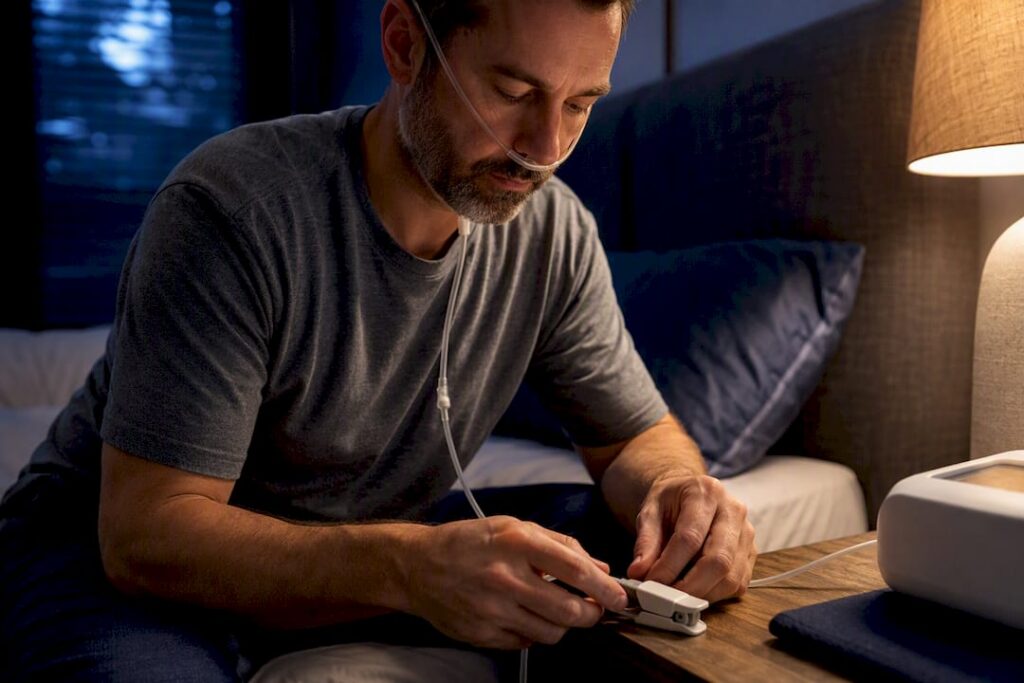
A dentist can help you get a home sleep apnea test moving, but the order and the diagnosis have to come from a physician or sleep specialist. If you suspect sleep apnea, start by asking your primary care provider or a sleep physician for a home sleep apnea test order. Your dentist’s role kicks in for setup guidance and, if the test comes back positive, custom oral appliance therapy.
TL;DR:
- Home sleep apnea tests are ordered by physicians, but dentists can assist with device setup and appliance fitting once a diagnosis is established.
- The most common devices used are Type III or IV monitors, which record key variables like airflow and oxygen levels, usually for one night at home.
- Home testing is recommended mainly for uncomplicated adults with high pretest probability of moderate-to-severe sleep apnea, while in-lab tests are necessary for complicated cases or inconclusive results.
- Insurance coverage depends on proper documentation, physician orders, and approved testing providers, with results typically available within 2 to 5 business days after device return.
- Confirmed moderate-to-severe sleep apnea often leads to CPAP or oral appliance therapy, with follow-up testing recommended if initial results are negative but symptoms persist.
Table of Contents
- What dentists can and cannot do with a home sleep test
- How a home sleep test actually works
- Who qualifies for a home sleep test versus an in-lab study
- Cost, insurance, and how long results take
- What happens after the test: treatment and the dentist’s part
- How Bay Area Dental, Airway & Sleep approaches airway screening and testing support
- Why team-based care beats going it alone
- How Bay Area Dental, Airway & Sleep can help with your sleep and airway care
- Sources
- FAQ
What dentists can and cannot do with a home sleep test
A dentist who screens for airway problems during a routine exam might spot warning signs long before a patient thinks to mention snoring or fatigue. That dentist can document findings, refer the patient to a sleep physician, and often handle the logistics of getting a testing kit to the patient’s door or dental chair. Once a diagnosis exists, the dentist can build and fit an oral appliance.
What a dentist generally cannot do is order the home sleep apnea test itself or diagnose obstructive sleep apnea. That authority belongs to a physician, per guidance from the American Academy of Dental Sleep Medicine. Some local protocols vary in how much logistical support a dental office provides, so confirm specifics before you rely on a practice for testing help.
Before using a dentist’s home sleep test facilitation service, ask:
- Does the dentist coordinate directly with a sleep physician, or just hand you a phone number?
- Who reviews and interprets the raw data: the dentist, a sleep lab, or a board-certified sleep physician?
- What happens if the test result is negative but your symptoms continue?
How a home sleep test actually works
A home sleep apnea test, often shortened to HSAT, follows a fairly consistent sequence regardless of which clinic coordinates it.
- You have a consultation, often prompted by a dentist’s screening or a primary care visit, where risk factors are reviewed.
- A physician issues the test order after reviewing your symptoms and history.
- You receive an FDA-cleared device, typically a Type III or Type IV monitor.
- You wear the device overnight in your own bed, usually for a single night.
- A board-certified sleep physician reviews the recorded data and issues a report, generally within 2 to 5 business days.
Device type matters because it determines what gets measured. Type II devices record closer to full polysomnography channels, while Type III and Type IV units focus on airflow, respiratory effort or peripheral arterial tone, and blood oxygen levels through pulse oximetry. Fewer channels mean less data if something looks ambiguous.
Pickup and mail models both exist, and either can work fine if the setup instructions are clear.
Pro Tip: Avoid alcohol the night of the test, secure the nasal cannula and finger sensor snugly before bed, and do a practice run wearing the device for a few minutes beforehand so you are not troubleshooting straps at midnight.
Who qualifies for a home sleep test versus an in-lab study
The AASM clinical practice guideline recommends home sleep testing for uncomplicated adults who show a high pretest probability of moderate-to-severe obstructive sleep apnea. That typically means someone with:
- Loud, habitual snoring reported by a bed partner.
- Witnessed pauses in breathing during sleep.
- Persistent daytime sleepiness despite adequate time in bed.
- Diagnosed hypertension, which correlates with undiagnosed sleep apnea.
In-lab polysomnography becomes the better path when a patient has significant cardiopulmonary disease, a neuromuscular disorder, chronic opioid use, suspected central sleep apnea, or is a child. The AASM guideline also calls for in-lab testing when a home test comes back negative or inconclusive in a patient whose symptoms still point toward sleep apnea, since missing a real case carries more risk than an extra night in a lab. Home tests are less sensitive than full polysomnography and can produce false negatives, which is exactly why persistent symptoms after a clean HSAT result deserve a second look rather than a shrug.
Cost, insurance, and how long results take
Out-of-pocket costs for home sleep testing vary by clinic, whether scoring and interpretation fees are bundled, and whether your insurance plan has a contracted rate with the testing provider. In-lab polysomnography tends to cost considerably more and takes longer to schedule, which is part of why home testing has become the first-line option for many uncomplicated cases.
Medicare and most commercial insurers follow criteria similar to the CMS national coverage determination for sleep testing, which permits Type II, III, and IV devices when documentation supports medical necessity. Coverage gets denied for predictable reasons:
- No documented symptoms or risk factors in the medical record.
- Missing or improperly issued physician order.
- Testing performed or handled by a supplier not authorized to do so, or without a CLIA-certified lab reviewing results.
Notably, CMS guidance specifies that no part of the testing process, including device delivery or pickup, may be performed by a durable medical equipment supplier, which is one reason clinic coordination matters.
Once the device is returned, most patients get results in about 2 to 5 business days. Delays usually trace back to incomplete data from a poorly fitted sensor, a lab backlog, or missing paperwork.
What happens after the test: treatment and the dentist’s part
A positive result puts you at a fork with two well-established paths.
- If moderate-to-severe OSA is confirmed, the physician typically prescribes CPAP or refers you for oral appliance therapy, and a qualified dentist fits a custom, titratable device while monitoring for dental side effects, consistent with joint AADSM and AASM guidance.
- If the test is negative but snoring, witnessed apnea, or daytime fatigue persist, the guideline-recommended next step is an in-lab polysomnogram rather than accepting the negative result at face value.
After an oral appliance is fitted, many sleep physicians order a follow-up HSAT or PSG to confirm the device is actually controlling apnea events, not just quieting snoring. Dental follow-ups continue on a regular cadence after that, since appliances often need titration adjustments and a dentist needs to check for jaw discomfort, bite changes, or other side effects over time.
How Bay Area Dental, Airway & Sleep approaches airway screening and testing support
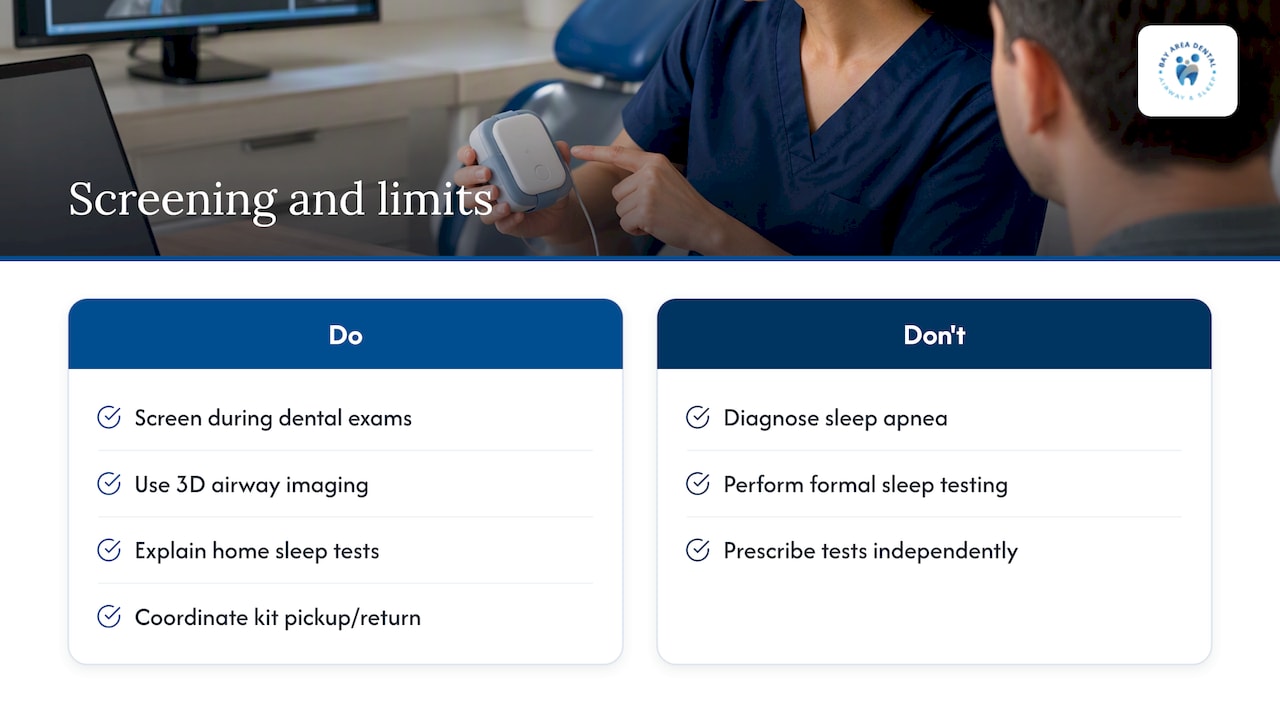
This practice builds airway screening into its dental exams rather than treating it as a separate visit, using 3D imaging to look at airway structure alongside teeth and gums. When that screening raises concern, the practice refers patients to a sleep physician for formal testing and diagnosis rather than attempting to diagnose sleep apnea itself.
Their involvement may include explaining what to expect from a home sleep test and how to wear the device correctly, coordinating pickup or return of testing kits with the prescribing physician’s office, fitting and adjusting custom oral appliance therapy once a diagnosis is confirmed, and scheduling follow-up visits to check appliance fit and monitor for side effects.
Readers who want specifics on how oral appliance therapy and airway care work at this practice can review the sleep and breathing services page.
Why team-based care beats going it alone
The temptation with home sleep testing is to treat it as a shortcut that skips the physician entirely. That instinct undersells what a negative or borderline result actually means, and it risks a missed diagnosis if symptoms persist. The safest, most effective pathway pairs physician-ordered testing with a dentist experienced in oral appliance therapy who stays in contact with that physician.
When choosing a dentist for this role, ask how many oral appliance cases they manage in a year, whether they have a working relationship with local sleep physicians, and how they confirm the appliance is working through follow-up testing rather than just asking if you feel better.
— Admin
How Bay Area Dental, Airway & Sleep can help with your sleep and airway care
If you already suspect sleep apnea or a dentist has flagged airway concerns during an exam, This practice offers a coordinated path forward, focusing on airway screening built into routine dental visits, support with home sleep test logistics once a physician has issued the order, custom oral appliance therapy for patients diagnosed with obstructive sleep apnea, and ongoing follow-up visits to adjust appliances and coordinate with a sleep physician.
To start with an airway screening or consultation, visit the Bay Area Dental, Airway & Sleep website to book an appointment.
This article is general information, not a substitute for advice from a qualified doctor. Consult a qualified healthcare professional about your own circumstances before acting on anything here.
Sources
- Use of home sleep apnea testing in adults: practice and clinical implications — PMC
- Clinical Practice Guideline for Diagnostic Testing for Adult Obstructive Sleep Apnea — AASM
- NCD – Sleep Testing for Obstructive Sleep Apnea (OSA) (240.4.1) — CMS
- Home Sleep Apnea Tests — AADSM
FAQ
What is the Japanese trick for sleep apnea?
There is no medically recognized “Japanese trick” for treating sleep apnea, and no guideline or clinical source supports a single technique as a fix. Anyone with symptoms like loud snoring, witnessed pauses in breathing, or daytime sleepiness should pursue a physician-ordered home sleep test or in-lab study instead of relying on unverified remedies.
Why would insurance deny an at-home sleep study?
Common reasons include missing documentation of symptoms, a physician order that was not properly issued, or testing handled outside CLIA-certified lab requirements. CMS coverage rules also specify that no part of the testing process may be performed by a durable medical equipment supplier, and violating that can trigger a denial.
Can I go to the bathroom during a home sleep study?
Yes, you can get up to use the bathroom during a home sleep study since you are in your own home and not being directly monitored like in a lab. Just try to minimize how long the device is off your body, since extended gaps in recording can affect data quality and the physician’s ability to interpret results.
What is the average cost of a sleep apnea dental appliance?
Bay Area Dental, Airway & Sleep does not publish a set price for oral appliance therapy, and cost varies by provider, appliance type, and insurance coverage. Contact a dental sleep medicine provider directly for a quote based on your specific case after a physician has diagnosed obstructive sleep apnea.