


Your nose does more than filter air. Your paranasal sinuses (the air pockets around your nose) make nitric oxide, a small gas molecule, and every breath in through the nose carries some of it down to your lungs. Mouth breathing skips most of that. For adults with snoring or sleep apnea, and for parents watching a child who sleeps with an open mouth, the practical point is simple: if breathing through the nose is hard, the cause is worth finding. At Bay Area Dental, Airway & Sleep in Fremont, we look at airway and breathing as part of dental care, not as a separate subject.
TL;DR
- Nasal breathing delivers 50 to 200 parts per billion of nitric oxide to the lungs per breath, versus under 10 ppb with mouth breathing.
- Nitric oxide widens blood vessels and airways, and supports the nose’s own defenses against germs.
- Humming raises nasal nitric oxide many times over, but only when the sinus openings are clear.
- Chronic mouth breathing, snoring and poor sleep are signals to look at the airway, in both children and adults.
- We evaluate airway, jaw and tongue function in one Fremont practice, with treatment options for adults and children.
Table of Contents
- What nitric oxide is and where your nose makes it
- Does nasal breathing increase nitric oxide?
- What the nitric oxide does once it reaches the lungs
- Why nose breathing is better than mouth breathing
- Can you boost nasal nitric oxide by humming?
- Why this matters for sleep and airway health
- What we look at in the dental chair
- A note on nitric oxide gas and supplements
- Our perspective
- Book an airway-focused visit in Fremont
- FAQ
- Sources
What nitric oxide is and where your nose makes it
Nitric oxide (NO) is a gas your body makes in small amounts. It is not the same thing as nitrous oxide, the “laughing gas” some people know from the dentist’s office. Nitric oxide is a signaling molecule: cells use it to tell blood vessel walls to relax, to help the airways stay open, and to coordinate defenses against germs.
In the upper airway, it is produced in a very particular place. A 2020 review reports that the human paranasal sinuses hold nitric oxide at about 10 parts per million, made by enzymes in the lining of the sinuses and the back of the nose. That is far higher than concentrations elsewhere in the airway. The research behind this is decades old. A 1996 review found that in healthy people, exhaled nitric oxide comes mainly from the upper airways, and that the sinus enzyme is working constantly, not only when something triggers it.
Swedish researcher Jon Lundberg described this as an “aerocrine” system: a messenger made in the nose and sinuses and carried to a distant target with every inhalation. In plain terms, your sinuses make a gas, you breathe it in, and it does work in your lungs.
Does nasal breathing increase nitric oxide?
Yes. Breathing in through the nose pulls air across the sinus openings and picks up the gas on the way. A study in the Journal of Applied Physiology found that 50 to 200 ppb of nitric oxide reaches the lungs with each nasal inhalation, compared with less than 10 ppb during mouth breathing. When you breathe through your mouth, the air never passes through the nose and sinuses, so it never collects that gas.
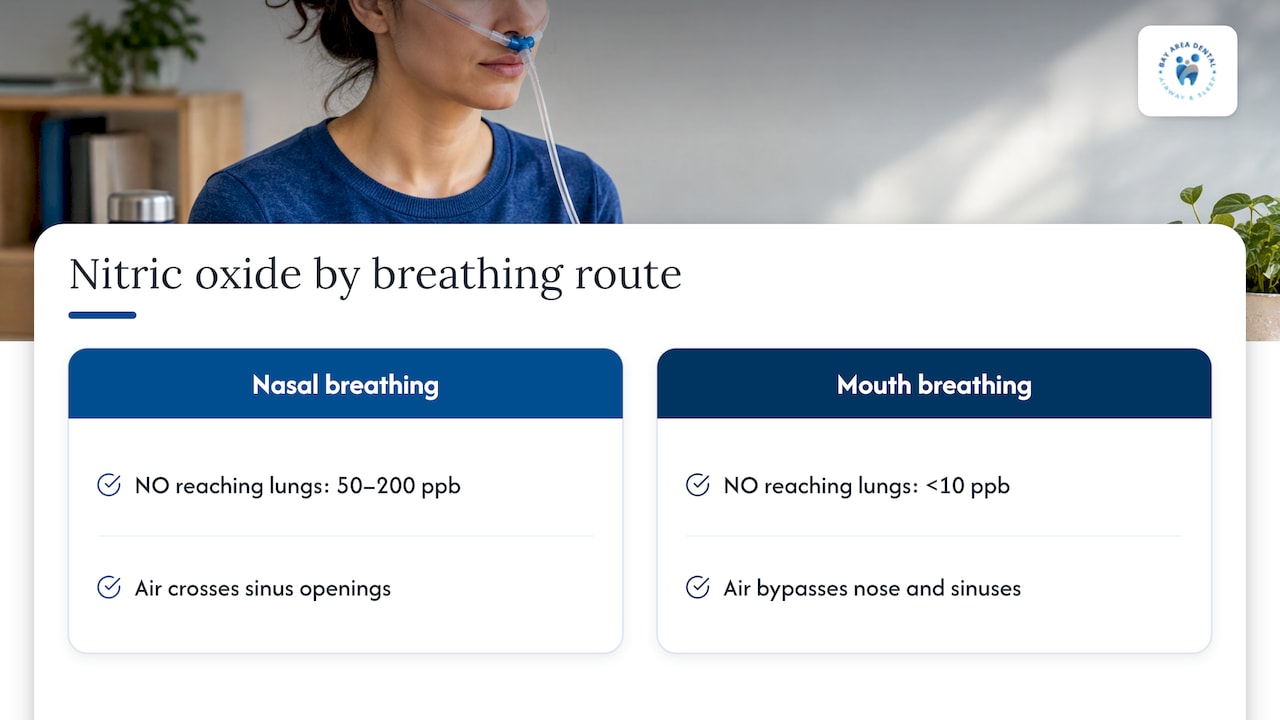
The same 2020 review notes that mouth breathers have measurably lower nitric oxide levels in the respiratory tract than nasal breathers. Think of it like a filter-and-conditioner built into the front of your airway. Nasal breathing uses it. Mouth breathing goes around it.
What the nitric oxide does once it reaches the lungs
Three effects matter most for everyday health.
It helps match blood flow to airflow. Nitric oxide relaxes the small blood vessels in the lungs. The 2009 study reported that nasal breathing redistributed blood flow in the lungs and noted earlier findings that it improved oxygen levels in the blood by 5 to 15% compared with mouth breathing. A smaller crossover study of ten patients after heart surgery found that pulmonary vascular resistance was lower with nasal breathing (256 versus 287 dyn·s·cm⁻⁵·cm⁻²), meaning blood moved through the lungs with a little less resistance.
It stays local. Nitric oxide that reaches the bloodstream is quickly grabbed by hemoglobin, the oxygen carrier in red blood cells. A review of inhaled nitric oxide explains that this prevents it from widening blood vessels throughout the body. So the effect is aimed at the lung vessels that sit next to the air you just breathed, not at your blood pressure overall.
It supports the airway’s defenses. According to the 2020 review, nitric oxide can widen the airways, activate the tiny hair-like cilia that sweep mucus, and act against bacteria, fungi and viruses. The authors also note that higher baseline exhaled nitric oxide has been linked to fewer common-cold symptoms.
Why nose breathing is better than mouth breathing
Nitric oxide is one reason, and it sits alongside several others that are easy to feel.
- Air is warmed, humidified and filtered before it reaches the lungs.
- Nitric oxide is delivered with each breath, as described above.
- Mouth breathing dries the mouth. A dry mouth is a setup for cavities and gum irritation, which is why dentists pay attention to it. The 2020 review lists abnormal facial and dental development, snoring, sleep apnea and tooth decay among problems associated with mouth breathing.
- In growing children, the way a child breathes can shape the face. We explain how in our article on nasal breathing and your child’s jaw development.
A fair note on exercise: a small study of nine people doing an all-out cycling test found no difference in power output between nose-only and mouth-only breathing, and the authors suggest personal preference can guide the choice during hard exercise. The nose advantage is clearest at rest and during sleep, when you are breathing quietly for hours at a time.
Can you boost nasal nitric oxide by humming?
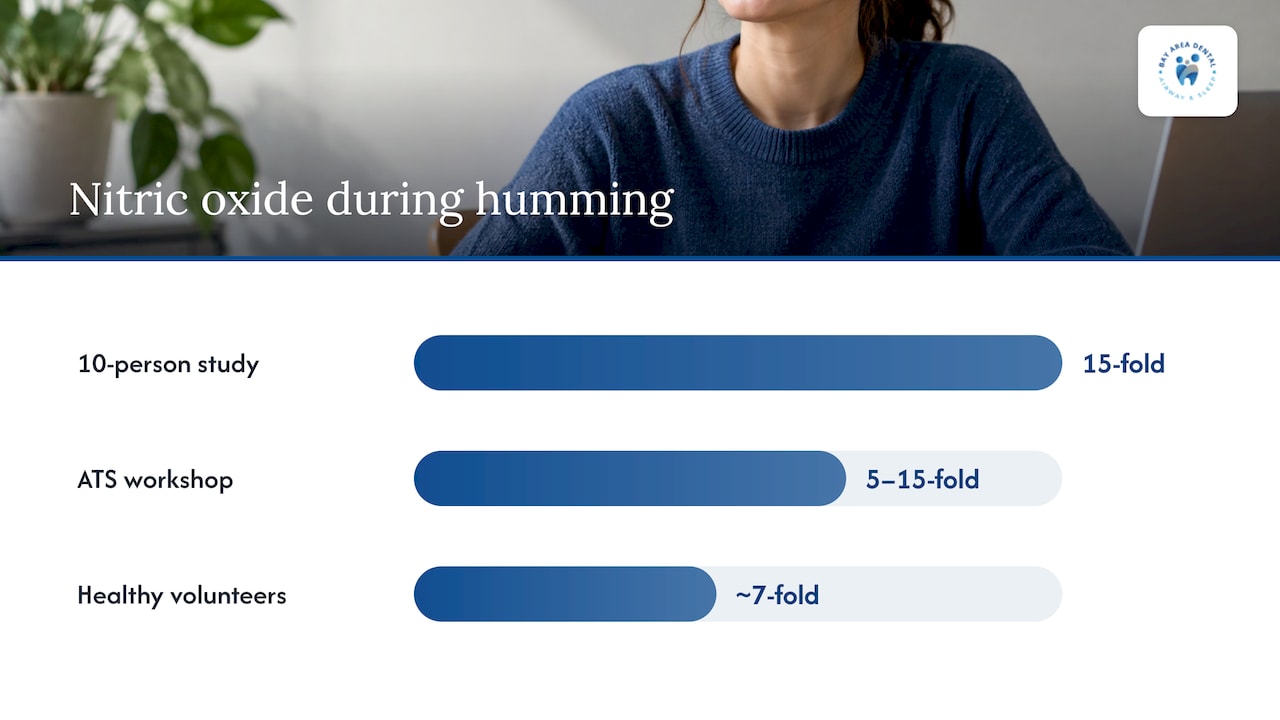
Yes, and this is the most-shared fact on the topic. Researchers measured a 15-fold increase in nasal nitric oxide during humming compared with quiet exhaling in ten healthy people. They attributed it to the vibrating airflow speeding up the exchange of gas between the sinuses and the nose. The American Thoracic Society’s workshop document gives a range of 5- to 15-fold during humming, with the peak lasting only briefly before levels recover after a short silence.
Two details matter for real life:
- It is brief. Humming does not “bank” nitric oxide. It is a short spike in the nose, not a lasting change.
- It depends on open sinuses. A later study found that in healthy volunteers nasal nitric oxide output rose about seven-fold during humming, while in people with chronic sinusitis and nasal polyps it did not change at all. The increase relies on the sinus openings (called ostia) being open. In one patient, the humming response returned about two weeks after sinus surgery.
That second point is useful as a self-check. A blocked nose and swollen sinuses cut off the nitric oxide supply. If congestion is a regular problem, sinusitis and nasal congestion can be a reason the nose is not doing its job, and a clinician should look at why.
Humming is harmless and pleasant, but it is a curiosity, not a treatment. The bigger question is whether you can breathe comfortably through your nose all day and all night.
Why this matters for sleep and airway health
The nitric oxide story is a good way into a larger one. When someone cannot breathe well through the nose, they switch to the mouth, usually without noticing, and often during sleep. Many things can cause this: enlarged tonsils or adenoids, allergies, a narrow palate, a tongue that sits low, or a restricted tongue or lip tie. A mouth that hangs open at night is also associated with snoring and with obstructive sleep apnea, where breathing repeatedly narrows or stops during sleep.
This is where a dentist who looks at the airway can add something. The shape of the jaw and palate, the position and mobility of the tongue, and the way teeth meet all affect how much room air has to move. Our pages on mouth breathing and sleep and on how snoring can damage your teeth walk through what that looks like in a dental exam.
Signs worth acting on
In adults:
- Waking with a dry mouth or sore throat
- Loud snoring or pauses in breathing that a partner notices
- Daytime tiredness despite a full night in bed
- Jaw soreness or clenching, which can travel with sleep-disordered breathing (see our piece on TMJ and sleep apnea)
In children:
- Sleeping with the mouth open, or snoring most nights
- Restless sleep, bedwetting, or trouble focusing during the day
- A narrow palate, crowded teeth, or a long, narrow face shape
- Trouble nursing or a visible tongue or lip tie in infants
None of these proves a breathing problem on its own. They are reasons to have the airway examined, and a physician should evaluate sleep apnea itself, since diagnosis involves a sleep test.
What we look at in the dental chair
We treat airway health as part of dentistry because the mouth is where much of the airway’s structure is visible. Our practice combines dental care with airway therapies, and we use advanced technology such as 3D imaging to see the structures involved and laser treatments to keep procedures minimally invasive.
Depending on what an exam shows, the options we offer include:
- Laser frenectomy, a tongue and lip tie release for infants, children and adults, when a restricted tongue or lip limits movement
- Myofunctional therapy, exercise-based training of the tongue and facial muscles, which pairs naturally with tongue tie care. Our guide to tongue thrust therapy explains the exercise side
- Oral appliance therapy and Solea laser treatments for sleep and breathing concerns
- Airway-friendly clear aligners and palatal expansion, orthodontic options that consider the airway. For more on how jaw and palate shape affect breathing, read what orthodontics can and cannot fix in mouth breathing
- Pediatric dental care with attention to how a child breathes, sleeps and grows
The goal in every case is to address the root cause of why someone is not breathing comfortably through the nose, rather than only treating the symptom that shows up in the mouth.
A note on nitric oxide gas and supplements
It helps to separate three different things that share the name:
- Nasal nitric oxide is the small amount your sinuses make and your breath carries to your lungs. It is part of normal breathing.
- Medical inhaled nitric oxide is a hospital therapy given as a gas at controlled doses. A review of its use in children notes that it is inactivated by hemoglobin within seconds and that dosing and workplace exposure limits are tightly managed. It is a prescribed treatment, not something to try at home.
- Supplements and “nitric oxide boosters” are a separate category. If you are considering one, especially with a heart condition, low blood pressure, or medications, ask your physician or pharmacist first.
None of these replaces the plain, free benefit of being able to breathe through your nose. If that is what is hard, the most useful step is finding out why.
Our perspective
Nitric oxide is a good reminder that the nose is part of the lungs’ supply line. When a patient cannot breathe through the nose, the problem rarely stays in the nose. We see it as a whole-body question that touches sleep, energy, growth and oral health.
That is why our practice brings dental care and airway care together. A tongue that cannot move freely, a narrow palate, or a jaw that sits back can all shape how someone breathes. Looking at those structures with 3D imaging and treating them with minimally invasive tools, including lasers, is how we aim to address causes rather than only symptoms.
We also believe care should be comfortable and personal. That includes families with infants who need a tongue tie evaluated, parents who worry about a child’s long-term health, and Deaf patients, for whom we tailor communication so every visit is clear.
Bay Area Dental, Airway & Sleep
Book an airway-focused visit in Fremont
If you or your child breathes through the mouth, snores, or sleeps poorly, a visit with our team is a practical first step. We provide general, restorative and cosmetic dentistry along with airway and sleep dentistry, laser frenectomy, orthodontics and myofunctional therapy, so a single practice can look at the whole picture.
You can see everything we offer on our main site, or read about sleep apnea dentistry in Fremont before you call.
FAQ
Does nasal breathing increase nitric oxide?
Yes. Nitric oxide is produced in the paranasal sinuses, and air breathed in through the nose collects it on the way to the lungs. Research reports 50 to 200 ppb reaching the lungs with each nasal breath versus under 10 ppb with mouth breathing. Breathing through the mouth bypasses the sinuses.
Why is nose breathing better than mouth breathing?
The nose warms, moistens and filters air and adds nitric oxide, which helps lung blood vessels and airways work well. Mouth breathing is associated with dry mouth, snoring, sleep apnea and tooth decay, according to a 2020 review. In children, it can also affect how the face and teeth develop.
Does humming really raise nitric oxide by 15 times?
In a study of ten healthy people, humming increased nasal nitric oxide 15-fold compared with quiet exhaling. The rise is brief and depends on open sinus passages. Think of it as a short spike, not a long-term boost.
Does nitric oxide stay active in the body for long?
Not for long. Once inhaled nitric oxide reaches the blood, hemoglobin inactivates it, with a half-life of about 2 to 6 seconds. That is why its effect stays in the lungs and why nasal breathing delivers it continuously, with each breath.
When should I have my child’s or my own breathing checked?
Consider an evaluation if you or your child snores regularly, sleeps with the mouth open, wakes unrefreshed, or has trouble nursing or moving the tongue. We can examine the airway, tongue and jaw at our Fremont practice, and a physician should confirm any sleep apnea diagnosis.
Sources
- Nasal nitric oxide and regulation of human pulmonary blood flow, Journal of Applied Physiology (2009)
- Decreased pulmonary vascular resistance during nasal breathing, PubMed (1998)
- Could nasal nitric oxide help to mitigate the severity of COVID-19?, PMC (2020)
- Airborne nitric oxide: inflammatory marker and aerocrine messenger in man, PubMed (1996)
- Nitric Oxide and the Paranasal Sinuses, The Anatomical Record (2008)
- Inhaled NO as a therapeutic agent, PMC (2007)
- Effects of Nasal or Oral Breathing on Anaerobic Power Output, PMC (2017)
- Humming greatly increases nasal nitric oxide, PubMed (2002)
- Humming, Nitric Oxide, and Paranasal Sinus Obstruction, JAMA (2003)
- American Thoracic Society nasal nitric oxide workshop document (2006)
- Inhaled nitric oxide applications in paediatric practice, PMC (2002)
- Sinusitis and nasal congestion