

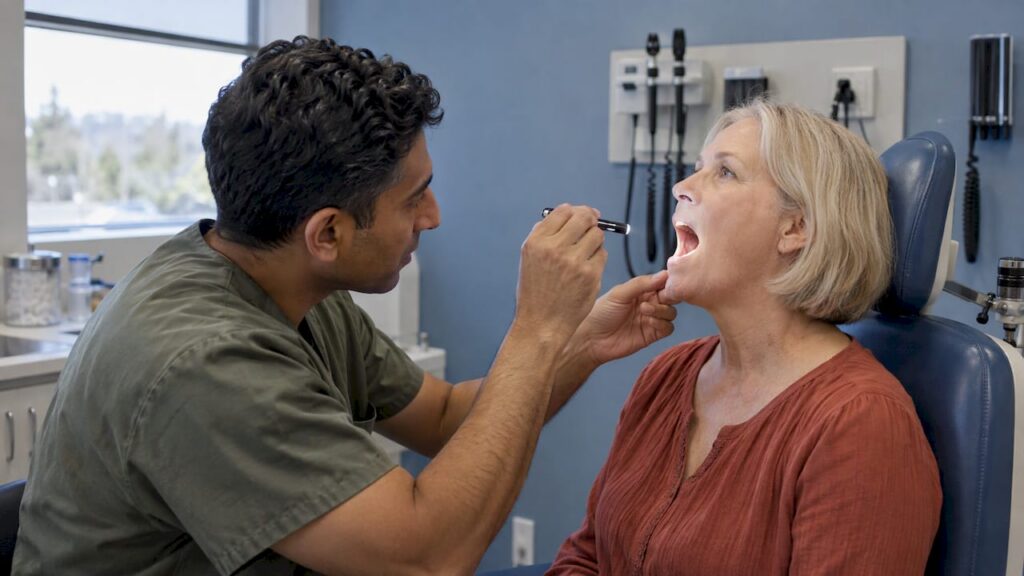
A physician diagnoses obstructive sleep apnea (OSA). After that, a sleep dentist and an ENT treat different parts of the problem. A sleep dentist fits and manages a custom oral appliance. An ENT evaluates the nose, tonsils, palate and throat, and can operate when anatomy is the obstacle. Many Californians need both at different points, so the useful question is who to see first and when to bring in the other.
TL;DR
- Sleep apnea is diagnosed by a physician, not by a dentist. A dentist can screen and refer you.
- A sleep dentist’s main job is fitting, adjusting and monitoring a custom oral appliance after a physician diagnoses you and prescribes one.
- An ENT looks for blockages in the nose, tonsils, palate or throat, and handles surgery when a pressure mask (CPAP) or an appliance is not enough.
- The two are often complementary: clearing a blocked nose can make CPAP or an appliance work better.
- Whichever door you enter, a sleep test comes first and follow-up testing confirms the treatment works.
Table of Contents
- The short answer: different jobs, same patient
- Who diagnoses sleep apnea?
- What a sleep dentist actually does
- What an ENT evaluates and treats
- When to see a sleep dentist, an ENT, or both
- How the handoffs work
- Questions to ask before you book
- Our perspective
- See a dentist who treats the airway
- FAQ
- Sources
The short answer: different jobs, same patient
The two specialties are not rivals. The American Academy of Otolaryngology-Head and Neck Surgery (AAO-HNS) states that OSA therapies, including PAP, upper-airway surgery and oral appliances, must be prescribed by a physician, and that an otolaryngologist or a qualified dentist may fit and adjust an oral appliance.
That sentence explains most of the confusion. The diagnosis and the prescription sit with a physician. The dentist brings the dental knowledge to build and manage the appliance. The ENT brings the surgical and anatomical knowledge to examine and correct the airway itself.
| Sleep dentist | ENT (otolaryngologist) | |
|---|---|---|
| Can diagnose OSA | No. Screens and refers | Yes, as a physician trained in sleep or otolaryngology, with a sleep test |
| Main treatment | Custom oral appliance | Nasal, tonsil, palate and other airway surgery; evaluation for CPAP problems |
| Best suited for | Adults diagnosed with OSA who cannot tolerate CPAP or prefer an alternative | Adults whose obstruction is anatomical, or for whom PAP is inadequate |
| Ongoing role | Regular appliance checks | Surgical care and airway reassessment |
Who diagnoses sleep apnea?
Neither a dentist nor a questionnaire can. The American Academy of Sleep Medicine (AASM) guideline says that questionnaires cannot diagnose OSA without a sleep test. The test is usually polysomnography (an overnight study in a lab) or, for appropriate uncomplicated adults, a technically adequate home sleep apnea test. A negative or inconclusive home test should be followed by polysomnography.
Some people should skip the home test. The same guideline recommends an in-lab study for patients with significant heart or lung disease, neuromuscular weakness, awake hypoventilation, chronic opioid use, prior stroke or severe insomnia.
The 2025 guidance from the American Academy of Dental Sleep Medicine (AADSM) says a qualified dentist may screen for suspected sleep-related breathing disorders, but the patient must be referred to a medical provider who is responsible for the diagnosis. The AAO-HNS adds that patients with OSA symptoms need a face-to-face evaluation by a physician trained in otolaryngology-head and neck surgery or sleep medicine. Oral and maxillofacial surgeons take the same view: the diagnosis is ultimately made by a sleep-trained physician, while they contribute exam and imaging of the airway and facial anatomy.
If you are wondering where a dentist fits into testing, we explain it in how dentists help with home sleep tests and what they cannot do.
What a sleep dentist actually does
A sleep dentist is a general dentist with additional training in dental sleep medicine. After a physician diagnoses and prescribes, the dentist can fit and adjust a medical oral appliance within their scope of practice.
What “qualified” means
AAO-HNS defines a qualified dental provider as a dentist certified by the American Board of Dental Sleep Medicine, or an appropriately trained director of an AADSM-accredited facility who meets set continuing-education criteria. Ask any dentist you consider about their training in dental sleep medicine.
Why the dentist’s skills matter
The joint AASM and AADSM guideline calls for a custom, titratable appliance overseen by a qualified dentist. That makes sense: moving the lower jaw forward affects the bite, the jaw joints and the teeth, so the person managing it needs to understand occlusion, temporomandibular joints, titration and side effects. The AADSM says the dentist should choose the appliance after a comprehensive dental sleep medicine examination of oral and craniofacial conditions, risks and factors that predict success.
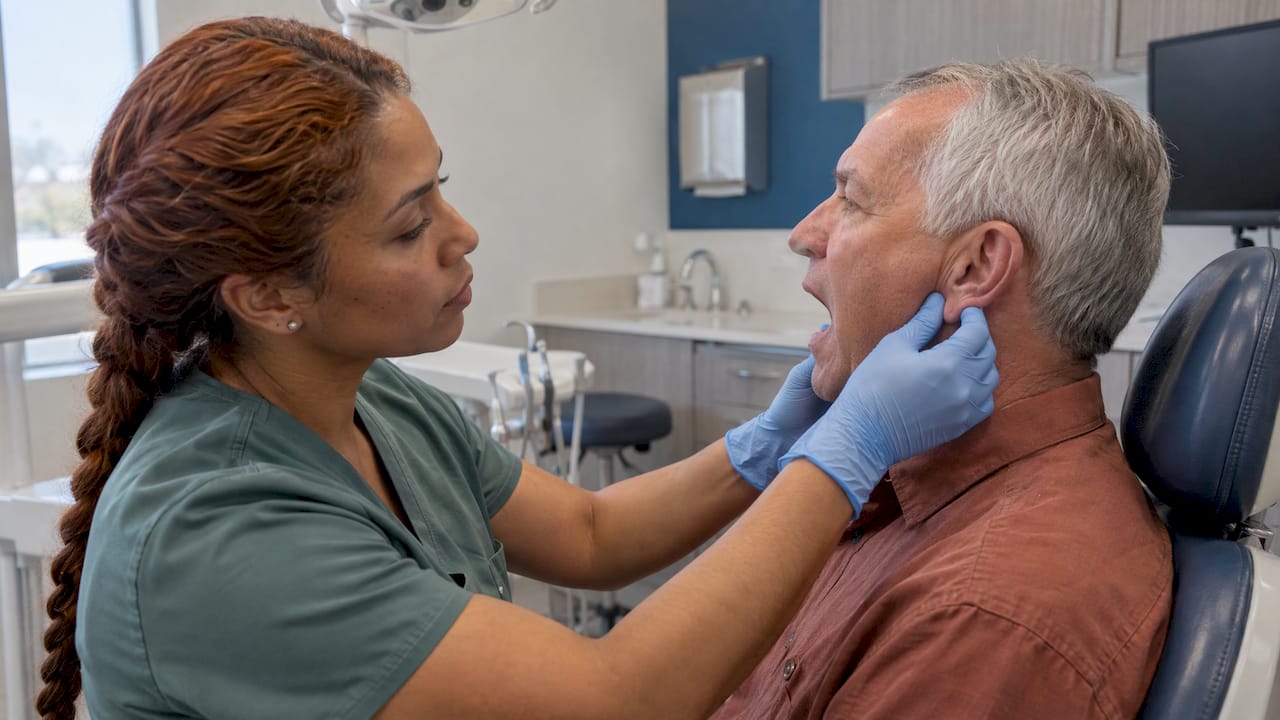
Jaw-joint health is a real part of that exam. Our article on TMJ risk and sleep apnea covers how it is screened.
When an oral appliance is considered
The AASM and AADSM say CPAP generally remains first-line because it is better at improving oxygen saturation and reducing the apnea-hypopnea and arousal indices. Sleep physicians should consider an appliance for adults who are CPAP-intolerant or prefer an alternative. AAO-HNS notes that appliances may be a first-line non-CPAP option for adults with mild-to-moderate OSA, followed by objective testing, such as a sleep study after titration, to verify that it works.
For what an appliance costs in the state, see our guide to sleep apnea oral appliance cost in California.
What an ENT evaluates and treats
An ENT approaches sleep apnea as a question of anatomy. AAO-HNS says surgery matters most when nasal, tonsillar, palatal, pharyngeal or other upper-airway obstruction can be corrected, or when PAP is inadequate.
- Tonsils: tonsillectomy may be an option for appropriately selected adults with enlarged tonsils.
- Nose: septoplasty, turbinate surgery and procedures for nasal-valve collapse may improve CPAP compliance, although the effect on the apnea-hypopnea index is often modest.
- Palate and throat: AAO-HNS clinical indicators for palatopharyngoplasty include OSA symptoms, a head-and-neck exam with fiberoptic airway evaluation, objective sleep testing, and non-adherence to or non-acceptance of PAP, unless a surgically correctable lesion is found.
AAO-HNS also explains that improving nasal patency can support other therapies, including CPAP and oral appliances. That is the clearest sign that ENT care and dental care work together.
When to see a sleep dentist, an ENT, or both
No single source gives a rule for every patient, so treat this as a practical way to think it through, then confirm with your physician.
- You snore, wake unrefreshed or feel sleepy by day, and have no diagnosis. Start with your primary care doctor, a sleep physician or an ENT, and get a sleep test. A dentist can screen you and refer you, and we are glad to do so.
- You have a diagnosis and cannot tolerate CPAP. Ask your physician about an oral appliance. A sleep dentist builds and manages it.
- Your nose is chronically blocked, or your tonsils are large. An ENT exam makes sense, since fixing the blockage may help CPAP or an appliance work better.
- You have moderate-to-severe OSA. AAO-HNS says CPAP is the initial treatment for most adults in this group, and it may also be used for mild OSA with significant symptoms such as excessive daytime sleepiness.
- Symptoms continue despite treatment. The AADSM advises that if signs and symptoms do not resolve after treatment modifications, the patient goes back to the medical provider for adjunct or alternative treatment. That may mean an ENT, a different device or retesting.
Children are different. Pediatric sleep-disordered breathing has its own pathways, and a pediatrician or pediatric ENT should be part of the picture. If you are a parent, our articles on bedwetting and sleep apnea and ADHD and sleep apnea explain what to raise with your child’s doctor.
How the handoffs work
Good care moves in a loop, not a line. A dentist may refer a suspected patient to a medical provider for diagnosis, and a medical provider may refer a diagnosed patient to a qualified dentist for appliance therapy.
After the appliance is in place, the AADSM’s 2025 guidance recommends evaluation every six months during the first year and at least annually after that. Those visits check efficacy, bite stability, the condition of the appliance, adherence and side effects. Patients who are not using the appliance should go back to their medical provider to consider other therapies. And the sleep physician should conduct follow-up testing to confirm the treatment is working.
So ask each provider the same three things: who is sending the prescription, who will see me for follow-up, and how will we know it works?
Questions to ask before you book
For a sleep dentist
- Are you board certified in dental sleep medicine, or do you direct an accredited facility?
- Do you work from a physician’s diagnosis and prescription, and who gets my follow-up results?
- How will you examine my bite and jaw joints before choosing an appliance?
- How often will I be seen after delivery?
For an ENT
- Is my obstruction something surgery can correct, and how large an effect is realistic?
- Would clearing my nose help me tolerate CPAP or an appliance?
- What testing do you want before and after any procedure?
Our perspective
We see the sleep dentist versus ENT question every week, and our answer is that the best outcomes come from a team. Sleep apnea is a whole-body problem, and the airway does not stop at the teeth or begin at the throat.
At our Fremont practice, we start with the root cause rather than the symptom. That means looking at how the jaw, tongue, bite and breathing patterns fit together, using tools such as 3D imaging, and working with your physician so the diagnosis, prescription and follow-up testing stay in the right hands. When your airway points to an ENT, we say so and coordinate.
We also look past the appliance. Mouth breathing, tongue posture, snoring that wears down teeth and jaw tension are all things a dentist who thinks about airway can notice early. Our airway dentistry work is built around finding those clues, then treating them with comfortable, minimally invasive care for adults and children, including Deaf patients who need clear communication at every step.
Bay Area Dental, Airway & Sleep
See a dentist who treats the airway
If you already have a diagnosis, or suspect sleep apnea and want a dental screening and a referral path, we can help. Our team in Fremont offers oral appliance therapy and works with your physician on testing and follow-up.
Learn more about oral appliance therapy at our practice or visit the Bay Area Dental, Airway & Sleep home page to book a visit. Prices are not published, so ask our team about your treatment and coverage when you call.
FAQ
Can a sleep dentist diagnose sleep apnea?
No. A qualified dentist may screen for suspected sleep-related breathing disorders, but a physician is responsible for the diagnosis, based on a sleep test. Once you are diagnosed and have a prescription, the dentist can fit and manage an oral appliance.
Should I see an ENT before a sleep dentist?
Not necessarily, but a physician evaluation and sleep test come first, and that physician can be an ENT, a sleep doctor or your primary care doctor. If your nose, tonsils or throat look like part of the problem, an ENT exam is worthwhile before or alongside appliance therapy.
Is an oral appliance better than CPAP?
Not according to the sleep medicine guidelines. CPAP generally remains first-line because it does more to reduce apnea events and improve oxygen levels. An oral appliance is considered for adults who cannot tolerate CPAP or prefer an alternative, and for some with mild-to-moderate OSA, with follow-up testing to confirm it works.
Can ENT surgery and a dental appliance be used together?
Yes. Improving nasal airflow can help both CPAP and oral appliances work better, so the two kinds of care are often complementary. Your physician and dentist should coordinate the timing.
How often do I need to see my dentist once I have an appliance?
The 2025 AADSM guidance recommends checks every six months in the first year and at least once a year after that. These visits look at how well it works, your bite, the device’s condition and any side effects.
Sources
- Position Statement: Use of Oral Appliances for the Treatment of Obstructive Sleep Apnea (AAO-HNS)
- Position Statement: Treatment of Obstructive Sleep Apnea (AAO-HNS)
- Position Statement: Nasal Surgery and OSAS (AAO-HNS)
- Clinical Indicators: Palatopharyngoplasty for Obstructive Sleep Apnea (AAO-HNS)
- Clinical Practice Guideline for Diagnostic Testing for Adult OSA (AASM)
- AADSM Special Article, Issue 12.2 (2025)
- Management of Sleep-Related Breathing Disorders in Adults (AADSM, 2025)
- Oral Appliance Therapy for OSA, Journal of Clinical Sleep Medicine (AASM/AADSM, 2015)
- Oral appliance therapy clinical guideline published jointly by AASM and AADSM
- Position Paper on OSA (AAOMS, 2013)