

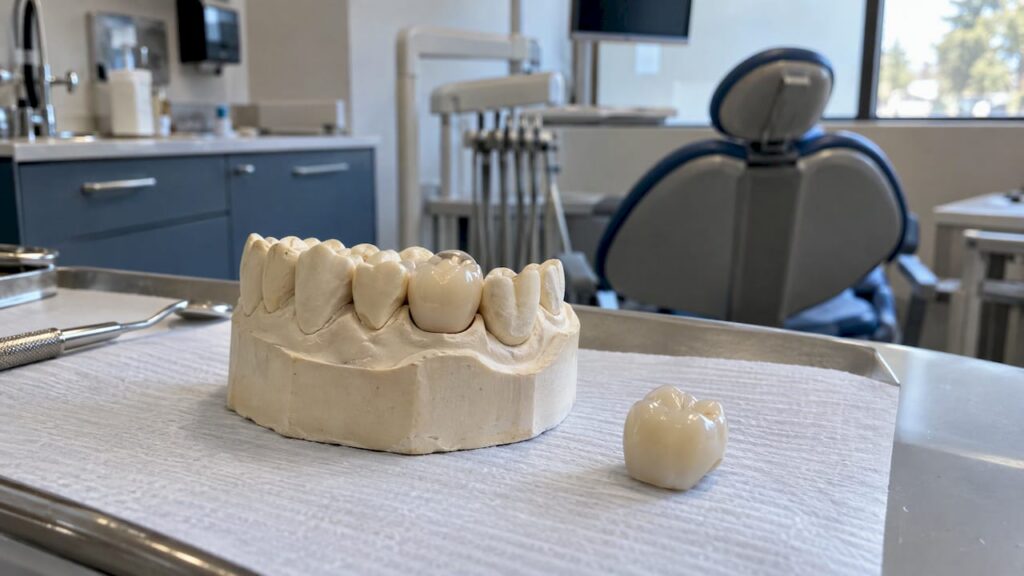
Most Fremont patients without insurance should expect a dental crown to cost roughly $1,000 to $2,000 per tooth, depending on the material, the condition of the tooth and whether extra work comes first. With insurance, your share is often about half of the office fee, until you reach your plan’s annual maximum. We don’t publish a fixed crown fee, because the price depends on your tooth. The most reliable number is a written estimate after an exam and X-rays. This guide shows how to read that estimate.
TL;DR
- Nationally, the average out-of-network price for a permanent crown falls between $1,100 and $2,000, per Delta Dental. Bay Area offices tend to sit in the middle or upper part of published ranges.
- Material drives the price: composite resin is lowest, PFM and metal sit in the middle, and all-ceramic can run highest.
- Dental plans typically cover about 50% of crowns, but deductibles and annual maximums of $1,000 to $1,500 are common.
- A build-up, root canal, gum work or imaging can be billed separately, so ask for an itemized estimate.
- A pretreatment estimate from your insurer shows your likely out-of-pocket cost before you commit.
Table of Contents
- What a crown costs in Fremont
- How the material changes the price
- The extras that change your total
- How dental insurance affects your share
- Questions to ask before you book
- Why a crown isn’t always the first answer
- Keeping future costs down
- Perspective
- Get an exact estimate for your tooth
- FAQ
- Sources
What a crown costs in Fremont
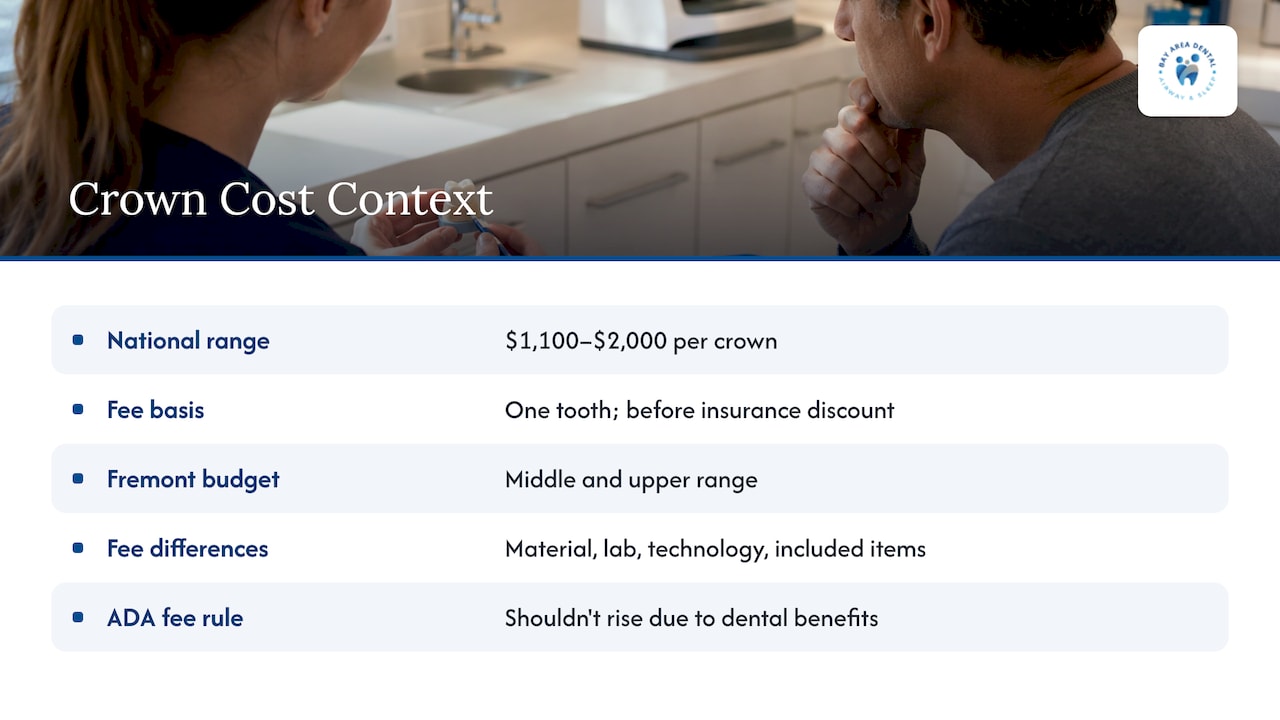
The national picture is a good starting frame. Delta Dental reports that the average out-of-network cost of a permanent crown is between $1,100 and $2,000. That figure is for one tooth, and it is the fee before any insurance discount.
The Bay Area is a higher-cost region than much of the country, with higher rent, lab fees and wages. So a Fremont quote at the lower end of a national range is possible, but plan your budget around the middle and upper parts of it. Two offices a mile apart can quote different fees for the same tooth. The difference usually comes from the material, the lab, the technology used and what the fee includes.
We don’t list a crown price on our site and won’t guess one here. Your tooth decides the plan. A tooth with a small fracture and plenty of healthy structure is a very different job from a tooth that has a large old filling, decay underneath or a root canal.
One rule is worth knowing. The American Dental Association’s Code of Ethics says a dentist should not raise a fee only because a patient has dental benefits. The fee for a patient without coverage is considered the dentist’s full fee. If you are uninsured, ask what the office charges you and whether it has a cash or membership discount.
How the material changes the price
The material is the largest single factor in the crown itself. Ranges published by RealSelf give a useful comparison:
| Crown type | Typical price per tooth | Where it is often used |
|---|---|---|
| Composite resin | $400 to $600 | Short-term or budget-driven cases |
| PFM (porcelain fused to metal) | $500 to $1,500 | Back teeth, when strength matters |
| Metal or gold alloy | $600 to $2,500 | Molars, especially for heavy biters |
| All-porcelain or all-ceramic | $800 to $3,000 | Visible teeth and patients who want the most natural look |
These are national ranges, not Fremont quotes. The spread is wide because a range covers different regions, labs and case difficulty. Here is what separates the options.
Porcelain and ceramic
All-ceramic crowns are chosen where appearance matters, such as front teeth and premolars. They match the shade of neighboring teeth well. They also contain no metal, which matters to patients who prefer a metal-free mouth.
PFM
PFM crowns pair a metal base with a porcelain surface. The Cleveland Clinic notes that they combine the durability of metal with the look of porcelain, though the porcelain can chip over time and show the metal beneath. That is why many dentists now steer visible teeth toward all-ceramic options.
Metal and gold alloy
Metal crowns are still a sound choice for a back molar nobody sees, since they need less tooth removed and handle heavy chewing. If you are asking how much a metal crown costs, RealSelf puts it at $600 to $2,500, and gold alloys land at the higher end because of the metal itself.
Composite resin
Composite crowns have the lowest sticker price. They are usually a short-term or interim choice, not the restoration most patients want to rely on for years.
The extras that change your total
A crown fee does not always cover everything that happens before the crown goes on. When you compare quotes, ask each office what is included. Here are the items that most often appear as separate lines:
- Exam and X-rays. A new patient exam and diagnostic images are usually billed on their own. A 3D scan may be added if the case is complex.
- Core build-up. If much of the tooth is missing from decay or a fracture, the dentist may need to rebuild a base before shaping it for the crown. This is typically a separate procedure code and fee.
- Root canal. A tooth with deep decay or infection may need root canal treatment first. The crown then protects the weakened tooth.
- Post and core. After a root canal, a post may anchor the build-up when little tooth structure remains.
- Gum work. If the tooth has broken at or below the gumline, there may not be enough tooth above the gum to hold a crown. Laser crown lengthening exposes more healthy tooth so the crown can fit and seal properly.
- Temporary crown. Often included, but confirm that it is.
- Remake or adjustment visits. Ask whether bite adjustments are included in the fee.
A fair estimate lists each of these, with a yes or no on whether you need it. If an office gives you only one figure, ask what that figure covers. For a tooth that needs a root canal, a build-up and a crown, the total can be several times the price of the crown alone, so a single number can mislead.
How dental insurance affects your share
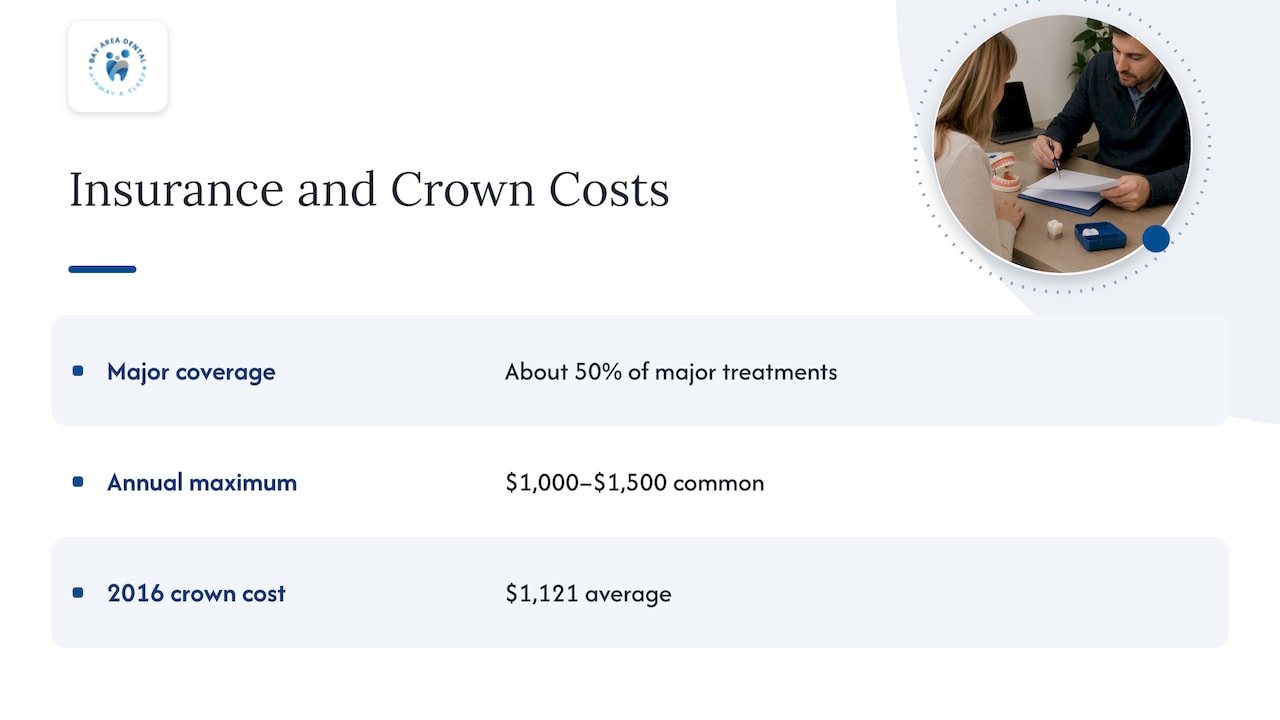
Insurance usually helps with a crown, but it rarely covers it all. The American Dental Association notes that dental plans cover about 50% of major treatments such as crowns, and that plans may have deductibles and annual maximums.
The annual maximum is where many patients are surprised. An ADA plan design paper says common annual maximums run $1,000 to $1,500. It also notes that the average crown cost in 2016 was $1,121, which nearly exhausts the maximum in many plans. Crown prices have not fallen since then.
A worked example
Say your office fee for a crown is $1,400 and your plan covers 50% after a $50 deductible, with a $1,500 annual maximum. Insurers also set their own allowed amounts for in-network offices, so the actual math depends on your contract. In a simplified case, the plan pays about $675 and you pay about $725. If you have already used $900 of your maximum on other care this year, the plan can pay only $600 more, and your share goes up. This is an illustration, not a quote.
Steps to protect your budget
- Ask for a pretreatment estimate. The ADA says patients can request a pretreatment estimate or prior authorization to anticipate out-of-pocket costs. Insurers may still adjust coverage afterward, so treat it as a guide, not a guarantee.
- Check your remaining maximum. Your insurer’s portal or a call to member services shows how much of the year’s benefit is left. Benefit years often reset in January, which can affect when you schedule.
- Check the waiting period and replacement rules. Some plans have waiting periods for major work. Others limit how often they will pay to replace a crown. Former ADA Council member Rod Hill has noted that insurers have imposed longer frequency limits that may not reflect an individual patient’s habits and oral health.
- Ask about the warranty. Hill describes the standard crown warranty period as 60 months. Ask any office what its own policy is, in writing.
- Ask whether the office is in network. Out-of-network fees can differ from in-network ones, and your share changes with them.
Questions to ask before you book
Crown quotes are only comparable when the details match. Ask each office:
- Which material is the quote for, and who makes the crown?
- Does the fee include the temporary crown and follow-up adjustments?
- Do I need a build-up, post, root canal or gum work first, and what does each cost?
- Is there a lower-cost alternative for this tooth, such as a filling or an onlay, and what are the trade-offs?
- What is the office’s policy if the crown fails or comes loose?
- Can you send the estimate in writing, with procedure codes, so I can send it to my insurer?
Our guide to choosing a dentist in Fremont covers how to compare offices on more than price.
Why a crown isn’t always the first answer
A crown is the right answer when a tooth has lost too much structure to hold a filling, or when a cracked tooth needs protection. It is not always the first step. Catching a problem early can keep the repair small and the bill lower.
The approach our practice takes is conservative. Professional bodies back it as well: the American Academy of Pediatric Dentistry and the ADA support minimally invasive care, and we cover that in our article on minimally invasive dentistry. Our biomimetic dentistry page explains how we try to preserve as much natural tooth as we can. Sometimes that means monitoring a small problem. Sometimes it means a smaller repair. When a crown is right, we say so and plan it carefully.
Keeping future costs down
The cheapest crown is the one you never need. Dr. Sara Stuefen has said that preventive care such as regular cleanings remains the most cost-effective way to avoid expensive procedures. Most plans cover cleanings and exams at a high percentage, often without touching the annual maximum in the same way major work does.
Daily habits matter just as much between visits. Cracks and decay near old fillings are the usual reasons a tooth ends up needing a crown, and thorough cleaning slows both. For more on why routine visits protect your wallet as well as your teeth, see this overview of why dental visits are important.
If you grind your teeth at night, tell your dentist. Grinding is hard on crowns and natural teeth alike, and it is sometimes linked to sleep-disordered breathing. Screening for that is part of what our practice does, so a crown plan can account for the cause, not only the damage.
Perspective
Patients often come to us with one question: how much for a crown? We understand why. But the better question is why this tooth needs one, and whether the cause will damage the next tooth too.
We look at the whole picture. A cracked molar can point to nighttime grinding, and grinding can point to an airway problem. Treating only the broken tooth restores the chewing surface, but it leaves the cause in place. Our practice brings dental, airway and sleep care under one roof so we can look at both.
We also use 3D imaging and minimally invasive methods, including lasers where they suit the case, so we can plan precisely and keep as much healthy tooth as possible. That planning is what makes an estimate accurate. You see what is needed, what is optional and why, before anything starts.
Our goal is a crown you only have to pay for once, on a tooth that is part of a healthier mouth.
Bay Area Dental, Airway & Sleep
Get an exact estimate for your tooth
If you have a cracked, worn or heavily filled tooth, the fastest way to a real number is an exam with imaging. At Bay Area Dental, Airway & Sleep in Fremont, we explain your options, the materials and each step of the treatment plan before you decide. We also welcome Deaf patients, with communication tailored to your needs.
See our restorative dentistry services or contact our Fremont office to book an exam and ask for an itemized estimate you can take to your insurer.
FAQ
How much does a dental crown cost in Fremont without insurance?
Plan on roughly $1,000 to $2,000 per tooth for a typical crown. Delta Dental reports a national out-of-network average between $1,100 and $2,000. Your exact fee depends on the material and on whether you need a build-up, root canal or gum work first.
How much does a metal crown cost?
RealSelf lists metal and gold-alloy crowns at $600 to $2,500. They are often used on back teeth such as molars, where strength matters more than appearance. Gold content and case complexity push the price toward the top of that range.
Will my insurance pay for a crown?
Most plans pay about half of the cost of a crown, after your deductible, up to your annual maximum. Common maximums are $1,000 to $1,500, so a crown can use most of a year’s benefit. Ask your dentist for a pretreatment estimate to see your likely share.
Why do two Fremont offices quote different crown prices?
Quotes differ when the material, lab, technology or included services differ. One office may bundle the temporary crown and adjustments, while another bills them separately. Ask for an itemized estimate from each office so you compare the same work.
How long should a crown last?
Longevity depends on the material, your bite, your habits and your home care. Insurance and offices often use a five-year warranty or replacement window, which is a billing norm and not a prediction of lifespan. Your dentist can tell you what to expect for your tooth.
Sources
- Delta Dental: Dental crown costs and insurance
- RealSelf: How Much Do Dental Crowns Cost?
- Cleveland Clinic: Dental Crowns: Types, Procedure & Care
- ADA News: Public misunderstanding of dental insurance is widespread
- ADA: Dental Benefit Plan Design
- ADA News: 3 dental benefit trends you should know
- ADA: 2023 Principles of Ethics and Code of Conduct
- Y-Brush: Why Dental Visits Are Important for Your Health