


A visible frenulum under your baby’s upper lip usually isn’t the problem on its own: what matters is whether feeding is actually working. If your baby clicks, loses latch often, or you have persistent nipple pain, the right next step is an observed feeding evaluation with a pediatrician or certified lactation consultant, not an automatic snip.
TL;DR:
- A complete assessment includes an observed feed, latch and swallowing checks, weight trends or weighed feeds, and an oral exam rather than visual grading alone.
- After lactation support, reassess within 48 to 72 hours; seek dental or ENT input if documented feeding problems persist despite that support.
- Frenotomy may ease nipple pain soon after treatment, but evidence for lasting breastfeeding benefits remains uncertain; about 4% experience adverse events, mostly minor.
- After release, some infants need only lactation support, while children with longstanding compensatory habits may benefit from structured myofunctional therapy.
Table of Contents
- What a Lip Tie Is and How It Differs From a Tongue-Tie
- Signs and Symptoms Parents Notice During Feeding
- How Clinicians Evaluate a Suspected Lip Tie
- Treatment Options: Support First, Then Release if Needed
- Recovery and What to Expect After a Release
- What the Clinical Evidence and Major Health Bodies Say
- Does a Lip Tie Affect Speech Development?
- Can an Untreated Lip Tie Affect Dental Health Later?
- Myofunctional Therapy as Support After a Frenectomy
- Advanced Diagnostic Tools Used in Lip Tie Evaluation
- Lip Tie Types and Severity: Why Grading Alone Isn’t the Full Picture
- Our Approach: Function First, Minimally Invasive When Needed
- Getting an Evaluation at Bay Area Dental, Airway & Sleep
- FAQ
- Sources
What a Lip Tie Is and How It Differs From a Tongue-Tie
A lip tie refers to the maxillary labial frenulum, the band of tissue connecting the upper lip to the gum. Nearly every infant has one. It’s a normal structure, and its thickness or attachment point varies widely from baby to baby, the way earlobes or finger length vary. Visual grading systems that sort lip ties into numbered classes look objective but research shows the frenulum’s appearance alone doesn’t reliably predict breastfeeding difficulty, which is why clinicians increasingly judge function overlooks. A tongue-tie, or ankyloglossia, involves the lingual frenulum under the tongue and tends to affect latch mechanics differently, often restricting tongue extension and cupping rather than lip flange.
Signs and Symptoms Parents Notice During Feeding
Feeding problems show up on both sides of the breastfeeding relationship, and watching for patterns matters more than fixating on any single symptom.
In your baby, watch for:
- Clicking sounds or frequent loss of suction during feeds.
- A shallow, pinched latch instead of a wide, flanged one.
- Feeding sessions that run unusually long or happen very frequently.
- Slow weight gain despite seemingly frequent feeds.
- Excessive gas, spit-up, or fussiness that looks reflux-like.
On your end, watch for nipple pain, cracked or damaged nipples, recurring blocked ducts or mastitis, or a sense that your supply is dropping. These signs can come from dozens of causes unrelated to any frenulum, including positioning, oversupply, or an unrelated latch habit, so a feeding-focused evaluation is the only reliable way to sort out the cause.
How Clinicians Evaluate a Suspected Lip Tie
Getting a clear answer usually takes more than one set of eyes. A pediatrician, a certified lactation consultant, and sometimes a pediatric dentist or ENT each bring a different piece of the picture, and many cases benefit from all three weighing in together.
A thorough assessment typically includes:
- Watching an actual feeding session, not just examining the mouth at rest.
- Checking latch quality and listening for audible or visible swallowing.
- Reviewing weight trends or doing weighed feeds to confirm the baby is transferring enough milk.
- Performing an oral exam to assess frenulum mobility and tissue thickness.
Referral to a dental or ENT specialist generally makes sense when feeding dysfunction persists after focused lactation support, rather than as a first step.
Treatment Options: Support First, Then Release if Needed
Conservative care comes first for almost every infant, and most feeding problems respond to it without any procedure. That usually means:
- Adjusting feeding positions and latch technique with hands-on lactation guidance.
- Trying paced bottle feeding or pumping to protect supply while latch issues are addressed.
- Scheduling a follow-up weight check to confirm the baby is gaining as expected.
Release is considered when documented functional impairment, not appearance, persists despite genuine conservative effort. The Academy of Breastfeeding Medicine’s protocol describes a sensible workflow: observe feeding, trial conservative measures, reassess within 48 to 72 hours, escalate to a dental or ENT consult if there’s no improvement, and only then consider frenotomy with documented deficit and informed consent.
A frenotomy or frenectomy itself is quick, typically performed in-office with small scissors or a laser, and many infants attempt breastfeeding again within minutes of the release. Systematic review data puts the pooled adverse event frequency at about 4%, mostly minor issues like brief bleeding, though overall evidence quality for long-term outcomes remains low.
Pro Tip: Bring your feeding notes, weight records, and any prior lactation consultant observations to the appointment: it speeds up shared decision-making considerably.
Recovery and What to Expect After a Release
The oral mucosa heals quickly, often within a few days, and many parents notice less nipple pain almost immediately after the procedure. Babies vary more than the tissue does: some latch noticeably better right away, while others need a week or two of practice and continued lactation support to catch up on technique.
Afterward, offer the breast for comfort, watch for unusual bleeding or signs of infection, and keep the scheduled follow-up with your lactation consultant or pediatrician. Persistent feeding trouble, bleeding beyond what you were told to expect, or concerns about how the area looks as it heals are all reasons to call the clinic rather than wait it out.
What the Clinical Evidence and Major Health Bodies Say
The American Academy of Pediatrics clinical report recommends prioritizing nonsurgical management and reserving frenotomy for documented functional impairment, noting that many infants with visible anatomical findings never need a procedure at all. The AAP also encourages a team-based approach, pairing lactation support with pediatric oversight before surgery enters the conversation.
Pediatric ENT consensus statements add an important caveat: definitions of lip tie, especially milder or “posterior” presentations, remain inconsistently applied across providers, and expert panels stop short of endorsing routine release just to prevent hypothetical future problems.
Short-term maternal nipple pain often improves after frenotomy, but the overall certainty of evidence for long-term breastfeeding outcomes remains low, with a pooled adverse event frequency of about 4%.
That gap between short-term relief and uncertain long-term data is exactly why multidisciplinary evaluation, not a quick visual check, drives sound decisions.
Does a Lip Tie Affect Speech Development?
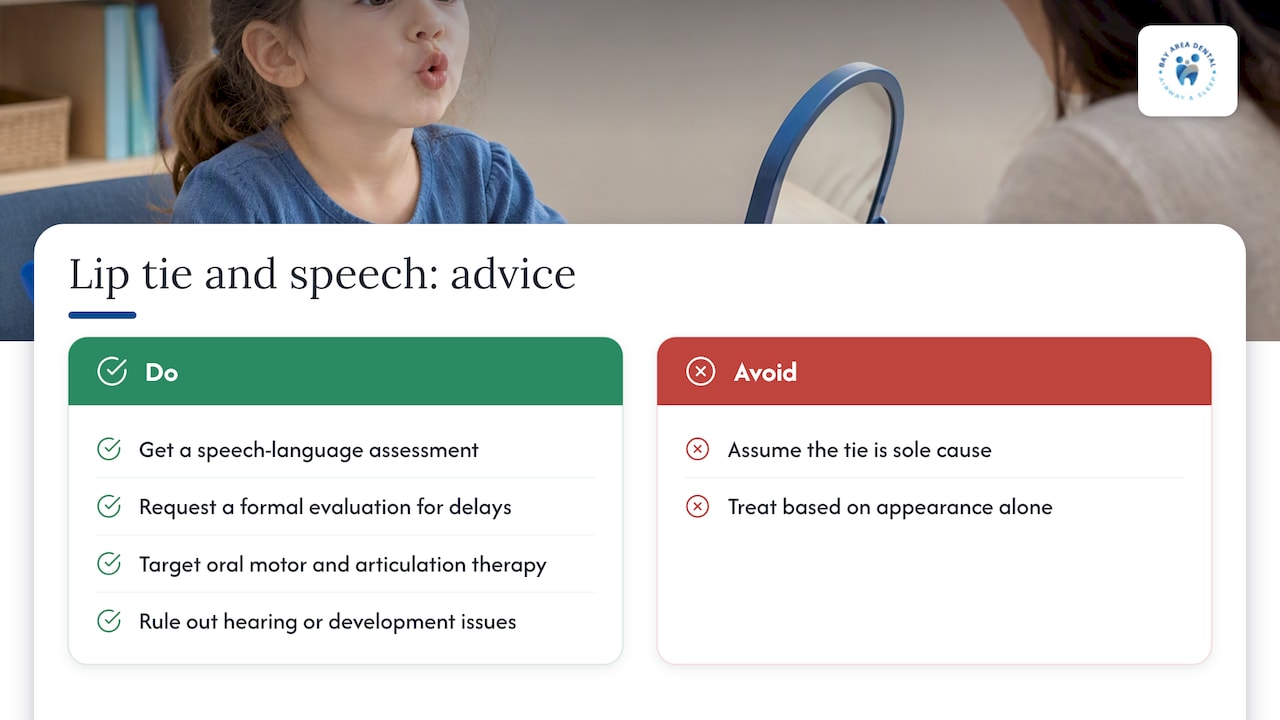
Lip tie’s effect on speech is generally smaller and less direct than tongue-tie’s, since most consonant and vowel sounds rely far more on tongue mobility than lip movement. Still, a severely restrictive lip tie can occasionally limit the lip rounding needed for certain sounds, like “b,” “p,” or “m,” particularly if the restriction persists into toddlerhood. Most speech concerns tied to tethered oral tissue trace back to the tongue rather than the lip, which is why a speech-language pathologist’s assessment focuses on overall oral function rather than the frenulum in isolation. If your child shows delayed or unclear speech alongside a lip tie, a formal speech evaluation helps determine whether therapy would target articulation habits, oral motor strength, or an unrelated developmental pattern. Speech therapy, when recommended, typically works on oral motor exercises and articulation drills rather than assuming the tie is the sole cause. Because speech milestones depend on so many factors, including hearing, general development, and practice opportunities, a lip tie rarely explains a delay by itself, and ruling out other causes alongside any structural concern gives a clearer path forward.
Can an Untreated Lip Tie Affect Dental Health Later?
A thick or low-attached lip frenulum can sometimes contribute to a gap between the upper front teeth, known as a midline diastema, because the tissue pulls on the gum between the incisors as teeth erupt. In some children, the same tension contributes to localized gum recession right at the gumline where the frenulum attaches, since the pull can make that area harder to keep clean and more prone to irritation. These outcomes are not universal: many children with a prominent lip tie never develop spacing or gum issues, and the frenulum sometimes recedes naturally as the jaw grows and permanent teeth come in. A pediatric dentist is well positioned to track this over time, watching how the frenulum behaves as teeth erupt rather than intervening preemptively. When a gap or recession does develop and persists after primary teeth are replaced, treatment options range from monitoring through adolescence to a frenectomy timed around orthodontic care, depending on how the bite and gum tissue are responding. The decision usually waits until there’s a clear pattern worth addressing, rather than being made in infancy based on appearance alone.
Myofunctional Therapy as Support After a Frenectomy
Releasing tight tissue solves the mechanical restriction, but it doesn’t automatically retrain years, or even weeks, of compensatory habits the mouth built around that restriction. Myofunctional therapy addresses that gap by working on tongue posture, lip seal, and swallowing patterns so the muscles relearn efficient movement now that the physical limitation is gone. For infants, this often looks like simple guided exercises and feeding cues coached by a lactation consultant or myofunctional therapist in the days after release. For older children who had a lip or tongue tie addressed later, therapy can include structured exercises targeting lip closure, tongue-to-palate contact, and coordinated swallowing. The goal isn’t to force a rigid routine but to help the muscles adopt the function that tight tissue previously blocked. Not every release needs formal therapy afterward. Some infants transition to efficient feeding within days with nothing more than lactation support, while others, particularly those with longstanding compensatory patterns, benefit from a structured follow-up program. Deciding which path fits is part of the same shared decision-making that should guide the original choice to treat.
Advanced Diagnostic Tools Used in Lip Tie Evaluation
Beyond a basic visual check, some clinics use 3D imaging to map frenulum attachment and tissue thickness with more precision than the eye alone provides, which can help clarify borderline cases before deciding on treatment. Laser technology also plays a role on the treatment side: a laser frenectomy typically produces a cleaner release with less bleeding than traditional scissor techniques, and many infants tolerate it well in a single short in-office visit. These tools support better-documented decision-making, but they don’t replace the core of any good evaluation, which is watching how your baby actually feeds. Imaging and laser assessment work best as a complement to observed feeding, weight tracking, and lactation input, not a substitute for them. A clinic that pairs advanced imaging with hands-on feeding assessment is generally better positioned to avoid both overdiagnosis and missed cases than one relying on either tool alone.
Lip Tie Types and Severity: Why Grading Alone Isn’t the Full Picture
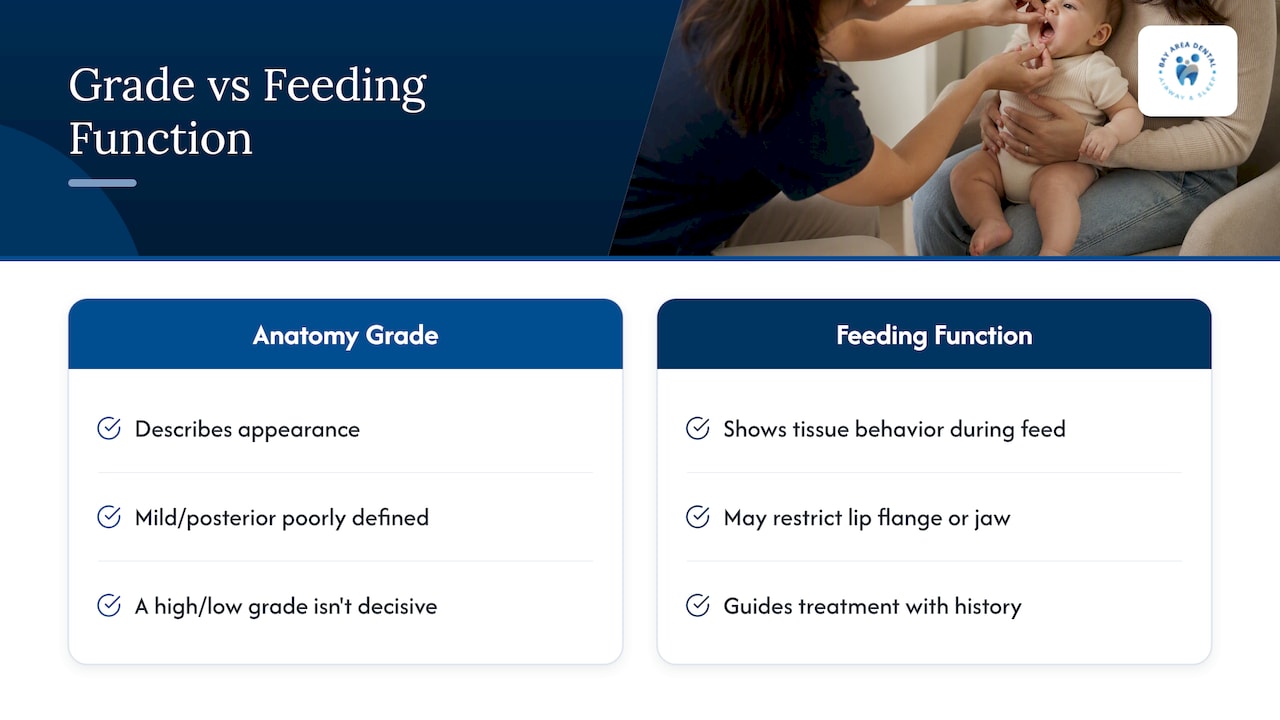
Lip ties are often described using classification systems that grade the frenulum from mild (a thin, barely noticeable band) to severe (a thick, fibrous attachment reaching deep into the gum). These grading systems can help describe anatomy consistently between providers, but clinical consensus statements caution that milder and “posterior” classifications are poorly and inconsistently defined, which limits how much weight any single grade should carry on its own. A high grade doesn’t guarantee feeding trouble, and a low grade doesn’t rule it out. What matters more is how the tissue behaves during an actual feed: whether it restricts lip flange, causes compensatory jaw movement, or correlates with the symptoms you and your care team have already observed. That’s why treatment decisions lean on functional assessment and feeding history alongside the grade, rather than the grade number dictating next steps by itself.
Our Approach: Function First, Minimally Invasive When Needed
We evaluate lip ties based on how your baby actually feeds, not just how the tissue looks, and offer frenectomy when conservative care hasn’t resolved documented feeding problems. We encourage every family to pursue a multidisciplinary evaluation before deciding on treatment.
— Admin
Getting an Evaluation at Bay Area Dental, Airway & Sleep
If feeding problems have persisted despite genuine conservative effort, we’re set up to give you a clear, team-based answer. Bring your feeding history, recent weight records, and any notes from your lactation consultant to your visit: those details let us assess function quickly rather than starting from scratch.

We evaluate lip tie through observed feeding, oral exam, and coordination with your pediatrician or lactation consultant, and we offer frenectomy when the assessment supports it. Our pediatric dental care also covers broader concerns as your child grows, from airway development to routine checkups.
Start with our tongue and lip tie evaluation page to see what’s involved, or explore our pediatric dental care services to book a visit.
FAQ
Does a baby lip tie need to be corrected?
Not automatically. Correction is generally considered only when a documented feeding problem persists after conservative lactation support, since the AAP clinical report notes many infants with anatomical findings feed well without any procedure.
How to fix a lip tie naturally?
There’s no way to loosen the tissue itself without a procedure, but many feeding problems blamed on a lip tie improve with positioning changes, latch coaching, and consistent lactation support alone. A feeding evaluation helps determine whether those conservative steps are enough before considering anything further.
Should I be worried if my baby has a lip tie?
A visible lip tie alone usually isn’t a cause for concern, since it’s a normal structure present in nearly every infant. What matters is whether your baby is feeding well and gaining weight as expected; if not, an observed feeding evaluation will clarify whether the lip tie is actually contributing.
Is lip tie surgery painful for babies?
A frenotomy is a quick procedure, and many infants breastfeed again within minutes afterward, which suggests discomfort is brief for most babies. Systematic review data reports a pooled adverse event frequency of around 4%, mostly minor issues rather than significant complications.
Sources
- Identification and Management of Ankyloglossia and Its Effect on Breastfeeding in Infants: Clinical Report | Pediatrics | American Academy of Pediatrics
- Healthychildren
- Frenotomy for Ankyloglossia Associated With Feeding Challenges in Infants: Effectiveness, Technique, and Safety–A Systematic Review and Meta-Analysis, Part 2
- Tongue-tie (ankyloglossia) – Cleveland Clinic