

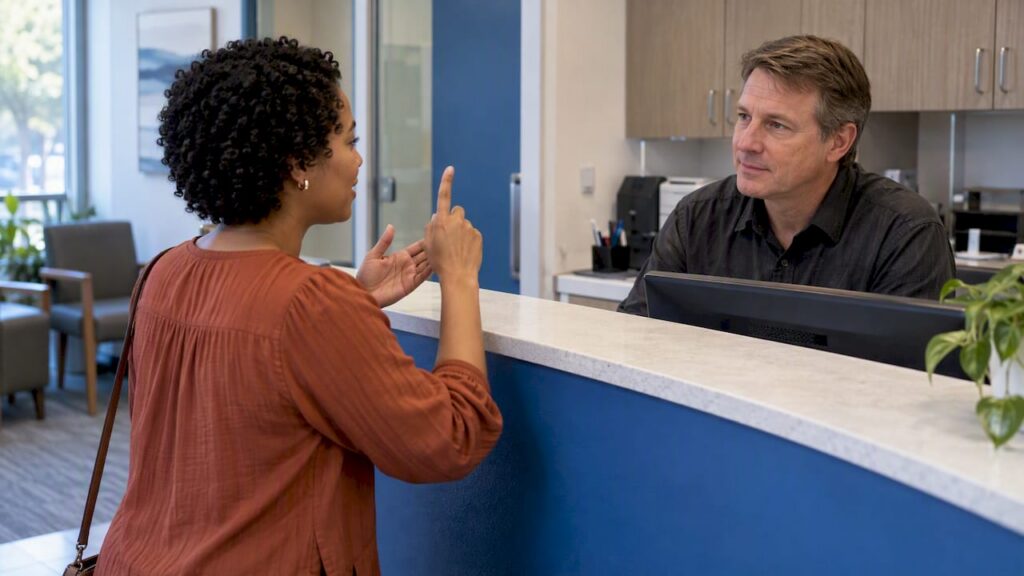
If you use American Sign Language (ASL), a dental office in the U.S. must communicate with you effectively, and that often means providing a qualified interpreter at no cost to you. The simplest way to get one is to tell the office you are Deaf or hard of hearing when you book, and to name the aid you need. This guide covers what the law says, how to make the request, what a well-run appointment looks like, and how to sign “dentist.”
TL;DR
- Federal law requires dental offices to provide effective communication, including a qualified sign language interpreter when one is needed, and they cannot bill you for it.
- Ask as early as you can, say you are Deaf or hard of hearing, and name the aid you want (in-person interpreter, video remote interpreting, captioning, written materials).
- A family member, friend or untrained staff member should not be used to interpret your medical history or treatment options.
- Good visits are planned: the interpreter is briefed, the dentist faces you, and instructions are short and clear.
- We welcome Deaf patients at our Fremont, CA practice. Tell us how you communicate best before your visit.
Table of Contents
- What the law says about ASL in a dental office
- Who pays for the interpreter?
- How to request an ASL interpreter for your appointment
- What an accessible dental visit looks like
- When interpreting matters most
- How do you sign “dentist” in ASL?
- Perspective
- Care at our Fremont practice
- Family and children: planning a first visit
- Common mistakes to avoid
- FAQ
- Sources
What the law says about ASL in a dental office
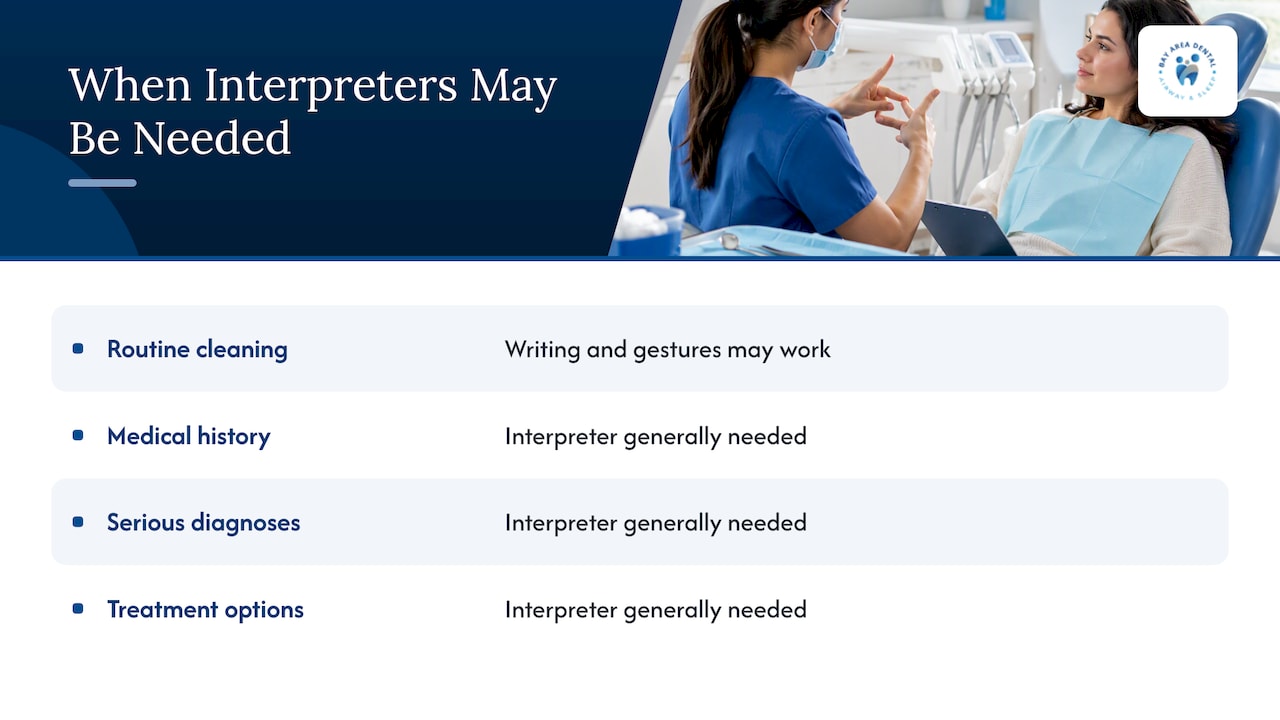
The Americans with Disabilities Act (ADA) requires businesses open to the public, dental practices included, to communicate effectively with people who have disabilities and to provide auxiliary aids when needed. The Department of Justice states that a qualified sign language interpreter may be needed for someone who uses sign language. The same guidance says an interpreter is generally needed when taking a medical history or discussing serious diagnoses and treatment options.
That last point matters in dentistry. A routine cleaning may be manageable with writing and gestures for some patients. A conversation about a root canal, extraction, sedation, consent forms or a sleep-related treatment plan is different. These are exactly the moments where misunderstanding carries real risk.
The Department of Health and Human Services adds that the office is responsible for effective communication and must provide a needed aid free of cost. It also notes that an office weighs whether an aid would cause a fundamental alteration or undue burden, case by case. That is a narrow exception, not a routine reason to say no.
The American Dental Association tells its member practices that appropriate auxiliary aids include on-site interpreters or video remote interpreting (VRI). So “interpreter” does not always mean someone physically in the chair-side room. It can be a qualified interpreter on a screen, as long as the setup works for you.
For more on the rights side, see our guides on ASL interpreter rights at the dentist and Deaf patient communication rights.
California adds its own protections
If you live in California, state law sits on top of the federal rules. The California Attorney General’s office explains that the state’s Unruh Civil Rights Act, Government Code section 11135 and the Disabled Persons Act protect people with disabilities in healthcare. The same document lists qualified sign-language interpreters, real-time captioning and written materials among the auxiliary aids and says providers may not charge for them.
Who pays for the interpreter?
Not you. A dental office cannot add an interpreter fee to your bill or pass the cost along as a surcharge. A 2023 advocacy letter from the Missouri Commission for the Deaf and Hard of Hearing puts it plainly: offices cannot charge patients for auxiliary aids and services, and they should not rely on family members, friends or unqualified staff to interpret. The letter is from Missouri, but it restates federal rules that apply in every state.
The ADA’s guidance on Section 1557 also says the practice must not rely on a minor child to interpret. An adult companion may help only in narrow circumstances, such as when you request it and the adult agrees, and relying on them is appropriate. You choose. Nobody can require you to bring someone.
There are good reasons to prefer a professional anyway:
- A family member may not know dental vocabulary, and may soften or skip bad news.
- Medical conversations are private. A professional interpreter follows confidentiality standards, and a relative may not.
- Your relative is there as your relative, not as a staff member for an hour of technical conversation.
How to request an ASL interpreter for your appointment
The wording is not complicated, but specifics help. The HHS advises patients to tell the office as soon as possible that they are Deaf or hard of hearing and to request the specific aid they need.
- Contact the office when you schedule. Use whichever channel works for you: email, the website contact form, text, a video relay call or a video phone. Offices that run automated phone systems must also provide effective real-time communication for Deaf and hard-of-hearing callers, including compatibility with TTYs and FCC-approved relay systems, according to the ADA.
- Say what you need. For example: “I am Deaf and use ASL. Please arrange a qualified ASL interpreter for my new patient exam on this date.” If you prefer in-person over video, say so.
- Describe the visit. A cleaning and a consultation about several procedures call for different planning. Mention if you expect to sign consent forms or discuss treatment options.
- Ask for confirmation in writing. Get the date, time and interpreter arrangement by email or text. This protects you if something changes.
- Follow up a few days before. Interpreter scheduling takes lead time, so a quick check helps.
The DOJ says that when choosing an aid, an office should consider the nature, length and complexity of the communication and your normal methods of communication. Government entities must give primary consideration to your choice, while businesses and nonprofits should work with you to choose an appropriate aid whenever possible. Your preference carries weight, so state it clearly.
What if the office says no?
Stay calm and ask them to put the refusal in writing. Point to their duty under the ADA and, in California, the state’s Unruh Act. Then you can contact the Department of Justice’s ADA information resources or the California Attorney General’s office. If you would rather find a practice that already plans for this, you can ask about interpreter arrangements before you book anything.
What an accessible dental visit looks like
Legal compliance is the floor. A good appointment feels different from a merely compliant one. The ADA’s guidance for dental teams on using an interpreter in the dental office gives a useful picture of the standard to expect:
- The team explains the goal of the conversation to the interpreter beforehand.
- The dentist speaks directly to you and keeps eye contact, not the interpreter.
- Sentences are short and complete.
- Slang, jargon and metaphors are avoided.
- The interpreter is allowed to pause and clarify.
For a Deaf patient, the less obvious details matter too. A mask hides lips and facial expression, and in ASL facial expression is part of the grammar. Ask the dentist to explain before masking up and to use a clear shield when possible. Once instruments are in your mouth, you cannot sign, so agree on a hand signal to stop. Scope, a UK disability charity, suggests patients can agree on a stop signal in advance and visit the office beforehand to meet staff and see the space, which can ease anxiety. Both ideas work in any country.
The ADA also recommends that dental offices keep an accessibility plan, train staff on disability etiquette and respond promptly to accommodation requests. When you call or write, notice how quickly and specifically the office answers. It tells you a lot.
Questions worth asking before you book
| Question | Why it matters |
|---|---|
| Which options do you use: on-site interpreter, VRI or both? | Lets you choose what works for your visit |
| How much notice do you need? | Avoids last-minute cancellations |
| Can the same interpreter come to follow-up visits? | Continuity helps with complex treatment |
| How do you handle consent forms and instructions? | Written follow-up should be clear and plain |
| How will staff get my attention in the chair? | Visual cues or a tap, agreed in advance |
| Can I see the treatment plan in writing? | A record you can review at home |
For a longer checklist, our page on Deaf dental care, your rights, your options and what to ask goes further.
When interpreting matters most
Not every appointment carries the same communication load. These are the points where you should insist on a qualified interpreter rather than notes:
- New patient exam and health history. Medications, allergies, past reactions to anesthesia and conditions such as sleep apnea need accuracy.
- Treatment planning. Costs, options, risks and the sequence of visits.
- Informed consent. Before any procedure, including extractions, laser procedures and sedation.
- Post-procedure instructions. Aftercare for bleeding, swelling, eating and medication is easy to misread when rushed.
- Children’s visits. Deaf parents should have their own interpreter for conversations about a child’s care, not rely on the child.
The DOJ guidance on medical history and serious diagnoses lines up with this list. When in doubt, ask for the interpreter. It is easier to cancel an unneeded arrangement than to repair a misunderstanding about treatment.
How do you sign “dentist” in ASL?
Signs vary by region and by signer, so you may see more than one version. One commonly shown version combines the signs for “tooth” and a person marker, and another lightly taps the side of the mouth with the pinkie side of the fist. A third variant uses an “X” handshape, with the index finger curled, touching the area under the lips. If your local Deaf community uses a different sign, use that. Your interpreter or a Deaf friend is the best guide.
A few other signs help at the dentist: “tooth,” “pain,” “stop,” “wait” and “numb.” Learn the ones you use and rehearse the stop signal before the appointment.
Perspective
Accessible dental care is not an add-on for us. It follows from how we practice. We look for root causes instead of treating symptoms, and that is impossible without a real conversation between patient and clinician. If the conversation is broken, the care is broken.
That is why we put communication at the center of our work with Deaf patients. We want you to understand your exam findings, your options and your aftercare in the way you communicate best, and to feel comfortable asking questions without worrying about how you will be understood.
The same whole-body approach shapes the rest of what we do: airway and sleep dentistry, myofunctional therapy, laser tongue and lip tie release for infants, children and adults, and restorative and cosmetic care. Tools like 3D imaging and lasers let us be minimally invasive, and clear communication lets you decide what happens in your own mouth.
If you use ASL, tell us before your visit. We would rather plan well than improvise.
Bay Area Dental, Airway & Sleep
Care at our Fremont practice
We are a dental practice in Fremont, CA that serves families, adults and children with general, restorative and cosmetic dentistry, orthodontics, airway and sleep care, myofunctional therapy and laser frenectomy. We also work to make care accessible for Deaf patients, with tailored communication and educational initiatives. When you contact us, let us know you use ASL and what arrangement you prefer, and we will plan your visit around it.
If you are looking for a general dentist, start with our general dentistry services, or see everything we offer on our main site. Parents of a baby or child can read about pediatric dental care and tongue and lip tie release.
Family and children: planning a first visit
If you are a Deaf parent, or your child is Deaf or hard of hearing, the same rules apply to you as the person responsible for the child’s care. You have the right to effective communication when the dentist discusses your child’s treatment. Our guide to the first dental visit and airway red flags explains what happens early on, and our page on pediatric airway evaluation outcomes covers what parents should expect to learn.
For kids, a few practical steps help:
- Ask for the interpreter to be booked for the parent’s conversation, not just the child’s treatment.
- Show your child the dental chair and tools in advance if the office allows a short walk-through.
- Agree on a simple stop signal that your child can use in the chair.
- Request written aftercare instructions as well as signed or interpreted ones.
Common mistakes to avoid
Waiting until you are in the chair. Interpreters need scheduling. Ask when you book.
Accepting notes for complex discussions. Writing back and forth is slow and loses nuance. It can work for a quick scheduling question. It is a poor substitute for a treatment discussion.
Signing forms you do not understand. You are entitled to understand a consent form before you sign. Ask for an interpreter to go over it, or time to read it.
Assuming VRI will work anywhere. Video interpreting depends on a stable connection and a screen you can see clearly from the chair. If it freezes or the picture is poor, say so and ask for another option.
Skipping the follow-up. If you have questions after the visit, you can request an interpreter or written replies for those too.
FAQ
Do dentists have to provide an ASL interpreter?
In most cases involving a patient who uses sign language and needs an interpreter to communicate effectively, yes. The ADA requires dental practices to provide auxiliary aids when needed, and an interpreter is generally needed for medical history and treatment discussions. The office decides on the specific aid in consultation with you, and your preference carries weight.
Can a dentist charge me for the interpreter?
No. Auxiliary aids and services must be provided at no cost to you. The office cannot add a surcharge or ask you to pay and seek reimbursement. If a bill includes an interpreter fee, ask that it be removed.
Can I bring my own family member to interpret?
You may choose to, but the office cannot require it. Relying on a family member, friend or untrained staff is discouraged for medical conversations, and minors should not be used to interpret. A qualified interpreter protects both accuracy and privacy.
How far ahead should I ask for an interpreter?
As early as possible, ideally when you book. Interpreters are scheduled in advance, and early notice gives the office time to arrange one. If your appointment is urgent, say so and ask what the office can do quickly, such as VRI.
What if I have a dental emergency?
Tell the office you are Deaf or use ASL when you call, text or email, and ask about the fastest accessible option, which is often video remote interpreting. The duty to communicate effectively applies in urgent situations too.
Sources
- ADA Requirements: Effective Communication, ADA.gov
- Communicating Effectively with People with Disabilities, ADA.gov
- Effective Communication for Persons Who Are Deaf or Hard of Hearing, HHS
- Section 1557 Auxiliary Aids and Services, American Dental Association
- Using an Interpreter in Your Dental Office, American Dental Association
- Accessibility Essentials for Dental Offices, American Dental Association
- Legal rights of persons with disabilities: access to healthcare, California Attorney General
- Dental care service advocacy letter, Missouri Commission for the Deaf and Hard of Hearing
- Dentists for disabled adults and children, Scope
- “Dentist” in American Sign Language, Lifeprint