


Ankyloglossia (tongue-tie) is sorted with several grading systems. The two you will hear most are Kotlow, which measures how far the tongue tip can extend, and Coryllos, which describes where the frenulum attaches. Both describe how the tie looks. Neither one, by itself, tells you whether a baby, child or adult needs treatment. What decides that is how the tongue moves and what problems that causes. We built this guide so that when someone says your child has a grade 3 tie, you know exactly what that does and does not mean.
TL;DR
- Kotlow grades by free-tongue length: Class I (12 to 16 mm), II (8 to 11 mm), III (4 to 7 mm) and IV (0 to 3 mm).
- Coryllos types I to IV describe where the frenulum attaches, from the tongue tip (I) toward the tongue base (IV).
- U.S. pediatric dental guidance says no single frenulum feature has been shown on its own to predict impaired tongue function, so grades describe appearance rather than diagnose.
- There is no firm evidence for one best age for release. The decision rests on demonstrated functional problems, not on a number or an age cutoff.
- A grade is a starting point. A function-focused exam is what tells you whether treatment makes sense.
Table of Contents
- What ankyloglossia is, and why classification exists
- The main classification systems at a glance
- Kotlow classification: grading by free-tongue length
- Coryllos classification: where the frenulum attaches
- Anterior, posterior and submucosal ties
- Function-based tools: HATLFF and TRMR
- What a grade cannot tell you
- What clinicians look at beyond the grade
- Best age for tongue-tie release and age limits
- A worked example: same grade, different answers
- How we evaluate and treat tongue and lip ties
- Next steps if you suspect a tongue or lip tie
- FAQ
- Sources
What ankyloglossia is, and why classification exists
The lingual frenulum is the thin band of tissue under the tongue that connects it to the floor of the mouth. Ankyloglossia means that band limits how well the tongue can move. A 2023 review describes it as decreased tongue mobility related to a tight lingual frenulum, puts its incidence at roughly 4%, and notes that the diagnosis is functional: clinicians should look at range of motion and, in babies, at feeding.
Classification systems exist because clinicians wanted a shared language. If one provider says mild and another says severe, a parent has no way to compare. Grading systems give everyone the same vocabulary for what they see. The catch, covered below, is that a shared vocabulary for appearance is not the same as a measure of how well the tongue works.
The main classification systems at a glance
| System | What it measures | Scale |
|---|---|---|
| Kotlow | Length of the free tongue (how far the tip can extend past the attachment) | Class I to IV |
| Coryllos | Where the frenulum attaches to the tongue and floor of the mouth | Type I to IV |
| HATLFF | Appearance and function items together | Appearance 0 to 10, function 0 to 14 |
| TRMR | Tongue tip lift compared with mouth opening | Percentage ratio |
The figures for Kotlow, Coryllos and HATLFF come from a 2022 systematic review of tongue-tie assessment tools. Here is each system in plain terms.
Kotlow classification: grading by free-tongue length
The free tongue is the part that can move forward and up without being held back. In the Kotlow system, a clinician measures that length and assigns a class:
- Class I (mild): 12 to 16 mm of free tongue
- Class II (moderate): 8 to 11 mm
- Class III (severe): 4 to 7 mm
- Class IV (complete): 0 to 3 mm
Those ranges are as reported in the 2022 review by Hatami and colleagues. If you search for what a grade 3 tongue-tie means, this is usually the scale behind the question. In Kotlow terms, grade 3 means the free tongue measures about 4 to 7 mm. That is a description of length, not a verdict on feeding, speech or sleep.
One caution: a lower class does not automatically mean worse trouble, and a higher class does not automatically mean none. The measurement shows how much tongue is free. It does not show whether the tongue can lift, cup and move the way eating, speaking and breathing require.
Coryllos classification: where the frenulum attaches
Coryllos types are about location. Per the same 2022 review:
- Type I: attachment at the tongue tip
- Type II: attachment 2 to 4 mm behind the tip
- Type III: attachment toward the mid-tongue
- Type IV: attachment against the tongue base
Types III and IV are generally called the more severe ones. A 2022 laser frenotomy study in newborns used this system to describe frenulum type, pairing it with a functional score to decide who needed a procedure.
You will notice that Kotlow and Coryllos use similar numbers in opposite directions. A Kotlow Class IV is the most restricted, and a Coryllos Type IV is the farthest back. Classes 1 and 2 are often grouped as anterior, and 3 and 4 as posterior. That is why a result like grade 3 can mean different things depending on which scale the provider used. Always ask which system a number refers to.
Anterior, posterior and submucosal ties
Anterior means the attachment is near the front of the tongue and is easy to see. Posterior or submucosal terms describe a restriction that is harder to spot because the tissue sits under the surface of the floor of the mouth. If you have seen a heavily shared posterior tongue-tie label online, know that this is a contested area. The American Academy of Pediatric Dentistry (AAPD) 2025 policy states that the lingual frenulum has no direct connection to the posterior tongue, calling the term posterior tongue-tie misleading. The same policy names tongue elevation, rather than protrusion (sticking the tongue out), as the most important quality for nursing, feeding, speech and dental arch development.
The practical takeaway: a tongue that sticks out well but cannot lift can still be restricted, and a tongue with a visible band can still work fine. If you want a parent-focused checklist for this exact question, we cover it in our guide to posterior tongue-tie.
Function-based tools: HATLFF and TRMR
Because appearance alone is a weak guide, some tools score function too.
The Hazelbaker Assessment Tool for Lingual Frenulum Function (HATLFF) gives an appearance score from 0 to 10 and a function score from 0 to 14. Impairment is flagged when function is below 11 and/or appearance is below 8, as summarized in the 2022 review. The same authors note that its detail and the time it takes make routine use hard, even though its function items are valuable.
The tongue range of motion ratio (TRMR) is used mainly in older children and adults. It compares how far the mouth opens with the tongue tip on the palate against how far it opens fully. A JPMER review describes the ratio and notes that in normal function the opening with the tongue tip raised should exceed 30 mm.
What a grade cannot tell you
This is the part most pages skip, and the part that matters most to you.
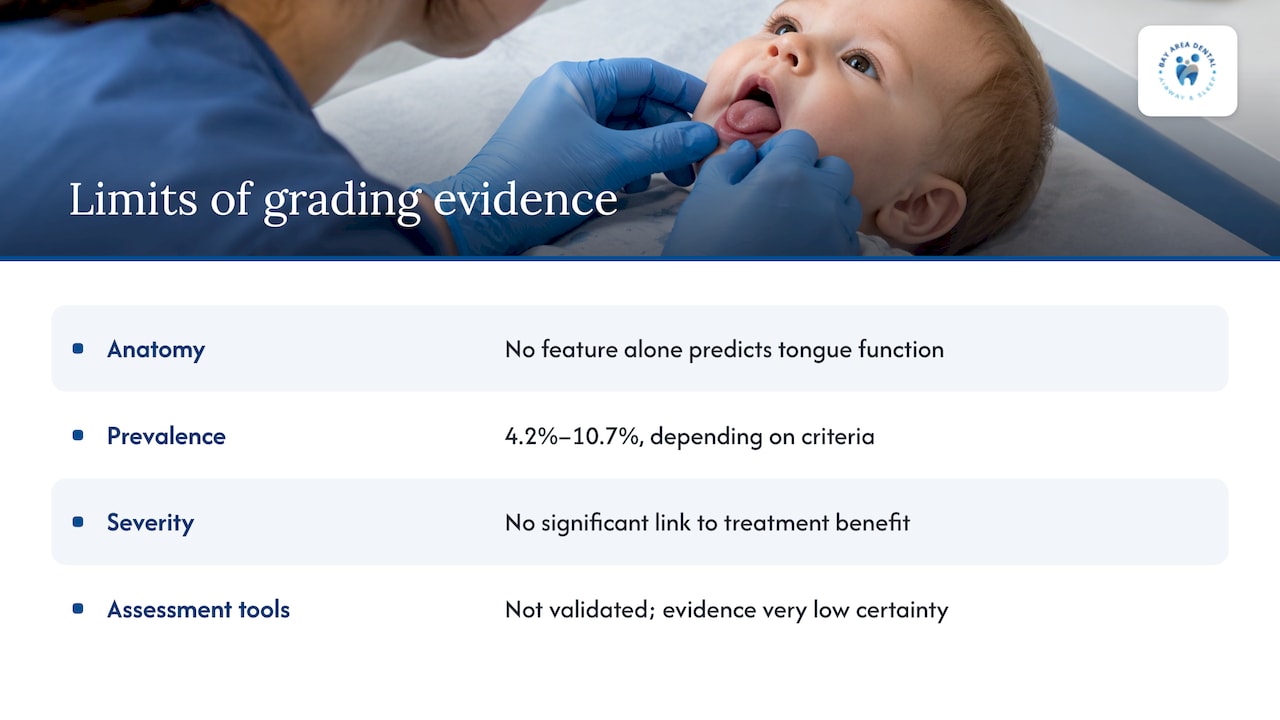
The AAPD policy says that no single anatomical feature of the frenulum has been shown on its own to correlate directly with impaired tongue function. Grading systems describe appearance and are not objective diagnostic tools. The same document cites a methodological review finding that reported prevalence ranges from 4.2% to 10.7%, depending on which diagnostic criteria are used.
The 2022 systematic review found no statistically significant link between severity measured before treatment and identifying who would benefit from division. A joint AAO-HNS and AAP statement adds that none of the published assessment tools, including Kotlow’s grading and the HATLFF, have been validated. A 2026 AAPD guideline likewise rates the evidence for all tools as very low certainty, while favoring tools that combine anatomy with function.
In plain words: a grade is useful for describing and documenting. It is not a prescription. Two children with the same grade can have very different feeding, speech or sleep experiences, and the useful question is what the tongue is actually doing.
What clinicians look at beyond the grade
What gets assessed depends on age.
Infants. The AAP defines symptomatic ankyloglossia as a restrictive frenulum causing breastfeeding problems that do not improve with lactation support. The statement lists visual inspection of the face, jaw, neck and mouth, testing tongue movement and suck reflex, noting whether the tongue can extend over the lower gum ridge or lift midway to the palate, and looking for a heart-shaped tongue on extension. It also lists milk-transfer assessment, such as weights before and after a feed and feeding observation. Painful latch, poor weight gain and ineffective feeding are the signals that matter. Our page on tongue tie and breastfeeding walks through the signs and tests.
Children. The AAPD policy links ankyloglossia to feeding difficulty in neonates, limited tongue mobility, speech difficulty, malocclusion (bite problems) and gum recession. For speech concerns, it recommends an evaluation by a speech-language pathologist before release is considered, because parents’ reports of speech issues are not always accurate. It also notes that many children compensate and have no speech difficulty. Our article on tongue tie and speech delay covers what the evidence says.
Adults. Adults are not graded on feeding. The questions are about mobility and symptoms such as limited tongue lift, jaw or neck tension and sleep-related complaints. You can start with our adult tongue-tie self checks before an exam.
Best age for tongue-tie release and age limits
Parents often ask when the best time is and whether there is a cutoff. The honest answer is that there is no single best age, and the research does not set a hard limit.
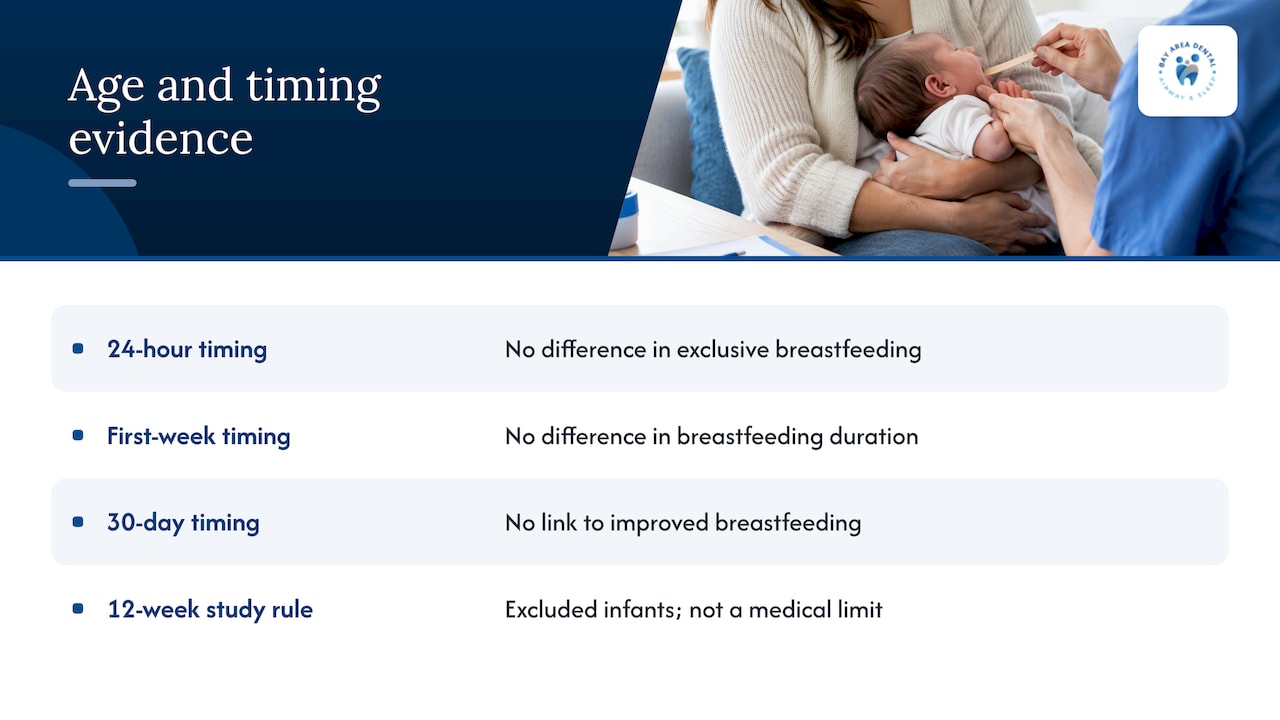
A 2021 evidence-based algorithm by Shekher and colleagues found no consistent evidence to guide timing. Studies showed no difference in exclusive breastfeeding at three months whether release happened before or after 24 hours, none in breastfeeding duration whether it happened within or after the first week, and no link between improved breastfeeding and release before or after 30 days. The same paper describes frenotomy (a simple release) in infancy and frenuloplasty, a more involved repair, under general anesthesia in older children.
You may see age numbers in research, but they are study rules, not medical limits. The 2022 newborn laser study, for example, excluded infants over 12 weeks to keep its sample consistent. That is how the study was designed, not a deadline for families.
What the guidance consistently points to instead is function. The 2025 AAO-HNS Bulletin describes ankyloglossia as relevant when it causes demonstrable functional impairment, such as an ineffective latch, maternal nipple pain or trauma, or poor weight gain, that persists despite skilled lactation support. Shekher and colleagues favor a HATLFF function-impaired score as the indication for division, because anatomy alone correlates less well with breastfeeding trouble.
So the useful timing question is not how old is my child. It is whether there is a documented problem with feeding, speech, eating or sleep, and whether support has been tried. A release done for a clear functional reason can be considered at any stage of life. Infants, children and adults can all be evaluated.
A worked example: same grade, different answers
Take two babies, both described as Kotlow Class III, a free tongue of about 5 mm.
Baby A feeds well, gains weight on schedule and her mother has no pain. The grade describes how the tongue looks. There is no demonstrated functional problem, so there is nothing to solve yet, and the family keeps working with their pediatrician and lactation consultant.
Baby B tires within minutes at the breast, clicks while feeding, gains weight slowly, and his mother has persistent nipple pain even after skilled lactation help. Here the grade is the same, but the function picture is different. This is the situation the AAO-HNS and AAP statements describe as symptomatic, and a function-focused exam is warranted.
The grade did not separate these two babies. Function did. That is why we always ask parents to tell us the story along with the number.
How we evaluate and treat tongue and lip ties
We are a dental practice in Fremont, CA, and our work centers on whole-body health and root causes rather than symptoms alone. We offer laser frenectomy, a tongue and lip tie release for infants, children and adults, using laser technology. Our care is minimally invasive by design, and we work with pediatricians, lactation consultants and other healthcare providers who refer families to us.
After a release, the AAP report advises that postfrenotomy stretching exercises are not recommended and may cause oral aversion, so aftercare should be set by your clinician rather than improvised at home. You can read what to expect in our guide to laser frenectomy recovery.
Our perspective
A number on a chart is a conversation starter. When a parent arrives with a grade from somewhere else, we want to know what the tongue does: how a baby latches, how a child chews and speaks, how an adult breathes and sleeps.
We treat the mouth as part of the whole body. The tongue sits at the crossroads of feeding, speech, jaw growth and airway, which is why our practice combines dentistry, airway care and myofunctional therapy under one roof. Looking at the root cause means the grade is one piece of information, not the answer.
We are also committed to making care accessible, including for Deaf patients, with communication tailored to them. Every family should be able to understand their options clearly before choosing anything.
Bay Area Dental, Airway & Sleep
Next steps if you suspect a tongue or lip tie
- Write down what you see. For a baby: latch, feeding time, weight, nipple pain, clicking. For a child: chewing, speech, mouth breathing, snoring. For an adult: tongue lift, jaw tension, sleep quality.
- Ask which classification was used. A Kotlow class and a Coryllos type are not interchangeable.
- Get a functional exam. Look for an evaluation of tongue elevation and movement, not only a look at the frenulum.
- Involve the right supporting professionals. For infants, skilled lactation support. For speech concerns, a speech-language pathologist before any release.
- Decide together. Weigh the documented problem against the options for care.
If you are in the Bay Area, our laser frenectomy page explains what we treat and how to book. We see infants, children and adults, and you can bring any grade or report you have already received. If a lip tie is part of your concern, our page on baby lip tie and feeding function is a good place to start. Children with related breathing or mouth-posture concerns can be seen through our pediatric dental care as well.
FAQ
What does a grade 3 tongue-tie mean?
In the Kotlow system, grade or Class III means the free tongue measures about 4 to 7 mm. In the Coryllos system, Type III means the frenulum attaches toward the mid-tongue. Either way it describes appearance, so a function exam is what shows whether it causes problems.
What are the different Kotlow classifications?
Class I is mild (12 to 16 mm of free tongue), Class II is moderate (8 to 11 mm), Class III is severe (4 to 7 mm) and Class IV is complete (0 to 3 mm). The ranges are summarized in a 2022 systematic review.
Is there a best age for tongue-tie release?
No single age has been proven best. A 2021 evidence review found no consistent evidence on timing, and the guidance focuses on whether a functional problem is documented. Infants, children and adults can all be evaluated.
Is there an age limit for tongue-tie release?
The research does not set one. Age cutoffs you may see, such as 12 weeks, come from how individual studies selected participants. If a tongue restriction is causing real problems, an exam is appropriate at any age.
Can I breastfeed after a tongue-tie release?
Yes, and improving feeding is often the reason for the release. Follow your clinician’s aftercare instructions and keep working with your lactation consultant. Our page on tongue tie and breastfeeding covers what to expect.
Sources
- Ankyloglossia (tongue tie) in infants, 2023 review
- Effectiveness of tongue-tie assessment tools in diagnosing tongue-tie, 2022 systematic review
- AAPD Policy on Management of the Frenulum, 2025 Reference Manual
- Ankyloglossia in Children and those with Special Healthcare Needs, JPMER 2022
- Lingual laser frenotomy in newborns with ankyloglossia, 2022
- AAO-HNS and AAP statement on breastfeeding in infants, 2024
- AAPD evidence-based guideline on ankyloglossia and breastfeeding difficulties, 2026
- How to Treat a Tongue-tie: An Evidence-based Algorithm, 2021
- AAO-HNS Bulletin, Holiday Pearls for Practice, 2025