


Yes, adults can have a symptomatic tongue-tie, and it often goes undiagnosed for decades because nobody looks for it. When the tissue under your tongue is genuinely limiting function, the usual path runs through a proper evaluation, targeted release if the exam supports it, and structured myofunctional rehabilitation afterward. Outcomes vary person to person, but the rehab phase is what tends to decide whether the results actually last.
TL;DR:
- Most adult tongue-ties involve posterior or submucosal restrictions that are difficult to detect without a thorough functional evaluation.
- Symptoms in adults generally manifest as a combination of limited tongue movement, speech quirks, and sleep or breathing issues, often overlooked for years.
- Diagnosis relies on assessing tongue mobility, tissue characteristics, and symptoms rather than a definitive test or imaging, often requiring a multidisciplinary team.
- Surgery typically involves frenuloplasty with laser methods preferred for reduced bleeding, but successful outcomes depend heavily on post-procedure myofunctional rehabilitation.
- Recovery involves weeks of targeted exercises to prevent tissue reattachment, with functional improvements in speech, hygiene, and airway health achievable even in long-standing cases.
Table of Contents
- What Adult Tongue Tie Actually Means
- What Symptoms Show Up in Adults?
- How Do Doctors Diagnose Tongue Tie in Adults?
- Treatment Options: From Exercises to Laser Release
- Recovery Timeline and Why Rehab Isn’t Optional
- Weighing the Risks Against What Treatment Can Realistically Fix
- The Whole-Body View Most Tongue Tie Guides Miss
- Ready for an Adult Tongue Tie Evaluation?
- Sources
- FAQ
What Adult Tongue Tie Actually Means
The lingual frenulum is the band of tissue connecting the underside of your tongue to the floor of your mouth. Ankyloglossia, the clinical name for tongue-tie, happens when that band is short, thick, or positioned in a way that restricts normal tongue movement. Not every visible frenulum is a problem. What matters is function, not appearance.
Clinicians generally sort ties into a few categories:
- Anterior ties, where the tethering is visible near the tongue tip and easy to spot.
- Posterior or submucosal ties, where the restriction sits farther back and hides under a layer of mucosa, making it easy to miss on a casual look.
There’s no single diagnostic scale every provider agrees on, which is part of why so many adults slip through the cracks as kids. A clinical review of ankyloglossia points out there’s still no universally accepted definition or grading system, so two dentists can examine the same mouth and reach different conclusions. Prevalence studies put newborn rates somewhere between 4% and 10.7%, with lower numbers reported in older children and adults, likely reflecting both healing patterns and inconsistent screening rather than the condition simply disappearing.
What Symptoms Show Up in Adults?
Adult tongue tie rarely announces itself with one dramatic sign. It usually shows up as a cluster of smaller issues that people have quietly worked around for years. If several of these sound familiar, that’s worth paying attention to.
- Limited tongue mobility. Trouble lifting the tongue tip to the roof of the mouth, sticking it out past the lower lip, or sweeping it side to side.
- Speech quirks. Difficulty with sounds like “t,” “d,” “l,” “n,” and “r,” sometimes mistaken for a lifelong lisp.
- Swallowing and eating habits. Food pocketing, slower eating, or a gag reflex triggered more easily than it should be.
- Oral hygiene struggles. A restricted tongue can’t naturally clear debris from the back teeth, which raises cavity and gum disease risk over time.
- Orthodontic relapse. Teeth that keep drifting back after braces, sometimes traced to tongue posture pushing against them.
- Jaw and neck tension. Chronic TMJ pain, clenching, or a stiff neck and shoulders from compensating with other muscles.
- Sleep and breathing issues. Snoring, mouth breathing, or fragmented sleep, since a low, tied-down tongue can crowd the airway.
- Social self-consciousness. Many adults report years of feeling embarrassed about how they talk or eat, without ever connecting it to their tongue.
A patient guide on adult tongue-tie collects many of these same complaints across clinical sources, which tells you this isn’t a rare cluster of coincidences.
How Do Doctors Diagnose Tongue Tie in Adults?
There’s no blood test or scan that definitively confirms a problematic tie. Diagnosis leans on functional testing: can the tongue actually do what it needs to do, not just what it looks like on paper.
A typical evaluation includes:
- Visual inspection of the frenulum’s attachment point and tissue thickness.
- Range-of-motion checks, including tongue elevation, lateral movement, and how far it protrudes.
- Assessment of speech clarity and swallowing patterns during simple tasks.
- A history of symptoms, since chronic jaw pain or snoring might point toward airway involvement rather than a purely oral issue.
Because no single metric captures the whole picture, many providers work as a team. Speech-language pathologists assess articulation and swallow function, myofunctional therapists evaluate resting tongue posture and muscle strength, and ENT or sleep specialists get involved when snoring or breathing issues suggest an airway component. If you notice worsening jaw pain, sudden speech changes, or breathing problems that seem to be escalating, don’t wait for a routine checkup. Those are the situations where a faster referral makes sense.
Treatment Options: From Exercises to Laser Release
Not every tongue-tie needs surgery. For mild cases, or as preparation before a procedure, conservative care through targeted stretches and myofunctional therapy exercises can improve tongue strength and coordination on its own. Some adults find this is enough; others use it to build the muscle control that makes a later release more effective.
When the restriction is significant enough to need cutting, there are two main surgical approaches:
- Frenotomy, a quick snip of the frenulum, often done with minimal anesthesia. It’s the standard for infants but frequently insufficient for adults.
- Frenuloplasty, a more involved release that includes repositioning the tissue and closing with sutures. Adult tissue is often thicker or partially scarred from a lifetime of stretching and compensating, which is why practitioner write-ups on adult frenectomy consistently note that adults need the sutured version far more often than children do.
Laser frenectomy has become common for both approaches. It tends to mean less intra-operative bleeding and faster hemostasis compared to traditional scissors, based on clinic-level reports on laser techniques. That said, the laser itself doesn’t determine the outcome. Tissue characteristics, the severity of the restriction, and the surgeon’s experience with adult anatomy all shape which technique makes sense for your specific case.
Pro Tip: Ask your provider whether they plan a frenotomy or a frenuloplasty before the appointment, not during it. If your tissue is thick or you’ve had prior partial releases, a simple snip may not hold, and you’ll want to know that going in.
Recovery Timeline and Why Rehab Isn’t Optional
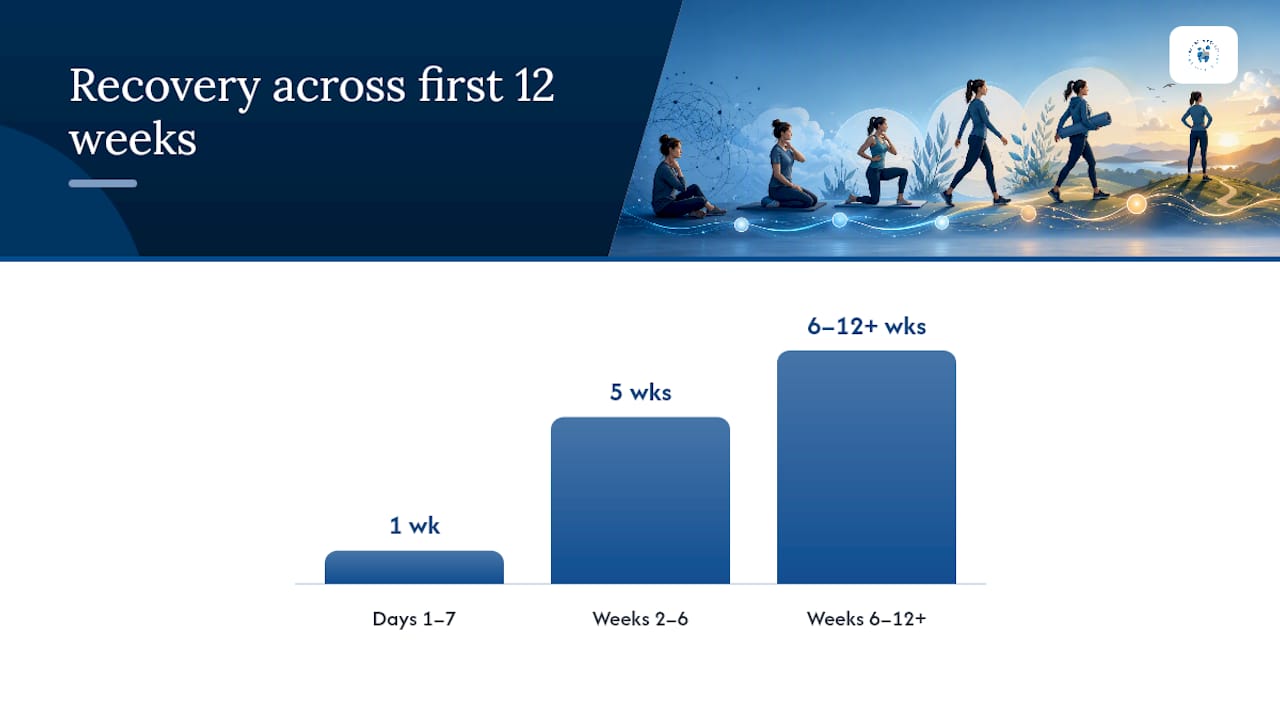
The first week after a release is mostly about wound care. Expect some soreness, mild swelling, and a yellowish film over the surgical site that’s part of normal healing, not infection. Contact your provider if you notice heavy bleeding, fever, or pain that gets worse instead of better after the first few days.
Recovery generally follows this arc:
- Days 1 to 7: Soreness peaks, gentle stretching begins to prevent the tissue from reattaching as it heals.
- Weeks 2 to 6: Swelling fades, exercises intensify, and you start noticing small gains in tongue range of motion.
- Weeks 6 to 12 and beyond: This is where the real functional change happens. Speech, swallowing patterns, and muscle coordination retrain gradually rather than overnight.
Rehab is not a nice-to-have add-on here. A review of myofunctional therapy’s role in post-release recovery identifies consistent post-op exercises as one of the strongest predictors of whether the release actually holds and translates into lasting function. Skip the stretches, and the tissue can reattach, undoing much of the surgical benefit. Adults carry decades of compensatory habits, so the brain needs time to relearn tongue posture and movement that a child’s nervous system would pick up almost automatically. Clinics that track recovery patterns typically describe an early mobility gain, a week of tissue remodeling, and then a longer window, often stretching into months, where the myofunctional work produces the biggest functional payoff.
Weighing the Risks Against What Treatment Can Realistically Fix
Frenectomy and frenuloplasty are generally low-risk procedures, but they aren’t risk-free. Common issues include temporary numbness, minor bleeding, and soreness that lingers longer than expected. Less common complications include infection, scarring that limits mobility again, or (rarely) nerve irritation near the release site.
What treatment reliably improves: tongue mobility, oral hygiene access, and in many cases speech clarity. What remains murkier: broad claims that releasing a tie will cure sleep apnea or resolve every case of chronic jaw pain. Those connections show up often enough to warrant airway evaluation, but they aren’t guaranteed outcomes for every patient.
Before deciding, consider:
- How much your symptoms actually interfere with daily life, not just how the tissue looks.
- Whether you’ve tried myofunctional therapy alone first.
- Whether a multidisciplinary team, not just one provider, agrees a release is appropriate.
Ask any provider directly: What’s your typical recovery timeline for someone with my presentation? What does the rehab plan look like, and for how long? What happens if the tissue starts to reattach?
The Whole-Body View Most Tongue Tie Guides Miss
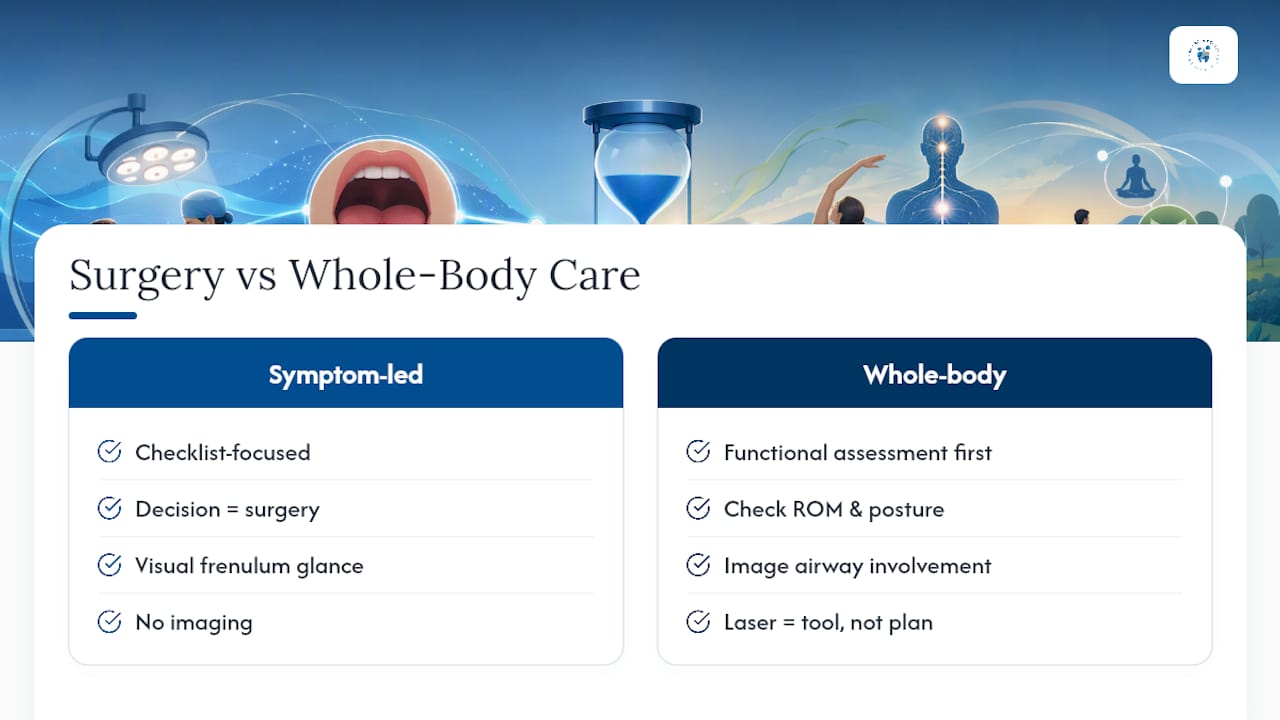
Most people searching this topic land on a symptom checklist and a surgical decision, as if the snip is the finish line. That framing undersells the harder, less glamorous part of the process. The release changes what your tongue can do. Whether it actually changes what your tongue does depends on weeks of retraining a nervous system that’s had thirty or forty years to build the wrong habits.
Functional assessment starts before any procedure gets scheduled. That means checking tongue range of motion, resting posture, and airway involvement using imaging, not just a visual glance at the frenulum. When a release is warranted, laser options may be available for cases where reduced bleeding and faster tissue response make sense, but the laser is a tool, not the treatment plan itself. Myofunctional therapy is often built in from the start, personalized to whatever compensations a patient has developed over the years, and outcomes get tracked against actual function, not just how the tissue looks a week later. Skipping that follow-up phase is the single most common reason a technically successful release fails to deliver lasting change.
— Admin
Ready for an Adult Tongue Tie Evaluation?
If years of jaw tension, speech quirks, or restless sleep have you wondering whether your tongue is the culprit, a proper functional exam beats another year of guessing. Bay Area Dental, Airway & Sleep offers laser frenectomy for adults alongside myofunctional therapy, airway evaluation, and Oral Appliance Therapy for patients whose symptoms overlap with sleep-disordered breathing. The advantage of the whole-body approach is straightforward: instead of treating the frenulum in isolation, the team evaluates how your tongue, airway, and jaw function together before recommending a plan.

A first visit typically includes a functional range-of-motion assessment, a review of your symptom history, and a discussion of whether conservative therapy, a frenuloplasty, or a combination makes sense for your case. If airway symptoms like snoring or mouth breathing are part of the picture, that gets folded into the same conversation rather than requiring a separate referral. Schedule a consultation with Bay Area Dental, Airway & Sleep to find out what your specific evaluation would involve.
This article is general information, not a substitute for advice from a qualified doctor. Consult a qualified healthcare professional about your own circumstances before acting on anything here.
Sources
- Ankyloglossia: Overview and prevalence data (PMC8522341)
- Clinical review of ankyloglossia and its management (NBK482295)
FAQ
Is It Worth Removing a Tongue-Tie as an Adult?
For adults with genuine functional restriction, tongue mobility, oral hygiene, and speech often improve after a release paired with myofunctional therapy. It’s less worth pursuing for a tie that’s visible but not actually limiting function, which is why a proper evaluation matters more than the frenulum’s appearance alone.
Is It Ever Too Late to Fix a Tongue-Tie?
No age makes a release impossible, and adults get treated for tongue-tie regularly. Recovery and retraining take longer than in children because the nervous system has decades of compensatory habits to unlearn, but functional gains are still achievable with consistent post-release therapy.
What Does Tongue-Tied Look Like in Adults?
It often looks like a lifetime of workarounds rather than one obvious symptom: trouble with certain speech sounds, food getting stuck at meals, chronic jaw tension, or snoring that nobody connected to the tongue. A patient guide on adult tongue-tie lists these overlapping signs as the common pattern clinicians see.
Does Tongue-Tie Surgery Hurt as an Adult?
Most adults describe manageable soreness rather than severe pain, typically peaking in the first week and easing over the following days. Laser techniques are often associated with less intra-operative bleeding and a smoother early recovery compared to traditional scissor release.