

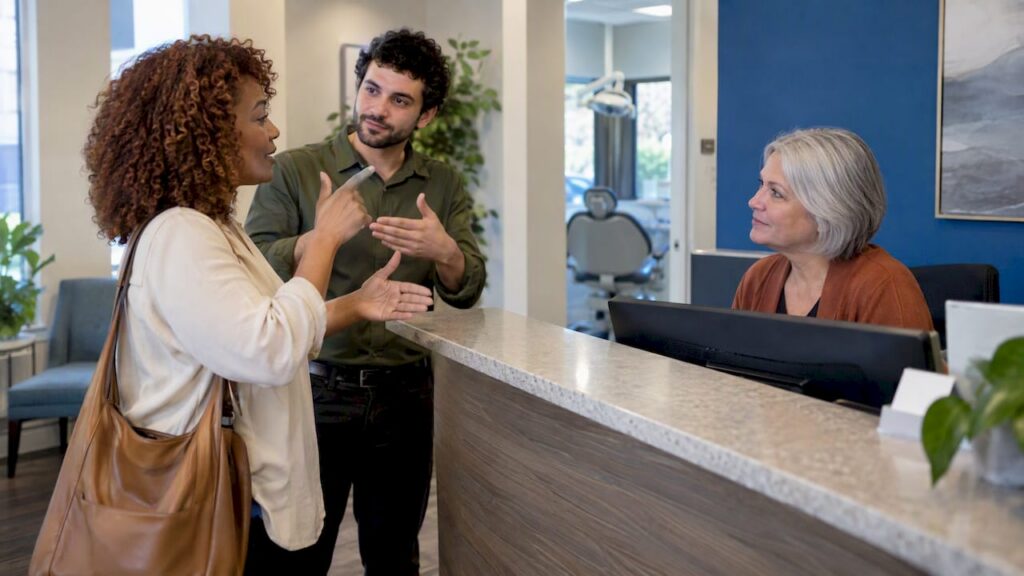
Good dental care for Deaf and hard-of-hearing patients comes down to one thing: a team that finds out how you communicate and sets it up before you sit in the chair. Under federal law, a dental office must provide effective communication aids, such as a qualified ASL interpreter, at no charge to you. This guide covers how to book, what to say, what to expect at the visit, and how we approach Deaf dental care at our Fremont practice.
TL;DR
- Federal law (the ADA and Section 1557 of the Affordable Care Act) requires dental offices to provide effective communication aids, including a qualified ASL interpreter, at no cost to the patient.
- Say what you need when you book, in writing if you can. In one study, callers who were Deaf were far less likely to get an appointment, especially when they asked for an interpreter.
- You choose the method: ASL, written notes, captioning or lip-reading. The office should ask, not assume.
- Avoid using a family member as your interpreter for treatment decisions. Privacy, bias and medical vocabulary are real risks.
- We welcome Deaf patients in Fremont and tailor communication to each person. Contact us to plan your visit.
Table of Contents
- Why Deaf patients still struggle to get dental care
- Your legal rights at the dentist
- How to book so your request is not lost
- What a good visit looks like
- Calming anxiety when communication has failed before
- Cost and coverage: what to know before you book
- How to vet a dental office for Deaf care
- Our perspective on accessible dental care
- Care for the whole family at our Fremont practice
- FAQ
- Sources
Why Deaf patients still struggle to get dental care
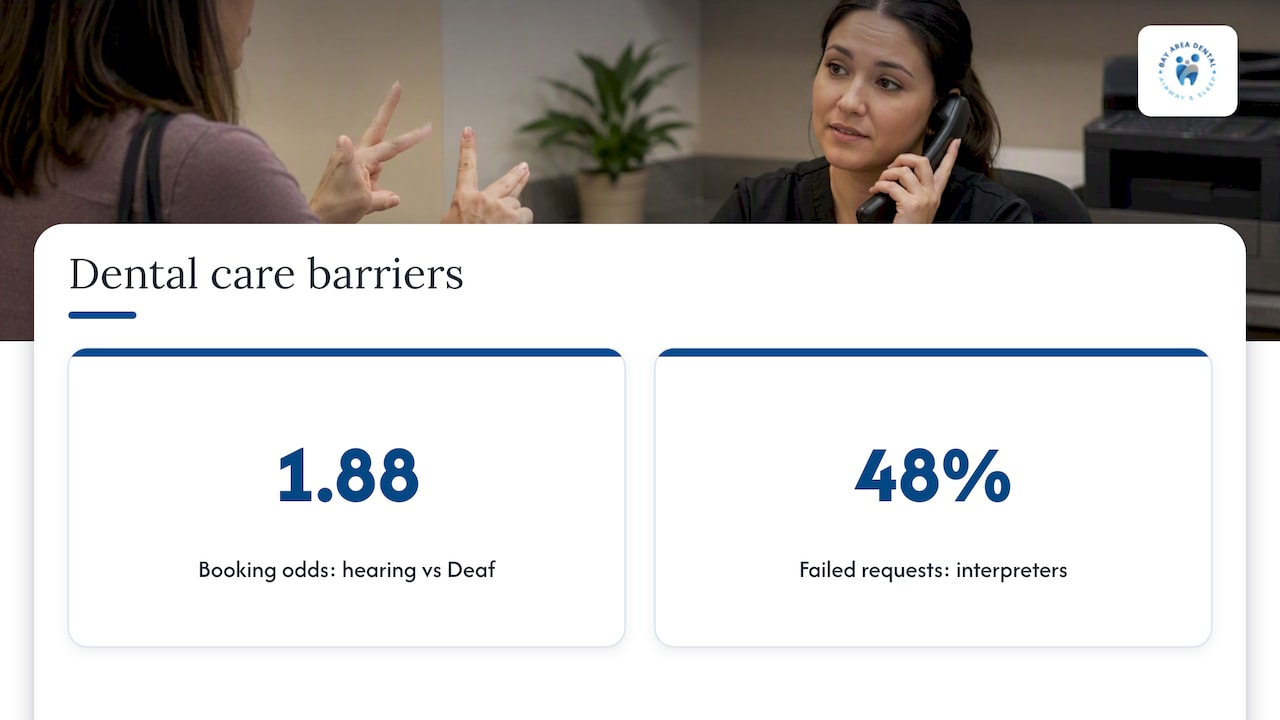
The barrier usually starts before the appointment. A 2021 study in JAMA Network Open used simulated patients to request primary care and dental appointments. Patients who could hear were nearly twice as likely to secure one (adjusted odds ratio 1.88). Among failed requests by Deaf patients, 48% were tied to a request for interpreter services.
The clinical side has gaps too. A scoping review of oral health in the Deaf and hard-of-hearing population compiled the literature on this group, and a national survey of dentists opens by noting that Deaf and hard-of-hearing adults have been shown to have poorer oral health than adults who are not part of this community. The 2023 survey also found that many dentists feel under-trained in treating these patients, and most are interested in more education.
In plain terms: the problem is rarely the patient. It is communication, scheduling and training. All three can be fixed by an office that decides to fix them.
Your legal rights at the dentist
Two federal laws matter most. The Americans with Disabilities Act treats a dental office as a public accommodation. Section 1557 of the Affordable Care Act adds obligations for covered health programs. Together, they mean the practice must take steps to communicate effectively with you, and the ADA’s effective communication guidance lists aids such as qualified interpreters, written materials and note-takers.
What that means in practice:
- The interpreter is free. The office pays, not you, and it cannot add a surcharge to your bill.
- The office cannot turn you away because you are Deaf or because you need an interpreter. The one exception is a practice that is not accepting any new patients.
- Family members are not a substitute. The California Attorney General’s guide to healthcare access stresses that untrained family interpreters can introduce bias, lack medical vocabulary and compromise privacy. If you prefer a specific person for comfort, you can still ask for a professional as well.
- The ADA’s own dental guidance says offices should be prepared for a patient to request an impartial professional interpreter.
We have a separate page that goes deeper on ASL interpreter rights at the dentist.
Hearing dogs and service animals
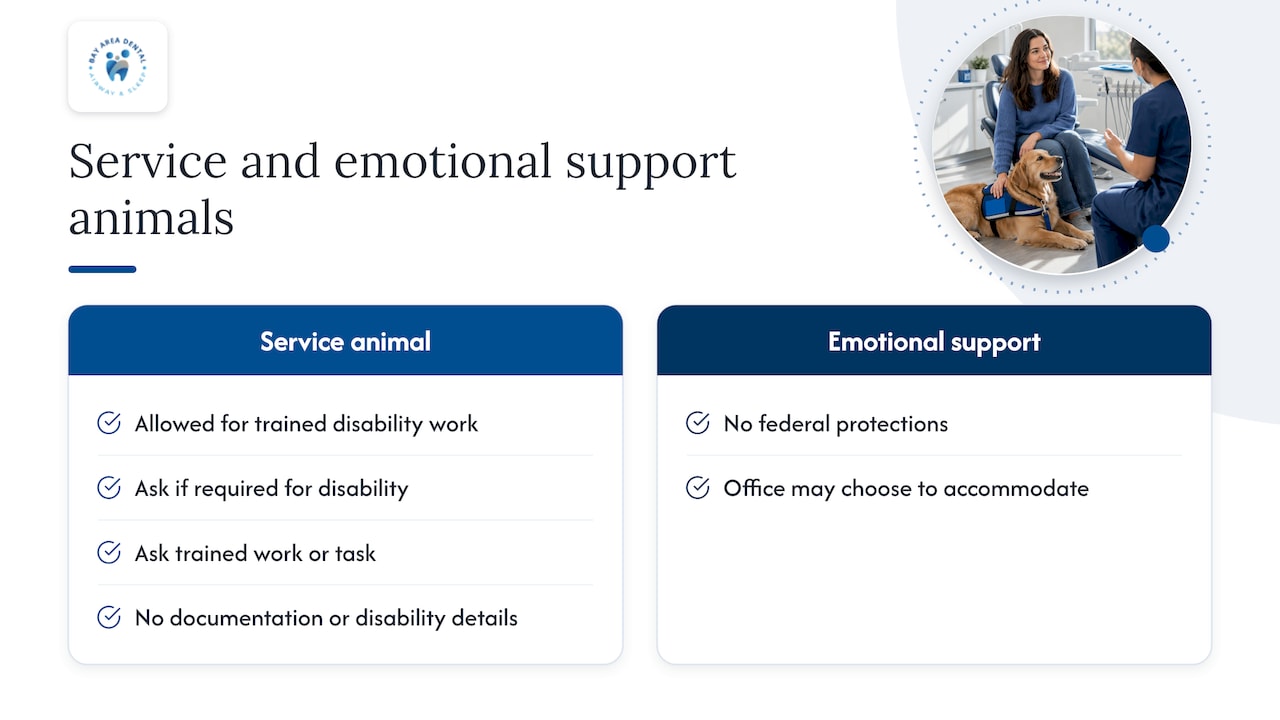
A hearing dog trained to do work for a person with a disability is allowed in a dental office. Under the California Attorney General’s guidance, staff may ask only two questions: whether the animal is required because of a disability, and what work or task it has been trained to perform. They cannot ask for documentation, ask about the extent of your disability, or charge an extra fee. Emotional support animals do not carry these federal protections, though an office may choose to accommodate them.
How to book so your request is not lost
The booking call or form is where most problems happen, so treat it like a small project.
- Use a channel that works for you. Email, a web form or text lets you keep a record. If you prefer phone, California’s relay services let you place calls by dialing 711, and the service can be set up with your preferred carrier.
- State the need up front. Write something like: “I am Deaf and need a qualified ASL interpreter for my visit. I understand this is provided at no cost under the ADA and Section 1557.”
- Name your preferred method. ASL, real-time captioning, written notes or lip-reading. You can use different ones for different parts of the visit.
- Ask for confirmation in writing. Get the date, time and interpreter arrangement by email or text.
- Ask about timing. Interpreters often need advance notice, so book early, and ask what happens if the interpreter cannot make it.
- Keep a record. If a practice refuses, you can file a complaint with the U.S. Department of Justice or your state’s civil rights agency. A written record helps.
Because research shows requests for interpreters can lower the odds of getting scheduled, a written message that cites your rights can help. Having a trusted advocate send it with you is another option.
What a good visit looks like
Communication is not one size fits all. The ADA’s guidance for dental teams says to ask the patient for their preferred method, ideally before the appointment. Forcing one method when it is not needed can make things harder, not easier.
Here is what to expect from a well-prepared office:
- The plan is set before you arrive. The interpreter or captioning is arranged, and the team knows your preference.
- Consent is real. The dentist explains what will be done, the risks, the alternatives and the cost, and you can ask questions. This matters most for anything beyond a cleaning: fillings, crowns, extractions, laser treatments.
- Visual cues replace sound. A mask hides the mouth, so a team may use clear masks, pause to face you, or write things down. Ask the team to tell you before they start the drill or laser, using a hand signal you agree on.
- You can pause the visit. Agree on a signal, such as a raised hand, that stops treatment right away.
- Instructions come in writing. Aftercare, medication directions and follow-up dates should be given in a form you can keep.
Treatments that need extra care in communication
Some procedures are harder to follow while you are reclined with equipment in your mouth. For these, ask to go through the plan, with the interpreter or captions, before you lie back. Examples include a laser frenectomy for tongue or lip ties, restorative and cosmetic work, and sleep appliance fittings. If you are bringing a child who is Deaf or hard of hearing, ask the team to explain each step to the child in the child’s own language, not only to the parent.
Calming anxiety when communication has failed before
Many Deaf adults have had a visit where nobody explained anything. That history can make a dental chair feel unsafe, and fear tends to make people avoid care until something hurts. Clear, accurate information is the first and best remedy, because you cannot consent to what you did not understand.
Some patients also pair that with relaxation methods. If anxiety is a major barrier for you, dental anxiety hypnosis options are one approach people explore alongside good communication. Talk with your dentist about what fits your health history and your visit plan.
Cost and coverage: what to know before you book
The interpreter is not a cost you carry. The dental treatment itself is billed as usual. A few points on coverage:
- Medi-Cal in California. Per the state Department of Health Care Services, as of July 2026 most adult members without satisfactory immigration status no longer have full-scope dental benefits, but emergency dental care, such as treatment for severe tooth pain or infection, remains covered. Full-scope benefits remain for children, for pregnant individuals through one year after pregnancy, and for most other members who meet income and residency rules. Check your own eligibility with the state.
- Disability benefits. Being deaf does not automatically qualify you for SSI or SSDI. The Social Security Administration sets medical criteria and also requires that the condition prevent substantial work. Details are on the SSA disability page, which also lists a TTY number for people who are Deaf or hard of hearing.
- Our fees. We do not publish prices for our services. Ask for a written estimate when you book, and request it in the format you prefer.
How to vet a dental office for Deaf care
Before you commit, ask these questions by email:
| Question | A good answer sounds like |
|---|---|
| Will you provide a qualified ASL interpreter at no charge? | “Yes, we arrange and pay for it.” |
| How much notice do you need? | A specific timeframe, plus a backup plan |
| How will we communicate during treatment? | A signal system, clear masks or captions, and pauses to face you |
| Can I get treatment plans and aftercare in writing? | “Yes, always.” |
| Do you welcome hearing dogs? | “Yes, with the two permitted questions only.” |
If an office hesitates on the first question, that tells you what you need to know.
Our perspective on accessible dental care
We treat dentistry as part of whole-body health, and that starts with whether a patient can fully take part in their own care. Our practice in Fremont focuses on airway therapies, restorative and cosmetic dentistry, myofunctional therapy and general dentistry. Alongside that, we have made a commitment to underserved communities, including Deaf patients, with tailored communication and education.
Our view is simple. Accessibility is not a favor and not an add-on. It is the base of informed consent. A patient who understands why a sleep appliance, a laser release or a filling is recommended makes better decisions and has better outcomes than one who nods along. That is why we start by asking how you want to communicate, and we plan around the answer instead of making you adapt to us.
We also believe in treating causes and not only symptoms. That applies to communication as much as teeth: if a Deaf patient avoided care for years because of past experiences, we want to understand that history, not just the cavity.
— Admin
Care for the whole family at our Fremont practice
Our practice serves families under one roof, including pediatric dental care, general dentistry, orthodontics and sleep and airway dentistry. If you or your child is Deaf or hard of hearing, tell us how you communicate when you reach out, and we will plan your visit with you. Start at our main site to request an appointment.
FAQ
Does a dentist have to provide an ASL interpreter?
Yes, in most cases. The ADA and Section 1557 require covered dental offices to provide effective communication aids, including qualified interpreters, at no charge when you request them. The only exception to treating you is a practice that is not accepting new patients at all. Ask in writing so there is a record.
Can my family member interpret for me at the dentist?
You can have family or friends with you for support, but they should not replace a professional. The California Attorney General’s guidance warns that untrained interpreters may be biased, may lack medical vocabulary and can compromise your privacy. If you want a professional, the office must provide one.
How do I book a dental appointment if I cannot use the phone?
Use email, a web form or text, and say that you need an interpreter or another aid. You can also place calls through a relay service by dialing 711 in California. Ask the office to confirm the details in writing.
Can I bring my hearing dog to the dental office?
Yes. A trained service animal is allowed, and staff may ask only whether it is required because of a disability and what task it performs. They cannot ask for documentation or charge a fee. Emotional support animals are not covered by the same federal protections.
Does Medi-Cal cover dental care in California?
Full-scope dental benefits remain for children, pregnant individuals and most other eligible members, while many adults without satisfactory immigration status now keep emergency dental coverage only, as of July 2026. Check the state’s page or your plan for your own situation.
Sources
- ADA Requirements: Effective Communication, ADA.gov
- Comparison of Access to Primary Care Medical and Dental Appointments Between Simulated Patients Who Were Deaf and Patients Who Could Hear, JAMA Network Open
- Oral Health and Dental Care in Deaf and Hard of Hearing Population: A Scoping Review
- Dentists’ considerations concerning treating patients from the Deaf and Hard of Hearing community: A national survey
- Using an Interpreter in Your Dental Office, American Dental Association
- Access to Healthcare for People with Disabilities, California Attorney General
- Relay Services, California Connect
- Medi-Cal changes, California Department of Health Care Services
- How To Apply For Social Security Disability Benefits, SSA