

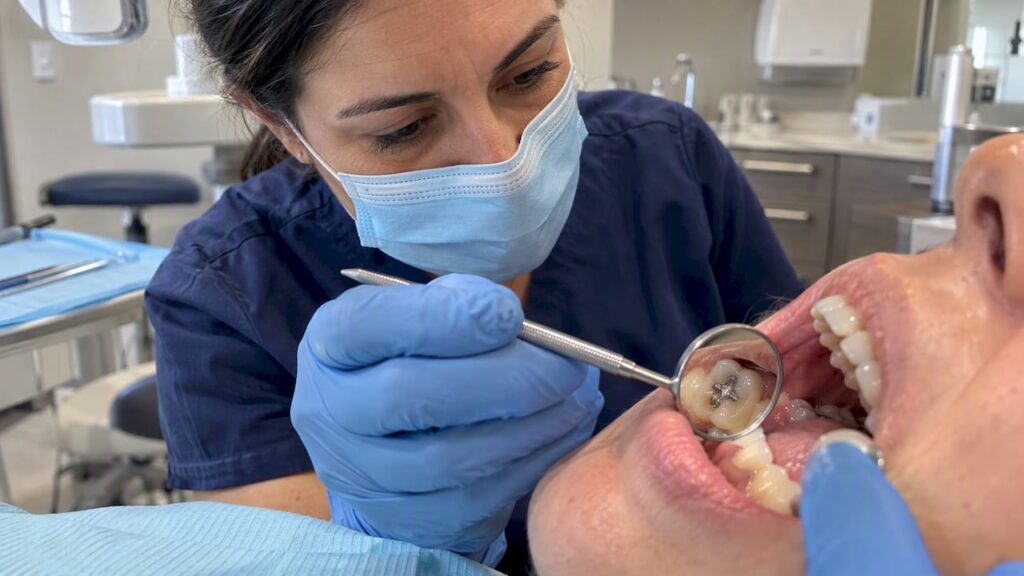
You usually should not remove an intact amalgam filling unless there is a medical reason to do so, and removal can be done safely when a dentist follows a mercury safe protocol. The FDA and the ADA both stand behind this guidance, with extra caution advised for pregnant or nursing women, young children, and people with neurological or kidney conditions.
TL;DR:
- Removal is justified for decay beneath the filling, a crack or failure, or a confirmed mercury allergy; anxiety alone does not meet that threshold.
- Pregnant or nursing patients, children under six, and people with neurological or kidney conditions should discuss alternatives for new fillings with a dentist and physician.
- Before booking, ask for a written protocol confirming a rubber dam, close high volume suction, water cooling, and an ISO compliant amalgam separator.
- Composite needs a dry field; glass ionomer suits low stress or pediatric cases, while crowns or onlays may better protect teeth with major structural loss.
- Ask whether an exam or imaging confirms decay, whether symptoms plausibly stem from the filling, and how much healthy tooth structure removal would sacrifice.
Table of Contents
- What regulators and studies say about amalgam safety and removal
- Who is higher risk and should avoid new amalgam or consider alternatives?
- Why removing intact fillings can increase risk
- Mercury safe removal: a patient checklist for what the dentist should do
- Replacement options after removal and their tradeoffs
- Shared-decision checklist: how to decide whether to replace a filling
- How we approach safe removal and minimally invasive replacement
- Clinician perspective: balancing patient concerns and evidence
- Ready to review your fillings with us
- FAQ
- Sources
What regulators and studies say about amalgam safety and removal
The FDA’s guidance on dental amalgam is direct: do not remove or replace an intact filling unless medically necessary, since removal itself can temporarily raise mercury vapor exposure and cause avoidable loss of healthy tooth structure. The agency notes that evidence gaps remain for certain high-risk groups, which is part of why it recommends case-by-case judgment rather than a blanket rule.
The ADA’s position on amalgam describes the material as safe, durable, and affordable, and frames the global move away from it as driven mainly by environmental concerns and the availability of alternatives, not by proof of clinical harm in the general population. Both groups endorse mercury hygiene best practices in the office regardless of whether removal happens.
On durability, a large real-world data review of amalgam and composite restorations covering 2014 to 2021 found mixed failure rates between the two materials, which keeps the longevity debate open rather than settling it in favor of either one.
Who is higher risk and should avoid new amalgam or consider alternatives?
The FDA has named specific groups who may be more sensitive to mercury vapor and should discuss alternatives to new amalgam fillings with a dentist or physician:
- Pregnant or nursing women, since mercury can cross to a developing fetus or infant.
- Children younger than six, whose developing nervous systems are more vulnerable to toxic exposures.
- People with pre-existing neurological disease, who may have less tolerance for added neurotoxic burden.
- People with impaired kidney function, since the kidneys help clear absorbed mercury from the body.
- Anyone with a documented mercury allergy, where even low exposure can trigger a reaction.
If you fall into one of these groups, loop in your physician as well as your dentist before deciding on a filling material.
Why removing intact fillings can increase risk
Drilling into an amalgam filling heats and fragments the metal, which can release mercury vapor and fine particles into the air and into the patient’s mouth. This is the core reason the FDA advises against removing intact fillings without a clinical reason: it trades a stable filling for a short-term spike in exposure.
Removal also takes a toll on the tooth itself. Each time a filling is drilled out and replaced, some healthy tooth structure goes with it, and a tooth that has been reworked several times may eventually need a crown or root canal it would not have needed otherwise.
Legitimate reasons to remove an amalgam filling include decay underneath it, a cracked or fractured filling, a confirmed mercury allergy, or a filling that has simply failed and needs replacing. Removing a sound, symptom-free filling out of general concern does not meet that bar.
Mercury safe removal: a patient checklist for what the dentist should do
When removal is medically justified, the steps a dental team takes matter. Experimental research on mercury release during removal found that technique has a measurable effect on how much mercury ends up in the mouth or wastewater. Look for a clinic that follows these steps:
- Places a rubber dam to isolate the tooth and keep fragments and vapor away from the airway.
- Uses high-volume intraoral suction positioned close to the tooth throughout the procedure.
- Cuts the filling into fragments rather than grinding it down in bulk, which cuts the amount of fine aerosol produced.
- Keeps the site cooled with water during cutting to limit heat-driven vapor release.
- Runs HEPA air filtration or strong room ventilation to clear any airborne particles.
- Has the clinical team wear appropriate PPE, including masks rated for particulate protection.
- Cleans up immediately after removal, rinsing the mouth and clearing debris before it can be swallowed or inhaled.
- Uses an ISO-compliant amalgam separator to capture mercury waste before it reaches the drain.
- Reviews post-op care with you, including what symptoms would warrant a follow-up call.
Pro Tip: Ask the office for its written removal protocol and confirmation that it uses high-volume evacuation and an ISO-compliant amalgam separator before you book the appointment.
Replacement options after removal and their tradeoffs
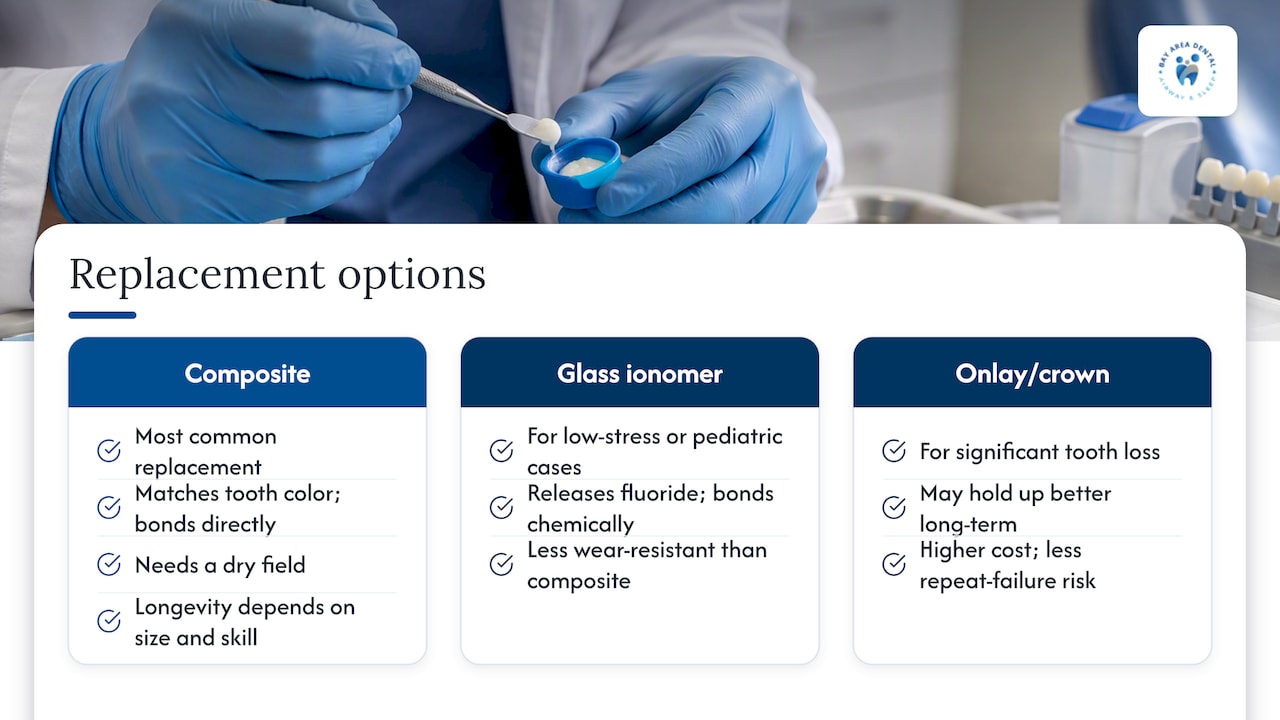
Composite resin is the most common replacement, prized for matching tooth color and bonding directly to the tooth. It is more technique-sensitive than amalgam, requiring a dry field during placement, and its longevity depends heavily on the size of the filling and the skill of the placement; our comparison of composite and amalgam walks through those tradeoffs in more detail.
Glass ionomer cement is another option, mainly for low-stress areas or pediatric cases, valued for releasing fluoride and bonding chemically to tooth structure, though it is generally less wear-resistant than composite.
For a tooth that has lost significant structure, an onlay or crown may hold up better long-term than another direct filling, at a higher cost but with less risk of repeat failure. Research on alternative restorative materials confirms that no single material is ideal for every situation. A partner overview of filling types and their expected lifespans is a useful comparison if you want more detail on how long each option tends to last.
Shared-decision checklist: how to decide whether to replace a filling
Before agreeing to remove and replace an amalgam filling, work through a few questions with your dentist:
- Is the filling actually intact, or is there visible wear, a crack, or a gap at the margin?
- Is there decay underneath that an X-ray or exam has confirmed?
- Do you belong to one of the FDA’s high-risk groups?
- Are your symptoms plausibly connected to the filling, or is the link speculative?
- How much tooth structure would removal likely take with it?
Bring a second set of questions to the consult itself: what exact steps will the dentist take during removal, how much experience does the team have with mercury safe protocols, what are the realistic lifespan and maintenance needs of the replacement material, and what does follow-up care look like? Our minimally invasive dentistry approach is built around this kind of preservation-first thinking. If you have a neurological condition, kidney disease, or are pregnant, loop your physician into the conversation too.
How we approach safe removal and minimally invasive replacement
We approach restorative decisions, including amalgam, with a philosophy of treating root causes rather than symptoms. We plan conservative treatment aimed at preserving as much natural tooth structure as possible.
When removal is medically appropriate, we follow mercury hygiene best practices, including proper containment and evacuation, and offer composite and other non-amalgam materials for patients who need or want a replacement. Our focus stays on keeping the tooth healthy first and the material choice second.
Clinician perspective: balancing patient concerns and evidence
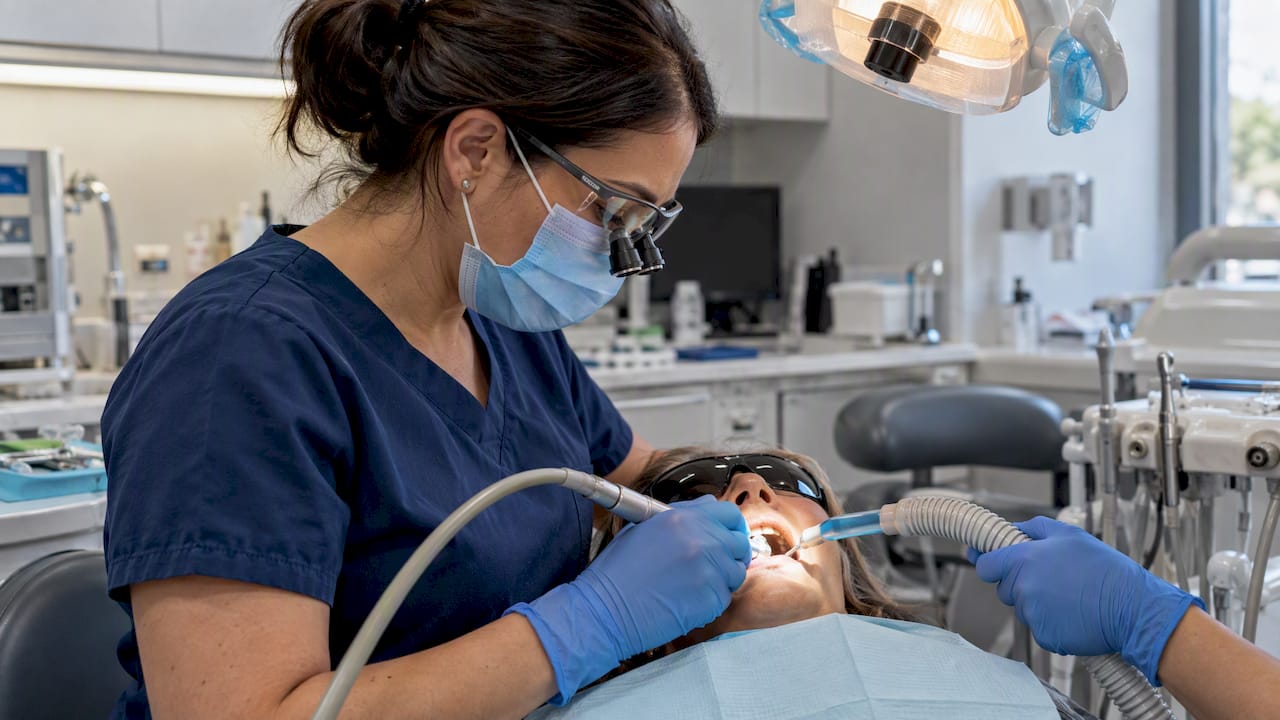
Patients often come in anxious about mercury, and that concern deserves a real answer, not dismissal. We lean on FDA and ADA guidance rather than fear or hype, and we talk through the actual evidence with each patient before recommending anything. If you are weighing this decision, start with an exam, ask for a written removal protocol, and share your full medical history. Safe removal is achievable when a team takes it seriously.
— Admin
Ready to review your fillings with us
If you have questions about an existing amalgam filling or want a second opinion on whether replacement makes sense, we are set up to walk through it with you using the minimally invasive, safety-first approach described above. 
We offer restorative dentistry alongside general and cosmetic care, and an exam is the right first step to see what your specific tooth actually needs. You can review our general and restorative dentistry services or book an exam through our main site to get started.
This article is general information, not a substitute for advice from a qualified doctor. Consult a qualified healthcare professional about your own circumstances before acting on anything here.
FAQ
What do you replace mercury fillings with?
The most common replacement is composite resin, a tooth-colored material bonded directly to the tooth. Glass ionomer cement is used in some low-stress or pediatric cases, and a crown or onlay may be recommended when the tooth has lost significant structure.
Are amalgam fillings safe?
The ADA considers amalgam a safe, durable, and affordable restorative material for most people, and the FDA does not recommend removing an intact amalgam filling unless there is a medical reason. Certain groups, including pregnant women and young children, are advised to discuss alternatives for new fillings.
What is the healthiest type of filling?
There is no single “healthiest” filling for everyone: the right choice depends on the location of the cavity, how much chewing force the tooth takes, and your own risk profile. Composite resin and glass ionomer are common non-amalgam options, each with different tradeoffs in durability and technique sensitivity.
Can I still get an amalgam filling?
Amalgam remains an available restorative option in general dental practice, though the FDA advises against it for certain high-risk groups, including pregnant or nursing women and young children. Your dentist can help you decide whether amalgam or an alternative material fits your situation.
Sources
- Dental Amalgam Fillings | FDA
- Amalgam | American Dental Association
- Survival Rates of Amalgam and Composite Resin Restorations from Big Data Real-Life Databases in the Era of Restricted Dental Mercury Use