

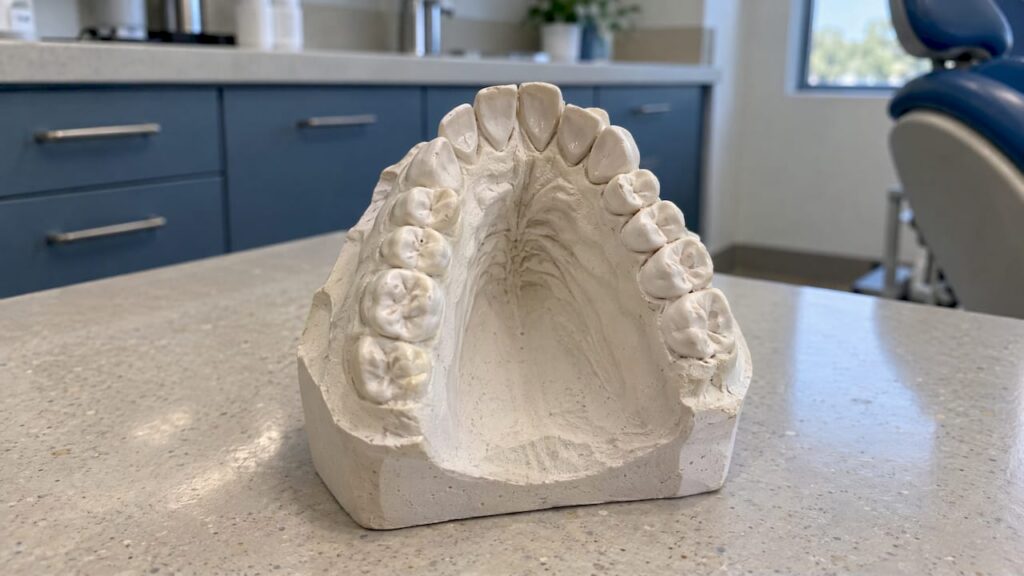
A high arched palate is a roof of the mouth that is unusually tall and narrow. It is often harmless to look at and easy to miss, but the shape can matter for how a person breathes, sleeps, swallows, speaks and fits their teeth together. The good news is that it is usually assessable in a single dental visit, and in growing children it is most responsive to treatment. At Bay Area Dental, Airway & Sleep in Fremont, we look at the palate as part of the airway and the whole child or adult, not as a stand-alone cosmetic detail.
TL;DR
- A high arched palate (also called a high-vaulted palate) is a tall, narrow roof of the mouth. It is usually a developmental feature, and in a minority of cases it appears alongside a genetic syndrome.
- Common companions are crowded or rotated teeth, crossbite, mouth breathing and, in babies, feeding difficulty. Mouth breathing is one of the recognized causes of a narrow upper jaw.
- Children can often be treated with palatal expansion, commonly starting around age 7 or 8. Adults who have finished growing have different options.
- Tooth contouring (enameloplasty) reshapes tooth edges. It does not change the palate.
- The earlier the palate is evaluated, the more options there are.
Table of Contents
- What a high arched palate actually is
- What causes a high palate
- Symptoms: when a high palate is a problem
- Palate shape, breathing and sleep
- Can a high arched palate be fixed?
- Tooth contouring is not palate treatment
- What the evaluation involves
- Book a palate and airway evaluation in Fremont
- Our perspective
- FAQ
- Sources
What a high arched palate actually is
Run your tongue along the roof of your mouth. In a typical palate the arch is broad and gently domed, with room for the tongue to rest against it. In a high arched palate the vault is taller and the width between the upper back teeth is narrower, so the arch looks more like a gothic window than a shallow dome.
Clinicians describe it as a vertical-depth difference, the distance between the tooth ridge and the roof of the mouth being greater than usual. Dentists often see it together with a narrow upper jaw, which the research literature calls maxillary transverse deficiency. In plain terms: the upper jaw did not grow wide enough.
There is no single number a parent can measure at home. Diagnosis is a clinical judgment, backed up by model analysis, clinical evaluation, radiographic measurement and occlusograms when a closer look is needed. That is why an exam beats guessing from a mirror.
What causes a high palate
The palate is shaped by growth and by the forces on it while a child grows. Several factors can contribute:
- Genetics and development. A high arched palate is usually a congenital developmental feature, meaning it is present from early development.
- Mouth breathing. A 2021 peer-reviewed review lists mouth breathing among the etiologies of maxillary transverse deficiency. When the mouth stays open, the tongue sits low instead of resting against the palate.
- Tongue posture and tongue tie. A tongue that cannot lift and rest on the roof of the mouth gives the upper jaw less natural pressure to widen it. Tongue and lip ties are one reason that can happen, and it is one reason babies with feeding trouble get a palate look.
- Prolonged thumb, finger or pacifier habits. These are commonly discussed by pediatric dentists as an influence on palate shape.
- Syndromes. A high arched palate is a facial feature of many syndromes. The classic association is Marfan syndrome, and Radiopaedia lists others such as Crouzon, Treacher Collins, Pierre Robin, Apert and Down syndromes. If a child has other signs, such as unusual joint flexibility, height, heart or vision concerns, or a known diagnosis, the pediatrician or the child’s physician is the right person to evaluate the whole picture.
Most people with a high palate do not have a syndrome. The shape is far more often a story about growth, breathing and tongue position.
Symptoms: when a high palate is a problem
A high palate is not automatically a problem. It becomes one when it shows up with function trouble. According to the same review, the main dental manifestations of a narrow upper jaw are severe crowding, rotated or displaced teeth, crossbite, a high palatal vault, and V-shaped or hourglass-shaped dental arches.
What patients and parents notice in daily life depends on age.
In babies
- Trouble latching or keeping a seal on the breast or bottle
- Clicking sounds, long feeds or gagging
- A tongue that looks restricted or heart-shaped when lifted
These signs often point to a tongue or lip tie, which is worth evaluating at the same time as the palate. Our laser frenectomy service treats tongue and lip ties for infants, children and adults.
In children
- Open-mouth breathing, snoring or restless sleep
- Crowded or crooked adult teeth coming in
- A crossbite, where the upper back teeth sit inside the lower ones
- Speech patterns such as lisping, which can also be tied to tongue position
- Tiredness or trouble focusing after poor sleep
If you recognize several of these, our guide to six signs at age seven that warrant interceptive orthodontics explains what an early evaluation looks for.
In adults
Adults searching for a high palate usually describe a different set of concerns: a narrow arch with crowding, a tongue that feels cramped, snoring or sleep apnea, nasal congestion, jaw tension, or a long-standing crossbite. The shape did not appear overnight, it has simply been there while other problems built up around it.
Palate shape, breathing and sleep
The roof of the mouth is also the floor of the nose. A narrow, high palate can go along with a narrower nasal airway, which is one reason airway-focused dentists pay attention to it. For a deeper look, see our overview of how jaw and palate shape affect breathing.
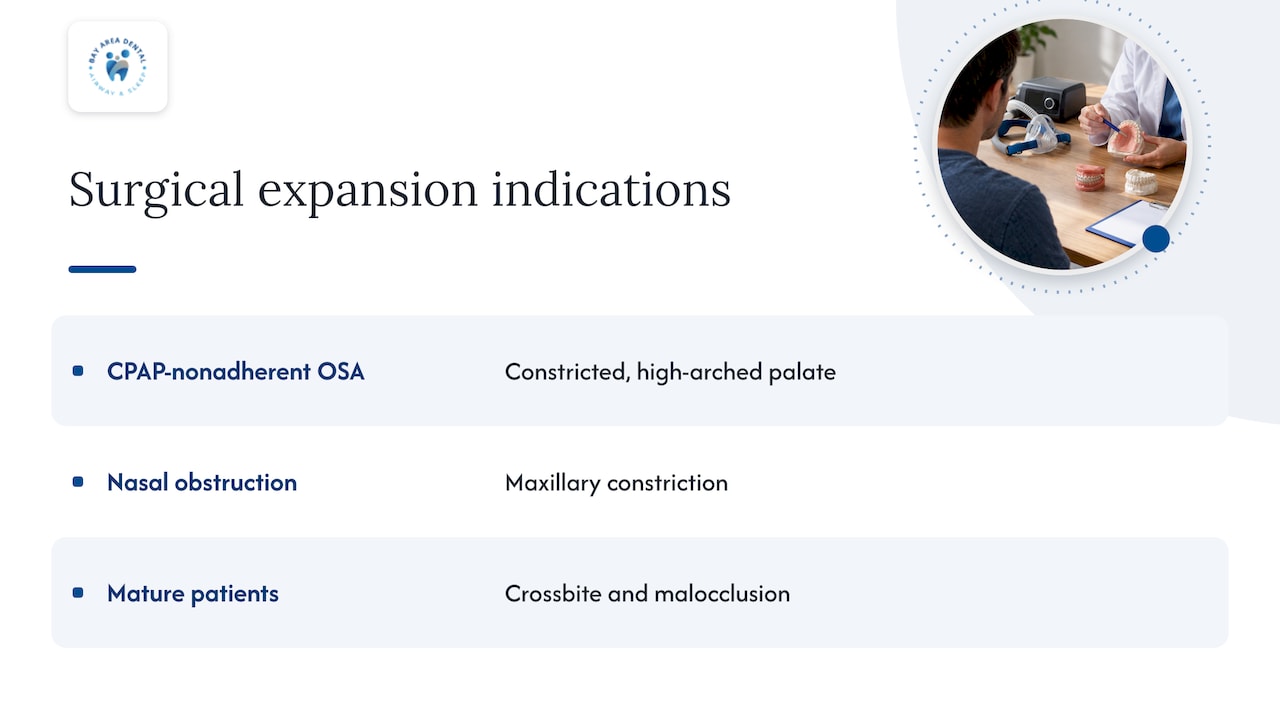
The American Academy of Otolaryngology–Head and Neck Surgery lists the patients for whom a surgical expansion is indicated in its position statement on surgically assisted rapid palatal expansion. They include CPAP-nonadherent patients with obstructive sleep apnea and a constricted, high-arched palate, patients with nasal obstruction and maxillary constriction, and skeletally mature patients with crossbite and malocclusion. That is a useful way to read the palate: it is one measurable piece of the airway puzzle.
For sleep apnea, a sleep study sets the starting point. Our article on why a sleep study should come first in airway orthodontics explains why. Expansion is also not a promise of curing apnea; our page on wider nasal volume from palate expansion describes what to expect for parents and adults.
Can a high arched palate be fixed?
The answer depends mostly on age, because the bones of a growing child respond differently from those of an adult.
Children and adolescents
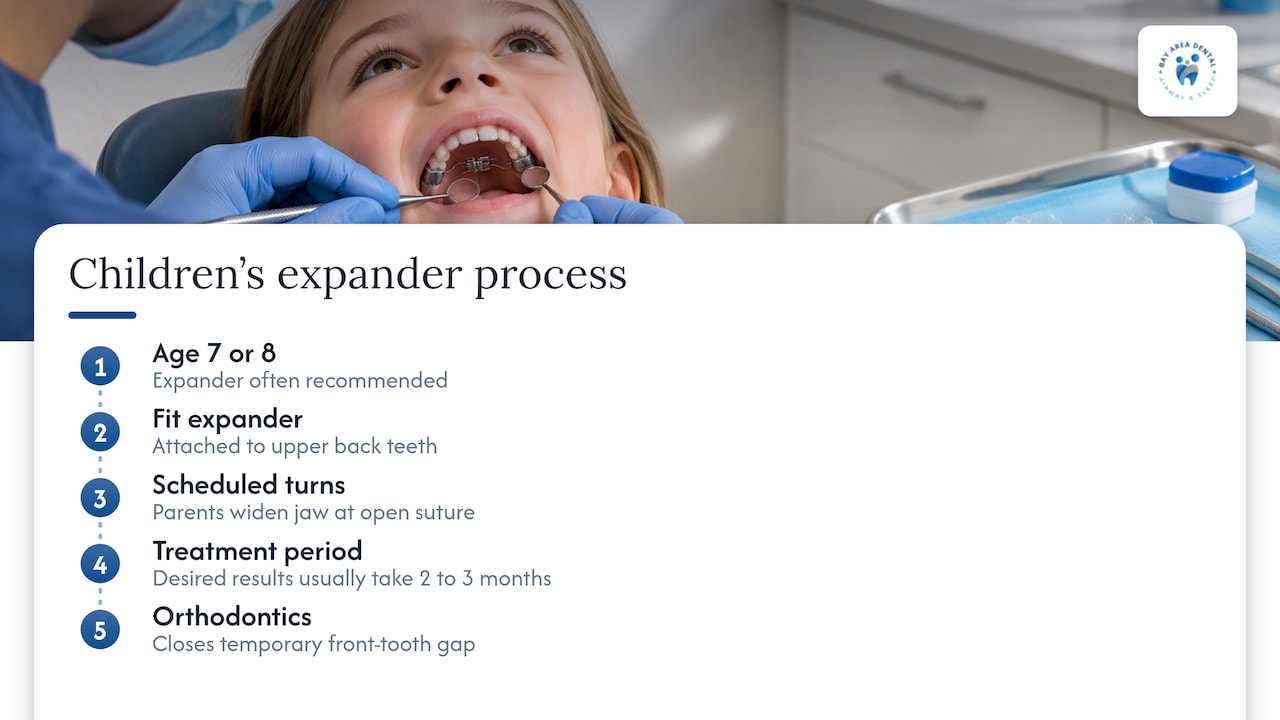
In growing patients, the same review says slow or rapid maxillary expansion may be used, and that early skeletal assessment matters because early diagnosis influences treatment effectiveness. Cleveland Clinic notes that orthodontists often recommend a palate expander at age 7 or 8, with desired results usually taking 2 to 3 months in children.
An expander is a small appliance fitted to the upper back teeth. Parents turn it on a schedule, and it gently widens the upper jaw at the suture, the seam in the middle of the palate that is still open in children. The temporary effects are mild: discomfort, headaches, drooling and lisping that typically settle as the mouth adapts. A gap between the front teeth can appear and is later closed with orthodontics.
We offer palatal expansion and airway-friendly clear aligners in our orthodontics service, and our page on best age for braces lays out why starting between age 7 and adulthood matters.
Teens and adults
Cleveland Clinic says results can take up to a year in teens and adults because their bones are fully developed. Braces move teeth but cannot move the jawbone, so a true skeletal narrowing needs an approach that addresses the bone. For skeletally mature patients with a skeletal transverse deficiency, the review describes SARPE or segmental surgery, and says SARPE appears to be the appropriate surgical choice when a large expansion is needed.
For adults whose narrowing is milder, our page on adult palate expansion with force-controlled protocols describes the approach we use. Surgical decisions belong with an oral and maxillofacial surgeon or ENT surgeon, and we coordinate with those colleagues when a case calls for it.
Tongue posture and myofunctional therapy
The palate does not live alone. Tongue posture, lip seal and nasal breathing all influence it, and they can be retrained. Myofunctional therapy is a set of exercises that teaches the tongue and facial muscles to work in healthy patterns, often paired with expansion or tie release.
Tooth contouring is not palate treatment
If you arrived here after searching enameloplasty, tooth reshaping or cosmetic contouring, here is the distinction. Enameloplasty is selective removal and remodeling of tooth hard tissue without adding restorative material, using a fine diamond bur and abrasive strips. It does not usually need local anesthesia, and it can finish an orthodontic case by refining tooth shape and alignment.
That makes it a finishing tool for the edges and shapes of teeth. It cannot widen a palate or change the airway. The same authors say the amount of enamel removed must be carefully defined, that the area can be marked beforehand to preview the result, and that the additive approach is generally preferred, adding material rather than taking it away.
For most cosmetic goals, that means composite bonding, veneers or gum contouring. Our pages explain how long bonding lasts and laser gum contouring. In a high palate case, the smart order is usually airway and alignment first, cosmetic refinement after, because moving teeth into a wider arch changes what the final smile needs.
What the evaluation involves
A good evaluation answers three questions: how the palate is shaped, why it is shaped that way, and what it is affecting. Typically that means:
- A look at the mouth and face. Palate depth and width, tooth position, crossbite, tongue mobility and lip seal.
- Breathing and sleep history. Snoring, mouth breathing, restless sleep, nasal congestion, daytime tiredness.
- Imaging when it helps. We use 3D imaging so the jaw and airway can be seen in three dimensions rather than guessed at.
- A plan by age. Interceptive treatment for children, a different pathway for teens and adults, and referrals for medical concerns.
Our page on how providers evaluate mouth breathing and the multidisciplinary care pathway shows how dental, medical and therapy input fit together.
Book a palate and airway evaluation in Fremont
If you or your child shows the signs above, our team in Fremont offers an integrated exam under one roof: orthodontics with palatal expansion, sleep and airway dentistry, myofunctional therapy and tongue and lip tie release. Parents can start with our pediatric dental care page. We also welcome Deaf patients with communication tailored to them.
Prices are not published online, so contact the office to ask about your visit.
Our perspective
We see the palate as the place where dentistry, breathing and sleep meet. Our practice is built on addressing root causes rather than only treating symptoms, and a narrow, high palate is a good example: it can show up as crowded teeth, but the cause may be tongue posture, a tie or mouth breathing.
That is why we pair minimally invasive tools, such as 3D imaging and lasers, with orthodontics, myofunctional therapy and tie release. For children, early attention gives the most options. For adults, we look at the whole airway picture and build a plan around comfort and long-term health.
The cosmetic side matters too. A smile designed around a healthy, well-supported arch looks and works better than one designed on a tooth-by-tooth basis.
Bay Area Dental, Airway & Sleep
FAQ
Is a high palate a problem?
Not by itself. It becomes a concern when it comes with crowding, crossbite, mouth breathing, snoring, feeding or speech trouble. An exam shows whether the shape is affecting function.
Can you fix a high arched palate?
In growing children, expansion appliances can widen the upper jaw, and Cleveland Clinic notes results usually take 2 to 3 months. Adults have a longer path, and the options depend on how much skeletal narrowing is present.
What syndromes are associated with a high arched palate?
Marfan syndrome is the classic association, and Down, Apert, Crouzon and Treacher Collins syndromes are also listed in the Radiopaedia reference. Most people with a high palate do not have a syndrome, but a pediatrician should review any child who has other signs.
Can a high palate affect speech?
It can go along with changes in tongue position, and a lisp is a recognized temporary effect of wearing a palate expander. A dental exam combined with a speech-language pathologist’s input can sort out what is driving the pattern.
When should my child be evaluated?
Orthodontists often begin around age 7 or 8, but earlier checks make sense for babies with feeding trouble or a tongue tie, and for children who snore or breathe through the mouth. See our guide on when to seek care.
Sources
- High arched palate, Radiopaedia
- The Diagnosis Methods and Management Modalities of Maxillary Transverse Deficiency, PMC
- Position Statement: Surgically Assisted Rapid Palatal Expansion, AAO-HNS
- Palate Expander: Uses, Types & Adjusting, Cleveland Clinic
- A Comprehensive Review of Treatment Plans for Marginal Tooth Discrepancies, MDPI
- Enameloplasty review, PMC