

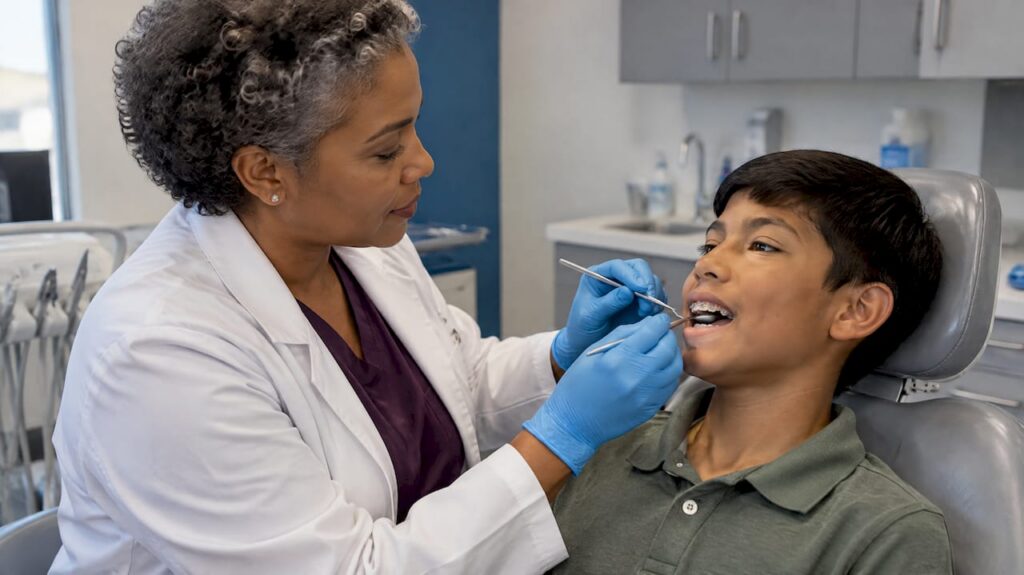
For most children, the best age for braces falls between about 9 and 14, once permanent teeth are coming in and the jaw is still growing. But the age to see an orthodontist comes earlier: the American Association of Orthodontists (AAO) recommends a first check-up no later than age 7. And if you are an adult, you have not missed the window. Healthy teeth can be moved at any age.
This guide walks through each stage, what orthodontists look for, which bite problems justify starting early, and how to decide when your own child or you should begin.
TL;DR
- Most orthodontic treatment starts between ages 9 and 14, when permanent teeth are erupting and growth is still working in your favor.
- The first orthodontic check-up should happen by age 7. A check-up is not the same as getting braces.
- Some problems, such as underbites and crossbites, are often better treated early, in a first phase while baby teeth are still present.
- Adults can get treatment too: about one in three orthodontic patients is over 18.
- The right start date depends on your child’s growth and tooth eruption, not on a birthday.
Table of Contents
- The short answer: there is a typical range, not a single best age
- Why the preteen and early teen years work well
- Age 7: the check-up that matters most
- Signs your child may need to be seen earlier
- What early treatment actually does
- When breathing and jaw growth are part of the picture
- Braces for teens: ages 12 to 17
- Can adults get braces?
- What affects the right start date for your child
- How long treatment takes and what it costs
- Our perspective
- Orthodontic care at our Fremont practice
- Preparing for the first orthodontic visit
- Common myths about timing
- FAQ
- Sources
The short answer: there is a typical range, not a single best age
Search results all circle the same numbers, and the numbers differ a little by source. Johns Hopkins Medicine says the ideal age for braces and other orthodontic treatment is between 8 and 14 in most cases. Healthline reports that treatment usually begins between 9 and 14, once children start getting permanent teeth, and that the best age varies from person to person. Delta Dental describes ages 10 to 14 as the point when most baby teeth have fallen out and the child is still growing, so teeth and bone move more easily.
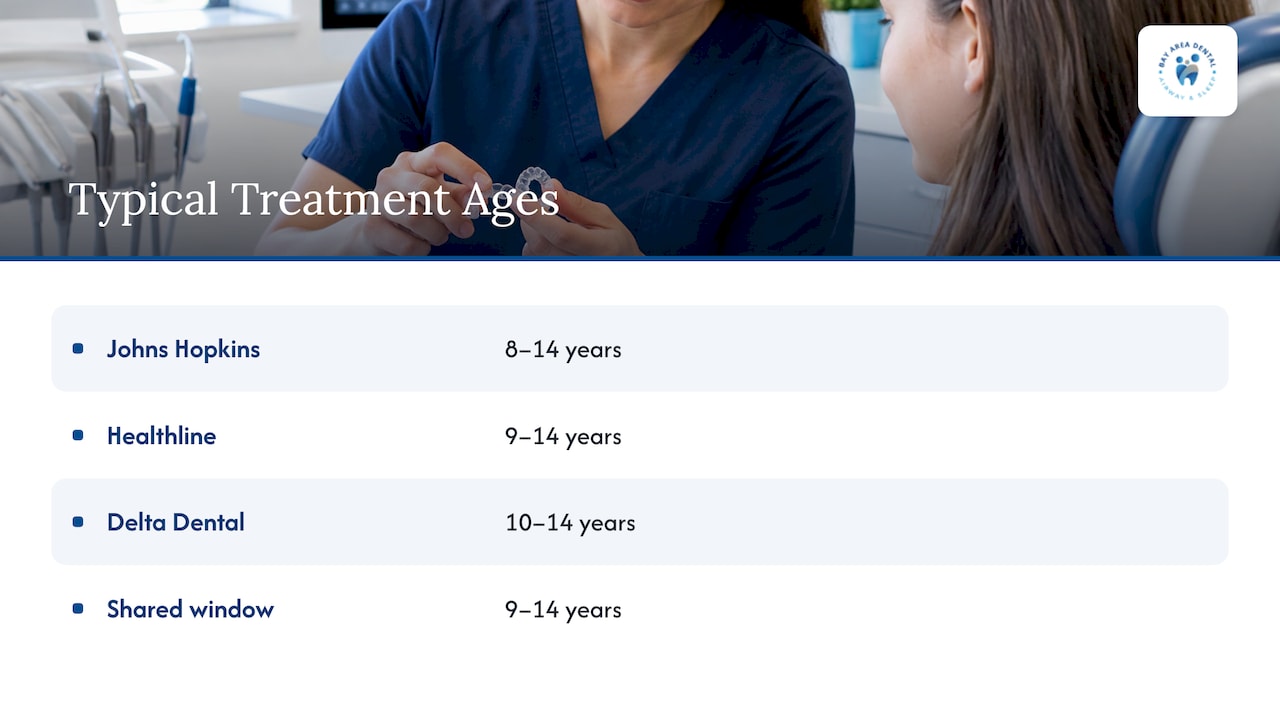
The overlap is clear: somewhere around 9 to 14 is when most kids are ready. The spread exists because children do not develop on the same schedule. One child may lose the last baby tooth at 10, another at 13. The better question is not “how old is my child?” but “which teeth are in, and how is the jaw developing?”
Why the preteen and early teen years work well
By early adolescence a child usually has all or most of the adult teeth in place. That lets the orthodontist plan the whole arch rather than a moving target. Jaw bone is also still growing, which Delta Dental notes makes teeth and bone move more easily.
There is a practical side too. A child of 11 or 12 can usually keep up with cleaning around appliances, wear elastics as directed and show up for adjustments. Timing treatment so it finishes before the busiest high school years is something many families value, though it is a scheduling preference, not a medical rule.
Age 7: the check-up that matters most
The AAO’s advice is a first evaluation by age 7. At that age, children typically have a mix of baby and permanent teeth, which lets an orthodontist see how teeth and jaws are developing. The AAO says that spotting problems early often means avoiding more complex or costly treatment later. It also emphasizes that orthodontic problems rarely fix themselves.
Most 7-year-olds who are checked do not start treatment that day. The common outcome is “we’ll watch and see you again in six to twelve months.” That is a good result: you now have a baseline and a plan, and you will know when to act.
If you want to see what we look for at this visit, our guide to signs at age 7 that warrant interceptive orthodontics covers it in detail.
Signs your child may need to be seen earlier
The AAO lists problems that may lend themselves well to early treatment:
- Underbites
- Crossbites and functional shifts of the jaw
- Very crowded teeth
- Excessively spaced teeth
- Extra or missing teeth
- Teeth that meet abnormally or do not meet at all
- Thumb, finger or pacifier habits that are affecting the teeth or jaw growth
Delta Dental adds that some growth and development problems are best treated while all baby teeth are still present, around ages 5 to 9, and that these early corrections are often only the first phase of treatment.
At home, you can notice a few things between check-ups: a child who breathes through the mouth much of the day, a lower jaw that seems to sit ahead of the upper teeth, teeth that overlap badly as they erupt, or a long-running habit like thumb sucking. If your child has a gap between upper and lower front teeth that does not close, read our piece on acting by ages 3 to 6 to prevent open bite.
What early treatment actually does
Early, or “interceptive,” treatment happens while some baby teeth are still present. The AAO explains that it can guide the growth of facial and jaw bones into a better pattern and make room for incoming permanent teeth, which can make later treatment shorter and simpler.
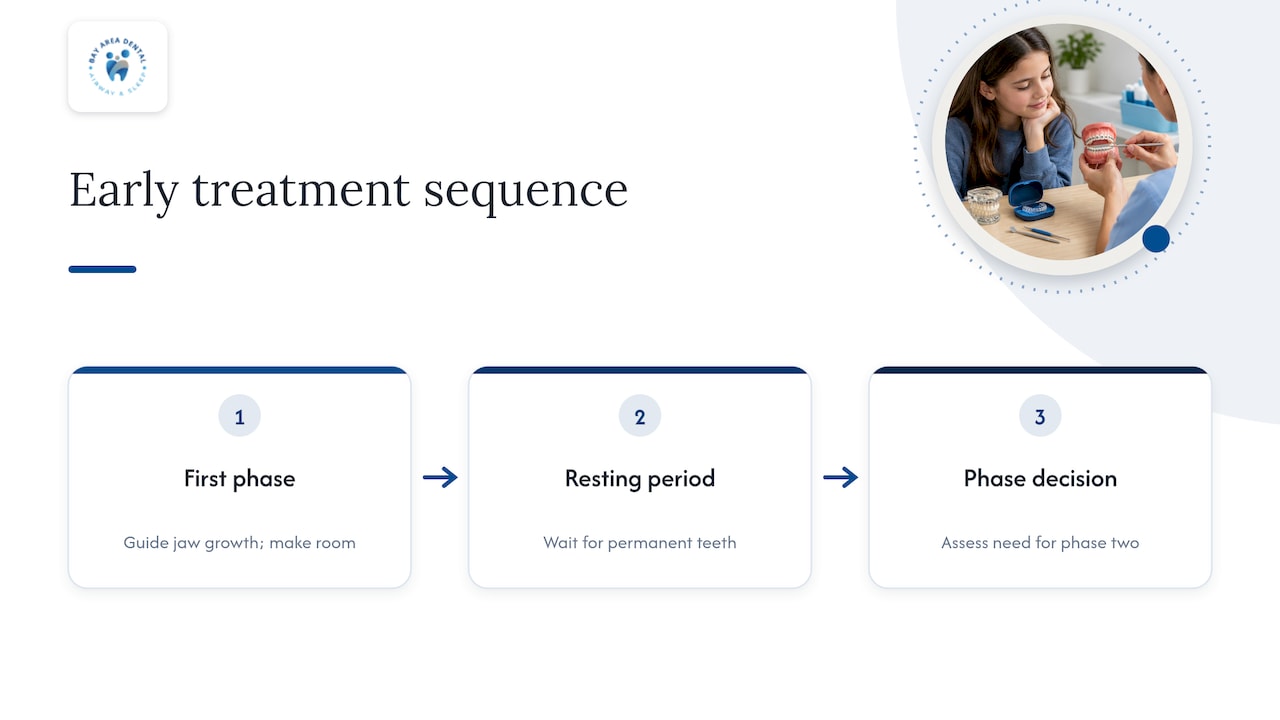
Notice the wording: can make later treatment shorter and simpler. Early treatment is not a guarantee that a second phase will be skipped. It is a way to correct a developing problem at the stage when the jaw responds best. Typical tools include palatal expanders, which widen the upper jaw, and limited appliances for habits or specific tooth positions. After a first phase, there is often a resting period while the remaining permanent teeth arrive, and then a decision about whether a second phase is needed.
Early start, or wait?
| Situation | What it usually points to |
|---|---|
| Age 6 to 7, no obvious bite problem | Check-up, then monitor |
| Age 6 to 9, underbite, crossbite or severe crowding | Evaluation for a first phase of treatment |
| Age 9 to 11, permanent teeth erupting, mild crowding | Plan for treatment when growth and tooth eruption line up |
| Age 10 to 14, most permanent teeth in | The most common window for braces or aligners |
| 15 to 17 | Still very workable; planning depends on remaining growth |
| 18 and up | Treatment is common; the approach may differ |
This table is a general guide drawn from the sources above. Your orthodontist’s exam, X-rays and 3D imaging decide the actual timing.
When breathing and jaw growth are part of the picture
We pay close attention to something many age charts skip: how a child breathes. A child who habitually breathes through the mouth may be developing a narrower upper jaw and a different facial growth pattern, and that can change what orthodontic timing makes sense. We explain what orthodontics can and cannot do in our article on mouth breathing and orthodontics, and why we think parents should not wait until growth stops to look at nasal breathing.
If snoring, restless sleep or daytime tiredness are also part of your child’s story, a pediatric airway evaluation can help sort out what is going on before an orthodontic plan is set. For older patients with suspected sleep-disordered breathing, we explain why a sleep study should come first.
Braces for teens: ages 12 to 17
Not every child fits the 10 to 14 pattern. Late bloomers who lose baby teeth at 12 or 13 will naturally start later. Teens who had no treatment earlier can still do very well, particularly if growth is not finished. Some things worth knowing for this group:
- Compliance matters. Elastics, retainers and cleaning habits shape the result as much as the appliance does.
- Sports and music. Mouthguards and instruments can be adapted; tell your orthodontist about both.
- Aligners are an option for many teens. Whether clear aligners suit a particular bite is a clinical judgment, based on what needs to move.
Can adults get braces?
Yes. The AAO reports that one in three orthodontic patients is over 18 and that healthy teeth can be moved at any age, because it is the same physiological process. The practical difference is that an adult’s jaw has finished growing. Johns Hopkins Medicine notes that an adult mouth must overcome already-positioned facial bones and jaw structure, so some problems may need more than one type of treatment and can occasionally include jaw surgery.
Why adults seek treatment
The AAO says many adults come in for problems that went untreated earlier or developed over time. The most common is crowding, which makes cleaning harder and can affect confidence. Adults also notice bite imbalances, spacing, drifting after tooth loss or gum disease, and jaw joint or muscle strain linked to an unbalanced bite.
There are health reasons beyond looks. The AAO states that aligned teeth can make daily hygiene easier, reducing the risk of cavities and gum inflammation, and that a balanced bite helps spread chewing forces, reducing abnormal wear and bite-related discomfort. Once teeth are straight, some adults also look at teeth whitening options for adults to finish the smile.
Because adult treatment starts with a healthy foundation, gums and existing dental work get checked first. If you have gum disease, it needs to be under control before teeth are moved. Our general dentists can evaluate that at the same visit.
What affects the right start date for your child
Rather than aiming for a birthday, use these factors:
- Which teeth are in. Many orthodontists prefer to begin comprehensive treatment when most permanent teeth have erupted.
- Growth. If the jaw is still growing, certain problems can be guided. This is why underbites and crossbites are often addressed early.
- Severity. A severe problem may justify an early first phase; a mild one often waits.
- Habits and breathing. Thumb sucking, pacifier use and mouth breathing can keep a problem going until the habit is addressed.
- Your child’s readiness. A child who can brush and floss carefully around appliances does better.
- Family logistics. School calendars, sports seasons and insurance benefits can reasonably shape the timing once the clinical window is clear.
How long treatment takes and what it costs
Duration depends on the problem. A first phase is often shorter than comprehensive treatment, and a full course typically runs longer for complex bites. We do not quote a fixed timeline in an article because it would not be honest: your exam and imaging set it. The same goes for cost. We do not publish a flat fee, and fees depend on the type of appliance and the length of care. For the factors that shape it locally, see orthodontics cost in the Bay Area. Many families also check what their dental plan covers for orthodontics before the consultation.
Our perspective
We think the most useful question for parents is not “what age?” but “what is my child’s jaw doing?”
Teeth are the visible part of orthodontics. The jaw, the airway and the way a child breathes and swallows sit underneath. That is why our approach is to look at the whole picture: the bite, the growth pattern, the tongue and the airway. When we see a child at 6 or 7, we are not trying to put braces on a young child. We are trying to understand what is developing, so that any treatment can be timed with growth rather than against it.
For some children, that means a simple “come back in a year.” For others, it means guiding the upper jaw with an expander or addressing a habit early, when the tissues respond best. We offer airway-friendly clear aligners and palatal expansion because we believe orthodontics should support healthy breathing as well as straight teeth.
For adults, our message is just as clear: it is not too late. Aligning teeth can make cleaning easier and a bite more comfortable, and we plan adult treatment around your gums, your bite and, where relevant, your sleep.
Bay Area Dental, Airway & Sleep
Orthodontic care at our Fremont practice
We offer orthodontics in Fremont, including airway-friendly clear aligners and palatal expansion, alongside pediatric and general dentistry under one roof. We use advanced technology such as 3D imaging to plan care, and we aim for minimally invasive, comfortable treatment. Families come to us to find out whether now is the right time, and sometimes the honest answer is a plan to check back later.

If your child is approaching age 7, or you have been thinking about straightening your own teeth, you can start with a conversation. Visit our Fremont practice page to book a visit, or see our pediatric dental care services if you are bringing a younger child. We also welcome Deaf patients with tailored communication.
Preparing for the first orthodontic visit
A little preparation makes the visit more useful:
- Note when your child lost baby teeth and when permanent ones appeared.
- Write down habits: thumb sucking, pacifier use, nail biting, mouth breathing, snoring.
- Mention any jaw clicking, teeth grinding or difficulty chewing.
- Bring any earlier dental X-rays and your dental plan details.
- Tell us about family history, since bite problems often run in families.
If your child has not yet had a first dental visit, our guide on the first dental visit by age one explains why that visit comes earlier than the orthodontic one.
Common myths about timing
“Wait until all the adult teeth are in, always.” For many children that works well. For an underbite or crossbite, waiting can mean missing the period when growth is easiest to guide.
“Early evaluation means early braces.” No. The AAO recommends the check-up at 7 so that problems can be seen early; most children are simply monitored.
“It’s too late for me.” Healthy teeth can be moved at any age, according to the AAO. Adult plans may just look different.
“Crooked teeth are only cosmetic.” Crowding can make cleaning harder, and an unbalanced bite can contribute to wear and jaw strain, as the AAO describes.
FAQ
What is the best age for braces?
Most children start between about 9 and 14, when permanent teeth are coming in and the jaw is still growing. Sources vary slightly, with some giving 8 to 14 and others 10 to 14. The exact best age depends on your child’s tooth eruption and growth.
Is 7 too young for braces?
Seven is the age for a check-up, not usually for full braces. The AAO recommends a first evaluation by then. Some children with underbites or crossbites may benefit from a first phase of treatment, but many are just monitored.
Is 13 too late for braces?
No. Thirteen sits inside the typical 10 to 14 window, and many children begin then, especially if their last baby teeth fell out later. Teens older than that can also be treated successfully.
Can adults get braces?
Yes. About one in three orthodontic patients is over 18, according to the AAO, because healthy teeth can be moved at any age. Adult treatment may take a different approach because the jaw has stopped growing, and your gums need to be healthy first.
Should my child see an orthodontist or a dentist first?
Begin with regular dental visits from a young age, and arrange an orthodontic check-up by age 7. At our practice, both pediatric dental care and orthodontics are available together, which keeps your child’s records and plan in one place.
Sources
- Your Guide to Orthodontic Health, American Association of Orthodontists
- The Right Time: When Should Your Child See an Orthodontist?, American Association of Orthodontists
- The Rise of Adult Braces, American Association of Orthodontists
- Orthodontics/Braces for Children, Johns Hopkins Medicine
- Do I Need Braces?, Healthline
- Does your child need braces?, Delta Dental