

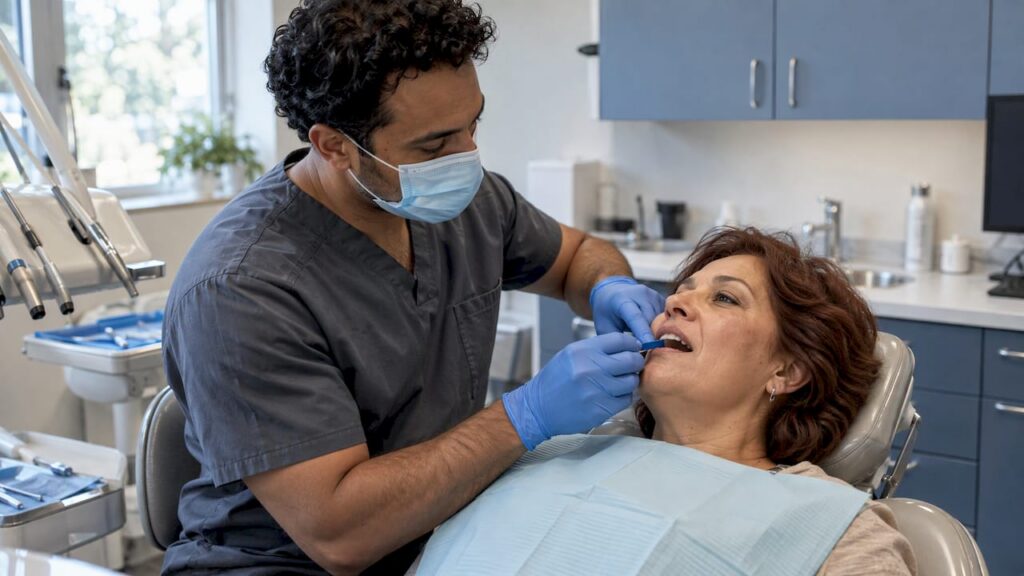
Bite equilibration, also called occlusal equilibration or a bite adjustment, is the careful reshaping of the biting surfaces of teeth (or of crowns, fillings and other dental work) so the upper and lower teeth meet evenly and the jaw closes without being steered by a high spot. It is planned, measured work, not casual grinding. It suits a specific set of patients, and it is not a cure-all for jaw pain, headaches or teeth grinding. This guide explains how it works, who is a good candidate, what a visit looks like and what people typically pay in the United States.
TL;DR
- Bite equilibration reshapes tooth contacts so force is shared evenly. Dentists use it to remove traumatic contacts, to stabilize orthodontic results and to prepare a bite before major restorative work.
- It works best when the jaw joints are healthy and there is a clear plan from a careful exam. “Guess and grind” adjusting is what to avoid.
- It is not a stand-alone fix for jaw disorders, bruxism or headaches, and it is often bundled into other treatment, which affects billing.
- Published cost ranges for a bite adjustment run from roughly $50 to $300 without insurance, depending on how many teeth are involved and where you live.
- Ask your dentist what problem the adjustment is meant to solve, how it will be measured and whether a reversible option should come first.
Table of Contents
- What bite equilibration actually is
- Why a dentist might recommend it
- How a dentist decides whether you need it
- What to expect during a bite adjustment
- Who is a good candidate, and who should wait
- What bite equilibration can and cannot do
- Bite equilibration versus a night guard or other bite treatments
- Bite changes in children
- How much bite equilibration costs in the US
- Questions to ask before you agree
- Have a bite concern? Start with a conversation
- FAQ
- Sources
What bite equilibration actually is
Your bite, which dentists call occlusion, is the way your teeth contact each other when you close, chew and slide your jaw side to side. When one tooth hits first or too hard, that tooth and the muscles and joints behind it absorb extra load.
Aetna’s clinical policy defines occlusal adjustment as reshaping tooth surfaces to create a harmonious contact relationship between the upper and lower teeth, with the main goal of improving function so that the teeth and the supporting gum and bone receive uniform stimulation.
The terms are used loosely, but some textbooks separate them. One dental reference describes adjustment as altering surfaces to change contacts, while equilibration is the planned alteration that aims for stable, simultaneous contacts on many teeth and smooth side-to-side movements with no interferences. In everyday practice, “bite adjustment dentist” and “occlusal equilibration” usually point to the same service.
Limited versus complete adjustment
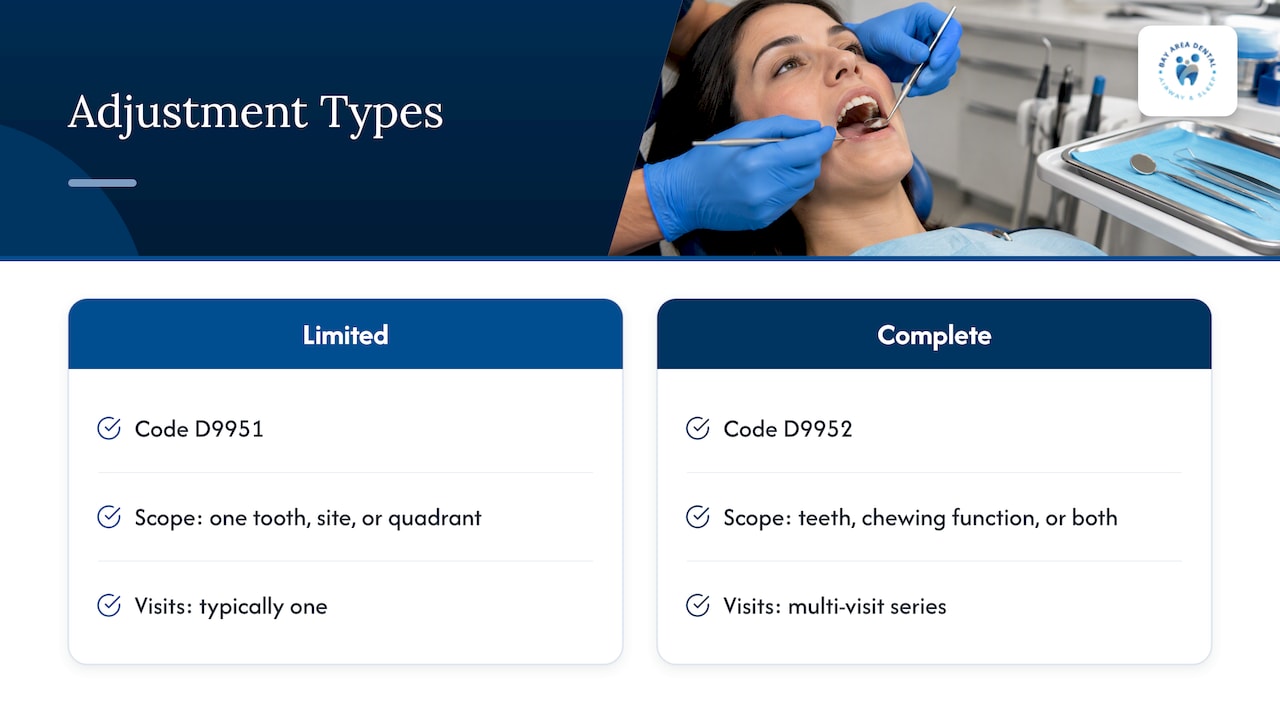
Dental billing draws a useful line. A limited adjustment is typically a single-visit procedure on one tooth, site or quadrant, billed under code D9951. A complete adjustment, code D9952, is a multi-visit series that can address the teeth, the neuromuscular side of chewing, or both. Knowing which one your dentist is proposing tells you how much time, and how many visits, to expect.
Why a dentist might recommend it
Aetna’s policy groups the reasons into three categories: eliminating traumatic occlusion, stabilizing orthodontic results, and establishing an optimal bite pattern before extensive restorative work. In plain terms:
- A tooth is taking too much force. You may notice a tooth that feels high, a sore tooth with no cavity, or wear and chipping in one area.
- You have finished orthodontic treatment. Teeth that have just moved sometimes settle into contacts that are uneven. Fine-tuning helps keep the result steady.
- You are about to get crowns, bridges, veneers or implants. Getting the bite stable first helps new work last.
The biology behind this is straightforward. A 2020 review notes that occlusal instability or trauma from functional and parafunctional forces can overwhelm the ability of teeth and their attachment tissues to adapt and repair, and that an unstable bite is a common cause of problems after restorations. The same article describes equilibration as a minimally invasive therapy in which teeth are reshaped once improper biting forces have been located.
Force also adds up quickly. Dental Economics reports that adding contacts in the bicuspid region doubles the force compared with front-tooth contact, and contacts all the way back to the second molars can produce five to eight times the force of canine contact alone, shared among teeth, joints and muscles. That is why where the teeth touch matters as much as whether they touch.
How a dentist decides whether you need it
Good equilibration starts with diagnosis, not a drill. The Dawson Academy, a dental education group, says the most critical skill is locating and verifying centric relation, the jaw position where the joints are seated comfortably. After the exam shows healthy joints and negative load testing, the dentist compares that position with the way your teeth fit together on their own. Only discrepancies that contribute to breakdown or instability of the chewing system need correcting.
A thorough evaluation typically includes:
- A review of your symptoms, such as sore teeth, jaw fatigue, clicking, worn edges, or loose teeth
- A look at wear patterns, cracks, gum recession and tooth mobility
- A joint and muscle exam, including gentle load testing
- Records of how your teeth meet, which may include models, photographs, imaging or digital bite analysis
At our practice, we use advanced tools such as 3D imaging as part of understanding how your teeth, jaws and airway relate. If you want to see how we think about measuring a bite, read our piece on digital bite analysis.
What to expect during a bite adjustment
The details vary by dentist and by how complex your case is, but the general flow is consistent.
Before the visit
Expect a conversation about what you feel and when. Tell your dentist about jaw pain, headaches, grinding, recent dental work and any sleep problems. Bring a list of medications.
During the visit
You bite on thin marking paper or a similar material so the dentist can see where contacts land. High or premature contacts are identified and reshaped in small steps, usually with fine polishing instruments, and you bite again to check. The process repeats until contacts are even and your jaw can glide without catching. Most patients describe it as feeling pressure and vibration rather than pain, and because only the outer enamel or restoration surface is typically refined, many adjustments need no numbing. Ask your dentist what to expect in your case.
The systematic approach matters. A 2020 review explains that the main purpose is to eliminate deflective contacts that interfere with the function of the jaw joint, and that following a defined sequence improves long-term success by creating a bite in harmony with your natural range of movement.
What to avoid
The Dawson Academy cautions against “guess and grind,” where a new restoration is ground indiscriminately and the patient is asked how it feels. It calls that approach time-consuming and frustrating, and says it can ruin the lab’s work by removing porcelain unnecessarily. The same source says success rests on three things: a stable joint, a skilled operator and a definitive plan built on careful examination.
After the visit
Your bite may feel different for a few days as your muscles adjust. Report a tooth that still feels high, new soreness or a change in how you chew, so it can be refined. A complete adjustment may need several appointments, and Aetna’s policy notes that a complete occlusal adjustment may require multiple visits.
Who is a good candidate, and who should wait
The procedure removes tooth structure, so it is chosen with care. Good candidates usually have healthy, stable jaw joints, a specific bite problem that the exam can pinpoint and a clear understanding of what the adjustment will and will not do.
The Dawson Academy advises that patients with longstanding jaw-joint symptoms, facial pain, muscle soreness, or joint tenderness on load testing should have those issues resolved first, and that patients who do not understand or accept the procedure are not appropriate candidates. If that describes you, ask your dentist about calming the muscles and joint first, often with a conservative and reversible approach.
Jaw pain can also have causes outside the mouth. Neck posture and spinal alignment are often discussed alongside jaw symptoms, and some people explore how upper cervical alignment relates to TMJ pain with a chiropractor while their dentist evaluates the bite. A sensible plan coordinates both views rather than relying on one.
What bite equilibration can and cannot do
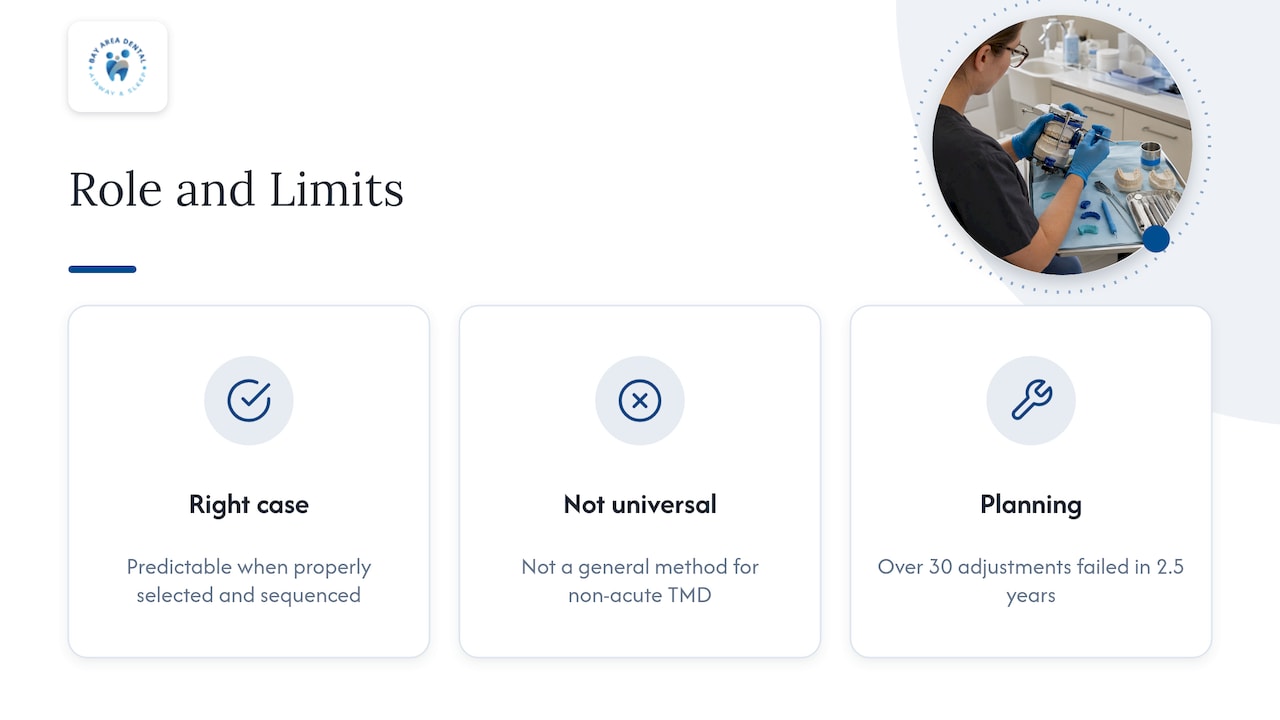
The procedure has a well-defined role. The 2020 review concludes that proper equilibration on a properly selected patient, in the right sequence, is one of the most predictable services a dentist can perform. The key words are properly selected and proper sequence.
It is not a universal treatment for jaw disorders. Aetna does not consider occlusal adjustment the sole treatment for managing or preventing temporomandibular disorder, and says the evidence does not support it as a general method for non-acute TMD, bruxism or headaches. Safe use means matching the tool to the problem.
Outcomes also depend on the operator and the plan. A published case report describes a patient with a chronic bite problem who had more than 30 prior adjustments over two and a half years without success. The report describes correcting the problem with a structured protocol that added and removed surface material. The lesson is that the planning and method behind the adjustment count as much as the adjustment itself.
Bite equilibration versus a night guard or other bite treatments
People often ask whether they need an adjustment or an appliance. They do different jobs.
| Approach | What it does | Reversible? | Typical use |
|---|---|---|---|
| Bite equilibration | Reshapes tooth or restoration surfaces to even out contacts | No | Specific interferences, post-orthodontic fine tuning, before restorative work |
| Occlusal splint (night guard) | Covers the teeth to redistribute load and protect them | Yes | Jaw muscle pain, grinding, joint symptoms |
| Orofacial myofunctional therapy | Retrains tongue, lip and jaw muscle patterns with exercises | Yes | Muscle patterns, joint noise, tongue posture |
| Orthodontics | Moves teeth to a new position | Partly | Crowding, bite relationships, long-term alignment |
The research leans toward conservative, reversible options first for jaw disorders. One academic review states that oral appliances provide a conservative and relatively reversible approach with minimal adverse effects, and suggests considering them among first-line options for TMDs, while noting that the evidence for pain management is weak to moderate because studies vary so much in design.
A 2024 Cochrane-style review found that a hard stabilization splint may slightly reduce muscle pain when chewing compared with no treatment, and that myofunctional therapy may slightly reduce joint noise compared with a splint, though the difference may not be clinically meaningful. Another review table identified splint therapy, alone or combined, as the most effective option for short-term TMD pain. A dentist who treats the jaw muscles first and reserves reshaping for clear cases is following sound judgment.
One caution on appliances: an academic paper on oral appliance therapy says that appliances designed to change the bite to treat TMD should be avoided and that therapy should stay conservative and reversible. Ask any provider which type of appliance is being proposed and what it is meant to do.
If tongue posture or mouth breathing may be part of your bite story, our guides on tongue posture training and myofunctional exercises explain the retraining side. If you also snore or wake unrefreshed, see how TMJ problems and sleep apnea are linked.
Bite changes in children
In kids, bite problems often start with habits and breathing patterns rather than tooth contacts. Thumb sucking, pacifier use and mouth breathing can shape how the teeth meet as they grow. Parents who want to act early can read about preventing open bite by ages 3 to 6 and the signs at age 7 that point to interceptive orthodontics. Guiding growth early is generally a different path from adult tooth reshaping.
How much bite equilibration costs in the US
Prices vary widely because the service ranges from a quick touch-up to a multi-visit series. One cost aggregator, updated in March 2026, reports that without insurance a bite adjustment costs $50 to $300, averaging $175, and with insurance patients pay $20 to $100, averaging $60. Its breakdown by scope:
| Scope | Reported cost without insurance |
|---|---|
| Simple adjustment, 1 to 2 teeth | $50 to $150 |
| Complex, multi-tooth adjustment | $100 to $250 |
| Full-mouth equilibration | $150 to $300 |
The same source says urban areas can cost 20% to 40% more, and that dentist experience, plan type and number of teeth all affect the price. Treat these as general national ranges, not a quote. We do not publish a price for this service, so your own estimate comes from an exam and a written treatment plan.
Why insurance can be confusing
Billing often depends on context. Aetna’s policy states that occlusal adjustment is considered part of and inclusive to restorative, prosthodontic, implant and endodontic services, and that a complete adjustment is part of comprehensive orthodontic treatment. That means a bite adjustment done with a crown may not be billed separately. Policies differ by insurer, so ask your plan before you book.
The aggregator also notes that bite adjustment is usually treated as a basic service, possibly covered at 80% when treating bite or TMJ problems, that many PPO plans have annual maximums of $1,000 to $2,500, and that many plans have 6 to 12 month waiting periods for major work. Also note that the fee for the adjustment is separate from the fee for diagnostic casts and analysis, so ask what the estimate includes.
Questions to ask before you agree
- What specific problem is this adjustment meant to solve?
- How did you locate the contacts, and what records did you take?
- Are my jaw joints and muscles healthy enough to proceed?
- Would a reversible option be a sensible first step?
- Is this a limited or a complete adjustment, and how many visits?
- Is it billed on its own or as part of other treatment?
A clear, unhurried answer to each is the mark of a well-planned procedure.
Our perspective on bite and whole-body health
We look at a bite as one part of a larger system that includes the jaws, the tongue, the airway and the way you sleep. A tooth that feels high is often a clue, not the whole story. That is why our approach centers on finding root causes rather than treating only the symptom in front of us.
In our experience, the best results come from careful measurement, a patient conversation about goals, and the most conservative option that fits the problem. Advanced technology such as 3D imaging helps us see structure and function before we recommend anything, and minimally invasive thinking guides what we do next.
When bite concerns overlap with clenching, mouth breathing, tongue posture or sleep-disordered breathing, we believe an integrated plan under one roof serves you better than treating each piece alone. Dental care, airway therapy and myofunctional therapy can be coordinated so each step supports the next.
Bay Area Dental, Airway & Sleep
Have a bite concern? Start with a conversation
If your teeth feel uneven, you are planning restorative work or you are noticing jaw tension, we can help you sort out what is going on. Our Fremont team offers general, restorative and cosmetic dentistry, orthodontics, myofunctional therapy and airway-focused care, with an emphasis on comfort and clear communication, including for Deaf patients.

Learn more about our general and restorative dentistry services, or visit our main page to book an appointment.
FAQ
Is bite equilibration the same as occlusal equilibration?
Yes, in everyday use the terms describe the same idea: reshaping tooth surfaces so your teeth meet evenly. Some textbooks separate a simple adjustment from a planned equilibration, but patients will hear the words used interchangeably. Ask your dentist whether the plan is limited or complete.
Does a bite adjustment hurt?
Most people feel pressure and vibration rather than pain, since the work is typically on the outer surface of the tooth or restoration. Your bite may feel different for a few days while your muscles adjust. Tell your dentist if a tooth still feels high or sore afterward.
Will bite equilibration cure jaw pain or teeth grinding?
Not on its own. Aetna’s policy says the evidence does not support it as a general treatment for non-acute TMD, bruxism or headaches. Reversible approaches such as a splint or myofunctional therapy are commonly considered first, so talk with your dentist about the right order.
How much does a bite adjustment cost?
One March 2026 cost report puts it at $50 to $300 without insurance, averaging $175, depending on how many teeth are involved and your location. Insurance may treat it as part of other work, so confirm coverage with your plan and ask your dentist for a written estimate.
Sources
- Occlusal adjustment (029), Aetna Dental Clinical Policy Bulletin
- Occlusal Adjustment and Equilibration, Pocket Dentistry
- Occlusal instability, occlusal equilibration and clinical outcomes, PMC
- The value of occlusal adjustment, Dental Economics
- How to recognize if your patient should be equilibrated, The Dawson Academy
- Clinical protocol for occlusal adjustment, PubMed
- Intraoral appliances for temporomandibular disorders, Frontiers of Oral and Maxillofacial Medicine
- Occlusal interventions for managing temporomandibular disorders, PubMed
- Temporomandibular Disorders Management: What’s New?, PMC
- Oral Appliance Therapy in the Management of TMD, Dinan
- Occlusal analysis and adjustment, Dental Economics
- Bite Adjustment (Occlusal Adjustment) Cost, Medical Cost Info