


Lip incompetence treatment starts with finding out why the lips rest apart, not with lip exercises alone. The usual plan is to clear any blocked nasal breathing first, then retrain the lips, tongue and breathing habits with myofunctional therapy, and bring in orthodontic care when the bite or jaw is involved. This guide explains what a weak lip seal is, what can cause it, which exercises are used, and when to book an evaluation for your child or yourself.
TL;DR
- Lip incompetence is a lips-apart resting posture. It can show up in children, teens and adults, and it can be a sign of an orofacial myofunctional disorder.
- Exercises make sense only after anything blocking nasal breathing has been ruled out or corrected.
- Treatment is usually a team effort: dentist or orthodontist, ENT or allergist, and a myofunctional therapist or speech-language pathologist.
- Research on myofunctional therapy is encouraging, but larger, longer studies are still needed, so progress is best judged by a clinician who sees you in person.
- In children, earlier assessment of mouth breathing and open-mouth habits gives you more options.
Table of Contents
- What lip incompetence actually is
- What can cause a weak lip seal
- How lip incompetence is evaluated
- Lip incompetence treatment options, in the order they usually work
- Lip seal exercises: what is used and how to do them well
- How long it takes and what results to expect
- When to get a professional evaluation
- Our perspective
- Get an evaluation in Fremont
- FAQ
- Sources
What lip incompetence actually is
Lip incompetence is an abnormal lips-apart resting posture. ASHA describes it as something seen in children, adolescents and adults, and notes that a habitual open-mouth, lips-apart rest position may signal an orofacial myofunctional disorder (OMD).
In dental research the term has a measurable definition. The American Academy of Pediatric Dentistry archives cite work defining it as lip separation at rest of more than 4 mm.
What it looks like day to day:
- The mouth hangs slightly open while watching TV, reading or concentrating.
- The chin shows a dimpled, tense look when the person tries to close the lips (clinicians call this mentalis strain).
- Dry lips, a dry mouth in the morning, or noisy breathing.
- Tongue resting low or pushing forward when swallowing or speaking.
A relaxed lip seal means the lips touch gently, without effort, while the tongue rests against the roof of the mouth and you breathe through your nose. If you have to squeeze to keep the lips shut, that is not a relaxed seal.
What can cause a weak lip seal
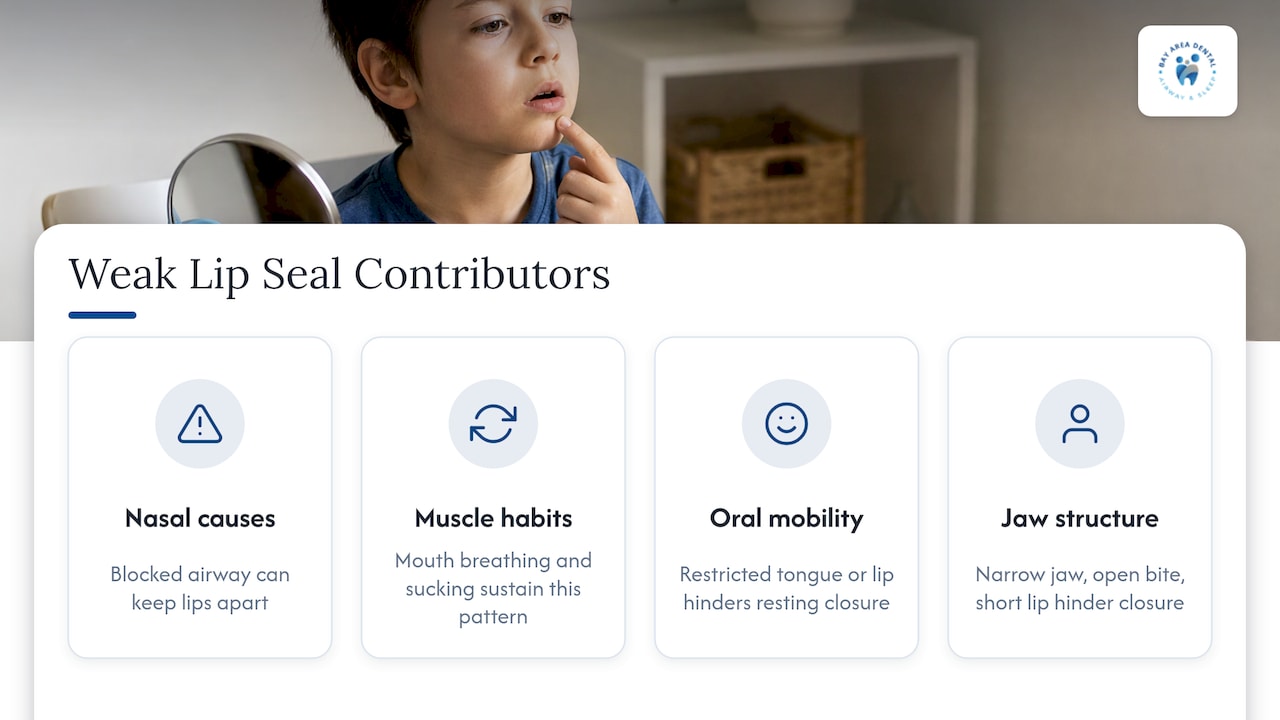
There is rarely one cause, which is why a one-size-fits-all exercise routine often disappoints. The common contributors fall into a few groups.
Nasal obstruction. When the nose is blocked by chronic congestion, allergies, enlarged tissue or a structural problem, the mouth takes over and the lips part. ASHA’s guidance is clear that exercises cannot reliably produce a closed-mouth posture while the airway stays obstructed. You can read more about this in our article on mouth breathing and sleep.
Habit and muscle patterns. Long-standing mouth breathing, thumb or finger sucking, prolonged pacifier use and a forward or low tongue posture can all keep the lips apart. Over time the muscles around the mouth settle into that pattern.
Tongue and lip mobility. A restricted tongue or lip can make a closed, relaxed resting posture harder to hold. If a tight tongue or lip tie is suspected, a functional exam is the way to find out. Our page on laser frenectomy for tongue and lip ties explains what that evaluation involves.
Jaw, bite and facial structure. A narrow upper jaw, an open bite or a short upper lip can make closing the lips at rest physically harder. The AAPD notes that the link between oral habits and unfavorable dental development is often associational, so a thorough clinical examination is needed to tell cause from coincidence.
This is why we look at the whole picture rather than the lips alone.
How lip incompetence is evaluated
An evaluation looks at how the face and mouth work together. According to ASHA, an SLP assesses symmetry, stability and movement of the lips, jaw and tongue and how those patterns affect breathing, talking and eating. The therapist may coordinate with dentists, orthodontists, ENTs and allergists.
In a dental airway setting, expect questions and checks like these:
- History. Snoring, restless sleep, daytime tiredness, allergies, frequent colds, thumb sucking, past tonsil or adenoid issues.
- Resting posture. Where the lips, tongue and jaw sit when you are not thinking about them.
- Breathing. Whether you can comfortably breathe through your nose with your lips closed.
- Bite and jaw. Tooth alignment, open bite, palate width, and how the teeth meet.
- Swallowing and speech. Tongue thrust, lisping or forward tongue movement.
- Imaging when needed. 3D imaging can show the airway and jaw structure in detail.
The result is a sequence: what to address first, who else should be involved, and what a realistic timeline looks like.
Lip incompetence treatment options, in the order they usually work
Treatment, as ASHA frames it, combines addressing structural airway issues, habit modification and myofunctional therapy. Here is how that tends to play out.
| Step | What it addresses | Who is typically involved |
|---|---|---|
| 1. Clear the nasal airway | Congestion, allergies, enlarged tissue, structural blockage | ENT, allergist, airway-focused dentist |
| 2. Address structure | Narrow palate, open bite, tongue or lip restriction | Dentist, orthodontist |
| 3. Modify habits | Thumb sucking, pacifier use, open-mouth habit | Dentist, therapist, family |
| 4. Retrain the muscles | Lip seal, tongue rest posture, swallowing, nasal breathing | Myofunctional therapist or SLP |
| 5. Maintain | Keep the new posture while awake and asleep | You, with periodic check-ins |
Skipping to step 4 is the most common reason people feel stuck. If the nose is not working, the lips will keep parting no matter how many reps you do.
When structure is part of the picture
For children, a narrow upper jaw can crowd the tongue and make nasal breathing harder. Palatal expansion and airway-friendly orthodontics can widen the space, and our guide to what orthodontics can and cannot fix in mouth breathing sets honest expectations. If your child gets an expander, a toothbrush suited to palate expanders makes daily cleaning around the hardware easier for caregivers.
Open bite is a related concern. We cover why acting early matters in preventing open bite in children.
When the tongue is the missing piece
A lip seal depends on the tongue resting up against the palate. If the tongue sits low or pushes forward, the lips often part. Our article on tongue thrust therapy covers the exercises and what results to expect.
Lip seal exercises: what is used and how to do them well
Exercises are the part most readers search for, and they do have a place once the airway is clear. ASHA lists approaches to build lip closure awareness, including holding a tongue depressor between the lips, using a lip gauge, alternating a wide smile with rounded lips, and lip resistance work.
Here is how those ideas translate into a routine you can discuss with your therapist:
- Lip hold. Gently hold a clean tongue depressor (or a similar flat, smooth object your therapist recommends) between closed lips for a short period, keeping the face relaxed and breathing through your nose.
- Smile and round. Alternate a wide closed smile with pursed, rounded lips, slowly, ten or so times.
- Resistance. Press the lips together against light resistance, as your therapist demonstrates, then release fully.
- Rest-posture check. Several times a day, notice: lips together, teeth slightly apart, tongue resting on the palate, nose breathing.
Tips for doing them safely and effectively:
- Keep sessions short and frequent rather than long and tiring.
- Stop if you feel jaw pain, clicking that is new, or chin and facial tension that builds. Tell your therapist or dentist.
- Do not force the lips closed all day. The goal is a relaxed seal, not a clenched one.
- For children, make it a game with a parent and keep it brief.
- If you have trouble breathing through your nose during the exercises, that is a signal to have the airway checked, not to push harder.
For more, see our clinician-vetted myofunctional exercises and our guide to tongue posture training.
How long it takes and what results to expect
No honest clinician can promise a timeline for everyone. What research says: a 2025 scoping review of orofacial myofunctional therapy found positive results in many studies, while noting that high-level evidence is still limited and that larger randomized trials with longer follow-up are needed.
In practice, that means:
- Progress depends on the cause. A person whose nose is now clear and who practices consistently often has a better runway than someone with an unaddressed blockage.
- Awareness comes first, then habit, then automatic posture, including during sleep.
- Children usually need parent involvement, and the habit pattern matters as much as the exercises.
- Re-evaluation at set intervals lets the plan change if something is not working.
If you are curious about cost, our overview of myofunctional therapy cost in California explains what to expect.
When to get a professional evaluation
Book an evaluation when you notice any of the following:
- A child who rests with the mouth open most of the time, especially with snoring, restless sleep or frequent congestion.
- An open bite, a narrow palate, or a persistent thumb or pacifier habit.
- Tongue thrust, lisping, or trouble swallowing normally.
- An adult with chronic dry mouth, jaw tension, or snoring along with a lips-apart posture.
For kids, timing matters. The AAPD says mouth breathing and similar habits should be identified and assessed as early as possible, with intervention started when the habit is tied to unfavorable dentofacial development. Our pediatric airway evaluation guide lays out four common outcomes, and our article on nasal breathing and jaw development explains why early matters. If your baby has feeding trouble, read about baby lip tie and feeding function.
Our perspective
We see lip incompetence as a clue, not a diagnosis. The lips are the visible part of a system that includes the nose, tongue, jaw, bite and sleep.
That is why we start by asking why the lips are apart. For some patients the answer is an airway issue that needs an ENT or allergist. For others it is a narrow palate, a tongue that cannot rest where it should, or a long-standing habit.
Our practice brings airway-focused dentistry, orthodontics, laser care and myofunctional therapy under one roof, so families do not have to piece the plan together alone. We use tools like 3D imaging to see what is happening, and we aim for minimally invasive solutions that keep children and adults comfortable.
We also tailor communication for our Deaf patients, so every explanation and exercise instruction is clear.
Our goal is a posture that holds on its own, day and night, because the underlying cause has been addressed.
Bay Area Dental, Airway & Sleep
Get an evaluation in Fremont
If your child or you have a persistent lips-apart posture, we can look at the whole picture: airway, tongue, bite and habits. Our team offers airway and sleep dentistry, pediatric dental care and myofunctional therapy at our Fremont, CA practice.
Visit Bay Area Dental, Airway & Sleep to learn more and request an appointment.
FAQ
Can lip incompetence be fixed with exercises alone?
Sometimes exercises are a major part of the plan, but not on their own. ASHA notes that exercises cannot consistently produce a closed-mouth posture if nasal breathing remains obstructed. The airway comes first, then retraining.
What is the difference between a weak lip seal and mouth breathing?
They overlap but are not identical. A weak lip seal describes the resting position of the lips. Mouth breathing describes how air moves. Many people have both, and both can trace back to a blocked nose, tongue posture or habit.
Is lip incompetence only a cosmetic concern?
No. It can be a sign of an orofacial myofunctional disorder, and in children it may be linked to bite and jaw development. A clinical exam is how you tell whether it matters in your case.
Who should I see first?
A dentist who understands airway and myofunctional issues is a good starting point, because they can coordinate with an ENT, allergist, orthodontist or myofunctional therapist. ASHA notes that SLPs collaborate with these professionals.
At what age should a child be checked?
As early as you notice a habit. Our guide to the first dental visit and airway red flags recommends starting by age one.
Sources
- Orofacial Myofunctional Disorders (ASHA Practice Portal)
- Open bite: a review of etiology and management (AAPD)
- Dentition and Occlusion in Pediatric Dentistry (AAPD)
- Effectiveness of orofacial myofunctional therapy (CDHA scoping review, 2025)