


You wake up tired every day, your sleep study looks fine, and no one can explain why. Upper Airway Resistance Syndrome causes daytime fatigue, unrefreshing sleep, snoring, morning headaches, and trouble concentrating, driven by repeated breathing effort and brief arousals that fragment sleep even when oxygen levels stay near normal. If these symptoms persist, a clinical sleep evaluation is the next right step.
TL;DR:
- A normal sleep study may not detect UARS, which features breathing effort and arousals without oxygen desaturation, causing significant daytime symptoms.
- In-lab polysomnography with nasal-pressure airflow and arousal scoring is essential for accurate UARS diagnosis, as home tests often miss key flow limitation events.
- UARS symptoms often cluster around nighttime effortful breathing and daytime fatigue, with some individuals exhibiting related issues like jaw tension or reflux.
- Treatment begins with addressing nasal congestion, positional therapy, and oral appliances, but requires ongoing adjustment due to limited UARS-specific evidence.
- Persistent symptoms despite normal tests warrant a multidisciplinary reevaluation, as UARS can be masked by normal oxygen levels and low apnea indices.
Table of Contents
- What UARS symptoms look like at night and during the day
- How doctors evaluate UARS and what the tests actually show
- Why UARS looks different from obstructive sleep apnea on paper
- Treatment options and how clinicians choose among them
- Getting ready for a sleep evaluation and knowing the warning signs
- How airway-focused dental care fits into UARS management
- Why persistent symptoms deserve a second look
- How Bay Area Dental, Airway & Sleep supports airway evaluation
- Sources
- FAQ
What UARS symptoms look like at night and during the day
UARS symptoms split into two clusters: what happens while you sleep and what you feel the next day. Both matter, because the nighttime events are often invisible to the person experiencing them and only show up in how the day unfolds.
At night, the airway narrows enough to force extra breathing effort without fully collapsing. This produces snoring, restless tossing, and brief awakenings that rarely involve gasping or choking, just a subtle shift toward lighter sleep. Bed partners often describe hearing labored breathing or noticing frequent position changes, even when the sleeper has no memory of waking.
During the day, the effects show up as a specific pattern:
- Persistent fatigue and excessive daytime sleepiness despite what feels like enough hours in bed
- Unrefreshing sleep, the sensation of waking up as tired as when you lay down
- Morning headaches that fade within an hour or two of waking
- Brain fog, memory lapses, and difficulty concentrating at work or school
- Irritability, anxiety, or mood swings that seem disconnected from daily stress
Beyond these core signs, UARS often travels with a set of complaints that seem unrelated to sleep at first glance: jaw tension or clenching, heartburn or reflux, needing to urinate multiple times overnight, and lightheadedness when standing up quickly. Stanford Health Care lists effortful breathing, frequent awakenings, and mood changes among the recognized features, noting that the underlying mechanism is increased breathing effort rather than the deep oxygen drops typical of more severe apnea.
Sleep specialists note that respiratory-effort-related arousals, or RERAs, can fragment sleep enough to cause daytime impairment even when no measurable drop in oxygen ever occurs. That single fact explains why so many people with UARS look completely normal on a basic overnight oximeter reading while feeling like they haven’t slept in days.
One pattern clinicians watch for is timing: arousals and awakenings that cluster two to three hours after sleep onset, coinciding with deeper sleep stages when airway muscles relax further. Symptom severity often seems out of proportion to what a basic sleep report shows, which is part of why UARS gets missed or misdiagnosed.
This overlap creates real diagnostic confusion. Fatigue, poor concentration, and mood changes look a lot like generalized anxiety, depression, or even irritable bowel syndrome, especially when the GI symptoms and lightheadedness get evaluated separately from the sleep complaints. Patients sometimes cycle through several specialists before anyone connects the pattern back to breathing during sleep.
How doctors evaluate UARS and what the tests actually show
Evaluation starts with a conversation, not a machine. A detailed sleep history, ideally supported by a sleep diary and observations from a bed partner, helps a clinician map out snoring patterns, awakenings, and daytime symptoms over time. A focused airway exam checks for nasal obstruction, a deviated septum, enlarged tonsils, or craniofacial features that narrow the upper airway.
From there, testing typically follows a sequence:
- Review sleep history and physical exam findings, including nasal breathing and jaw or palate structure.
- Order attended, in-lab polysomnography rather than a basic home test whenever UARS is suspected.
- Confirm the study includes nasal-pressure airflow monitoring and formal arousal scoring, not just an oxygen sensor.
- Discuss esophageal manometry only if standard testing is inconclusive and specialty referral is available, since it directly measures breathing effort but is invasive and rarely used outside research settings.
Attended polysomnography is considered the standard test when sleep-disordered breathing is suspected, and it needs to capture airflow limitation, respiratory effort, arousals, oxygen saturation, and RERAs together, since any one measurement alone can miss the picture. Research definitions commonly used for UARS include an Apnea-Hypopnea Index under 5, a RERA index of 5 or more events per hour, and minimum oxygen saturation generally at or above 92%, though no single diagnostic standard is universally agreed upon across sleep centers.
Home sleep apnea tests, the kind mailed to your house or picked up at a pharmacy, are built to detect oxygen desaturation and airflow stoppages associated with moderate to severe OSA. They generally do not measure sleep stages or score arousals, which means they can miss the flow limitation and RERAs that define UARS entirely. A negative home test does not rule out UARS if your symptoms persist.
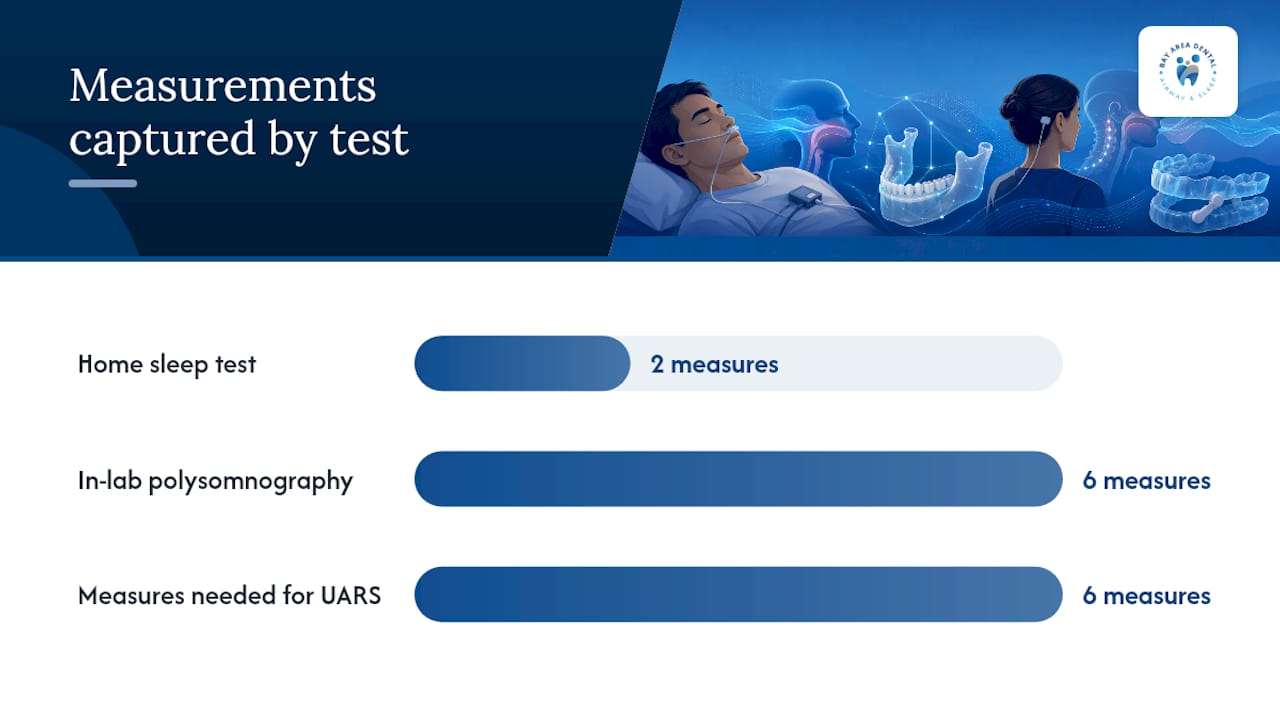
Pro Tip: If a home sleep test comes back normal but your symptoms haven’t improved, ask your doctor specifically for in-lab polysomnography with nasal-pressure flow monitoring and RERA scoring, not just a repeat of the same type of test.
Why UARS looks different from obstructive sleep apnea on paper
The clearest way to understand UARS is to look at what the numbers do and don’t capture. Obstructive sleep apnea is defined by repeated airway collapse producing measurable drops in oxygen and a higher Apnea-Hypopnea Index. UARS involves airway narrowing severe enough to increase breathing effort and trigger arousals, but not always enough to register as an apnea or hypopnea event or to drop oxygen saturation significantly.
- OSA: elevated AHI, frequent oxygen desaturation events, often diagnosed at higher body weights.
- UARS: low or normal AHI, RERAs and flow limitation instead of desaturation, frequently seen in people with a narrower airway and lower body mass index.
- Symptom overlap: fatigue, concentration problems, and unrefreshing sleep can be just as severe in UARS as in OSA, even when the AHI looks unremarkable.
- Clinical impact: a standard sleep report showing “normal” oxygen and a low AHI can still hide clinically significant sleep-disordered breathing.
Consider a patient in their thirties with a lean build, chronic fatigue, and morning headaches whose home sleep test shows an AHI of 2 and no meaningful desaturation. On paper, that looks reassuring. An in-lab study with nasal-pressure flow monitoring, however, reveals a RERA index above 10, explaining the fragmented sleep that oxygen numbers alone never showed.
Treatment options and how clinicians choose among them
Treatment usually starts with the least invasive options and escalates based on anatomy, tolerance, and how well symptoms respond. Nasal obstruction and allergies get addressed first, since something as simple as chronic congestion can meaningfully worsen airway resistance during sleep. Positional therapy, avoiding sleeping flat on your back, and consistent sleep hygiene often round out the first line of management.
- Nasal and allergy care: treating congestion, deviated septum issues, or chronic rhinitis to reduce airway resistance.
- Positional therapy: side-sleeping strategies or wedge pillows to prevent airway narrowing.
- Positive airway pressure (PAP): can reduce RERAs and effort-related arousals, though tolerance varies and some patients find pressure settings tuned for OSA less comfortable for UARS-driven symptoms.
- Oral appliance therapy and palatal expansion: dental devices that reposition the jaw or widen the palate to open the airway during sleep.
- Myofunctional therapy: exercises targeting tongue and airway muscle function, used alongside other treatments rather than alone.
- Surgery: reserved for cases with a clearly identified anatomic obstruction, such as significantly enlarged tonsils, and typically considered after conservative options are exhausted.
A 2015 review of UARS treatment evidence found the research base specific to UARS considerably smaller than what exists for typical OSA, and it called for larger trials before any single approach could be considered clearly superior. Oral appliance efficacy, in particular, was not yet firmly established in that literature. That doesn’t mean these treatments don’t help individual patients, it means outcomes need to be tracked and adjusted rather than assumed.
Pro Tip: Ask whichever clinician manages your treatment to document your symptom response over time, not just a single follow-up visit, since UARS treatment often needs adjustment based on how you actually feel.
Because the evidence base is thinner than for OSA, treatment selection depends heavily on your specific anatomy and documented physiology rather than a one-size-fits-all protocol. A patient with a clearly narrow palate benefits from a different plan than one whose main issue is nasal obstruction.
Getting ready for a sleep evaluation and knowing the warning signs
Walking into an appointment prepared makes a real difference. Bring a two-week sleep diary noting bedtime, estimated awakenings, and how rested you feel each morning, along with any observations your partner has made about snoring or breathing pauses.
- Track sleep and wake times, number of awakenings, and a simple daytime sleepiness rating from 1 to 10 for at least two weeks.
- Write down specific daytime symptoms: headaches, brain fog, mood changes, and when they tend to hit hardest.
- Ask directly for in-lab polysomnography with nasal-pressure airflow monitoring and arousal scoring if a home test has already come back normal.
- Mention any jaw tension, reflux, or nighttime urinary frequency, since these details help connect the full symptom picture.
If daytime sleepiness ever puts you at risk behind the wheel or operating machinery, treat that as urgent and avoid driving until it’s addressed. Persistent, worsening symptoms deserve a prompt clinical evaluation rather than a wait-and-see approach.
How airway-focused dental care fits into UARS management
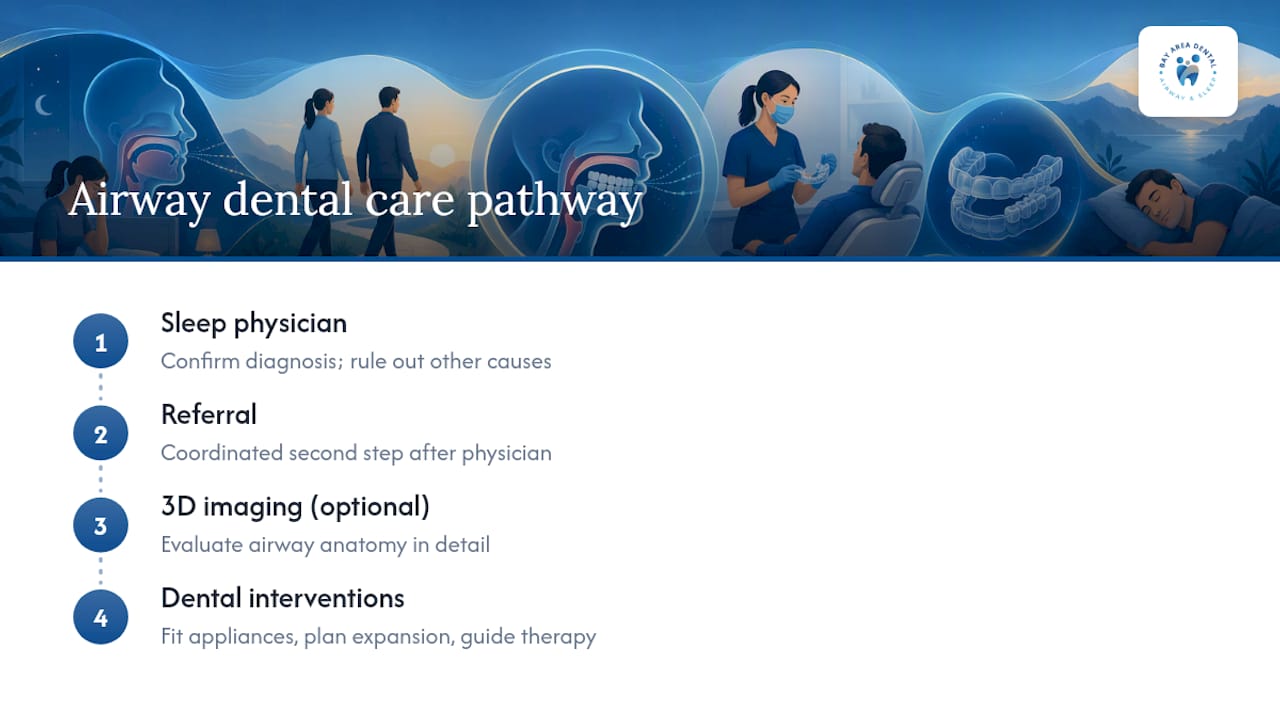
Dental airway specialists play a specific role once sleep-medicine testing confirms a diagnosis: fitting oral appliances, planning palatal expansion, and guiding myofunctional therapy to support airway muscle function. Some dental practices offer airway therapies alongside 3D imaging to evaluate airway anatomy in detail. Dental airway care works best as a coordinated second step, after a sleep physician has confirmed the diagnosis and ruled out other causes of your symptoms.
Why persistent symptoms deserve a second look
Patients with a low AHI and heavy symptom burden get dismissed too often, simply because a basic report looks reassuring. Careful, multidisciplinary evaluation catches what a single number misses. If your test looks normal but you don’t feel normal, say so clearly and ask what else can be measured.
— Admin
How Bay Area Dental, Airway & Sleep supports airway evaluation
If breathing effort during sleep is part of your picture, an airway-focused dental evaluation can work alongside your sleep physician’s findings rather than in place of them. Oral Appliance Therapy (OAT), myofunctional therapy, and palatal expansion are airway therapies sometimes supported by 3D imaging to map airway anatomy before recommending a path forward.
- Good fit: patients who already have a sleep-medicine diagnosis and want to explore oral-appliance or airway-structural options.
- First visit: an assessment of jaw and airway anatomy, possible 3D imaging, and discussion of how findings coordinate with your sleep physician.
- Ongoing care: follow-up to track how your symptoms respond once an appliance or therapy plan is in place.
| Service | What it addresses |
|---|---|
| Oral Appliance Therapy (OAT) | Repositions the jaw to reduce airway resistance during sleep |
| Palatal Expansion | Widens a narrow palate contributing to airway restriction |
| Myofunctional Therapy | Trains tongue and airway muscle function |
A 2015 review found UARS-specific treatment evidence remains limited, which is why individualized, monitored care matters more than any single fixed protocol.
Visit the sleep and airway therapy page to see current options or book an evaluation directly.
Sources
- Symptoms of Upper Airway Resistance Syndrome | Stanford Health Care
- Upper Airway Resistance Syndrome – StatPearls (NCBI Bookshelf)
- Guidelines and commentary supporting polysomnography and evaluation standards (PMC article)
This article is general information, not a substitute for advice from a qualified doctor. Consult a qualified healthcare professional about your own circumstances before acting on anything here.
FAQ
Can UARS be cured?
There is no single cure, but symptoms often improve significantly with the right combination of nasal treatment, positional changes, oral appliance therapy, or PAP, chosen based on your specific anatomy. Because the treatment evidence base for UARS is still developing, management usually means ongoing adjustment rather than a one-time fix.
How do I know if I have UARS?
The clearest signs are unrefreshing sleep, daytime fatigue, morning headaches, and trouble concentrating despite a seemingly normal sleep study, especially when a home sleep test shows a low Apnea-Hypopnea Index. Confirming UARS generally requires in-lab polysomnography with nasal-pressure airflow monitoring and arousal scoring, since home tests often miss the RERAs that define the condition.
What is the best position to sleep for sleep apnea?
Side-sleeping is generally recommended over sleeping flat on your back, since back-sleeping allows the tongue and soft tissue to fall backward and narrow the airway further. Positional therapy is one of several first-line, low-risk measures used alongside nasal and allergy treatment for both UARS and obstructive sleep apnea.
Is UARS worse than sleep apnea?
Neither condition is uniformly worse, they cause different patterns of disruption. Research comparing the two suggests symptom burden, including fatigue and cognitive complaints, does not always track with oxygen-based severity scores, meaning someone with UARS and a low AHI can feel just as impaired as someone with more measurable OSA.