

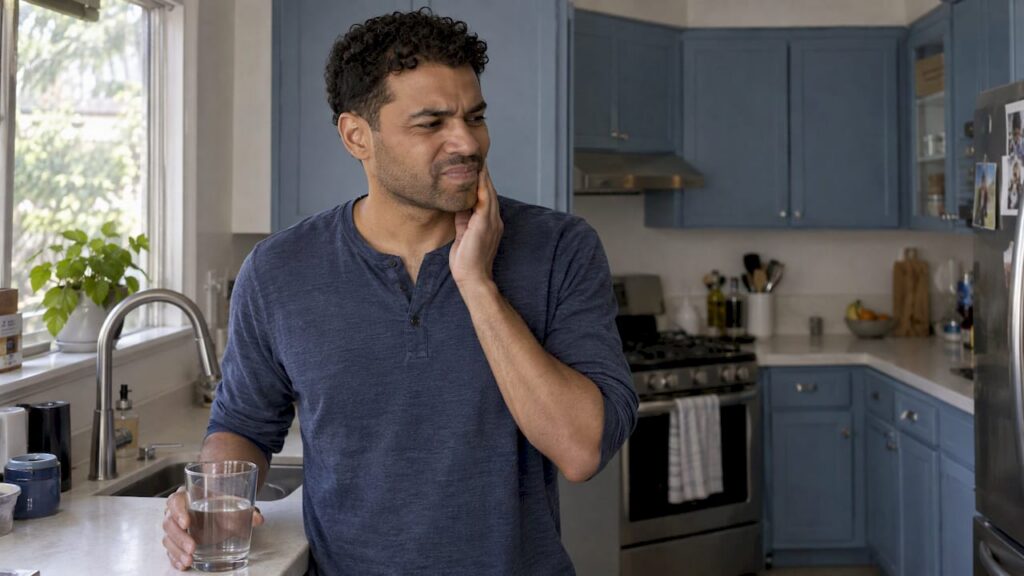
Some sensitivity after a filling is normal and fades on its own in a week or two. Pain that gets worse, pain when you bite, or a bite that feels uneven is not normal, and it usually has a simple fix: your dentist reshapes the filling. This guide helps you sort out which one you have, what to do at home in the meantime, and when to pick up the phone. If you’re in Fremont, Union City or the wider Bay Area, our general and restorative dentistry team can check a filling that doesn’t feel right.
TL;DR
- Brief sensitivity to cold, air or pressure after a filling is common. Cleveland Clinic says it should go away in a week or two.
- Sensitivity that eases a little each day is a good sign. Pain that stays the same or grows is a reason to call.
- Pain only when you bite, or a bite that feels uneven, often means the filling sits a bit too high. A quick reshaping usually solves it.
- Lingering hot or cold pain, throbbing, swelling or fever needs prompt attention from a dentist.
- Desensitizing toothpaste and gentle habits can make the first days more comfortable.
Table of Contents
- Why a Filled Tooth Can Feel Sensitive
- How Long Sensitivity Lasts
- Mild Sensitivity or a Nerve Problem?
- Signs Your Filling Is Too High
- What You Can Do at Home While It Settles
- When to Call the Dentist
- What a Dentist Does About It
- Our Perspective
- Get a Filling Checked in Fremont
- FAQ
- Sources
Why a Filled Tooth Can Feel Sensitive
A filling replaces decayed tooth structure. To place it, the dentist removes the decay, cleans the cavity and seals it with filling material. Every one of those steps works close to the tooth’s nerve, which lives in the soft center of the tooth called the pulp. The tooth responds the way any irritated tissue does: it gets inflamed and reacts more strongly than usual to cold, sweets, air and pressure.
A 2026 peer-reviewed review of dentin hypersensitivity explains the mechanism. Sensitivity needs two things at once: exposed dentin (the layer under the enamel) and open microscopic channels in that dentin that let fluid move. When fluid shifts, the nerve fires and you feel a quick zing. Drilling, air, temperature swings and the filling material itself can all disturb that fluid.
Common reasons a filled tooth reacts:
- Pulp irritation. The nerve is inflamed from the decay itself and from the work to remove it. Deeper cavities, closer to the nerve, tend to mean more reaction.
- Exposed dentin. Until the tooth settles, the surface under the filling can be more reactive to cold and sweets.
- A bite that is slightly off. If the filling stands a little above the surrounding teeth, that tooth takes more force every time you chew or clench. Cleveland Clinic lists this as one cause of pain when biting after a filling, fixed by reshaping the filling.
- Material and metal contact. Some people feel a brief jolt when a filling touches another metal restoration. Filling type can also change how a tooth feels in the first days. We compare materials in our guide to composite versus amalgam fillings.
- A problem that was already there. A tooth that was already inflamed before treatment, or one with a crack, can keep hurting after the cavity is filled.
How Long Sensitivity Lasts
For a routine filling, expect sensitivity to fade within one to two weeks. Cleveland Clinic describes minor sensitivity and gum soreness after a filling as temporary, going away in a week or two. A deeper filling, where the cavity was close to the nerve, may take longer to quiet down.
The pattern matters more than the exact day count. Use this as a rough guide:
| What you notice | Usually means | What to do |
|---|---|---|
| Short zing to cold or air that fades a little each day | Normal healing | Gentle care, wait, watch |
| Sensitivity to sweets or cold that stops within seconds | Mild, reversible irritation | Wait, use desensitizing toothpaste |
| Pain only when you bite or clench | Filling may be high | Call for a bite check |
| Bite feels uneven or your jaw feels tired | Filling may be high | Call for a bite check |
| Pain lingers well after hot or cold is gone, or throbs on its own | Nerve may be more inflamed | Call your dentist promptly |
| Swelling, fever, severe pain medication does not touch | Possible infection | Call right away |
If the sensitivity is not getting better after two weeks, don’t wait for a third. A short visit now is easier than a bigger problem later.
Mild Sensitivity or a Nerve Problem?
Dentists describe nerve inflammation as pulpitis, and they split it into two kinds. The difference is practical because it tells you whether a simple filling is enough.
In reversible pulpitis, the nerve is irritated but can heal. Cleveland Clinic describes it this way: no pain when the tooth is tapped, no sensitivity to heat, and a reaction to cold or sweets that goes away quickly. The Merck Manual puts a number on it: pain stops within about one to two seconds after the trigger is removed. Treatment is removing the decay and sealing the tooth with a standard filling, which is exactly the care you just had.
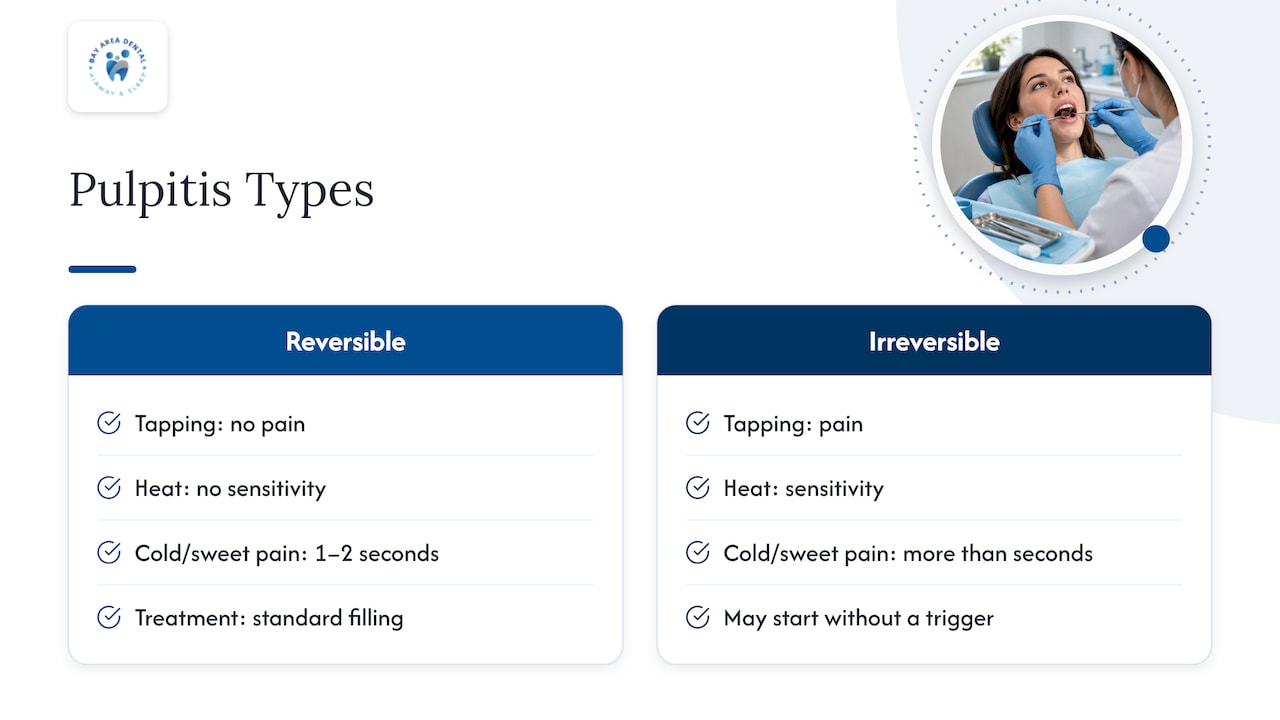
In irreversible pulpitis, the nerve is too inflamed to recover. Pain shows up when the tooth is tapped, and sensitivity to heat, cold or sweets lasts more than a few seconds, often as a throbbing or aching. The Merck Manual adds that the pain may start on its own or linger for minutes after the stimulus is gone, usually heat. This is treated with root canal therapy, or in some cases extraction, per Cleveland Clinic.
The simple test to apply to yourself: how long does the pain last after the cold or hot thing is gone? A second or two is reassuring. Many seconds, minutes, or pain with no trigger at all is a signal to be seen soon. Only an exam and X-ray can tell you which situation you’re in, so use this as a guide for when to call, not a way to diagnose yourself.
Signs Your Filling Is Too High
A “high” filling is one that sits a hair above the natural height of the tooth. You may not see it, but your bite will notice. Numbness can hide the problem on the day of the appointment, so symptoms often show up once the anesthetic wears off, or the next day when you chew normally.
Typical signs:
- The bite feels uneven, as if one tooth hits first.
- Sharp or aching pain when you close your teeth together or chew.
- Pain that is worse biting down than with cold or heat.
- A sore, bruised feeling in the tooth, sometimes with jaw tiredness or a mild headache.
- Food seems to press on that tooth in a way the others don’t.
The tooth is taking more load than the teeth around it, so it gets sore, much like a bruise from repeated pressure. The good news: this is one of the easiest post-filling problems to correct. The dentist checks the bite with marking paper, finds the spot that contacts too soon, and smooths it down. Cleveland Clinic notes that reshaping the filling resolves pain caused by the filling interfering with your bite.
Don’t try to wear it down by chewing hard on it, and never file it yourself. A high spot left alone keeps overloading the tooth, and a tooth under constant extra force can become sore for longer than it should.
What Bite Adjustment Involves
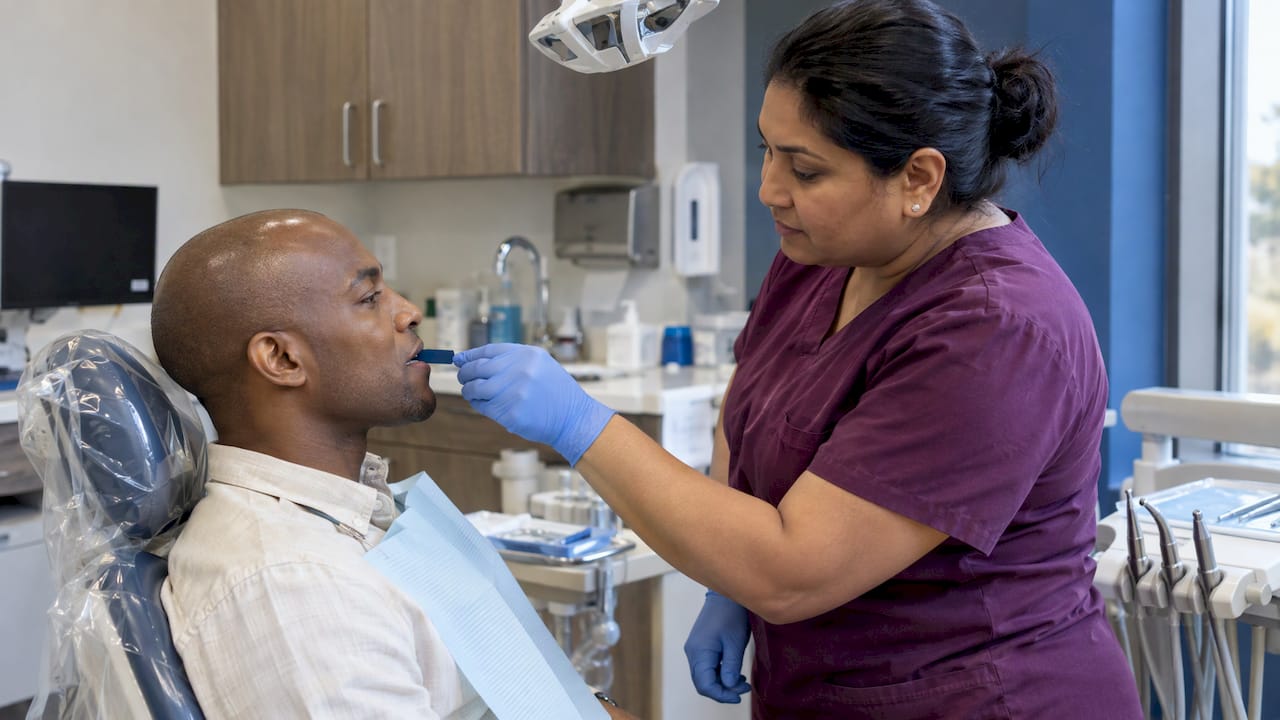
It is usually a short appointment. You’ll bite on thin colored paper that leaves marks where teeth touch, and the dentist polishes away only the marked high point until your teeth meet evenly. If you’ve been feeling that your bite is off in more places than one filling, a broader check may help. We explain that process in our guide to bite equilibration.
If the discomfort is a sharp pain when you release the bite, rather than when you press, or a fillings-and-chewing pain that comes and goes, a hairline crack can be the cause. Our page on cracked tooth symptoms describes what that feels like.
What You Can Do at Home While It Settles
Most sensitivity responds to a few small changes. These are for normal, mild sensitivity, not for pain that is worsening or that comes with swelling.
- Use a desensitizing toothpaste. These work in two ways, per the 2026 dentin hypersensitivity review: some plug the open tubules (stannous fluoride, strontium salts, calcium phosphates, arginine), and potassium nitrate calms the nerve’s response. The review found potassium nitrate, stannous fluoride, NovaMin and arginine gave strong clinical results. A 2023 systematic review of 20 randomized trials found calcium phosphate products reduced hypersensitivity pain, with an estimated drop of about 2.5 points on a 10-point pain scale after four weeks. Brush with it twice a day, and give it time: these products build up their effect over days and weeks, not minutes.
- Switch to a soft brush and brush gently. Aggressive scrubbing near the gumline makes sensitive teeth worse.
- Avoid temperature extremes. Skip ice water and piping hot coffee for a few days. Let drinks sit at a moderate temperature.
- Chew on the other side. Give the filled tooth a break until it calms down, and avoid very hard or sticky foods.
- Go easy on sweets and acidic drinks. They are common triggers for a reactive tooth.
- Mind clenching and grinding. If you notice yourself clenching, try to keep your teeth slightly apart during the day. Clenching puts extra load on a freshly filled tooth.
If you want an over-the-counter pain reliever, follow the label directions and your own doctor’s or pharmacist’s guidance, especially if you take other medications or have a health condition.
When to Call the Dentist
Call during office hours, ideally within a day or two, if:
- Your bite still feels uneven two or three days after the numbness has worn off.
- Biting on the tooth hurts.
- Sensitivity is not improving after one to two weeks.
- Cold or hot pain lingers after the trigger is gone.
- The tooth throbs or aches on its own, or wakes you at night.
Call right away, and do not wait for a routine slot, if you have any of the signs Cleveland Clinic flags as urgent: a filling that breaks, severe pain that medication does not relieve, a swollen face or jaw, or fever, chills or other signs of infection. Swelling in the face or trouble breathing or swallowing is an emergency: go to an emergency room.
What a Dentist Does About It
The fix depends on the cause, and a proper exam sorts it out quickly.
- A high filling: the dentist reshapes it so the bite is even. Relief is often fast.
- Mild nerve irritation: often nothing more than time and a desensitizing routine. In-office options exist for stubborn cases, including occlusive treatments, laser therapy and iontophoresis, according to the 2026 review.
- A filling that has not sealed well or has broken: it is repaired or replaced.
- Nerve inflammation that will not heal: root canal therapy, or extraction in some cases, as described by Cleveland Clinic.
Notice how much of this depends on a careful diagnosis rather than guessing. 3D imaging, which we use in our practice, lets us look at a tooth and the structures around it in detail, which helps when the cause of the pain isn’t obvious from a surface exam.
Our Perspective
Most of the post-filling calls we would want to hear about are the ones that start with “it’s probably nothing.” Sometimes that is true, and a week of patience is all a tooth needs. But a bite that feels off, or a tooth that hurts when you chew, is not something to tough out. It is a mechanical problem with a mechanical fix.
We practice dentistry with the whole person in mind. A tooth that keeps hurting after treatment is not just a tooth: it can be a bite that is overloading one spot, a habit like clenching or grinding, or even how a person breathes and sleeps at night. That is why we look at the root cause rather than simply treating the symptom.
We favor minimally invasive care, and we use technology such as 3D imaging and lasers to keep treatment gentle and precise. If a filling does not feel right, tell us. We would rather adjust it in a short visit than have you live with a sore tooth for weeks. And if you are Deaf or hard of hearing, we tailor how we communicate so you can describe exactly what you feel and understand exactly what we find.
Bay Area Dental, Airway & Sleep
Get a Filling Checked in Fremont
If your filled tooth is not settling, or the bite feels wrong, we can look at it, check how your teeth come together, and tell you whether it needs a small adjustment, a little more time, or further treatment. Our restorative and general dentistry services cover fillings, bite concerns and emergency dental needs for children and adults.

You can see everything we treat on our general dentistry page, or start from our home page to book a visit.
FAQ
How long should a tooth be sensitive after a filling?
Usually one to two weeks. Cleveland Clinic says minor sensitivity after a filling should go away in a week or two. It should get a little better every few days. If it is flat or getting worse, call your dentist.
Why does my tooth hurt only when I bite after a filling?
The filling may be sitting slightly too high, so that tooth hits first and takes extra force. This is a common and easily fixed cause. The dentist checks your bite and reshapes the filling, often in a short visit.
Can a high filling fix itself?
Don’t count on it. A filling that is noticeably high keeps overloading the tooth, and the soreness tends to continue rather than fade. If your bite still feels uneven a few days after the numbness is gone, have it adjusted instead of waiting.
Is sensitivity to cold normal after a filling, even weeks later?
A brief zing to cold that fades in a second or two is typical of mild, reversible irritation, according to the Merck Manual. If it lasts longer than that, or you feel lingering pain after hot or cold, have the tooth examined.
What helps tooth sensitivity after a filling?
A desensitizing toothpaste with ingredients such as potassium nitrate, stannous fluoride or arginine, a soft brush, and avoiding very hot, cold or sugary things for a few days. See your dentist if the pain is severe, throbbing, or comes with swelling or fever.
Sources
- Dental Fillings: Types, Materials & What They’re For, Cleveland Clinic
- Pulpitis: Types, Symptoms & Treatment, Cleveland Clinic
- Pulpitis, Merck Manual Professional Edition
- Dentin hypersensitivity, an enigma revisited: Mechanisms (PMC)
- The Effectiveness of Calcium Phosphates in the Treatment of Dentin Hypersensitivity (MDPI)