

Most people think of tongue tie as an infant issue, something caught in the first weeks of nursing. But plenty of adults live for years with an undiagnosed tongue tie, quietly working around it without ever connecting it to the symptoms it causes. If you have wondered whether an adult tongue tie could be behind your jaw tension, poor sleep, or effortful speech, this guide explains what to look for and what can be done.
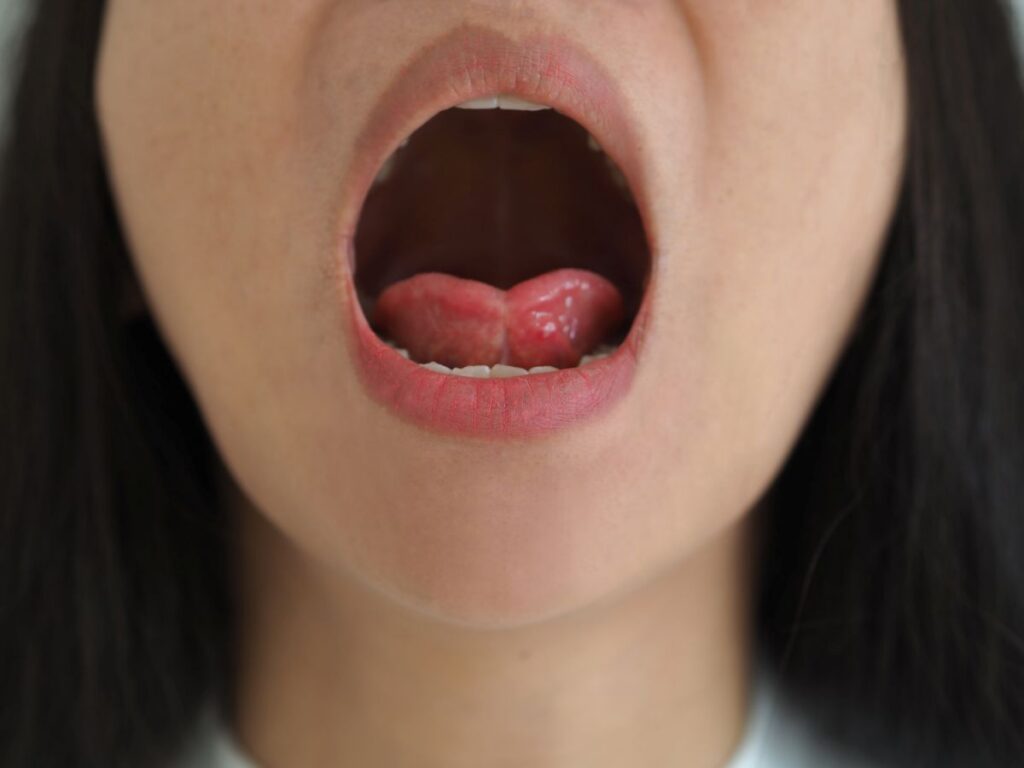
Can adults have a tongue tie?
Yes. A tongue tie in adults is the same restriction seen in children: a lingual frenulum, the band of tissue under the tongue, that is too short or tight and limits how far the tongue can lift, extend, or move. It does not go away on its own. Many adults simply adapted to it early and never realized their tongue was not moving normally. The same is true of an adult lip tie, where the upper lip is tethered tightly to the gums.
Adult tongue tie symptoms you might not connect to a tie
Because adults compensate so well, the signs often show up as seemingly unrelated problems. A tongue tie may contribute to any of the following, though none of them prove a tie on their own, which is why an evaluation matters.
Speech and tongue movement
Certain sounds feel effortful, speech tires you out, or you cannot lift your tongue to the roof of your mouth or sweep it across your teeth easily.
Eating and swallowing
Trouble clearing food from your teeth, difficulty licking your lips, or a swallowing pattern that pushes the tongue forward.
Jaw, neck, and head tension
Chronic jaw tightness, clenching or grinding, and neck or shoulder tension can all trace back to a tongue that cannot rest properly against the palate.
Sleep and breathing
When the tongue cannot rest on the roof of the mouth, it can fall back during sleep, contributing to mouth breathing, snoring, and disrupted rest. This is why we assess ties alongside our sleep and breathing care.
Teeth shifting after braces
If your teeth drifted back out of alignment after orthodontic treatment, a tongue tie may be part of the reason, since improper tongue posture keeps pressing on the teeth.
Why so many adults are diagnosed late
A tongue tie is easy to miss. Adults are rarely screened for it, the restriction can sit deeper and out of sight (a posterior tongue tie), and the symptoms overlap with so many other conditions that a tie is seldom the first suspect. Many of our adult patients only discovered the connection after years of treating the symptoms without lasting relief.
How we evaluate adult ties
From infancy through adulthood, we use detailed, function-focused evaluations to identify ties and their impacts. For adults, that means a thorough assessment that connects the tie to your specific symptoms rather than judging by appearance alone. We look at how your tongue actually moves, rests, and functions, and how that ties into your bite, jaw, and airway. If a restriction is not the cause of your symptoms, we will tell you.
Treatment for adult tongue tie
When a release is warranted, we perform a gentle laser frenectomy that seals tissue as it works, so most adults experience minimal bleeding and a quick recovery. For adults especially, the release is only half the picture. Because the tongue has moved a certain way for decades, we pair treatment with myofunctional therapy to retrain tongue posture, swallowing, and breathing, which is what produces lasting results. You can read more about our approach on our tongue and lip tie treatment page.
What recovery is like for adults
Most adults return to normal activity the same day, with mild soreness for a few days that eases with simple care. The post-release exercises are important for adults, since they help the tongue learn its new range of motion and prevent the tissue from reattaching.
When to seek an evaluation
If long-standing jaw tension, snoring, effortful speech, or teeth that shifted after braces sound familiar, an evaluation is the fastest way to find out whether a tongue tie is involved. Our Fremont practice sees adults from across the East Bay and Peninsula, including Newark, Union City, Hayward, San Leandro, Pleasanton, San Jose, and Palo Alto. You can request an evaluation or call our office at 510.651.8479.
Frequently asked questions
Is it too late to treat a tongue tie as an adult?
No. There is no age limit. Adults often see meaningful improvement in comfort, sleep, and tongue function after a release, especially when it is paired with myofunctional therapy.
Does an adult tongue tie release hurt?
Most adults report minimal discomfort. The laser is precise and gentle, the appointment is short, and soreness afterward is usually mild and short-lived.
Can treating a tongue tie help my jaw tension or sleep?
It can. When the tongue can finally rest against the palate, many adults notice less jaw and neck tension and improved breathing during sleep. Results vary, which is why we start with an evaluation of your specific symptoms.
Will I need myofunctional therapy too?
Often, yes. For adults, retraining the muscles is what turns a release into a lasting change, so we usually recommend myofunctional therapy alongside treatment.
How do I know if I have an adult tongue tie?
The clearest way is a hands-on evaluation. If you cannot lift your tongue to the roof of your mouth, struggle to clear food, or have unexplained jaw tension or snoring, those are reasons to have it checked.