

Professional in-office bleaching, dentist-supplied take-home trays, and peroxide-based OTC kits are the three approaches that reliably whiten teeth, and each trades speed, cost, and risk differently. In-office treatment moves fastest but costs the most. Take-home trays land in the middle. OTC strips and gels cost the least but ask for weeks of patience. If you have fillings, crowns, cavities, or gum disease, talk to a dentist before starting any of them.
TL;DR:
- OTC whitening strips typically provide 1 to 3 shades of improvement over one to four weeks, but only offer subtle results compared to professional treatments.
- Custom-fitted take-home trays can produce larger shade gains within one to two weeks and are more effective for moderate stains than OTC options.
- In-office bleaching offers immediate, dramatic results in a single session, but at a higher cost and with increased sensitivity risk, especially for sensitive teeth.
- Acidic or abrasive DIY remedies like lemon juice or charcoal pose a significant risk of enamel erosion and should be avoided.
- A prior dental exam is crucial to evaluate stain type, restorations, and oral health to select a safe, effective whitening method tailored to individual conditions.
Table of Contents
- Teeth Whitening Options Explained: How Each Method Works
- Comparing Cost, Speed, and Stain Type Across Methods
- How Fast You’ll See Results and How Long They Last
- Is Teeth Whitening Safe? Side Effects and DIY Risks
- How to Choose the Right Whitening Option for You
- Why Professional Supervision Changes Whitening Outcomes
- The Real Trade-Off Nobody Talks About Enough
- Ready for a Supervised Whitening Consultation?
- Sources
- FAQ
Teeth Whitening Options Explained: How Each Method Works
Every whitening method falls into one of two camps: it either bleaches the tooth structure itself, or it just scrubs off surface stain. That distinction explains almost everything about why some products work in days and others barely move the needle.
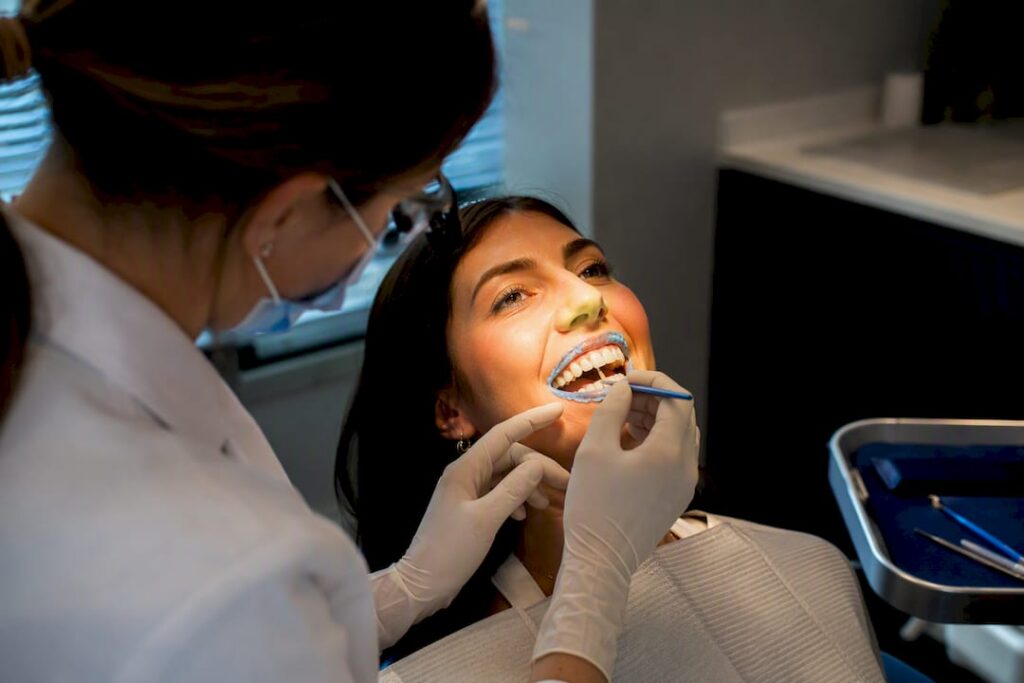
In-office professional bleaching uses hydrogen peroxide concentrations far higher than anything sold over the counter, sometimes 25 to 40%. Your dentist isolates your gums with a protective barrier or gel first, then applies the bleaching agent directly to your teeth for a series of short intervals during one visit. Because a professional controls concentration and contact time, results show up immediately, often several shades lighter by the time you leave the chair.
Dentist-supplied take-home trays split the difference between clinical strength and convenience. Your dentist takes an impression of your teeth, fabricates a custom-fitted tray, and sends you home with carbamide peroxide or hydrogen peroxide gel, typically in the 10 to 22% range for carbamide peroxide. Some patients wear the trays for 30 to 60 minutes during the day; others use a lower-concentration overnight formula. The custom fit matters more than people realize. A loose or generic tray lets gel leak onto your gums, which is a common cause of irritation.
OTC whitening strips and gels are the version most people try first. According to WebMD, these products typically lighten teeth by about 1 to 3 shades, which is real improvement but nowhere near what a dental chair delivers in a single session.
Whitening toothpastes and rinses work through a different mechanism entirely. Most rely on mild abrasives, silica or hydrated aluminum oxide, to polish away surface stain rather than bleach the tooth underneath, though some formulas include a low concentration of peroxide. The American Dental Association notes these products tend to lighten teeth by roughly one shade at most. They work best as maintenance, not as your primary whitening strategy.
LED kits, whitening pens, and light-activated devices get marketed as accelerators, but the evidence for that claim is thin. Clinical reviews have found no meaningful benefit from light activation over peroxide gel alone. The gel and the contact time do the work; the blue light mostly does marketing. If a kit’s main selling point is its LED tray, treat that as a bonus feature, not a reason to pay a premium.
Natural and DIY approaches deserve a clear-eyed look because so many circulate online with no real backing:
- Baking soda mixed with water can gently lift some surface stain through mild abrasion, though its effect is limited and short-lived.
- Oil pulling has no evidence supporting a whitening effect and works, if at all, only on plaque buildup.
- Activated charcoal is marketed as detoxifying and whitening, but dentists warn its abrasiveness can wear down enamel with repeated use.
- Lemon juice and other acidic rinses actively erode enamel, which permanently thins the tooth surface and can make teeth look more yellow over time, not less.
The Cleveland Clinic is direct about this: acidic and abrasive home remedies carry real risk of enamel damage, and that damage doesn’t reverse.
Comparing Cost, Speed, and Stain Type Across Methods
Here’s how the three primary categories stack up when you weigh cost against speed against what they can actually fix.
| Method | Typical cost | Speed | Best for |
|---|---|---|---|
| In-office bleaching | a higher cost per visit | Immediate, one session | Extrinsic staining, fast timelines, and events |
| Take-home trays (dentist-supplied) | high cost | 1–2 weeks of daily use | Moderate staining, custom fit needs |
| OTC strips/gels | moderate cost | 1–4 weeks | Mild surface staining, budget-conscious |
| Whitening toothpaste/rinse | low cost | Weeks to months, subtle | Maintenance only |
Extrinsic stains, the surface discoloration from coffee, tea, red wine, and tobacco, respond well to nearly all of these methods. Intrinsic stains, which live inside the tooth structure from aging, trauma, or certain medications, need higher peroxide concentrations and longer contact time, which usually means professional or take-home tray treatment rather than OTC strips.
Tetracycline staining is its own category and the hardest to treat. This gray or banded discoloration comes from the antibiotic tetracycline being taken during tooth development in childhood, and it often resists standard bleaching entirely. If you suspect tetracycline staining, a dentist consult isn’t optional. It’s the only way to know whether whitening will even work or whether veneers or bonding are the more realistic path.
One number worth sitting with: OTC strips typically deliver 1 to 3 shades of improvement, while professional in-office treatment produces the fastest, most dramatic single-visit results. That gap is the entire reason cost varies so widely between categories.
Results don’t last forever regardless of method. Smoking, coffee, tea, and red wine all shorten how long whitening lasts, sometimes cutting the effective window in half compared to someone who avoids those habits after treatment.
How Fast You’ll See Results and How Long They Last
Timelines vary enough by method that setting the wrong expectation is the fastest way to feel disappointed with a product that’s actually working as designed.
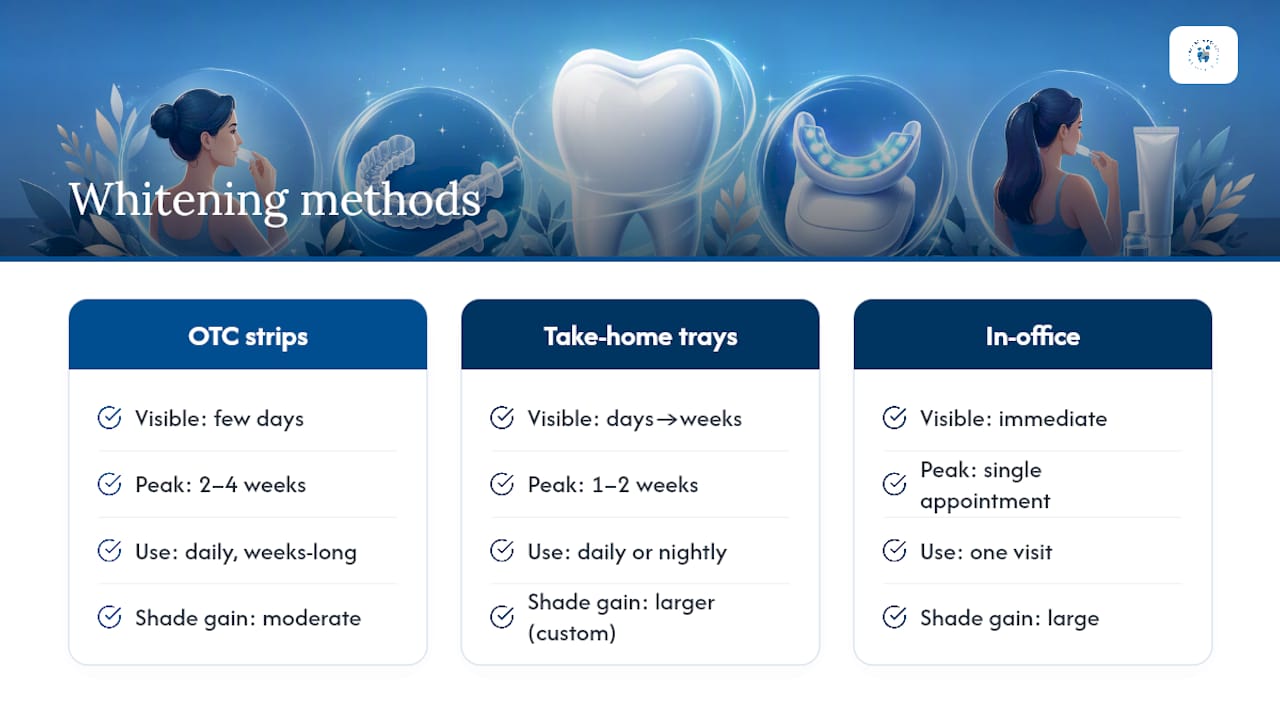
OTC strips and gels show visible change within a few days, typically peaking around two to four weeks of consistent use. That gradual curve is normal. It’s not a sign the product is failing if day three looks unremarkable.
Take-home trays follow a similar multi-week arc but tend to produce a larger total shade gain than OTC kits, largely because the custom tray keeps gel in full contact with every tooth surface instead of just the flat strip zones. Most regimens run one to two weeks of daily or nightly wear.
In-office bleaching is the outlier. You see the full result in a single appointment, which is why it remains the go-to for anyone with a wedding, interview, or event on a tight deadline. That immediacy comes at the highest price point of the three.
None of these results are permanent. Touch-ups are the norm, not a sign something went wrong. Most people benefit from a touch-up treatment every six months to a year, depending on diet and habits, and dentists often send take-home tray patients home with extra gel specifically for periodic maintenance rather than a full re-treatment.
Is Teeth Whitening Safe? Side Effects and DIY Risks
Tooth sensitivity is the most common side effect across every peroxide-based method, professional or OTC. Peroxide penetrates enamel to reach the dentin underneath, and that process can temporarily irritate the nerve, producing sharp, short-lived twinges to hot or cold. Gingival irritation is the second most common complaint, usually from gel making direct contact with gum tissue rather than staying confined to the tooth surface.
When used as directed, hydrogen peroxide and carbamide peroxide whitening is safe and effective, with sensitivity and gum irritation as the expected, temporary trade-offs. The operative phrase is “as directed.” Problems tend to show up when people leave strips on longer than instructed or repeat treatments back to back without giving enamel a rest.
DIY methods carry a different kind of risk entirely. Charcoal and acidic rinses like lemon juice don’t just fail to whiten reliably, they can permanently thin enamel through abrasion or acid erosion. Once enamel erodes, it doesn’t grow back, and thinner enamel often looks more yellow because it exposes more of the dentin underneath.
Whitening should be delayed or avoided in a few specific situations:
- Untreated cavities or active gum disease, since peroxide can aggravate exposed or inflamed tissue.
- Recent dental work like fillings or crowns, which don’t whiten the same way natural enamel does and can end up mismatched in color.
- Pregnancy, where most dentists recommend waiting out of general caution rather than a documented specific risk.
Pro Tip: If sensitivity hits during a whitening regimen, switch to a desensitizing toothpaste containing potassium nitrate for a few days before your next application, and consider spacing sessions every other day instead of daily. It’s a small adjustment that lets most people finish their regimen without giving up.
How to Choose the Right Whitening Option for You
Start by answering a few honest questions about your own mouth before you pick a product off a shelf or book an appointment.
- Identify your stain type. Coffee and wine stains respond to almost anything; intrinsic or tetracycline-type discoloration needs professional evaluation first.
- Check for restorations. Crowns, veneers, and fillings don’t whiten, so bleaching around them can create a visible mismatch. If you have visible dental work in your smile line, get a consult before starting.
- Assess your sensitivity history. If you already wince at cold drinks, start with the lowest concentration option and build up rather than jumping straight to in-office treatment.
- Set a realistic timeline. Need results in three days? That rules out OTC strips. Have a month? Take-home trays or a strip regimen both work.
- Match the method to your budget, using the cost ranges above as your starting point.
- Be honest about compliance. Take-home trays only work if you actually wear them on schedule. If you know you’ll forget, in-office treatment removes that variable entirely.
At a consultation, ask your dentist directly: What’s causing my discoloration? Am I a good candidate given my restorations or enamel condition? What concentration and wear schedule do you recommend? On any OTC product, treat these as red flags: no listed peroxide concentration, vague “natural whitening” claims with no active ingredient disclosed, or instructions that encourage daily use beyond two weeks without a break.
Why Professional Supervision Changes Whitening Outcomes
A dental exam before whitening catches what a mirror can’t: hidden decay, gum recession, or restorations that won’t respond to bleach the way natural enamel does. Dentists recommend an evaluation first precisely because it lets them tailor peroxide strength to your specific enamel and gum condition rather than applying a one-size-fits-all product.
Bay Area Dental, Airway & Sleep approaches whitening as part of a broader picture of oral health rather than an isolated cosmetic fix, pairing it with restorative and cosmetic dentistry built around addressing root causes. The practice uses 3D imaging and laser treatment to plan minimally invasive care, and extends that same attention to personalized communication for underserved patients, including tailored care for the Deaf community. Patients consistently report better sleep, stronger oral health, and a more comfortable overall experience.
The Real Trade-Off Nobody Talks About Enough
Most whitening advice treats this as a simple menu: pick a method, pick a budget, done. What gets skipped is that speed and enamel safety pull in opposite directions more often than marketing admits. The fastest routes concentrate peroxide and shorten your margin for error if your teeth aren’t a good candidate to begin with.
The conventional wisdom oversells OTC convenience and undersells how much a five-minute dental exam changes the calculus. A stain that looks like coffee discoloration might be intrinsic. A tooth that looks fine might have a hairline crack that turns peroxide contact into a painful surprise. None of that shows up by reading a strip’s packaging.
If there’s one thing worth prioritizing first, it’s this: get eyes on your teeth before you commit to a regimen, especially if you’ve never had a whitening treatment before. Cost matters, timeline matters, but knowing what you’re actually working with matters more than either.
— Admin
Ready for a Supervised Whitening Consultation?
Skipping the guesswork around concentration, fit, and sensitivity is the biggest advantage of going the professional route instead of trial-and-error with OTC kits. Whitening consultations typically start with an exam to check for restorations, decay, or gum issues before any bleaching begins, followed by custom tray fabrication or supervised in-office treatment depending on what the teeth actually need.

If you’ve tried OTC strips with disappointing results, or you have crowns, fillings, or sensitive teeth that make self-treatment risky, a consult gives you a plan tailored to your mouth instead of a generic wear schedule off a box. Book a consultation through Bay Area Dental, Airway & Sleep to get a professional evaluation and find the whitening approach that fits your teeth and your timeline.
Sources
For deeper reading on safety and technique, the American Dental Association’s whitening overview covers ingredient guidance, the clinical review on tooth bleaching examines light-activated systems, and Johns Hopkins Medicine breaks down method comparisons in patient-facing terms.
This article is general information, not a substitute for advice from a qualified doctor. Consult a qualified healthcare professional about your own circumstances before acting on anything here.
- Tooth whitening: a critical review of the literature
- How to whiten teeth safely
- Teeth Whitening — Johns Hopkins Medicine
- Teeth whitening — WebMD
FAQ
What is the most recommended teeth whitening method?
Dentists generally recommend starting with a professional evaluation, then choosing between in-office bleaching for speed or dentist-supplied take-home trays for a gentler, custom-fit approach depending on your stain type and sensitivity.
Which procedure is best for teeth whitening?
In-office professional bleaching delivers the fastest, most dramatic results in a single visit, while take-home trays offer nearly comparable results over one to two weeks at a lower cost.
What is the best solution for teeth whitening if I have sensitive teeth?
Lower-concentration take-home trays under dentist supervision, combined with a desensitizing toothpaste beforehand, typically cause less discomfort than high-concentration in-office treatment or unsupervised OTC strips.
Do teeth whitening strips actually work?
Yes, OTC strips and gels typically lighten teeth by about 1 to 3 shades when used as directed, though results take longer to appear than professional treatment.
Are natural teeth whitening remedies like charcoal or lemon juice safe?
No. Dentists warn that charcoal and acidic rinses like lemon juice can erode enamel permanently, and that damage does not reverse on its own.