

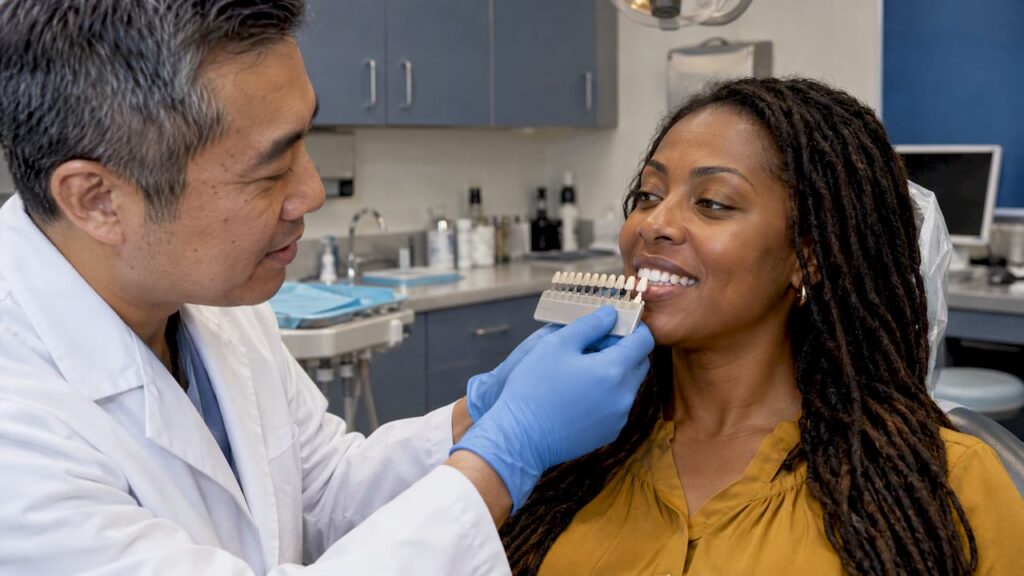
Most smile makeovers in the U.S. cost between $15,000 and $35,000, and luxury cases can reach $50,000 to $80,000 or more. Bay Area fees tend to land on the higher side of that spread, because California dental fees run about 13% above the national average. A smaller makeover, such as bonding and whitening on a handful of teeth, can cost far less. The final number depends on which treatments your smile needs and how many teeth they involve, and only an exam and written treatment plan can settle it.
TL;DR
- A full smile makeover typically runs $15,000 to $35,000 nationally, and Bay Area practices sit above the national average.
- A “smile makeover” is a plan, not one procedure. Veneers, bonding, aligners, gum contouring and crowns each carry their own price.
- Insurance rarely covers purely cosmetic work, but it may cover parts of the plan that restore function, such as crowns.
- Ask for an itemized, written plan so you can compare two quotes line by line.
- We do not publish fixed prices for makeovers, because the right plan is different for every mouth. We give you a written estimate after an exam.
Table of Contents
- What a smile makeover actually is
- What a smile makeover costs in the Bay Area
- What makes one estimate higher or lower than another
- A worked example: how a makeover adds up
- Does insurance cover a smile makeover?
- Ways to pay for a smile makeover
- How to compare two smile makeover quotes
- Our perspective: the cheapest smile is a healthy one
- Start with a plan, not a price
- FAQ
- Sources
What a smile makeover actually is
A smile makeover is a comprehensive cosmetic plan that combines several procedures to redesign how your smile looks. There is no standard package. One patient needs two veneers and a whitening. Another needs gum contouring, aligners, bonding and a crown.
That is why a search for one price returns such wide ranges. You are really asking what the sum of several smaller treatments will be.
The treatments that most often appear in a plan:
- Veneers: thin shells bonded to the front of teeth to change shape, color and alignment.
- Composite bonding: tooth-colored resin sculpted onto the tooth to close gaps, repair chips or reshape edges.
- Teeth whitening: often the first step, since veneer and bonding shades are matched to your final tooth color.
- Clear aligners or braces: to straighten teeth before any cosmetic work, which can reduce how much needs to be covered.
- Gum contouring: reshaping the gum line, often with a laser, for a more balanced smile.
- Crowns and bridges: restorative work for teeth that are weak, broken or missing.
The national research lists veneers, whitening, bonding, clear aligners, gum contouring and restorative crowns and bridges as the usual building blocks.
What a smile makeover costs in the Bay Area
The national range of $15,000 to $35,000 is the best checked starting point for a full, multi-treatment makeover. Because California fees are about 13% above the national average, with the highest fees in the coastal metros, you should plan for the Bay Area to sit toward the upper half of any national range. The same research points to coastal real estate and payroll costs as the reason.
Here is how to think about the pieces. These are planning categories, not quotes:
| Treatment | What drives the price | Where to read more |
|---|---|---|
| Porcelain veneers | Number of teeth, material, lab work, whether teeth need preparation | Bay Area veneer costs |
| Veneers in the East Bay | Same factors, local fees | Veneers cost in Fremont |
| Clear aligners | Case complexity and length of treatment | Bay Area Invisalign costs |
| Braces | Type of braces, treatment length | Braces cost in Fremont |
| Composite bonding | Number of teeth, size of the repair | Bonding longevity |
| Gum contouring | Amount of tissue, laser vs. conventional | Laser gum contouring |
One figure we can point to: our own guide to Bay Area aligner pricing lays out a range of $4,200 to $12,400 for Invisalign, along with a checklist for judging a clinic’s quote. Our veneer guide explains why a full set often covers 8 to 10 teeth, which is the main reason veneer-heavy makeovers land at the top of the range.
If a number you find online is a single price for a “smile makeover,” treat it as an advertisement. It tells you little until you know how many teeth, which material and what preparation work are behind it.
What makes one estimate higher or lower than another
Two patients can walk into the same office and leave with estimates thousands of dollars apart. These are the real reasons.
Number of teeth treated
The research names the number of teeth treated as one of the main cost drivers. Most people show eight to ten teeth when they smile, which is why a full-smile plan often involves that many. Treating only the two or four teeth that bother you costs a fraction of that.
Material
Porcelain, ceramic and composite resin behave differently and cost differently. Porcelain is generally more stain-resistant and lasts longer. Composite is less expensive up front and can be repaired or adjusted in the chair, but it may need touch-ups sooner. We cover the lifespan question in detail in our bonding longevity guide.
Preparation: what the teeth need first
Some makeovers also require restorative work before anything cosmetic. A cavity, a failing filling or gum inflammation has to be handled first, and those steps are part of the total. Some patients qualify for veneers that need little or no tooth reduction, which we explain in how dentists decide on no-prep veneers. Others do not, and the plan changes accordingly.
Clinician experience and technology
Experience is another factor named in the research. A dentist who designs the smile digitally, shows you a mock-up before anything is permanent and uses lasers for gum work may charge differently than one who does not. More planning often means fewer surprises later.
Where the practice is
Bay Area overhead is high. The same procedure often costs less in a Fremont or Union City office than in downtown San Francisco, though that is a general pattern and not a guarantee. Compare actual written estimates rather than assuming.
A worked example: how a makeover adds up
Here is a hypothetical plan to show the logic. These are not prices, and they are not an estimate for any patient.
Imagine a patient with crowded, slightly stained front teeth and an uneven gum line. A careful plan could look like this:
- Exam, X-rays and 3D imaging to check bone, gums and any hidden decay.
- Treat disease first. Any cavities or gum problems are handled before cosmetic work.
- Straighten with clear aligners, which can reduce how much tooth needs to be shaped later.
- Contour the gum line with a laser so teeth look even.
- Whiten, so the final shade is set before veneers are made.
- Place veneers or bonding on the teeth that need shape or color correction.
Each step has its own fee, and the sum is the makeover. If you only need steps 5 and 6 on four teeth, you are in a much smaller price bracket. That flexibility is the point: the best plan is the least that gets you the smile you want.
Does insurance cover a smile makeover?
Usually only in part, and often not at all. FAIR Health explains that dental plans commonly treat crowns as major restorative care, often reimbursed at about 50%. Orthodontics may or may not be covered and, when it is, commonly has a separate lifetime maximum. Strictly cosmetic services such as whitening are rarely covered.
So a veneer chosen for looks is typically out of pocket, while a crown that rebuilds a cracked tooth may be partly covered. Several plan rules change what you pay:
- network status
- your deductible
- coinsurance
- annual or lifetime maximums
- waiting periods
- alternate-benefit rules, where the plan pays toward the cheaper option
Before you commit, it helps to understand how insurance acceptance works so that you ask your plan the right questions.
Get a pre-treatment estimate
For any part of the plan that might be covered, ask your dentist for an itemized treatment plan and to submit it to your insurer. FAIR Health says the response should show the estimated plan payment, your share, your deductible balance and your remaining benefit maximum. It is an estimate and not a guarantee of payment.
Ways to pay for a smile makeover
Because most of the cost is usually yours, financing matters. Discover’s consumer-finance guide lists the common routes: dentist payment plans, credit cards, HSAs, FSAs, personal loans and dental discount plans. It also warns that cosmetic procedures are generally excluded from insurance and that purely cosmetic work may not qualify for FSA use.
A few practical points:
- HSA and FSA funds generally require a qualifying dental expense. Ask your plan administrator before assuming a veneer qualifies, and ask whether the restorative portion of your plan does.
- Splitting a makeover into phases can spread the cost over months. Treat the disease and function first, then the cosmetic layer.
- Compare the total cost of any loan or card, including interest, not only the monthly payment.
How to compare two smile makeover quotes
The cheapest quote is not always the lowest-cost plan. A headline number can hide what is left out. Use this checklist:
- Ask for an itemized plan. It should list each procedure, each tooth and each fee.
- Check the scope. How many teeth are included? Are whitening, gum work and temporary restorations in the number?
- Ask about materials and lab work. Which porcelain or composite, and which lab?
- Ask what is not included. Diagnostics, anesthesia, follow-up adjustments and a night guard are common extras.
- Ask about maintenance and replacement. Veneers and bonding do not last forever. What does upkeep cost, and is there any warranty?
- Ask to see a mock-up or digital preview before anything is permanent.
- Confirm what insurance may pay, using the pre-treatment estimate above.
FAIR Health also lets you compare estimated prices for the same procedure in nearby areas, and it distinguishes a provider’s charge from the in-network price a plan pays. That is a useful reality check on any number you are handed.
One caution on aftercare: whitening and new cosmetic work are easier to protect if you know what stains them. A short guide on foods to avoid after whitening is worth reading before your appointment.
Our perspective: the cheapest smile is a healthy one
We approach a smile makeover the way we approach everything else in the practice: whole-body health first. A smile that looks perfect over teeth that are decaying, a bite that is out of balance or an airway that is compromised will not stay perfect.
That shapes how we plan cosmetic work:
- Treat the cause, not just the look. Crowding, a narrow palate or mouth breathing can affect how teeth sit and how well you sleep. Where it matters, we look at airway and function before we design the cosmetic result.
- Preserve tooth structure. We favor minimally invasive options when they are right for you, including no-prep veneers for qualifying patients and biomimetic dentistry, which aims to keep as much natural tooth as possible.
- Use technology that improves comfort. 3D imaging helps us plan precisely, and laser treatments such as gum contouring can mean less bleeding and faster healing.
- Communicate clearly. Everyone should understand their plan and their costs. We tailor communication for each patient, including Deaf patients.
If a plan needs less than a full makeover, we will say so.
— Bay Area Dental, Airway & Sleep
Start with a plan, not a price
If you are weighing a makeover in Fremont, Union City or elsewhere in the Bay Area, the most useful first step is a consultation that ends in a written, itemized plan. At our practice, veneers, smile makeovers and composite bonding are planned around your goals and your oral health, and you leave knowing what each phase involves.
We do not publish fixed prices for these services, since the right number depends on your exam. Ask us for an itemized estimate and, if you have dental insurance, we can help you request a pre-treatment estimate for the parts that may be covered. Visit our main site to get started.
FAQ
Is a smile makeover expensive?
A full makeover is a significant investment: most U.S. cases run $15,000 to $35,000, and Bay Area fees run above the national average. But a makeover can be scaled. Bonding, whitening and a few veneers cost much less than a full set, so the right plan for your goals may be well under the top of the range.
Does dental insurance pay for a smile makeover?
Usually not for the cosmetic parts. Plans commonly cover crowns at about 50% as major restorative care, and whitening is rarely covered. Ask your dentist to send an itemized plan to your insurer for a pre-treatment estimate, which is not a guarantee.
How much does Invisalign cost in the Bay Area?
Our Bay Area guide gives a range of $4,200 to $12,400, depending on how complex your case is and how long treatment takes. Your own price depends on the exam findings. Our Invisalign cost guide includes a checklist for comparing clinic quotes.
Can I do a smile makeover in phases?
Yes, and many patients do. Health work such as cavities and gum treatment comes first, followed by straightening, then whitening, then veneers or bonding. Phasing spreads the cost and lets you stop when you are happy with the result.
Sources
- Smile Makeover Cost, National Average and by State | Pearl
- California Dental Costs, State Averages | Pearl
- Dental Plans | FAIR Health
- Shopping for Shoppable Services | FAIR Health
- Dental Financing Options: How to Pay for Dental Work | Discover