

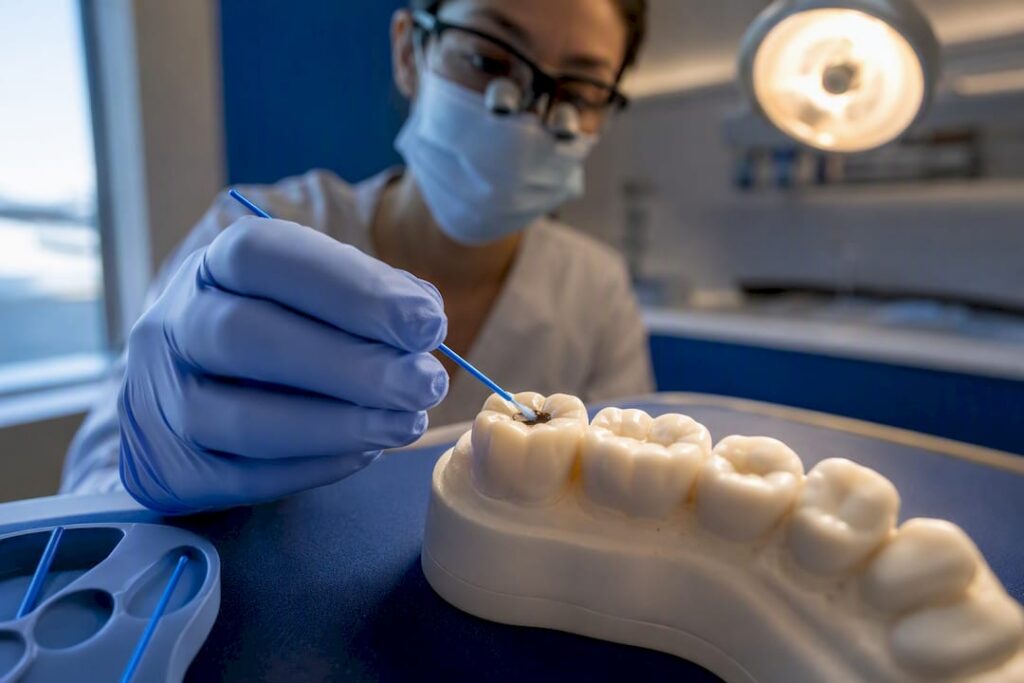
Silver diamine fluoride can stop many cavities from getting worse without a drill, a needle, or a single tear from your child. The catch is real: the decay it treats often turns permanently black. For active decay in a spot nobody will see, or for a patient who simply can’t tolerate a restoration right now, that trade tends to be worth it.
TL;DR:
- SDF effectively arrests about 54% of cavities in children within six months, compared to 21% with no treatment, according to NIH studies.
- Staining begins within two minutes and deepens over six hours, mainly affecting decayed tissue and serving as evidence of treatment success.
- Reapplication every six months is recommended to maintain arrest, with follow-up assessing lesion hardness and stability rather than assuming permanence.
- SDF is best suited for patients who cannot tolerate drills or restorations, not for large cavitated lesions or visible front teeth where cosmetic concerns outweigh benefits.
Table of Contents
- What Is Silver Diamine Fluoride and How Does It Work?
- What Does the Evidence Actually Show?
- Who Is a Good Candidate for SDF Treatment?
- What Happens During an SDF Appointment?
- What Are the Risks? Staining and Other Side Effects
- How to Reduce or Manage SDF Staining
- How Often Does SDF Need to Be Reapplied?
- How Does SDF Compare to Other Cavity Treatments?
- How Bay Area Dental, Airway & Sleep Applies SDF in Practice
- The Honest Take on SDF: Useful, Not Universal
- Scheduling an SDF Evaluation at Bay Area Dental, Airway & Sleep
- Sources
What Is Silver Diamine Fluoride and How Does It Work?
Silver diamine fluoride, usually shortened to SDF, is a liquid made of silver, ammonia, and fluoride dissolved in water. Dentists most often use a 38% concentration, which sounds abstract until you see it in plain numbers: that solution carries roughly 253,870 ppm of silver and 44,800 ppm of fluoride, according to an evidence review of SDF’s clinical use. That’s a serious concentration of both ingredients, which is exactly why a few drops go a long way.
The mechanism is a one-two punch. Silver acts as an antimicrobial, killing off the bacteria driving the decay process and disrupting the biofilm that lets cavities spread. Fluoride does the remineralizing work, pulling minerals back into the softened tooth structure and hardening it. There’s a third, less-discussed effect: SDF appears to inhibit collagenases, the enzymes that break down the collagen matrix inside dentin, according to research on SDF’s dual mechanism. That combination is why a single application can functionally arrest a lesion instead of just slowing it down.
Where SDF sits legally is worth clarifying, because it trips people up. The FDA cleared SDF specifically for treating tooth sensitivity, not cavities. Every use for arresting caries is technically off-label, though it’s one of the most common and well-supported off-label uses in dentistry today. That’s not a red flag. Off-label use is standard practice across medicine when evidence accumulates faster than formal approval processes move.
Professional guidance has caught up regardless of the labeling technicality. The American Dental Association recognizes SDF as a legitimate caries-management tool and recommends biannual application of the 38% solution for sustained benefit. The American Academy of Pediatric Dentistry and the World Health Organization have issued similar guidance, treating SDF as a recognized option, especially for young children, patients with special needs, and anyone who struggles with traditional restorative visits.
A few practical points worth knowing about the material itself:
- SDF is alkaline, with pH generally around 9 to 10.
- It requires protection from light and proper storage to maintain stability.
- Concentrations can vary by manufacturer.
- The solution is initially colorless; staining develops after application.
What Does the Evidence Actually Show?
The strongest data point comes from a National Institutes of Health funded trial in young children: at the six-month interim mark, 54% of cavities treated with SDF stopped progressing, compared to 21% in the placebo group, according to the NIH news release on the trial. That’s not a marginal edge. It’s more than double the arrest rate of doing nothing, in a trial designed specifically to test SDF against a control.
By the numbers: 54% of treated lesions stopped progressing at six months versus 21% with placebo, one of the clearer head-to-head comparisons available for a caries-arrest treatment in children.
Zoom out to the broader research and the picture holds up, though with more spread. Systematic reviews and meta-analyses looking at SDF in primary teeth report high arrest rates, though the exact figures vary depending on study definitions and follow-up intervals, per a comprehensive review of SDF therapy. The variation isn’t a weakness in the treatment so much as a reflection of how differently studies define “arrest” and how long they track patients afterward.
The Cochrane systematic review on SDF takes the more cautious stance you’d expect from Cochrane. It concludes SDF likely helps arrest caries in primary teeth and root caries, but it rates the overall certainty of that evidence as ranging from very low to moderate, depending on which outcome you’re looking at. Cochrane’s reviewers specifically call for more high-quality trials, particularly ones that track aesthetic outcomes and adverse effects over longer periods, not just short-term arrest rates.
A few limitations are worth sitting with before you assume SDF will work the same way for every situation:
- Response varies by tooth type. Root caries and lesions in primary (baby) teeth tend to respond better than certain permanent-tooth presentations.
- Not every lesion arrests. Even in the strongest trials, roughly one in five to one in three treated lesions kept progressing.
- Evidence is stronger for prevention and arrest than it is for reversing deep or long-standing decay.
- Most of the highest-quality data comes from studies on children and older adults with root caries, so extrapolating to every age group and lesion type involves some guesswork.
None of that undercuts the core finding. SDF outperforms placebo by a wide margin in the populations studied most closely. It just isn’t a universal fix, and no honest reading of the research pretends otherwise.
Who Is a Good Candidate for SDF Treatment?
SDF tends to work best for people who have decay but aren’t good candidates for a drill right now, for one reason or another. That’s a bigger group than most parents assume.
Strong candidates typically include:
- Young children with early, non-cavitated or shallow carious lesions, especially those too anxious or too young to sit through a filling.
- Patients who can’t tolerate restorative treatment because of medical complexity, behavioral challenges, or sensory sensitivities.
- Older adults with root caries, a group where restorations are often harder to place and maintain successfully.
- Anyone with limited access to comprehensive dental care, where SDF can arrest decay and buy time until a full restorative visit is possible.
- Patients managing multiple active lesions at once, where treating everything restoratively in one visit isn’t realistic.
SDF is a poor fit for:
- Large cavitations that already need structural rebuilding. SDF stops the bacterial process, but it doesn’t rebuild missing tooth structure the way a filling or crown does.
- Front teeth or any visible area where a permanent black stain is not acceptable to the patient or family.
- Any lesion with a direct pulp exposure. That level of damage needs restorative or endodontic treatment, not a topical solution.
The role SDF plays matters as much as the candidate selection. Dental professionals generally treat it as a management tool, not a replacement for ongoing dental care. It’s a way to arrest active decay and reduce sensitivity while a patient stays connected to a dental home for exams, monitoring, and eventual restorative work when that becomes appropriate. Treating one application as a permanent fix and skipping follow-up visits defeats the purpose.
What Happens During an SDF Appointment?
The appointment is short enough that most patients are surprised when it’s already over. Here’s the typical sequence:
- Isolation and drying. The dentist isolates the tooth with cotton rolls or a similar barrier and dries the surface so the SDF can contact the decay directly instead of diluting in saliva.
- Application. SDF is painted directly onto the affected area using a small brush or microbrush, left in place for roughly 10 to 60 seconds depending on the product and protocol, per guidance from the American Academy of Pediatrics.
- Blotting excess. Any solution that hasn’t absorbed gets blotted away to limit contact with surrounding gum tissue and to control how much silver reaches unintended surfaces.
- Optional fluoride varnish. Some dentists paint a layer of fluoride varnish over the treated tooth afterward, which improves the taste experience and can support the remineralization process.
There’s no drilling. There’s usually no local anesthesia needed, since the process doesn’t touch a nerve or remove tooth structure. Most children sit still for the whole thing without complaint, partly because it genuinely doesn’t hurt and partly because it’s over before nerves have time to build.
Expect the whole appointment, including the exam that leads up to it, to run somewhere in the ballpark of a standard checkup visit. The application step itself takes under a minute per tooth. Afterward, your dentist should document which teeth were treated and schedule a follow-up to monitor how each lesion is responding.
If you’re bringing your child in for a first SDF visit, a short list of questions makes the conversation more useful:
- Which specific teeth are being treated, and are any of them visible when your child smiles?
- What should you expect to see in terms of color change, and how soon?
- When is the follow-up visit, and what will the dentist be checking for?
Pro Tip: Ask your dentist to show you exactly which tooth surfaces will be treated before the applicator touches anything. It takes thirty seconds and it prevents the most common source of parent frustration afterward: being surprised by a stain on a tooth they didn’t realize was included.
What Are the Risks? Staining and Other Side Effects
The staining is the headline risk, and it deserves a straight answer instead of a vague warning. Once SDF contacts an active carious lesion, staining can begin within about two minutes and continues intensifying for up to six hours, according to research on SDF’s staining potential. It’s fast, it’s dark, and it’s permanent on the treated tissue.
The number that matters here: staining onset can start in roughly 2 minutes and deepen over the following 6 hours, so the color you see at the end of the appointment isn’t necessarily the final result.
Here’s the part that reassures most families once they understand it: staining only affects demineralized or already-decayed tooth tissue. Sound, healthy enamel resists the reaction almost entirely. That’s not a coincidence. It’s chemistry. Decayed tooth structure has an altered mineral composition that reacts with silver ions in a way healthy enamel doesn’t, so the stain effectively maps onto exactly where the cavity already was.
There’s a way to reframe this that actually changes how the conversation feels: staining is, in a real sense, evidence the treatment worked. The black color generally marks arrested decay, not decay in progress. It’s not a cosmetic accident sitting on top of successful treatment. It is, in a fairly literal way, the visible signature of the treatment succeeding.
Beyond staining, the side-effect profile is mild:
- A metallic taste immediately after application, which usually fades within minutes.
- Temporary gingival or soft-tissue irritation if SDF contacts the gums, which is why careful isolation matters.
- Rare, mild systemic findings reported in trial data, with no serious safety signals identified in the major studies.
Dosing guidance in clinical practice keeps a wide safety margin. Some protocols reference limits like one drop per 10 kilograms of body weight per visit, a figure cited in clinical guidance on SDF therapy, specifically to avoid unnecessary silver exposure. Clinicians are also trained to avoid unnecessary soft-tissue contact during application, since the goal is to treat the tooth, not the surrounding gum.
How to Reduce or Manage SDF Staining
Nobody wants their child’s front tooth turning gray, so it’s worth knowing what actually helps and what has more limited proof behind it.
Potassium iodide (KI) is the most common mitigation strategy. Applied immediately after SDF, it reacts with excess silver ions to form a less visibly dark compound, reducing staining in the short term. The catch: evidence for its long-term benefit is mixed, and staining can resurface within 7 to 14 days in some cases, per research on staining-reduction strategies. Treat KI as a way to soften the initial appearance, not a guaranteed long-term fix.
Delayed glass ionomer restoration is the more durable option when a stain-free result actually matters. Some dental teams apply SDF and KI together, then wait one to two weeks before placing a tooth-colored glass ionomer restoration over the treated area, according to clinical practice guidance on staining management. That delay isn’t arbitrary. Waiting preserves bond strength between the restoration and the tooth, which a same-day restoration wouldn’t achieve as reliably.
A few practical guidelines for deciding how much mitigation effort makes sense:
- If the lesion is on a back molar nobody sees, most families skip mitigation entirely and let SDF do its job without extra steps.
- If the lesion is on a visible front tooth, KI plus a planned glass ionomer restoration is the more realistic path to an acceptable cosmetic outcome.
- If staining of any kind is a dealbreaker, SDF probably isn’t the right treatment, and a conventional restoration should be the primary plan instead.
How Often Does SDF Need to Be Reapplied?
Guidelines commonly point to a biannual reapplication schedule, meaning SDF gets reapplied roughly every six months to sustain the benefit, a recommendation reflected in ADA guidance on SDF use. One application can arrest a lesion, but ongoing reapplication improves the odds that arrest holds over time rather than reversing.
Success looks specific, not vague. A dentist checking a previously treated lesion is looking for:
- A hardened, leathery, or firm texture where the decay used to be soft.
- No new symptoms like sensitivity or pain.
- No visible progression of the lesion’s size or depth compared to prior visits.
- Stable or improved radiographic appearance when X-rays are taken at follow-up.
Radiographs and more detailed assessment become warranted when a lesion’s status is unclear on visual exam alone, particularly for interproximal decay between teeth that’s hard to evaluate directly. If a lesion continues progressing despite reapplication, or if it reaches a size where structural integrity is compromised, that’s the signal for a dentist to move from SDF management to a definitive restoration. SDF buys time and arrests activity; it isn’t meant to be the permanent endpoint for every lesion indefinitely.
How Does SDF Compare to Other Cavity Treatments?
SDF and fluoride varnish get grouped together a lot, but they’re not interchangeable. Varnish is preventive, aimed at strengthening enamel before decay takes hold or slowing very early demineralization. SDF works on active, established lesions, arresting a bacterial process that’s already underway. Evidence comparing the two directly is mixed, but SDF’s advantage for actual caries arrest, not just prevention, is the reason dentists reach for it once decay is already visible.
Conventional restorations like fillings and crowns solve a different problem entirely. They rebuild missing tooth structure and restore full chewing function, neither of which SDF does. For a molar that’s already broken down structurally, a filling isn’t optional. The comparison isn’t really “SDF versus a filling” so much as “arrest the process now versus rebuild the tooth later,” and often the honest answer is both, in sequence.
That sequencing is where SDF earns its place in a broader treatment plan:
- Use SDF to halt an active lesion when immediate restoration isn’t feasible, whether due to age, behavior, medical status, or scheduling.
- Follow up with a definitive restoration once the patient can tolerate it, particularly for lesions affecting function or visible esthetics.
- Reserve fluoride varnish for prevention and early, non-cavitated risk areas rather than established decay.
Framed that way, SDF isn’t competing with fillings. It’s buying time and stopping damage until a filling becomes possible.
How Bay Area Dental, Airway & Sleep Applies SDF in Practice
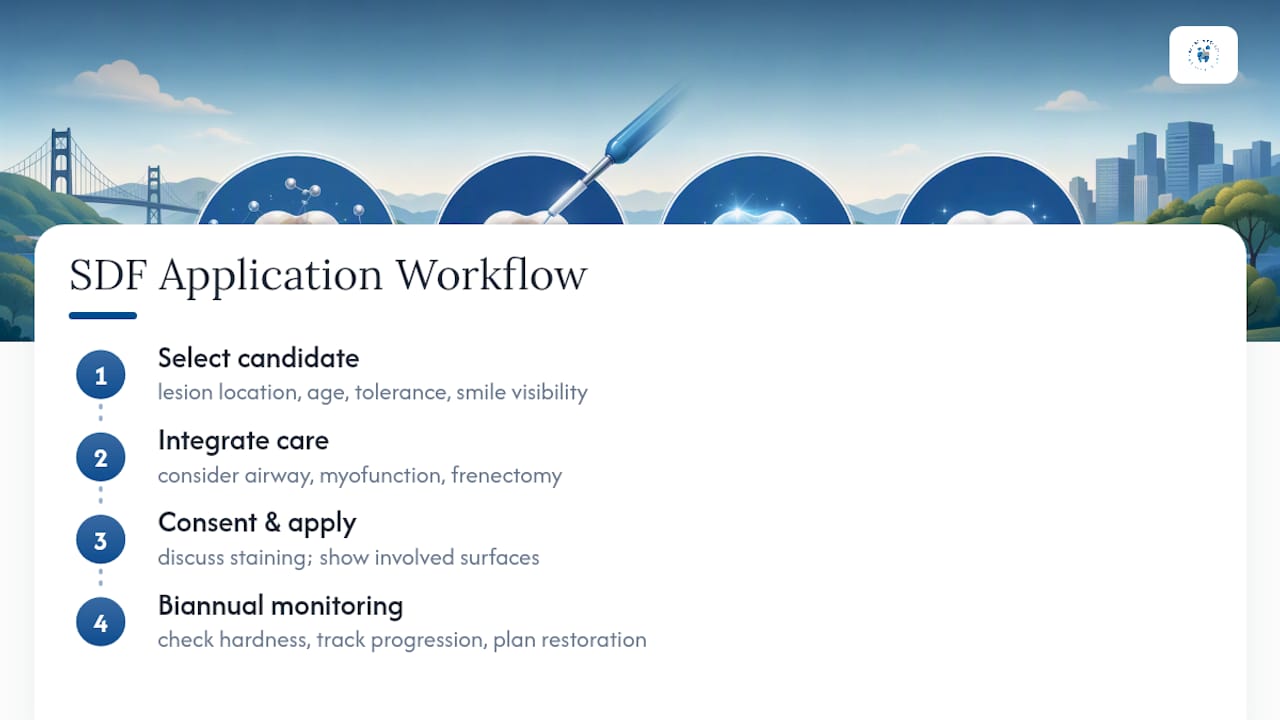
Selecting SDF candidates starts with an honest conversation, not a default recommendation. At Bay Area Dental, Airway & Sleep, the team looks at the lesion’s location, the patient’s age and tolerance for restorative work, and whether the tooth in question is visible when the patient smiles, before ever suggesting SDF over a filling. Staining gets discussed upfront, with families shown exactly which surfaces are involved so there are no surprises at the follow-up visit.
Because the practice treats airway health, myofunctional patterns, and restorative dentistry as connected rather than separate problems, SDF decisions get folded into a bigger picture. A child with early decay and a tongue tie affecting oral function, for instance, might need both a laser frenectomy and a caries-management plan, not just one isolated fix. Monitoring after SDF application follows the same biannual rhythm the evidence supports, with each visit checking lesion hardness, tracking any progression, and deciding when it’s time to move toward a permanent restoration.
The Honest Take on SDF: Useful, Not Universal
SDF gets oversold in two opposite directions online. One camp treats it as a miracle that makes drilling obsolete. The other dismisses it as a cosmetic disaster not worth the trade-off. Neither read survives contact with the actual data. It’s also not a coin flip that works every time, and the black staining is not a minor footnote you discover after the fact.
Where I think the conventional advice falls short is in treating staining as purely negative instead of explaining what it actually signals. Parents who understand that the black color usually marks a decay process that’s been stopped, not one that’s ongoing, tend to make calmer, better-informed decisions. That reframe doesn’t erase the cosmetic cost. It just puts it in proportion.
Prioritize this: ask specifically which teeth are visible before agreeing to treatment, and ask what the follow-up plan looks like if the lesion doesn’t respond. Those two questions do more for your decision than any amount of general reading.
— Admin
Scheduling an SDF Evaluation at Bay Area Dental, Airway & Sleep
If a cavity has your family weighing a filling against something less invasive, Bay Area Dental, Airway & Sleep offers straightforward evaluations to figure out whether SDF fits the situation or whether restorative treatment is the better call. No pressure toward one option over the other. Just a clear look at the lesion, an honest conversation about staining if a visible tooth is involved, and a plan that fits your child’s age, tolerance, and the tooth in question.

Your first visit typically includes an exam, a review of any imaging already on file, and a conversation about what treatment, SDF included, would realistically accomplish for that specific lesion. The practice’s approach to airway and sleep dentistry means a cavity conversation often opens into a broader look at oral development, especially for younger patients. If you’re ready to get a lesion evaluated, reach out to Bay Area Dental, Airway & Sleep in Fremont to schedule a visit and get a straight answer on whether SDF makes sense for your child’s teeth.
This article is general information, not a substitute for advice from a qualified doctor. Consult a qualified healthcare professional about your own circumstances before acting on anything here.