

A palatal expander usually causes pressure and mild soreness, not sharp pain. The feeling is strongest in the first few days and after each turn of the key, and it fades as your body adapts. Most families get through it with soft foods, an over-the-counter pain reliever and a steady turning routine. This guide covers what to expect, how long it lasts, what helps, and the signs that mean you should call your orthodontist. If your child’s expander is part of a plan to improve breathing or jaw growth, our team at Bay Area Dental, Airway & Sleep in Fremont, CA offers palatal expansion and can answer questions about your own case.
TL;DR
- Expect pressure, a “full” feeling and mild tenderness for the first few days and after each turn. Severe pain is not expected.
- Research tracking patients found pain peaks within the first days after activation and drops to minimal or none by the end of active expansion.
- Soft foods, a pain reliever your orthodontist or doctor approves, and keeping to the turning schedule take the edge off.
- Call the orthodontist’s office if pain feels severe, does not improve, or something about the appliance seems wrong.
- Pain depends partly on the appliance design and how fast it is turned, so it is worth talking through the plan before you start.
Table of Contents
- What palatal expander pain actually feels like
- How long palatal expander pain lasts
- What helps: a practical plan
- Why some patients hurt more than others
- When to call your orthodontist
- Palate expansion and breathing
- Our perspective
- Considering expansion in the Bay Area?
- FAQ
- Sources
What palatal expander pain actually feels like
A palatal expander is a small appliance that sits across the roof of the mouth. A tiny screw in the middle is turned with a key, usually once a day for a set number of days, to widen the upper jaw gradually. Because the appliance is moving bone and the seam where the two halves of the upper jaw meet, the sensations are different from the ache of a cavity.
The American Association of Orthodontists describes pressure, a full feeling or mild tenderness when you first wear an expander and after adjustments. It also notes that expanders have been used for decades and that the discomfort is typically minimal and short-lived under an orthodontist’s supervision.
Cleveland Clinic similarly says an expander can cause minor discomfort for the first few days and slight discomfort after turning the key, but should not cause severe pain.
People describe it in a few common ways:
- Pressure on the back teeth and roof of the mouth, strongest in the minutes to hours after a turn.
- Pressure behind the face. Nationwide Children’s Hospital explains that because the expander is moving bone, you can feel pressure below the eyes and at the top of the nose between the eyes.
- Sore teeth the day after, similar to the feeling after braces are tightened.
- A tight or crowded feeling in the mouth, plus a little extra saliva and a lisp for the first days while the tongue gets used to the new hardware.
Pain is also personal. The authors of a 2023 systematic review point out that pain perception is complex and tolerance varies from person to person, which is why one child barely notices the expander and another asks for extra comfort food. Both are within the normal range.
How long palatal expander pain lasts
The pattern is consistent across studies: the worst of it comes early, then it settles.
The 2023 systematic review found that pain is the most commonly reported symptom of rapid maxillary expansion, reported by more than 90% of children, and that it is higher during the first days or the first screw activations and decreases as treatment progresses. That figure sounds alarming, but it counts any pain at all, including mild soreness. It does not mean most children are in severe pain.
A 2026 prospective study from Italy followed patients through expansion. Pain peaked within the first few days after activation and declined to minimal or absent levels by the end of the active phase. Pain scores converged after about 12 days and were low or zero toward day 35. The researchers found no statistically significant difference between boys and girls.
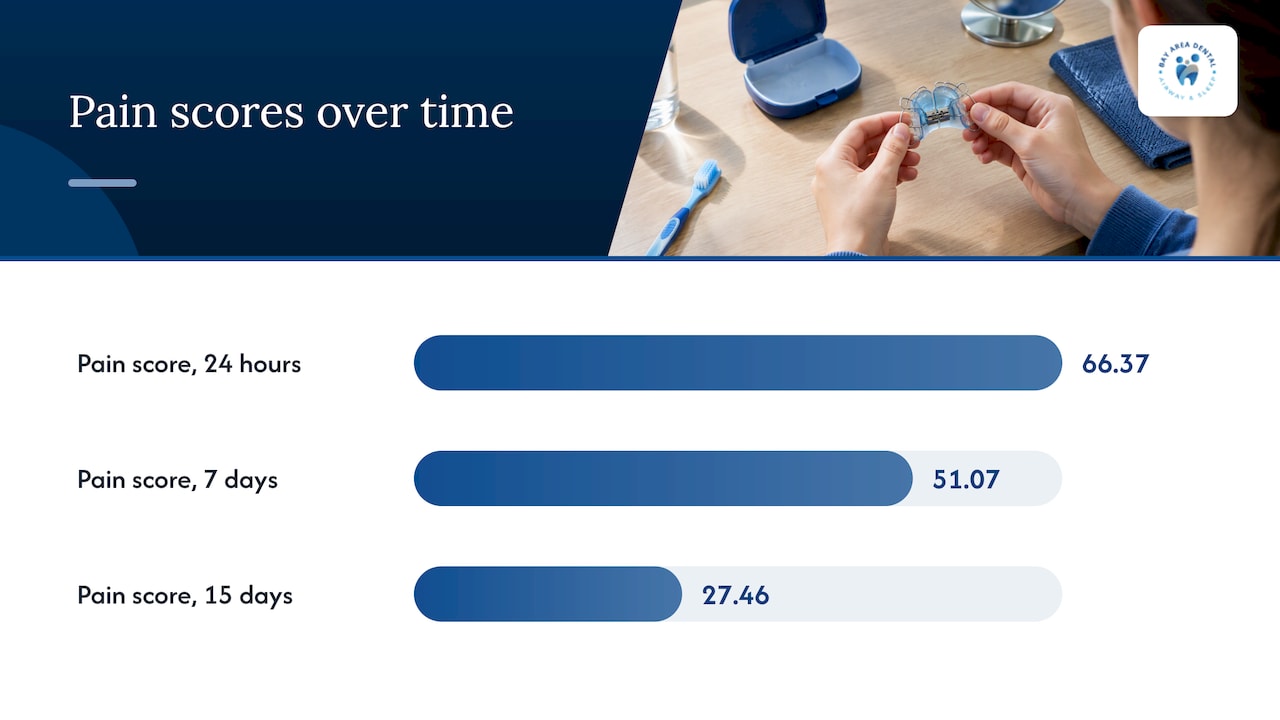
A 2022 randomized trial of 52 adolescents gives a more detailed picture of a fixed rapid expander. Pain scores were highest at 24 hours (66.37), lower at 7 days (51.07) and 15 days (27.46), and mild at one and four months. Chewing and swallowing difficulties were greater in the rapid expansion group for the first month.
| Time point | What studies and clinical guidance describe |
|---|---|
| First 24 hours | Highest pain scores in the trial above; pressure and tenderness are expected |
| First few days | Pain peaks after activation; most analgesic use happens now |
| After each turn | Brief pressure or slight discomfort that fades |
| Around day 12 | Pain levels in the 2026 study converge toward low values |
| End of active expansion | Minimal or no pain in most patients |
| Weeks 3 to 5 | Low or zero pain in the 2026 study; chewing may still feel different |
If you read elsewhere that discomfort lasts three to five days after each turn, that matches the same pattern: each turn creates a short wave of pressure, and the waves get easier as the jaw adapts.
What helps: a practical plan
Use an approved pain reliever for the first days
Cleveland Clinic recommends over-the-counter pain relievers such as acetaminophen, ibuprofen or naproxen to reduce tenderness. In the research, these are also what patients actually use. In one study cited in the 2023 review, 48% of patients used a drug at least once during expansion, most often Tylenol, Advil or Motrin, and 69% of that use happened during the first six screw activations. A Swedish trial of 72 children found analgesic use was highest on day 1.
Dose by age and weight, and who should avoid which medicine, is a question for your child’s pediatrician, your own doctor or the orthodontist’s office, particularly for young children or anyone with a stomach, kidney, liver or bleeding condition, or on other medications. Follow the package directions and do not combine products that contain the same ingredient.
Many families find it easier to give the first dose before the turn on the first days rather than waiting for the ache to build. Ask your orthodontist whether that timing suits your child.
Switch to soft foods
The American Association of Orthodontists notes softer foods are easier to start with. In practice that means:
- Scrambled eggs, oatmeal, yogurt, smoothies (with a spoon, not a thick straw pushed against the palate), mashed potatoes, soup that is warm rather than hot.
- Pasta, soft rice, tender shredded chicken, bananas, applesauce and well-cooked vegetables.
- Cold items such as ice cream or frozen yogurt can soothe a sore palate.
Avoid very hard, sticky or chewy foods such as caramel, hard candy, taffy, bagels and raw carrots, which can irritate the area or loosen the appliance. Food also collects around the appliance, so brush it gently after meals and rinse well. A clean appliance is also less likely to cause sore spots in the tissue.
Why eating hurts more than usual
Eating is where most families feel it first. The expander changes how the tongue and palate work together, and sore teeth do not like biting pressure. The trial of adolescents recorded more chewing and swallowing difficulty in the first month with a fixed rapid expander. That is normal and improves as the pressure subsides and the tongue adapts. Cutting food into smaller pieces and chewing on the sides that feel best helps in the meantime.
Keep the turning routine steady
Nationwide Children’s Hospital gives practical guidance: if discomfort continues after a turn, do not turn the expander any more that day, resume the next day, and complete the required number of turns before the next appointment. Do not skip turns to avoid soreness and then double up, and do not change the schedule on your own, because the plan is built around a specific amount of widening. If you are unsure whether you turned correctly, or the key slipped, call the office.
A few habits make turn time easier:
- Pick a calm, consistent time, for example after dinner, rather than just before school or sleep.
- Have a soft snack or cold drink ready afterward.
- Check that the key is fully seated and turns in the direction of the arrow printed on the instructions.
- Write down the date of each turn so no one is unsure whether today’s turn happened.
Small comforts
Cold drinks, popsicles and a cool cloth held to the cheeks can ease pressure. Gentle distraction helps younger children. If the appliance rubs the tongue or cheek, tell the office. A small adjustment may be possible.
Why some patients hurt more than others
Two things are within the orthodontic team’s control: the appliance and the protocol.
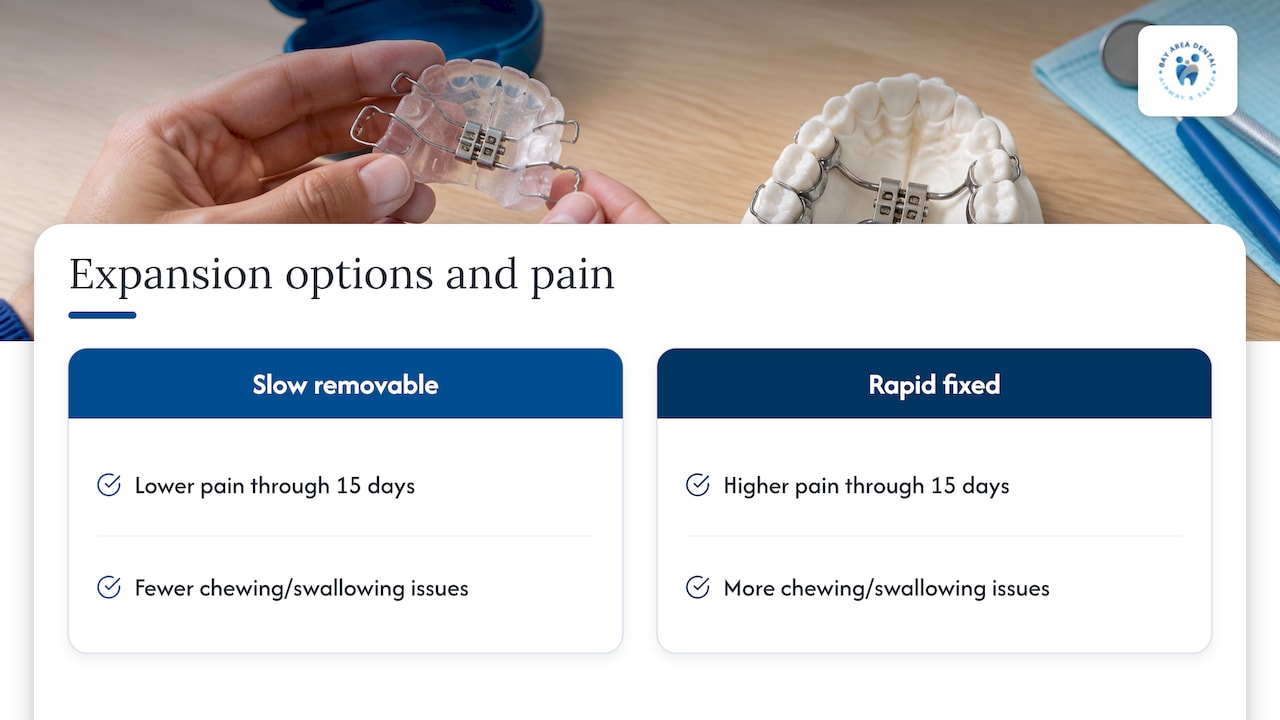
The 2023 review concluded that perceived pain is influenced by expander design and expansion protocol. It found that a slower expansion protocol, with fewer screw activations per day, correlates with less perceived pain, and that Haas and light-expander appliances appear to result in lower pain levels. The Syrian trial found lower pain and discomfort with slow removable expansion than with rapid fixed expansion through 15 days, and fewer chewing and swallowing difficulties through one month.
This is useful context for parents and adults weighing options. Pain is not a fixed price of palatal expansion. The type of appliance, how many turns per day and how the plan is paced for the patient’s age and anatomy all play a part. Age and gender did not clearly change perceived pain in the 2023 review, so a teenager or adult should not assume the experience will be dramatically harder or easier simply because of age. If you are an adult considering expansion, our page on adult palate expansion explains how that treatment is approached.
The jaw joint can also feel achy or tired when the bite changes, which is a different kind of discomfort from palate pressure. Jaw joint and muscle discomfort is its own topic, and it is worth mentioning to your orthodontist if the ache sits in front of the ears rather than in the palate.
When to call your orthodontist
Mild pressure is expected. These are reasons to call the office rather than wait:
- Pain that feels severe or is not improving as the days go by. The American Association of Orthodontists advises contacting the orthodontist’s office in this case.
- Any concerning side effect. Cleveland Clinic says to call your dentist or orthodontist right away.
- A loose, broken or displaced appliance, or one that is cutting into the tongue or gums.
- Sores, swelling or redness in the tissue under or around the appliance.
- Uncertainty about how many turns have been done or whether a turn was missed.
- Fever, facial swelling or trouble swallowing or breathing. Seek urgent medical care for trouble breathing or severe swelling, and call a doctor or the emergency services if it is an emergency.
A gap opening between the two front teeth is normal and is a sign the expander is working, as Nationwide Children’s Hospital notes. It often closes later as teeth move with braces or aligners.
Palate expansion and breathing
Many families come to expansion because of mouth breathing, snoring, crowding or a narrow palate. The pain question is often the last hurdle before agreeing to the plan. If you want to understand what expansion can and cannot do for the airway, our guide to how jaw and palate shape affect breathing explains the connection, and our article on wider nasal volume after palate expansion covers what parents and adults can realistically expect. For children around age seven, our list of signs that warrant interceptive orthodontics shows when an evaluation makes sense.
Our perspective
We hear the same question from nearly every parent: will this hurt my child? Our honest answer is that expansion brings pressure and tenderness for a short window, and that the research backs a predictable pattern: it peaks early, then fades.
We treat the mouth as part of the whole body. A narrow palate can be tied to how a child breathes, sleeps and grows, so we look at expansion as one part of a broader airway plan rather than a stand-alone appliance. That is why we put so much weight on preparing families: knowing what a turn feels like, what to eat, and when to call makes the first week far less stressful.
We also believe comfort is part of good care. Pain is influenced by appliance design and pacing, so we plan expansion around the patient, and we keep communication clear and accessible for every family, including Deaf patients and parents who rely on tailored communication.
If your child is wearing an expander and something feels wrong, call us. If you are considering one, we would rather answer every question before the first turn than after.
Bay Area Dental, Airway & Sleep
Considering expansion in the Bay Area?
If you are weighing palatal expansion for your child or yourself, our Fremont team can evaluate your situation and explain the appliance, the turning schedule and what the first weeks will feel like. We offer palatal expansion and airway-friendly clear aligners as part of our orthodontic care, alongside pediatric dental care and airway-focused treatment under one roof. See our orthodontics page to learn more or to book a visit.

Parents of younger children can also read about our children’s airway dentistry in Fremont.
FAQ
Does a palate expander hurt?
Most people feel pressure, fullness and mild soreness rather than sharp pain. Cleveland Clinic describes minor discomfort for the first few days and slight discomfort after turning the key. Intensity varies from person to person, and it should fade as expansion continues.
How long does it take for expander pain to go away?
Soreness is usually worst in the first few days and after early turns. In a 2026 study, pain declined to minimal or absent by the end of active expansion and was low or zero toward day 35. Contact your orthodontist if it is severe or is not improving.
What is the best way to relieve expander pain?
Soft foods, cold treats and an over-the-counter pain reliever such as acetaminophen or ibuprofen are the usual first steps, as Cleveland Clinic outlines. Ask your child’s pediatrician, your doctor or the orthodontist’s office about the right product and dose. If discomfort continues after a turn, wait until the next day for the next one.
Why does my expander hurt when I eat?
Chewing puts pressure on teeth and tissue that are already tender, and the appliance changes how the tongue and palate work together. A trial found chewing and swallowing difficulties were greater with a fixed rapid expander through the first month. Soft, small bites and careful cleaning help until it settles.
Do braces or expanders hurt more?
Both cause pressure and tenderness after adjustments, and each person’s experience differs. Expander pressure may be felt in the roof of the mouth and behind the face, while braces soreness is mostly in the teeth. Your orthodontist can tell you what to expect for your specific plan.
Sources
- Palate Expander: Uses, Types & Adjusting, Cleveland Clinic
- What are Palatal Expanders and What Do They Correct?, American Association of Orthodontists
- Dental: Wearing a Palatal Expander, Nationwide Children’s Hospital
- Pain during Rapid Maxillary Expansion: A Systematic Review (2023)
- Pain Experience During Rapid Maxillary Expansion (2026)
- Assessment of Patient-Centered Outcomes When Treating Maxillary Constriction (2022)
- Pain and discomfort during the first week of maxillary expansion (2022)
- Jaw joint and muscle discomfort