


Prolonged pacifier use is linked to specific dental changes, including anterior open bite, posterior crossbite, and increased overjet, and duration matters more than any other factor. Most pediatric guidance supports beginning to limit and wean pacifier use by 12 to 18 months and avoiding continued use past age 3. If you notice a visible gap between the upper and lower front teeth, a narrow upper jaw, or a bite that looks off, a pediatric dentist can tell you whether it needs attention.
TL;DR:
- Prolonged pacifier use beyond 12 to 18 months significantly increases the risk of anterior open bite, posterior crossbite, and increased overjet, especially after age 3.
- Duration of use is the strongest predictor of dental changes, with habits lasting over a year more likely to cause persistent malocclusion than shorter use.
- Choosing pacifiers with a thinner, flatter design may modestly reduce open-bite risk but does not reliably prevent crossbite, making limit on duration more important.
- Weaning before age 3 is crucial to minimize long-term dental issues, with gradual stopping strategies being most effective.
- Most early dental changes caused by pacifier habits resolve once the habit ends, but persistent issues should prompt a pediatric dental evaluation.
Table of Contents
- How Pacifiers Mechanically Influence Palate Shape and Teeth
- Risk Factors That Change the Odds: Duration, Frequency, Intensity, and Age
- Do ‘Orthodontic’ Pacifiers Really Protect the Palate?
- Benefits vs Risks: Soothing, SIDS, Ear Infections, and Speech
- How to Wean: Age-Based Plans That Actually Work
- When to See a Pediatric Dentist or Orthodontist
- A Clinical Look at Pacifier-Related Palate Concerns
- A Parent’s Honest Take on Pacifier Worry
- How We Support Pacifier-Related Palate Concerns
- FAQ
- Sources
How Pacifiers Mechanically Influence Palate Shape and Teeth
A baby’s palate is soft bone tissue that is still being shaped by the forces around it: the tongue pressing up from below, the cheeks pressing in from the sides, and whatever sits between the teeth. In a mouth with no pacifier or thumb, the tongue usually rests against the roof of the mouth and the hard palate widens into a broad, U-shaped arch as the child grows. A pacifier (or a thumb) changes that pattern. It sits between the upper and lower teeth, keeps the tongue lower in the mouth, and lets outside cheek pressure narrow the upper arch instead of letting the tongue counterbalance it.
Three malocclusions show up again and again in the research on this habit:
- Anterior open bite: the front teeth do not meet when the back teeth are closed, leaving a visible vertical gap.
- Posterior crossbite: the narrowed upper arch sits inside the lower arch at the back teeth instead of outside it, so the bite looks shifted to one side.
- Increased overjet: the upper front teeth protrude noticeably further forward than the lower front teeth.
The evidence connecting pacifier habits to these outcomes is substantial. A scoping review of pacifier research found a strong and consistent association between prolonged pacifier use and these three malocclusion patterns across multiple studies. One cited meta-analysis found daily pacifier users had an odds ratio of 10.22 for anterior open bite compared with non-daily users, a striking gap that shows how much daily habit intensity matters.
It is worth being precise about what this evidence does and does not show. These are association studies, not controlled experiments isolating pacifier use from every other variable in a child’s development. Genetics, airway anatomy, and general growth patterns also shape how a palate develops. But the consistency of the pattern across many independent studies, with the same malocclusions showing up repeatedly in children with heavy pacifier habits, gives parents a genuinely useful signal rather than a vague correlation.
Risk Factors That Change the Odds: Duration, Frequency, Intensity, and Age
Not every pacifier habit carries the same risk. Research consistently points to duration as the single strongest predictor of whether a child ends up with lasting dental changes, more important than how intensely a child sucks or how often during the day.
A pacifier habit lasting 12 months or longer raises posterior crossbite risk sharply, with one RCT and cohort analysis showing 7% prevalence in children whose habit continued past 12 months versus 1% in those who stopped by 11 months, a sevenfold difference tied to a single extra month or two of use.
A few thresholds show up repeatedly across the research:
- Before 12 months: risk of lasting structural change is relatively low, and most changes that do appear tend to self-correct once the habit stops.
- 12 to 18 months: the window pediatric guidance points to for beginning active weaning, since risk starts climbing meaningfully after this point.
- Beyond 36 months: multiple cohort studies identify this as a threshold where malocclusion becomes more likely to persist rather than correct on its own.
Frequency and intensity still matter, just less than duration. A child who uses a pacifier only at naptime and bedtime faces a different risk profile than one who has it in their mouth most waking hours. Co-occurring habits raise the stakes further: concurrent thumb or finger sucking, atypical swallowing patterns (tongue thrust), and habitual mouth breathing all compound pressure on the developing palate and are worth flagging to a dentist if you notice them alongside pacifier use.
Do ‘Orthodontic’ Pacifiers Really Protect the Palate?
Pacifier packaging often advertises “orthodontic” or “dental” shapes, implying a meaningfully lower risk profile. The evidence supports a more modest claim. Design differences, mainly a thin neck versus a thick one, and a flattened nipple profile versus a rounded one, do change how a pacifier distributes pressure against the roof of the mouth.
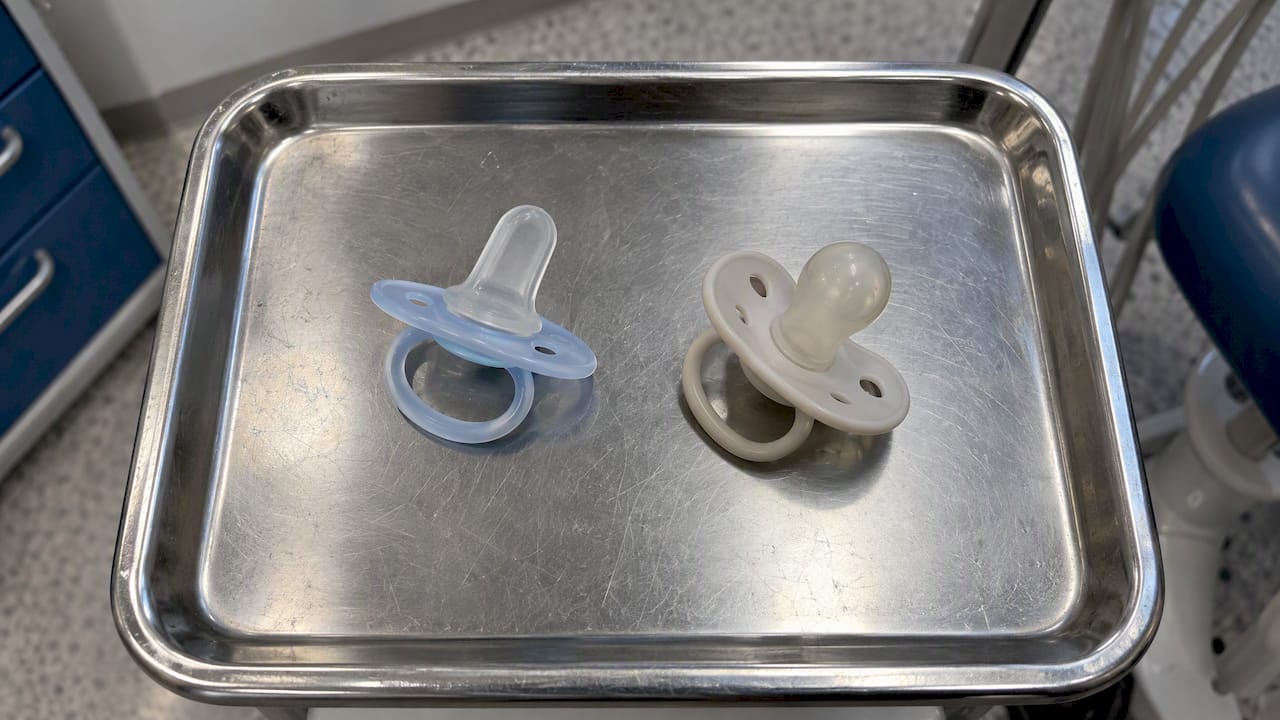
A systematic literature review of pacifier sucking and orofacial structures found moderate-quality evidence that these thinner, flatter designs tend to produce fewer anterior open bites than conventional rounded pacifiers. The same review found the evidence for posterior crossbite prevention was inconsistent. Biomechanical modeling backs this up: finite element analysis of pacifier shapes shows that narrower nipple designs concentrate pressure in the front and middle of the palate (consistent with lower open-bite risk), while broader, trapezoid shapes distribute force more evenly but do not clearly protect against the sideways narrowing that causes crossbite.
Practical takeaways for choosing a pacifier:
- A thin-neck, flattened design may modestly lower open-bite risk compared with a bulky rounded one.
- No pacifier design reliably prevents posterior crossbite, so shape should not be treated as a safety net.
- Design choice is a secondary lever. Limiting duration and frequency still does more to protect palate development than switching pacifier brands.
Benefits vs Risks: Soothing, SIDS, Ear Infections, and Speech
Pacifiers earn their popularity for real reasons, and the trade-offs are not one-sided. In the early months, pacifier use supports a non-nutritive sucking reflex that calms infants, and pediatric guidance has long noted a possible reduction in sudden infant death syndrome risk when pacifiers are offered at sleep time in the first year of life.
The risks accumulate mainly with prolonged, heavy use rather than infant-stage use. Three non-dental concerns come up consistently in pediatric and dental literature:
- Ear infections (otitis media): sucking motion can affect Eustachian tube function, and reducing pacifier use after the first year is associated with lower otitis media risk in AAPD guidance.
- Speech and articulation: a raised or indented palate shape from prolonged use can alter the oral cavity used to form certain sounds, and research on prolonged pacifier use and language development links this palate shape to articulation difficulty, though the size of the effect varies across studies.
- Dental malocclusion: covered above, and the risk that grows most directly with duration rather than any other factor.
The practical rule that falls out of this evidence is straightforward: lean on the pacifier for soothing and sleep safety during the first year, when the benefits are strongest and the dental risks are lowest, then start deliberately reducing access as your child approaches 12 to 18 months. You are not choosing between “good baby item” and “bad baby item.” You are matching the tool to the age where its benefits outweigh its costs.
How to Wean: Age-Based Plans That Actually Work
Weaning works best when it is deliberate rather than reactive. Pediatric guidance generally recommends minimizing pacifier use between 6 and 12 months, actively working toward stopping by 12 to 18 months, and treating age 3 as a hard outer limit given the rising risk of structural changes that no longer self-correct.
A staged approach tends to go more smoothly than an abrupt stop:
- Restrict daytime use first. Limit the pacifier to naps and bedtime before touching nighttime use, so your child gets used to daytime without it while keeping sleep routines stable.
- Replace the ritual, not just the object. Swap in a comfort item, a short song, or a specific cuddle routine at the moments the pacifier used to fill.
- Shorten gradually rather than cutting cold. Reduce the minutes allowed with the pacifier at each sitting over one to two weeks instead of removing it in a single day.
- Use small, concrete rewards for older toddlers. A sticker chart or a small milestone reward can motivate a 2 or 3 year old who understands the concept of giving something up.
- Bring in your dentist if progress stalls. The scoping review on pacifier habits cites clinical reports of notably higher cessation success when professionals support the plan with structured steps and follow-up, compared with parent explanation alone.
Pro Tip: Expect a few rough nights right after you start weaning, especially around sleep. Staying calm and consistent matters more than the specific method you choose, since toddlers pick up on parental stress and often resist harder when they sense frustration.
When to See a Pediatric Dentist or Orthodontist
Most pacifier-related changes caught early resolve on their own once the habit stops. A few signs mean it is worth scheduling a dental evaluation rather than waiting:
- A visibly narrow or high-arched palate that does not seem to be widening with age.
- An open bite or crossbite that is still present several months after the pacifier habit ends.
- Speech sounds that seem affected by tongue position or mouth shape.
- A bite that looks misaligned once the permanent front teeth start coming in, usually around age 6 to 7.
A first evaluation typically involves a visual and hands-on exam of the bite, palate shape, and tongue posture. Depending on what the dentist sees, next steps range from simple monitoring, to a referral for myofunctional therapy, to palatal expansion later if the narrowing has not corrected itself. Catching concerns early generally means simpler, less invasive treatment later.
A Clinical Look at Pacifier-Related Palate Concerns
A dental exam for pacifier-related concerns usually starts with a visual and functional check of the palate, bite, and tongue posture, sometimes supported by 3D imaging when a clinician needs a clearer picture of arch width or airway space. Myofunctional screening looks specifically at tongue rest position and swallowing pattern, since those habits interact with pacifier use to shape the palate over time.
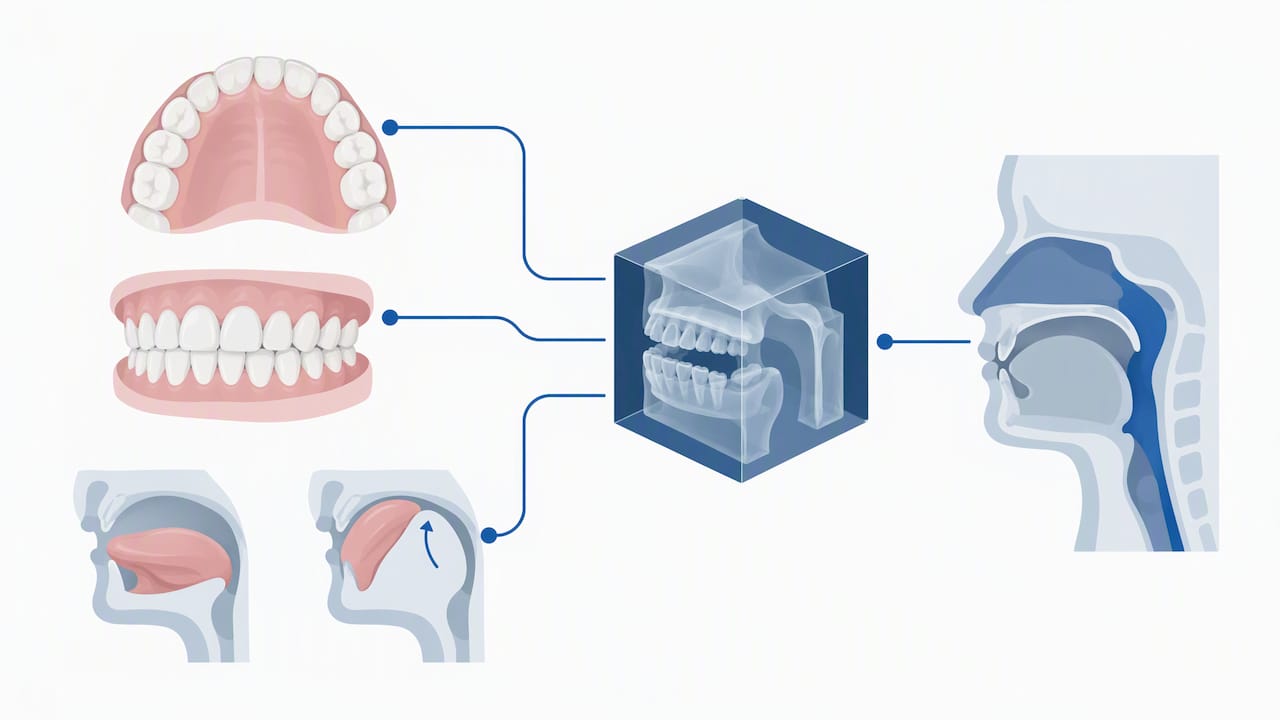
Early, noninvasive options often come first: structured weaning support, scheduled follow-up visits to track palate development, and myofunctional therapy to retrain tongue posture. Appliances and palatal expansion are generally reserved for cases where crossbite or narrowing persists well after the habit has stopped. If you are bringing a child in for this concern, it helps to note when the pacifier habit started, how often it is used now, and any speech or bite changes you have noticed.
A Parent’s Honest Take on Pacifier Worry
Watching for palate changes while also just trying to get your toddler to sleep is a lot to hold at once, and most parents are not doing anything wrong by leaning on a pacifier in year one. The goal is not perfection, it is attention: start trimming the habit around 12 to 18 months, and do not let it drift past age 3. Catching a narrow palate or an open bite early almost always means a simpler fix, often nothing more than watching and waiting, rather than years of orthodontic work later.
— Admin
How We Support Pacifier-Related Palate Concerns
If weaning has stalled or you have noticed a bite or palate change that is not resolving, you can seek pediatric dental evaluations designed for this situation. Our pediatric dental care visits start with a straightforward exam of bite, palate shape, and tongue function, add imaging only when it would actually change our recommendation, and end with a concrete weaning or treatment plan plus a follow-up schedule.

When a habit has already affected the palate, available options can include myofunctional therapy, palatal expansion, and orthodontic treatments to correct it without overcomplicating care a child might not need yet. Schedule a pediatric evaluation and get a clear answer on where your child’s palate development stands.
This article is general information, not a substitute for advice from a qualified doctor. Consult a qualified healthcare professional about your own circumstances before acting on anything here.
FAQ
Do pacifiers help when babies are teething?
Pacifiers primarily soothe through sucking rather than by directly easing teething pain, since they do not deliver cold or pressure relief the way a chilled teething ring does. Many parents still find the sucking motion calms a fussy teething baby, but it is a comfort tool rather than a targeted teething remedy.
Why are babies obsessed with pacifiers?
Babies are born with a strong non-nutritive sucking reflex that helps them self-soothe, regulate stress, and settle into sleep. A pacifier satisfies that reflex without requiring feeding, which is why infants often reach for one well beyond mealtimes.
Does thumb sucking affect your teeth?
Yes, thumb sucking can produce the same malocclusions linked to pacifier use, including anterior open bite and increased overjet, since the mechanical pressure on the palate and teeth works the same way. Thumb sucking can be harder to wean than a pacifier because you cannot simply put the thumb away.
Can a cleft palate baby use a pacifier?
Pacifier use for a baby with a cleft palate depends on the specific cleft type and feeding plan a craniofacial or pediatric specialist sets up, since standard pacifiers may not fit or function safely for every cleft presentation. Always follow the guidance of the treating craniofacial team rather than general pacifier advice for this situation.