
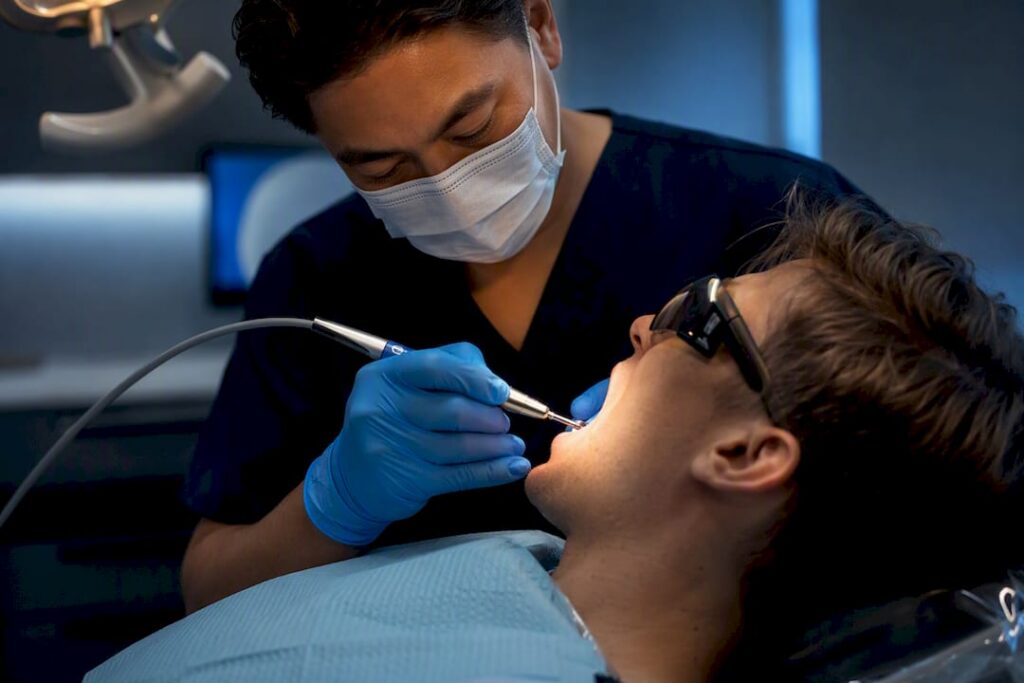
No shot dentistry uses tools like dental lasers, air abrasion, and strong topical anesthetics to treat certain cavities and soft-tissue issues without a needle or a traditional drill. It works best on early, shallow decay and many gum or tongue-tie procedures. It is not a fit for deep cavities, multi-surface fillings, or most crowns, so think of it as one option among several rather than a universal replacement for the drill.
TL;DR:
- No-shot dentistry is effective for early, surface-level cavities and minor soft-tissue procedures but cannot replace traditional drilling for deep, multi-surface, or large restorations.
- Laser and air abrasion tools minimize discomfort and promote faster healing, although their effectiveness depends on specific device types, operator training, and patient medical history.
- Patients with respiratory conditions or extensive dental work may face limitations or additional risks when using air abrasion or laser techniques.
- Choosing a provider requires verifying device models, clinician credentials, and understanding procedure indications, especially for children or anxious patients.
- Post-treatment, patients may experience brief sensitivity and should monitor for ongoing pain or swelling, with shorter appointment times often associated with no-shot approaches.
Table of Contents
- How No-Shot Dentistry Actually Works
- Who Benefits, and Where the Limits Show Up
- Weighing the Benefits Against the Real Risks
- How Do You Choose a Dentist for No-Shot Treatment?
- What Happens During the Appointment and After
- How Bay Area Dental, Airway & Sleep Applies This in Practice
- Why We Offer No-Shot Options Selectively, Not by Default
- Ready to Ask About No-Shot Options at Your Next Visit?
- Sources
How No-Shot Dentistry Actually Works
Dentists reach for a mix of technologies depending on what they’re treating, and “no shot” rarely means one single device.
Dental lasers come in two broad types. Hard-tissue lasers cut into enamel and bone, useful for removing small areas of decay. Soft-tissue lasers work on gums, frenula, and other tissue, sealing blood vessels as they cut, which is why laser frenectomy procedures tend to bleed less than the scalpel version. The wavelength of the laser determines what it can safely treat, and a dentist trained on one device isn’t automatically qualified on another.
Air abrasion sprays a fine stream of abrasive particles, usually aluminum oxide or silica, at the tooth to remove decay without vibration or heat. It’s been described as dental health without the drill, and it shines on small, surface-level cavities where preserving healthy enamel matters.
Topical anesthetics numb the surface before any laser or air abrasion work begins, sometimes paired with:
- Vibration devices that distract nerve signals during injections when they’re still needed
- Nitrous oxide for anxious patients who need extra calming
- Cold spray or gel anesthetics for quick surface numbing
Hall crowns, a pediatric option, cement a metal cap over a decayed baby tooth with no drilling or numbing at all, sealing the decay in place until the tooth naturally falls out.
Who Benefits, and Where the Limits Show Up
No-shot approaches work well for early or surface-level cavities, minor enamel reshaping, and most soft-tissue procedures like frenectomies or gum contouring. Anxious kids and needle-phobic adults tend to see the biggest comfort gains.
The limits are just as real:
- Decay that’s reached or is close to the tooth’s nerve usually needs numbing and often a drill, regardless of the tools available
- Cavities between teeth or spanning multiple surfaces are harder to access with a laser or air abrasion tip
- Crowns, bridges, and most large restorations still rely on conventional prep work
Medical history matters too. Patients with asthma or other respiratory conditions need extra care during air abrasion because of the particle spray, and teeth with existing metal fillings can block a laser’s access to the decay underneath.
Pro Tip: Ask your dentist to look at your X-rays with you and point out exactly why a tooth does or doesn’t qualify for a no-shot approach. It takes two minutes and clears up most of the confusion.
Weighing the Benefits Against the Real Risks
The upside is well documented. Laser dentistry can reduce bleeding, speed healing, and lower post-op infection risk compared to traditional cutting tools, and many patients skip the injection entirely for smaller procedures. Air abrasion adds another benefit: it preserves more of the natural tooth structure than a drill typically would.
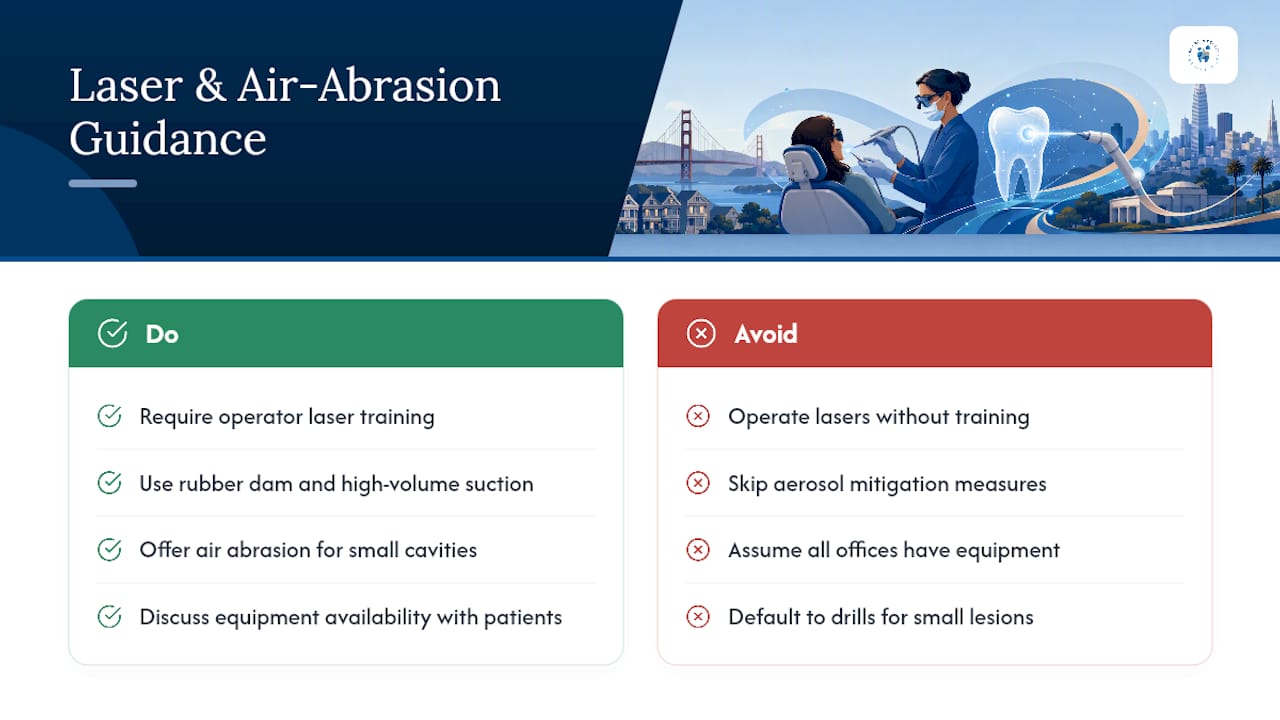
The risks are smaller but worth naming honestly. Some hard-tissue lasers carry a small chance of affecting the tooth’s pulp if not used correctly, which is why operator training matters as much as the device itself. Air abrasion aerosolizes fine particles, so practices mitigate that with rubber dams and high-volume suction. Equipment cost also shapes availability: a single laser unit can be costly, sometimes reaching into the higher price ranges, which is part of why not every dental office offers these options.
How Do You Choose a Dentist for No-Shot Treatment?
Not every practice that advertises “laser dentistry” or “no-drill options” applies them the same way. A short conversation before booking tells you a lot.
- Ask which specific devices they use. Get the laser model or air-abrasion system by name, then ask whether the clinician holds device-specific training or credentials through a body like the Academy of Laser Dentistry.
- Ask which procedures at that office skip injections or drills, and why. A good answer explains the clinical reasoning, not just the marketing pitch.
- Request examples or before-and-after photos of similar cases, especially if you’re weighing this for a child’s cavity or a tongue-tie release.
- Confirm the safety basics: protective eyewear, rubber dam isolation, high-volume suction for air abrasion, and a thorough medical history review before treatment.
- Look for practice-level signals that they take comfort seriously: dedicated pediatric or anxiety-focused services, transparent pricing, and a willingness to explain limits upfront.
Pro Tip: If a practice can’t name their laser’s wavelength or explain why it works for your specific case, that’s worth a follow-up question before you book.
What Happens During the Appointment and After
“Painless” doesn’t always mean you feel nothing. Most patients still notice pressure, mild vibration, or the sensation of air and water spray, even without a needle involved. That’s normal, and a dentist who’s upfront about it ahead of time makes for a much calmer visit.
For small cavities or soft-tissue work, appointments often run shorter than a traditional filling because there’s no numbing wait time built in. Afterward:
- Mild sensitivity to hot or cold for a day or two is common with laser or air abrasion work
- Soft-tissue procedures like frenectomies may need a brief follow-up to check healing
- Return if you notice ongoing pain, swelling, or a filling that feels high when you bite down
How Bay Area Dental, Airway & Sleep Applies This in Practice
Minimally invasive care isn’t a marketing line at Bay Area Dental, Airway & Sleep. It’s built into how the practice diagnoses and treats in the first place.
- 3D imaging maps out decay and airway structure before deciding whether a laser, air abrasion, or conventional approach fits best
- Laser treatments support both restorative work and procedures like frenectomy for infants, children, and adults
- Myofunctional therapy and airway-focused care address root causes, not just symptoms
- Communication access for Deaf patients, including tailored scheduling and interaction, extends comfort-focused care beyond just needles and drills
Why We Offer No-Shot Options Selectively, Not by Default
Comfort matters, but so does doing right by the tooth. We choose laser or air-abrasion approaches when the clinical picture supports it, not because “no shot” sounds appealing on a website. If you’re anxious about needles or drills, tell us before your appointment. Ask us directly whether your specific case qualifies.
— Admin
Ready to Ask About No-Shot Options at Your Next Visit?
If needles or the sound of a drill have kept you or your child from the dentist’s chair, you have more options than a lot of practices let on. Bay Area Dental, Airway & Sleep uses laser treatments and air abrasion for the cases where they genuinely fit, alongside frenectomy, myofunctional therapy, and pediatric care built around comfort from the first visit.
When you call to book, ask three things: which laser or air-abrasion device they use, whether your specific procedure is a realistic candidate for a no-shot approach, and what the visit will actually feel like. You can schedule a consultation with Bay Area Dental, Airway & Sleep and get straight answers before you commit to anything.
This article is general information, not a substitute for advice from a qualified doctor. Consult a qualified healthcare professional about your own circumstances before acting on anything here.