

Yes, most people can train themselves to breathe through the nose instead of the mouth, provided their nasal passages aren’t structurally blocked. Start with two 5-minute formal breathing sets, twice a day, plus habit cues like taping your lips shut during rest or exercise walks. If congestion, snoring, or daytime fatigue don’t improve after a few weeks of consistent practice, that’s a sign to see an ENT or a myofunctional therapist rather than pushing through on your own.
TL;DR:
- Most individuals can improve nasal airflow with consistent practice, but structural issues may require clinical intervention for lasting results.
- Training routines of two five-minute sessions twice daily, including diaphragmatic breathing and alternate nostril exercises, produce measurable improvements in nasal passage function within four weeks.
- Nasal breathing enhances nitric oxide production, supports circulation, and activates the parasympathetic nervous system, contributing to better health and stress regulation.
- During high-intensity exercise or heavy lifting, mouth breathing remains necessary; nasal training is most effective at low to moderate effort levels.
- Persistent symptoms such as nasal blockage, loud snoring, or sleep pauses after weeks of practice indicate the need for professional assessment and possibly structural correction.
Table of Contents
- Why Nasal Breathing Training Matters for Health and Performance
- Nasal vs Mouth Breathing: What Changes and How to Tell
- How to Do Nasal Breathing Exercises Step by Step
- A 4-Week Nasal Breathing Training Plan
- Nasal Breathing During Exercise: When It Works and When It Doesn’t
- When to See a Doctor About Nasal Breathing Problems
- The Bay Area Dental, Airway & Sleep Perspective on Nasal Breathing
- Get an Airway Assessment at Bay Area Dental, Airway & Sleep
- Sources
- FAQ
Why Nasal Breathing Training Matters for Health and Performance
Your nose does more than smell things. It filters particles, humidifies and warms incoming air, and releases nitric oxide, a gas that helps dilate blood vessels and improve oxygen uptake in the lungs. Mouth breathing skips all of that, delivering cold, dry, unfiltered air straight to your airway.
The nervous system benefits are just as real. Slow nasal breathing activates the parasympathetic system, the “rest and digest” side of your body, which can steady heart rate variability and lower stress reactivity. Physiologists studying breath-based interventions caution that this is a supportive habit, not a stand-alone treatment for something like chronic hypertension — it complements medical care, it doesn’t replace it.
For exercise, nasal breathing forces a slower, more controlled respiratory rate. That tends to improve diaphragmatic bracing, reduce hyperventilation during steady-state cardio, and build endurance at submaximal effort.
The evidence for trainability itself is solid. A 4-week online breathing rehabilitation protocol produced statistically significant improvements in nasal obstruction and self-reported mouth breathing, with participants who stuck to the routine seeing the biggest gains.
Key benefits worth training for:
- Better air filtration, humidification, and warming before it reaches your lungs
- Increased nitric oxide release, which supports circulation and oxygen delivery
- Calmer autonomic nervous system response during rest and low intensity effort
- Improved diaphragmatic engagement and pacing during aerobic exercise
Quick stat: In that same 4-week trial, most participants completed formal practice more than four times a week, and nearly all of them used the techniques informally throughout the day.
Nasal vs Mouth Breathing: What Changes and How to Tell
Nasal and mouth breathing aren’t just two paths to the same result. A narrative review found they activate different brain regions and appear to affect respiratory muscle recruitment differently, with nasal breathing linked to stronger activity in areas tied to attention and memory.
Here’s how to self-check which mode you default to:
- Mirror test: Watch your lips at rest. If they’re parted and you’re not talking, you’re likely a habitual mouth breather.
- Morning dry mouth: Waking up with a dry mouth or throat almost always points to nighttime mouth breathing.
- Snoring or witnessed pauses in breathing: Both suggest airway resistance that nasal training alone may not fix.
One caveat: don’t force nasal-only breathing when your body genuinely needs more oxygen. During max-effort sprints or heavy lifts, mouth breathing is a normal, necessary release valve, not a failure of technique.
How to Do Nasal Breathing Exercises Step by Step
Nasal breathing training works best as a short daily routine, not a one-time fix. These five moves cover the core skill set.
- Diaphragmatic (belly) breathing. Lie down or sit tall, one hand on your belly. Inhale through your nose for a count of four, letting your belly rise while your chest stays quiet. Exhale for a count of six. Do 2 to 5 minutes, following the same daily practice window lung-health groups recommend for building respiratory stamina.
- Alternate nostril breathing. Close your right nostril with your thumb, inhale through the left for four counts, close both nostrils briefly, then release the right and exhale for four. Reverse and repeat for 5 minutes. This one is especially useful before bed or during a stressful moment, since it slows your breathing rate almost automatically.
- Humming (Bhramari-style). Inhale through the nose, then exhale while humming at a steady pitch. Humming meaningfully raises nasal nitric oxide production, which helps keep nasal passages open and functional.
- Breath holds. After a normal nasal exhale, pinch your nose and hold for 5 to 10 seconds before releasing. This builds tolerance to mild carbon dioxide buildup, which is part of what makes nasal breathing feel effortful at first.
- Nose-push (mirror) practice. Stand in front of a mirror, close your mouth, and practice resting your tongue on the roof of your mouth with lips gently sealed. Hold that posture for a minute at a time, several times a day.
Common mistakes: clenching your jaw instead of relaxing it, breathing too fast (over-breathing defeats the purpose), and forcing your nostrils open with your fingers instead of training the muscles to do it naturally.
Pro Tip: Practice the nose-push drill right after brushing your teeth. Pairing it with an existing habit makes it far more likely to stick.

A 4-Week Nasal Breathing Training Plan
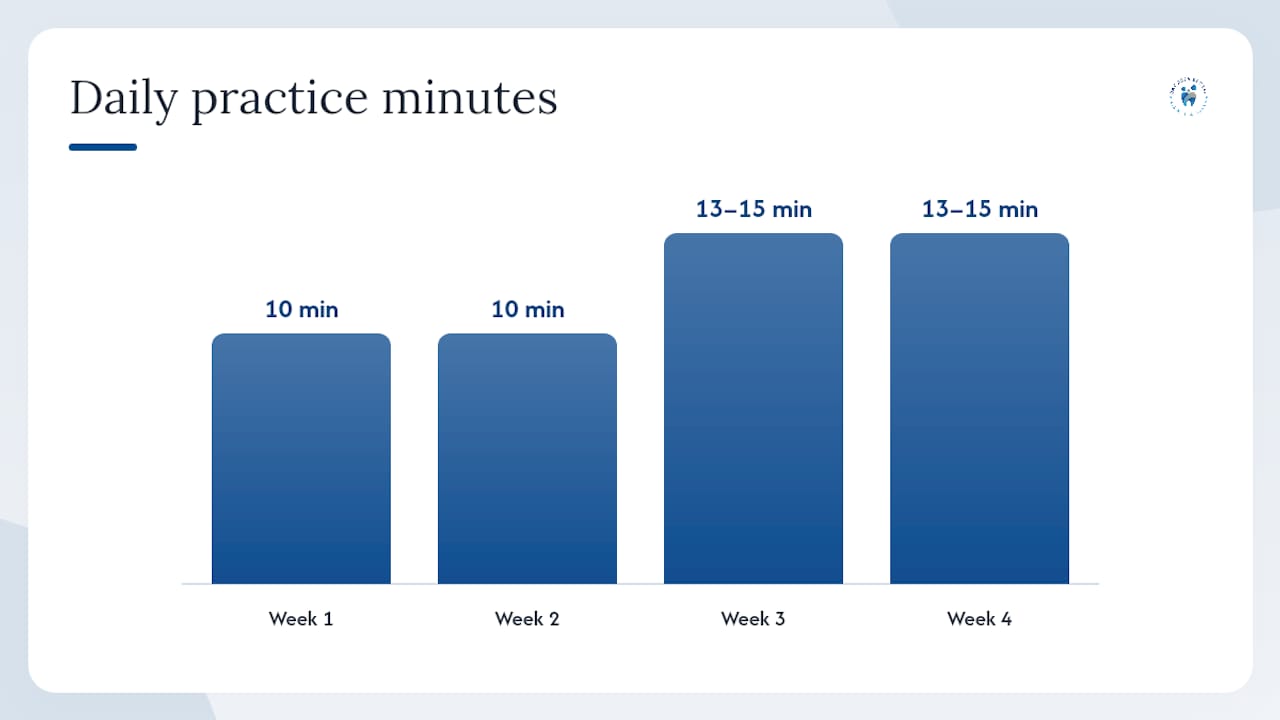
Consistency beats intensity here. Myofunctional therapy guidance recommends two 5-minute formal sets per session, twice daily, for about 10 minutes of total daily practice, done in front of a mirror so you can monitor your form.
Here’s how to progress it over a month:
- Week 1: Focus purely on form. Two 5-minute sets of diaphragmatic and alternate nostril breathing, twice daily. Add lip-taping during quiet activities like reading.
- Week 2: Introduce humming and short breath holds into your sets. Keep the same twice-daily frequency.
- Week 3: Extend one session to 8 to 10 minutes and start applying nasal breathing during light walks or easy cardio.
- Week 4: Maintain your routine and fold nasal breathing into your regular workouts, resistance training included.
Adherence is what actually drives results. In the FNBR trial, participants who practiced more than four times a week saw the clearest improvement in nasal obstruction scores within that same 4-week window. Track your own progress with a simple log: rate nasal comfort, note how open your airflow feels, and jot down one line about sleep quality each morning.
Nasal Breathing During Exercise: When It Works and When It Doesn’t
Ease into it. Start applying nasal breathing at low-to-moderate intensity, like brisk walking or an easy jog, and use cadence to match your breath rather than the other way around.
- Cardio: Try a 3:2 step-to-breath ratio (three steps per inhale, two per exhale) and adjust pace to keep it comfortable.
- Resistance training: Inhale through the nose during the lowering phase of a lift, exhale through the nose (or pursed lips) on the exertion phase, keeping your core braced throughout.
- High intensity: Accept mouth breathing during sprints or near-maximal lifts. Forcing nasal-only breathing under high oxygen demand can cause dizziness or dyspnea, which defeats the purpose.
Pro Tip: Use nasal breathing for your warm-up and cool-down every session, even on days you know you’ll need your mouth for the hard part. That’s where most of the adaptation actually happens.
When to See a Doctor About Nasal Breathing Problems
Some obstacles need more than practice. See a clinician if you notice persistent nasal blockage, loud snoring, witnessed pauses in breathing during sleep, daytime sleepiness, or no improvement after weeks of consistent training.
- An ENT evaluates structural issues like a deviated septum, enlarged turbinates, or a narrow nasal valve, and can discuss surgical options when anatomy is the real obstacle.
- A myofunctional therapist or airway-focused dentist addresses tongue posture, lip seal, and jaw position, since weak oral muscle tone can undermine nasal breathing even when your airway is technically clear.
- Bring a symptom log and a few nights of sleep notes to your first appointment. It gives the clinician something concrete to work from instead of a vague description of “feeling tired.”
The Bay Area Dental, Airway & Sleep Perspective on Nasal Breathing
Nasal breathing training doesn’t happen in isolation at Bay Area Dental, Airway & Sleep. It’s woven into airway assessments and myofunctional therapy, especially for patients whose oral rest posture or tongue position is quietly working against every breathing drill they try.
When anatomy or habit patterns are part of the problem, clinicians build breathing retraining into a broader treatment plan rather than treating it as homework handed out on its own.
— Admin
Get an Airway Assessment at Bay Area Dental, Airway & Sleep
Most people can make real progress on nasal breathing with nothing more than a mirror and 10 minutes a day. But if you’ve tried the routine above for a few weeks and you’re still congested, still snoring, or still waking up exhausted, the issue probably isn’t effort. It’s anatomy or oral posture, and that needs a trained eye.
A local practice offers airway assessments, myofunctional therapy, and laser frenectomy when a restricted tongue or lip tie is limiting proper oral rest posture. A first visit typically includes a look at your nasal airway, oral posture, and sleep-related symptoms, so you leave with a sense of whether you’re a good candidate for self-directed training or need a more targeted plan. If nighttime symptoms or persistent obstruction have been holding your breathing back, schedule an airway evaluation and find out what’s actually going on.
Sources
- Functional nasal breathing rehabilitation: Effectiveness and feasibility of an online integrative breathing therapy protocol
- Myofunctional therapy and nasal breathing exercises
- Effects of nasal and oral breathing on respiratory muscle and brain function (narrative review)
- Breathing exercises for better lung health | American Lung Association
FAQ
Is it possible to train yourself to breathe through your nose?
Yes. A 4-week structured breathing protocol produced significant improvements in nasal obstruction and mouth breathing among participants who practiced consistently, though people with significant structural blockage may need clinical treatment alongside training.
How long does it take to train nasal breathing?
Most people notice change within 4 weeks of consistent practice, following a routine of two 5-minute sets, twice daily. Full habit change, especially overnight, can take longer and often benefits from ongoing myofunctional work.
Is nasal breathing better for exercise?
For low-to-moderate intensity activity, yes. It improves pacing, diaphragmatic bracing, and reduces hyperventilation, but during sprints or maximal lifts, mouth breathing is a normal and necessary response to high oxygen demand.
Is nasal breathing healthier than mouth breathing?
Generally, yes. It filters, warms, and humidifies air while releasing nitric oxide that supports circulation, and it engages different, often more favorable brain and muscle activity patterns than mouth breathing does.