
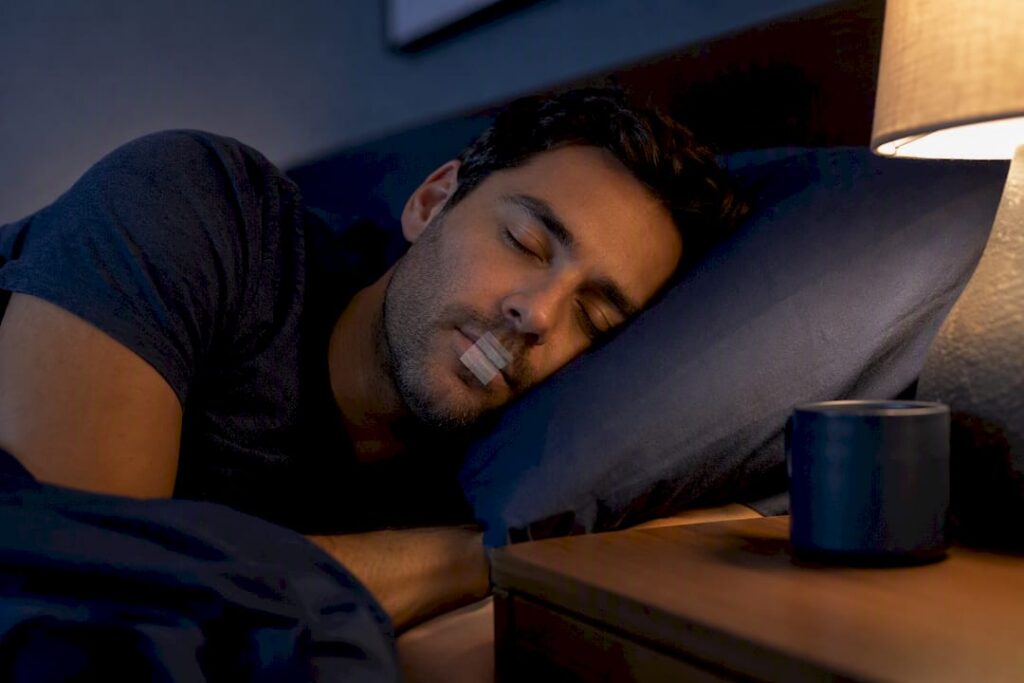
Mouth taping is not broadly recommended, and the newest evidence backs that caution. A 2025 systematic review found only limited clinical benefit, and major health systems warn it can be dangerous for anyone with sleep apnea or nasal obstruction. If you snore heavily, gasp at night, or have never been screened for sleep apnea, skip the tape and get evaluated first. Everyone else should read the risks and safety steps below before trying it.
TL;DR:
- Mouth taping shows limited benefit mainly for mild sleep apnea and often requires combination therapy to be effective, with the risk of blocking nasal airflow.
- Many studies exclude individuals with nasal obstructions or sleep apnea, making the evidence less applicable to those most likely to try mouth taping.
- The practice carries serious risks for people with nasal blockage, sleep apnea, or respiratory issues, including asphyxiation, skin irritation, and disrupted sleep.
- Safer, evidence-based alternatives include positional therapy, nasal strips, saline rinses, weight management, and oral devices for sleep apnea.
- Proper diagnosis and evaluation by a healthcare professional should precede any home trial, as mouth taping cannot address structural airway issues.
Table of Contents
- What Does the Research Say About Mouth Taping for Sleep?
- What Benefits Does Mouth Taping Actually Deliver?
- What Are the Risks and Who Should Avoid Mouth Taping?
- How Can You Try Mouth Taping Safely, If You Still Want To?
- What Are the Alternatives to Mouth Taping for Snoring and Sleep Apnea?
- When Should You See a Clinician Instead of Trying Tape?
- Our Take: Evidence Over Hype
- Ready for a Real Airway Evaluation Instead of a Guess?
- Sources
What Does the Research Say About Mouth Taping for Sleep?
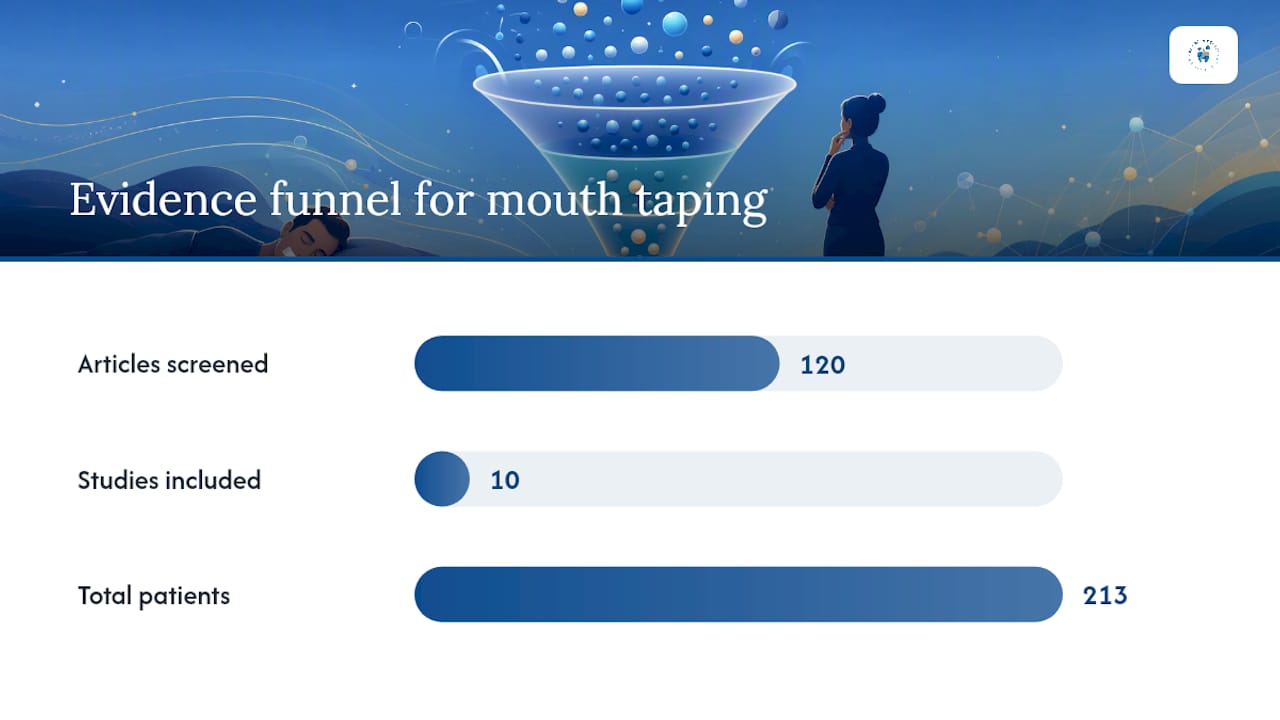
The evidence base for mouth taping is thinner than social media suggests. A 2025 systematic review published on PMC screened 120 articles and narrowed the field to just 10 studies covering 213 patients total. That is a small pool for a trend with millions of social media mentions, and the review’s authors were blunt about it: the overall clinical benefit of mouth occlusion is minimal, and the practice carries real asphyxiation risk for people with obstructed nasal breathing.
That gap between hype and data is the whole story here. Nasal breathing during the day, which most sleep experts genuinely encourage, is a voluntary choice you can abandon the second it feels wrong. Taping your mouth shut at night removes that choice while you are unconscious. Researchers at CU Anschutz Medical Campus have pointed out that this distinction gets lost in viral videos: practicing nasal breathing while awake and forcing it while asleep are not the same intervention, and they do not carry the same risk profile.
What the studies actually measured
The 10 studies in the systematic review generally tracked three outcomes:
- Apnea-hypopnea index (AHI), the standard measure of how often breathing stops or nearly stops per hour of sleep.
- Oxygen desaturation index (ODI), which tracks how often blood oxygen drops during sleep.
- Snoring index, a measure of how frequently and loudly a person snores.
A handful of trials reported statistically significant AHI improvements, but the pattern matters more than the headline. In one trial, AHI dropped from 8.3 to 4.7; in another, a reduction in AHI was seen in mild OSA cases. Both improvements showed up in mild OSA subgroups or in patients using mouth tape alongside an oral appliance, not tape alone. That is a meaningfully different claim than “mouth taping fixes sleep apnea.” A statistically significant change in a small mild-OSA sample does not tell you what happens in a moderate or severe case, and it says nothing about safety for someone with a blocked nose.
Only a minority of the 10 studies in the review showed statistically significant AHI improvements, and those gains clustered in mild OSA subgroups or combination therapies rather than mouth tape used by itself.
Why the studies exclude the people most likely to try this
Here is the detail that gets buried in most coverage: many of these trials excluded people with nasal obstruction, deviated septums, or chronic congestion from enrollment. That is a reasonable safety decision for a researcher running a trial. It is also exactly the population most likely to see mouth-taping videos and think, “this could help me stop snoring.” The evidence was never generated on the people asking the question.
Harvard Health reaches a similarly cautious conclusion: there is no strong evidence supporting mouth taping as a snoring or sleep apnea treatment, and clinicians should rule out structural causes like a deviated septum before anyone tries to force nasal breathing at night. The PLOS ONE version of the same systematic review data reinforces the point: combination approaches, where tape is paired with an oral appliance, sometimes outperformed tape used alone. That is not evidence for mouth taping as a stand-alone therapy. It is evidence that tape might do something when it is not the only thing being done.
Small sample sizes, short trial durations, and inconsistent tape products across studies all limit how far you can generalize any of these findings. If you’re looking at a single number like “AHI dropped 44 percent,” ask what the baseline severity was, how many participants that number represents, and whether nasal obstruction was screened out before you assume it applies to your situation.
What Benefits Does Mouth Taping Actually Deliver?
Social media claims tend to run well ahead of what small trials have actually shown. Here is what people commonly claim, sorted by how much evidence backs each one.
Claims with some trial support:
- Reduced snoring index in a subset of participants, particularly those without nasal obstruction.
- Modest AHI improvement in mild OSA cases, usually alongside another intervention like an oral appliance.
- Reduced dry mouth on waking, a plausible mechanical effect of keeping lips closed, though this is rarely the primary outcome measured in trials.
Claims with little to no trial support:
- Better deep sleep or REM sleep quality.
- Improved jawline or facial structure.
- General anxiety or stress reduction from “nasal breathing training.”
- Broad-spectrum energy or cognitive improvements the next day.
The gap between these two lists is the gap between statistical significance and clinical significance, and it is worth understanding if you are going to make a decision based on a headline. A result can be statistically significant, meaning it is unlikely to be due to chance, while still being too small to matter in daily life. An AHI drop from 12 to 7.8 is statistically real in that study’s sample. Whether it translates into you feeling less tired, sleeping through the night, or reducing your long-term cardiovascular risk from untreated apnea is a separate question the trial was not designed to answer.
There is also a mechanical wrinkle researchers have flagged: mouth puffing. Some people wearing tape still attempt to breathe through their mouth against the barrier, puffing their cheeks rather than actually switching to nasal breathing. If that happens, the tape is not doing what it is marketed to do. It just adds a layer of restriction on top of an airway problem that was never addressed.
None of this means nasal breathing itself is a bad goal. Encouraging nasal breathing during the day, through posture, allergy treatment, or simple awareness, has a much better safety profile than sealing your mouth while unconscious. The trend conflates a reasonable daytime habit with an overnight intervention that has not been proven safe for the people most likely to need help.
What Are the Risks and Who Should Avoid Mouth Taping?
The most serious risk is straightforward: if your nose is blocked and your mouth is taped shut, you cannot breathe. That is not a hypothetical. The systematic review specifically flagged asphyxiation risk in people with nasal obstruction, and the Sleep Foundation notes that an estimated 30 million Americans have sleep apnea, many of them undiagnosed. Restricting mouth breathing in someone with untreated obstructive sleep apnea can lower blood oxygen levels during exactly the hours when no one is around to notice.
Beyond the worst-case scenario, Cleveland Clinic and other health systems list a set of more common, less dramatic adverse effects:
- Skin irritation or breakdown around the lips, especially with repeated use or the wrong tape.
- Pain or skin tearing on removal, particularly with adhesives not designed for facial skin.
- Anxiety or panic sensations, especially for anyone with a history of claustrophobia.
- Mouth puffing, where the person keeps attempting to mouth-breathe against the tape instead of adapting to nasal breathing.
- Disrupted sleep from discomfort, which defeats the entire purpose of trying the tape in the first place.
Who should never try this at home
- Anyone diagnosed with, or suspected of having, obstructive sleep apnea.
- Anyone with chronic nasal obstruction: a deviated septum, chronic sinusitis, large nasal polyps, or severe seasonal allergies during flare-ups.
- Anyone who has used alcohol or sedatives that evening. Both suppress the natural arousal response that would otherwise wake you if breathing became difficult.
- Anyone with severe cardiopulmonary disease, where even brief oxygen dips carry outsized risk.
- Anyone with chapped, irritated, or broken skin around the mouth.
- Anyone with a history of panic attacks or significant claustrophobia.
Houston Methodist adds another item worth taking seriously: GERD. If you have frequent nighttime reflux, taping your mouth shut removes one of your body’s release valves if you need to clear your airway quickly. Combine that with chronic congestion, and you have two independent reasons your airway could be compromised at the same time.
Pro Tip: If you snore loudly enough that a partner has recorded it, or if you wake up gasping even occasionally, treat that as a sign to get screened for sleep apnea before you try any home remedy, tape included. A home sleep test is faster and less invasive than most people expect.
The pattern across every major source here, Cleveland Clinic, Harvard Health, the Sleep Foundation, and the 2025 systematic review, is consistent: the risk profile is not evenly distributed. If you have a clear nose, no diagnosed sleep disorder, and reasonably calm nights, the downside is mostly skin irritation and a bad night’s sleep. If any of those conditions do not apply to you, the downside gets a lot more serious, a lot faster.
How Can You Try Mouth Taping Safely, If You Still Want To?
If you have ruled out sleep apnea, nasal obstruction, and the other contraindications above, and you still want to experiment, a staged approach limits how much can go wrong on any single night.
Before you start, ask yourself:
- Have I ever been screened for sleep apnea, even informally? If not, that comes first, not after.
- Can I currently breathe through my nose comfortably, with no congestion, for a full five minutes while sitting still?
- Do I take any sedative medication, or did I drink alcohol tonight?
- Do I have any skin sensitivity, eczema, or recent irritation around my mouth?
A “no” on question 2, or a “yes” on question 3, is a reason to stop before you start that night.
Materials matter. WebMD and Cleveland Clinic both recommend medical-grade, skin-safe tape, the kind designed for sensitive skin or post-surgical use, rather than anything from a hardware store. Duct tape, packing tape, or generic office tape can tear skin on removal and often are not breathable. Moisturize your lips beforehand to reduce friction, but let the moisturizer absorb fully before applying tape, or it will not adhere properly.
Stage the trial instead of jumping straight to eight hours unconscious:
- Daytime test, 15 to 30 minutes. Apply the tape while you are awake and doing something relaxed, like reading. Confirm you can still breathe comfortably through your nose and that the adhesive does not irritate your skin.
- Short nap, 20 to 60 minutes. Try it during a daytime nap when someone else is home or awake nearby, never as your very first overnight attempt.
- First overnight trial. Only after the first two stages go smoothly, and ideally with a partner aware you are trying it, so someone would notice if something went wrong.
Watch for mouth puffing, waking up anxious, or any sense of restricted breathing at any stage. Any of those is a stop signal, not something to push through.
Pro Tip: Keep the tape loose enough that you could remove it with one hand in under two seconds if you needed to. If you cannot do that test right now while reading this, the tape is too restrictive.
Skin care matters more than most people expect. Remove tape slowly, in the direction of hair growth, and consider an oil-based makeup remover if the adhesive resists. Give your skin tape-free nights between attempts rather than using it every single night from day one.
What Are the Alternatives to Mouth Taping for Snoring and Sleep Apnea?
Mouth taping alternatives with a stronger evidence base exist, and most of them cost less risk for comparable or better results.
Lower-effort, lower-risk options worth trying first:
- Positional therapy. Many people snore primarily on their back; a body pillow or a positional trainer that discourages back-sleeping can reduce snoring without touching your airway directly.
- Nasal strips. Adhesive strips that lift the nostrils open reduce airflow resistance without covering the mouth, making them a genuinely lower-risk option for simple congestion-related snoring. Nasal strips vs. mouth tape is not really a close comparison for safety. One opens an airway; the other restricts an exit.
- Saline nasal irrigation. Clearing congestion before bed with a saline rinse addresses one of the actual causes of mouth breathing rather than masking the symptom.
- Weight management and alcohol timing. Both directly affect airway muscle tone and are backed by decades of sleep medicine research, unlike tape.
When you need more than a home remedy:
Mandibular advancement devices, custom-fitted mouthpieces that shift the lower jaw forward to open the airway, have a genuine evidence base for mild to moderate OSA and snoring, and dentists trained in airway care often fit them. CPAP remains the gold-standard treatment for moderate to severe obstructive sleep apnea, backed by decades of outcome data on oxygen levels and cardiovascular risk that mouth tape simply does not have.
Mouth taping vs. chin strap comparisons come up often, too. A chin strap supports the jaw to reduce mouth breathing without sealing the airway shut the way tape does, which makes it a somewhat gentler mechanical approach, though it still is not a substitute for diagnosis if OSA is suspected.
Myofunctional therapy, which retrains tongue and facial muscle function through targeted exercises, addresses the muscular causes behind chronic mouth breathing rather than covering the symptom at night. Mouth taping vs. myofunctional therapy is really a comparison between a temporary mechanical fix and a longer-term functional one. An ENT can evaluate structural nasal obstruction, and a dentist trained in airway assessment can evaluate jaw structure, tongue position, and tongue-tie, factors that often explain why someone breathes through their mouth in the first place.
For readers dealing specifically with nighttime nasal congestion, Snozzing’s guide on nocturnal nasal breathing covers practical causes and remedies worth reading before you consider any mouth-occlusion product.
When Should You See a Clinician Instead of Trying Tape?
Certain symptoms should send you to a professional before you touch any home remedy, mouth tape included.
Red flags that warrant evaluation:
- Witnessed apneas, meaning someone has seen you stop breathing during sleep.
- Choking or gasping awake in the middle of the night.
- Excessive daytime sleepiness, especially if you doze off during normal daily activities.
- Very loud, regular snoring most nights, particularly if it has grown worse over time.
- Morning headaches or a dry, sore throat that shows up almost every day.
What a proper evaluation usually involves:
- A home sleep test for suspected mild to moderate cases, or in-lab polysomnography (PSG) for more complex presentations.
- An ENT exam to check for structural nasal obstruction, septal deviation, or enlarged tonsils.
- A dental airway assessment, which looks at jaw structure, tongue position, and tongue-tie, all of which influence whether someone breathes through their mouth at night.
- 3D imaging in some dental airway practices, which gives a detailed look at airway volume beyond what a standard exam can show.
Bay Area Dental, Airway & Sleep approaches this evaluation as a starting point rather than a single test. An initial visit typically includes a screening conversation about symptoms and sleep history, 3D imaging to assess airway anatomy, and a referral pathway to sleep medicine or ENT specialists when the findings point toward a diagnosis outside dentistry’s scope. That combination matters because a taped mouth cannot fix a structurally narrow airway, and no amount of home experimentation substitutes for actually seeing what is going on.
Our Take: Evidence Over Hype
The honest read of the current research is that mouth taping is a low-evidence trend riding a wave of anecdote, not a validated treatment. A handful of small studies show modest benefit in narrow subgroups, mostly mild OSA cases or people already using another device. That is not nothing, but it is a long way from “safe for everyone” or “fixes snoring.”
The bigger issue is who is drawn to try it: people with loud snoring, chronic congestion, or undiagnosed apnea, exactly the group every major health system says should avoid it. If tonight is not your first night snoring, and you have never been screened, that screening matters more than any tape brand. Bay Area Dental, Airway & Sleep offers a place to start that conversation with actual imaging and a real referral pathway instead of a guess.
— Admin
Ready for a Real Airway Evaluation Instead of a Guess?
Tape can mask a symptom for a night. It cannot tell you whether your airway is structurally narrow, whether your tongue position is contributing to mouth breathing, or whether you have sleep apnea that needs actual treatment. Bay Area Dental, Airway & Sleep is built around answering those questions directly, with 3D imaging that shows airway anatomy in detail no home test can match, and myofunctional therapy that addresses the muscle function behind chronic mouth breathing rather than sealing it shut at night.
An initial visit starts with a conversation about your sleep and breathing history, moves into imaging, and, when the findings point toward something outside dental care, includes a referral to sleep medicine or ENT rather than a one-size-fits-all fix. That is the honest process: sometimes the answer is a mouthpiece, sometimes it is a referral for a sleep study, and sometimes it is a straightforward dental fix you would never have found by experimenting with tape at home. If loud snoring, morning headaches, or daytime exhaustion sound familiar, book an airway evaluation with Bay Area Dental, Airway & Sleep and find out what is actually happening in your airway.