

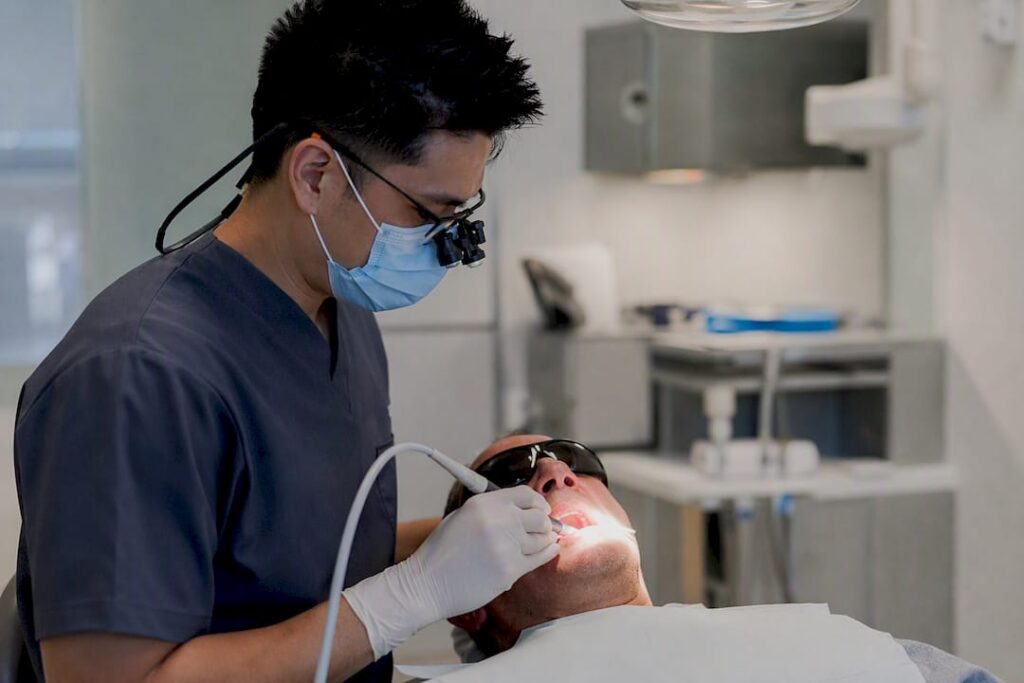
Laser crown lengthening uses an erbium laser to remove excess gum tissue, and sometimes a sliver of bone, so more of the tooth shows above the gumline. Dentists use it to fix a gummy smile or to expose enough healthy tooth structure to seat a crown or filling properly. Most cases skip the scalpel entirely, which typically means less bleeding, fewer or no sutures, and a shorter recovery than traditional flap surgery.
TL;DR:
- The success of laser crown lengthening depends on accurately measuring biologic width and avoiding excessive tissue or bone removal that could cause recession or inflammation.
- Erbium lasers can reshape both gum tissue and underlying bone in a single, minimally invasive, flapless procedure, often reducing discomfort and healing time.
- Proper water cooling, tip angulation, and operator experience are essential to prevent thermal injury and ensure stable, long-lasting results.
- The procedure’s cost varies based on the number of teeth, bone recontouring needs, and practice location, with broader coverage for medical-related cases.
- Alternatives like orthodontic extrusion or tissue management exist but are slower or less predictable for restorative or cosmetic needs.
Table of Contents
- What Is Laser Crown Lengthening Used For?
- How Does Laser Crown Lengthening Work?
- What Happens During a Laser Crown Lengthening Appointment?
- Recovery Timeline and Aftercare
- Laser vs. Traditional Scalpel Crown Lengthening: What’s the Real Difference?
- What Are the Risks of Laser Crown Lengthening?
- How Much Does Laser Crown Lengthening Cost?
- Are There Non-Surgical Alternatives to Crown Lengthening?
- Do the Results of Laser Crown Lengthening Last?
- How Bay Area Dental, Airway & Sleep Approaches Laser Crown Lengthening
- Deciding If Laser Crown Lengthening Is Right for You
- The Gap Between Marketing and Reality on Laser Gum Surgery
- Ready to Talk to Someone About Your Smile?
- Sources
What Is Laser Crown Lengthening Used For?
Dentists reach for crown lengthening in two very different situations, and knowing which one applies to you changes almost everything about the plan.
The first is cosmetic. A “gummy smile,” where excess gum tissue covers too much of the visible tooth, is one of the most common reasons patients ask about gum recontouring. The second is restorative necessity: a tooth has decayed below the gumline, fractured close to the bone, or simply doesn’t have enough exposed structure for a crown to grip onto securely.
Common reasons a dentist recommends the procedure include:
- Short clinical crowns from wear, old dental work, or genetics
- Subgingival decay or a fracture line that dips below the gum
- Uneven gingival margins that make teeth look different lengths
- A gummy smile where a significant amount of gum shows at rest
Before recommending laser gum surgery, your dentist runs a fairly quick but precise exam. That includes periodontal probing (measuring pocket depth with a small ruler-like instrument), radiographs to see bone levels, a visual smile analysis, and an assessment of your gingival biotype, meaning whether your gum tissue is naturally thick and fibrous or thin and delicate. Thin biotypes need more conservative planning because they recede more easily.
The central concept guiding every decision is biologic width, the roughly 3 millimeter zone of gum and bone attachment your tooth needs to stay healthy long after the procedure heals. Violate that width and you risk chronic inflammation or gum recession, no matter how precise the laser was. This is why probing continues throughout the appointment, not just at the diagnostic visit.
How Does Laser Crown Lengthening Work?
Not all lasers do the same job, and that distinction matters more than most patients realize going in.
Erbium lasers, specifically Er:YAG and Er,Cr:YSGG, can cut both soft tissue and bone because their wavelength is absorbed strongly by water and by hydroxyapatite, the mineral that makes up bone and tooth structure. That dual capability is what allows a dentist to remove gum tissue and, if needed, reshape the underlying bone crest in a single flapless visit. Diode and CO2 lasers can’t do this. They work on soft tissue only, which makes them a fine choice for simple gum reshaping but useless for cases that require actual bone recontouring.

Water cooling and tip selection are what keep erbium lasers safe near bone. The laser’s energy generates heat, and without adequate water spray, that heat can build up and injure bone cells. Tip angulation matters too. A dentist controls these variables in real time, which is part of why operator experience shapes outcomes as much as the equipment itself.
The clinical record backs up the appeal. A case series using the Er,Cr:YSGG laser for flapless esthetic crown lengthening reported minimal postoperative pain, little bleeding, and no need for sutures in many cases. Separate reporting on Er:YAG flapless technique in the aesthetic zone found faster clinical healing than conventional scalpel and flap methods.
Statistic Callout: In a comparative study, patients treated with a flapless Er,Cr:YSGG laser showed a gingival margin that stayed remarkably stable, moving by an average of just 0.17 ± 0.31 millimeters at the three-month follow-up.
What Happens During a Laser Crown Lengthening Appointment?
Planning starts before you’re ever in the chair. If a crown or filling is waiting on the outcome, your dentist coordinates timing with your restorative dentist so the final tooth preparation and the gum healing line up correctly.
Local anesthesia numbs the area, and most patients feel pressure or vibration rather than pain during the procedure itself. Because lasers cauterize as they cut, many patients report less discomfort than they expected walking in.
Here’s the general sequence:
- The dentist maps the new gum outline based on your probing measurements and smile goals.
- The laser performs the gingivectomy, removing the targeted gum tissue in a flapless approach for most cosmetic cases.
- The dentist re-probes to confirm biologic width is respected before deciding if bone recontouring is necessary.
- If bone needs reshaping, the laser (or in some open cases, traditional instruments after a small flap) removes a thin layer of bone.
- The site gets a final check, and sutures go in only if the case required an open flap. Many flapless cases need none.
The whole visit usually runs 30 to 90 minutes depending on how many teeth are involved. You’ll leave with mild swelling at most in straightforward cases.
Pro Tip: Ask your dentist beforehand whether your case is likely to be flapless or open. Knowing which one you’re getting changes what “normal” healing looks like, so you won’t panic over swelling that’s actually expected for your specific case.
Recovery Timeline and Aftercare
Recovery follows a fairly predictable arc, and knowing the shape of it in advance makes the process far less stressful.

The first 48 hours carry the highest risk for pain and swelling, according to periodontal recovery data. Over-the-counter pain relievers usually handle it, though your dentist may prescribe something stronger for more involved cases. Weeks one and two involve gentle care around any sutures or protective dressing, and the tissue starts to firm up and settle into its new contour by weeks three through six.
Statistic Callout: Full healing can take several weeks, and clinicians commonly wait a sufficient period before placing a permanent crown so the gum has fully stabilized around it.
A basic aftercare checklist looks like this:
- Take medications exactly as prescribed, even if you feel fine early on
- Rinse with warm salt water or a prescribed antimicrobial rinse, not aggressive mouthwash
- Stick to soft, cool foods for the first several days
- Avoid smoking, which slows healing and raises infection risk substantially
- Keep every follow-up visit so your dentist can track tissue maturation
Call your dentist promptly if you notice fever, bleeding that won’t stop with gentle pressure, or pain that gets worse instead of better after day three. Those are signs something needs a closer look, not just more patience.
Laser vs. Traditional Scalpel Crown Lengthening: What’s the Real Difference?
The appeal of laser gum surgery isn’t hype. It’s a genuine shift in what the recovery experience feels like for most patients.
Evidence-backed advantages include:
- Less intraoperative bleeding, since the laser cauterizes vessels as it cuts
- Fewer sutures needed, and often none at all in flapless cases
- Lower immediate post-op pain in several measured outcomes
- Faster tissue healing reported in multiple case series
That said, laser isn’t automatically the right call for everyone. Cases that need significant bone recontouring across multiple teeth, or patients with more complex periodontal architecture, sometimes still need an open flap approach so the dentist can see the bone directly rather than working by feel and probe alone. Traditional osseous surgery hasn’t disappeared. It’s simply reserved for cases where visibility and access genuinely matter more than minimizing incisions.
Skill matters as much as the tool. A laser in inexperienced hands doesn’t guarantee a better outcome than a scalpel wielded by someone who understands biologic width and probes carefully throughout the case.
What Are the Risks of Laser Crown Lengthening?
No dental procedure is risk-free, and laser crown lengthening carries a specific set of things to watch for.
Possible complications include:
- Thermal injury to bone if water cooling is inadequate during hard-tissue work
- Biologic width violation from over-aggressive tissue or bone removal
- Rebound tissue growth, where gum partially regrows toward its original position
- Temporary sensitivity as the tooth root surface is more exposed
- Infection, though rare with proper aftercare
Certain patients are better served by a different approach. A thin gingival biotype, active periodontal disease that hasn’t been controlled first, or anticoagulant therapy that can’t be safely paused are all reasons a dentist might recommend an open flap procedure or delay treatment until other issues are managed.
Clinicians reduce these risks primarily through control and vigilance. That means correct water-cooling settings and tip angulation throughout the procedure, plus repeated probing to catch a biologic width problem before it becomes permanent.
Pro Tip: If you take blood thinners, tell your dentist at the very first consultation, not the day of the procedure. It changes the anesthesia plan and sometimes the technique itself.
How Much Does Laser Crown Lengthening Cost?
Cost varies more than most patients expect, largely because “crown lengthening” covers a wide range of case complexity.
The biggest cost drivers are the number of teeth involved, whether bone recontouring is needed on top of soft tissue removal, the clinician’s experience level, and your geographic location. A single-tooth cosmetic touch-up costs meaningfully less than a multi-tooth case requiring bone work.
As a broad guide, single-tooth procedures in the U.S. often run in the low hundreds of dollars, while multi-tooth or bone-involved cases can run into the thousands. These figures shift by region and practice, so a direct quote after your exam is the only reliable number.
Insurance coverage typically depends on the reason for treatment:
- Restorative crown lengthening, needed to properly seat a crown or filling, is more often covered as medically necessary
- Purely cosmetic gum recontouring for a gummy smile is more often treated as elective and excluded
Are There Non-Surgical Alternatives to Crown Lengthening?
Some patients ask if they can skip surgery altogether, and the honest answer depends entirely on why lengthening was recommended in the first place.
For a genuinely gummy smile with healthy underlying bone, orthodontic intrusion (moving teeth slightly into the jaw with braces or aligners) can sometimes reduce gum show without touching tissue at all. It’s slow, often taking many months, and it doesn’t work when the excess gum is caused by tissue overgrowth rather than tooth position.
For restorative cases, alternatives are more limited. If decay or a fracture sits below the gumline, no rinse, filling material, or orthodontic trick exposes that margin the way removing tissue does. Some dentists try orthodontic extrusion, gently pulling the tooth upward to bring more structure above the gum, but this changes the tooth’s position permanently and isn’t appropriate for every case.
Retainers or night guards sometimes get mentioned online as ways to “manage” a gummy smile, but they don’t address the actual tissue or bone relationship causing it. If your case is purely cosmetic and bone levels are normal, ask specifically whether orthodontic intrusion is realistic for your bite before assuming surgery is the only route. If restorative access is the issue, laser crown lengthening usually remains the most direct and predictable solution.
Do the Results of Laser Crown Lengthening Last?
The available follow-up data is encouraging, though it comes with the usual caveat that longer-term studies are still limited compared to decades-old scalpel techniques.
In the comparative trial mentioned earlier, the laser-treated group’s gingival margin stayed essentially where it was placed at the three-month mark, which is the window where most rebound or relapse would show up if it were going to happen. Case series on Er,Cr:YSGG and Er:YAG flapless techniques report similarly stable outcomes, with tissue holding its new contour once fully healed.
Long-term success comes down to two things beyond the laser itself: whether biologic width was respected during the procedure, and whether the final restoration was placed only after tissue fully matured, typically at that six-to-eight-week mark. Cases where a crown gets seated too early, before tissue has settled, are more prone to irritation and slow recession over time regardless of which technique created the space.
Success rates in published series are consistently high for well-selected cases, meaning patients with adequate biologic width and no uncontrolled periodontal disease. Patients with thin biotypes or aggressive tissue removal are the ones most likely to see some regrowth or recession later, which is exactly why conservative, probe-guided technique matters more than raw laser power.
How Bay Area Dental, Airway & Sleep Approaches Laser Crown Lengthening
At Bayareadentalairwaysleep in Fremont, laser crown lengthening isn’t treated as a standalone cosmetic fix. It’s coordinated with 3D imaging, restorative timing, and, where relevant, airway and myofunctional considerations that affect the whole mouth’s function.
The practice uses probe-based assessment throughout each case rather than relying on imaging alone, which keeps biologic width front and center during treatment planning. Restorative dentists and the treating clinician align on timing so a crown or filling isn’t seated before tissue has fully matured.
Bayareadentalairwaysleep also serves Deaf patients with tailored communication support, an accommodation that’s rare in general dental practice and reflects a broader commitment to accessible, whole-patient care rather than procedure-by-procedure treatment.
Deciding If Laser Crown Lengthening Is Right for You
Laser crown lengthening tends to suit patients with a clear restorative need or a cosmetic gum concern paired with healthy, adequate bone levels. It’s less suited to complex multi-tooth cases with thin biotypes or unmanaged periodontal disease.
At your consultation, ask specifically about your probe measurements and biologic width, what imaging was used to assess bone, how long you’ll wait before a final crown goes in, and what the anesthesia plan looks like for your case. If your dentist flags significant bone irregularities or a thin biotype requiring an open approach, a periodontist referral is often the more prudent path.
The Gap Between Marketing and Reality on Laser Gum Surgery
Most of what gets written about laser crown lengthening online treats “laser” as shorthand for painless and instant, and that’s the part worth pushing back on. The laser is a tool, not a guarantee. What actually determines whether you heal well and keep your results is whether your dentist respected biologic width and probed carefully throughout, not which company made the equipment.
The conventional wisdom oversells the flapless part and undersells the planning part. Patients read “no sutures” and assume “no risk,” but the case series showing the best outcomes are the ones where clinicians re-probed repeatedly and coordinated restorative timing rather than rushing to seat a crown. If you take one thing from all the research into this procedure, it’s this: ask about the measurement process, not just the equipment. A dentist who talks about millimeters of biologic width before they talk about laser wavelengths is the one doing this correctly.
Where laser dental procedures genuinely earn their reputation is recovery speed and comfort for well-selected cases. That part holds up. Just don’t let the word “laser” substitute for asking the harder, more useful questions about your own anatomy and healing timeline.
— Admin
Ready to Talk to Someone About Your Smile?
Bayareadentalairwaysleep gives you something most cosmetic-only dental offices can’t: a team that plans crown lengthening alongside your full restorative picture, not as an isolated cosmetic add-on. That means the laser work, your 3D imaging, and the timing of your final crown all get coordinated by the same team, so you’re not bouncing between offices trying to sync up appointments.
The practice uses erbium laser technology for minimally invasive, often sutureless procedures, and offers tailored communication support for Deaf patients, an accommodation that’s genuinely uncommon in general dentistry. If you’re dealing with a gummy smile, a tooth that needs more structure exposed for a crown, or you’re simply not sure which category your case falls into, a probe-based exam will answer that clearly. Schedule a consultation with Bayareadentalairwaysleep to get your biologic width measured and a restorative timeline mapped out before you commit to anything.
This article is general information, not a substitute for advice from a qualified doctor. Consult a qualified healthcare professional about your own circumstances before acting on anything here.