


Yes. Persistent thumb or finger sucking, daily pacifier use, and abnormal resting tongue posture are strongly linked to anterior open bite in children. Stop the habit early, commonly before ages 3 to 6, and many bites correct on their own. If the habit continues, front teeth still do not touch, or speech and chewing are affected, track how often and how long the habit happens and get a pediatric dental check.
TL;DR:
- Persistent thumb or finger sucking that lasts beyond age 3 significantly increases the risk of developing an anterior open bite, especially with high-pressure or prolonged habits.
- Resting tongue posture and mouth breathing are often invisible but exert a stronger influence on bite development than occasional habits like swallowing thrusts.
- Behavioral habit cessation is most effective before age 6, but ongoing daily habits past age 3 warrant a pediatric dental evaluation, especially if front teeth do not meet.
- Treatments include habit-focused behavioral strategies and myofunctional therapy, with appliances like palatal crib used around ages 4 to 8 for persistent habits.
- Addressing airway issues and checking tongue resting position are critical, as habit correction alone may not resolve skeletal or muscular contributors to open bite.
Table of Contents
- What an Open Bite Looks Like and How to Spot One
- Which Habits Actually Raise the Risk
- Why Resting Pressure Matters More Than Occasional Habits
- When to Watch and When to Get Help
- How Treatment Is Staged, From Habit Coaching to Orthodontics
- Practical Steps to Reduce Habit-Related Risk at Home
- How an Airway-Focused Clinic Evaluates a Child’s Bite
- The Part of This Advice Most Parents Get Backwards
- Getting a Bite Evaluation That Looks at the Whole Picture
- Sources
- FAQ
What an Open Bite Looks Like and How to Spot One
An anterior open bite means the upper and lower front teeth don’t touch when the back teeth are together, leaving a visible vertical gap. A posterior open bite affects the back teeth instead, with only the front teeth meeting, and it’s less common but still tied to the same habits.
Parents usually notice it before a dentist does. Watch for these signs:
- A visible gap between top and bottom front teeth when the mouth is closed but relaxed
- Trouble biting cleanly into foods like an apple or sandwich
- A slight lisp or other speech changes, especially with “s” and “th” sounds
- A resting mouth that hangs open, with lips not meeting naturally
- Front teeth that never seem to line up even as new ones come in
A quick photo of your child biting down naturally, lips relaxed, is genuinely useful to bring to a dental visit. It gives the dentist a baseline without needing your child to sit still for a formal exam right away.
Which Habits Actually Raise the Risk
Not all sucking habits carry the same risk, and the differences matter more than most parenting advice suggests.
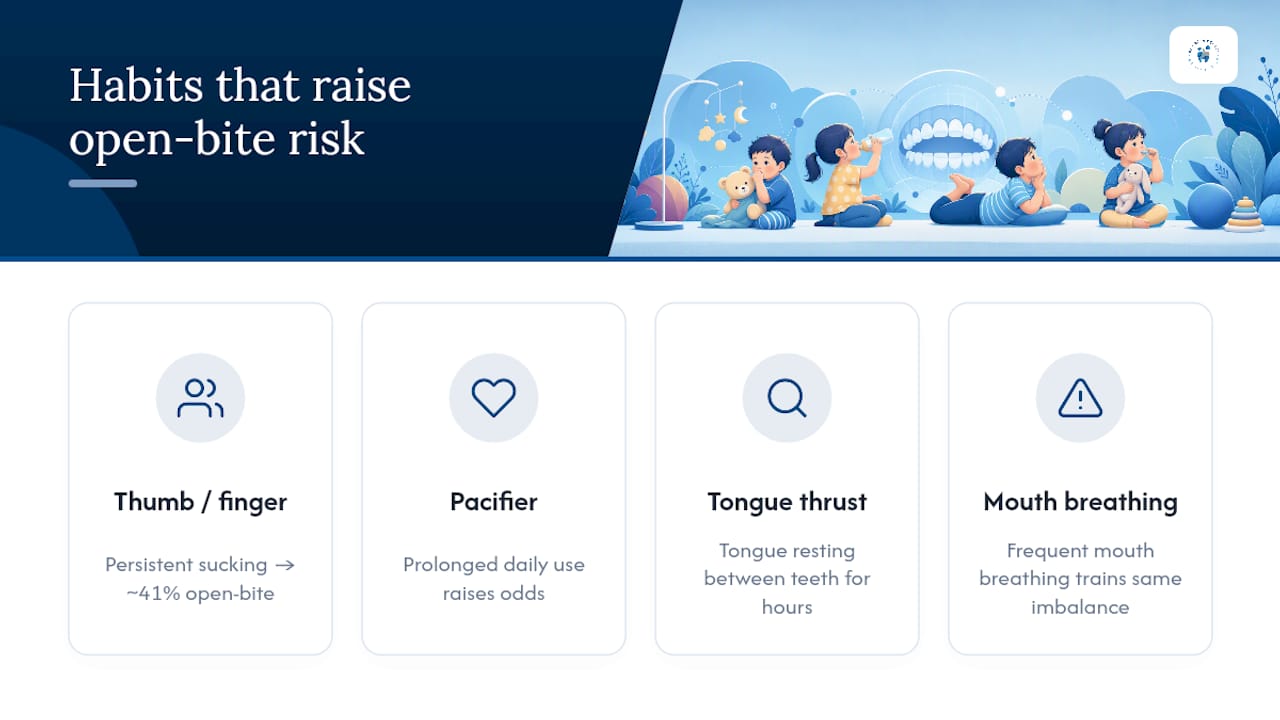
Thumb and finger sucking is the habit most consistently tied to anterior open bite, and position matters. A thumb resting against the palate with steady pressure does more damage than a brief, low-pressure habit. Research on children with sucking habits found open bite prevalence around 16.5% overall, but in groups with persistent sucking habits, prevalence jumped to roughly 41%.
Pacifier use follows a similar pattern. A systematic review and meta-analysis found that prolonged, daily pacifier or digit sucking significantly raises the odds of anterior open bite, with longer daily duration driving the risk higher rather than occasional use.
Tongue thrust is trickier to judge. An occasional forward tongue push during swallowing isn’t the problem. What matters is where the tongue sits at rest, between the teeth or against the palate, for hours a day.
Mouth breathing often signals a nasal airway obstruction, like enlarged tonsils or chronic congestion, and a mouth held open all day trains the same muscle imbalance as a thumb habit. When mouth breathing is frequent, an ENT referral alongside dental evaluation is worth raising with your pediatrician.
Pro Tip: If you’re unsure whether your child’s habit counts as “high risk,” time it for a few days. A habit that happens for 20 minutes at bedtime is a different animal than one that runs most of the afternoon.
Why Resting Pressure Matters More Than Occasional Habits
Teeth move in response to sustained, low-grade pressure, not brief forces. A thumb resting against the upper front teeth for hours applies exactly that kind of steady load, tipping incisors forward and narrowing the palate over time. A forward tongue posture works the same way from the opposite direction, wedging itself between the teeth and physically blocking them from meeting.
This is why an occasional tongue thrust during swallowing rarely causes lasting harm, while a tongue that rests low and forward all day reliably does.
- Sustained pressure reshapes bone and tooth position; brief, intermittent pressure mostly doesn’t
- Timing matters: habits active while permanent incisors are erupting (roughly ages 6 to 9) cause more lasting change than the same habit in a toddler with baby teeth
- Stopping the habit removes the cause, but if a skeletal growth pattern has already developed, habit cessation alone may not fully close the bite
Pro Tip: Ask your child’s dentist to check tongue position at rest, not just during a swallow. That single detail often explains why one child’s habit resolved and another’s didn’t.
When to Watch and When to Get Help
Most sucking habits fade naturally, and chasing every occasional thumb-in-mouth moment in a toddler causes more stress than it prevents.
- Ages 0 to 2: Sucking is a normal comfort behavior. No action needed unless it’s constant and intense.
- Ages 2 to 3: Start gentle redirection. Most children self-wean from thumb and pacifier habits in this window, and the American Academy of Pediatric Dentistry recommends anticipatory guidance around age 3.
- Age 3 and beyond: If the habit persists daily, clinical guidance points to scheduling a dental evaluation, since resting pressure at this stage starts affecting permanent tooth positioning.
- Any age, if you notice: speech changes, difficulty biting food, a visibly asymmetric gap, nightly heavy sucking, or snoring and mouth breathing, don’t wait for a scheduled checkup. Start with a pediatric dentist, who can loop in an orthodontist or ENT as needed.
How Treatment Is Staged, From Habit Coaching to Orthodontics
Treatment for open bite almost never starts with an appliance. It starts with the habit itself.
The first step is behavioral: reward charts for habit-free days, identifying when and why the habit happens (boredom, sleep transition, stress), and gradually weaning off a pacifier rather than stopping cold. This alone resolves plenty of mild cases in children under 6, especially when baby teeth are still involved and there’s time for the bite to self-correct.
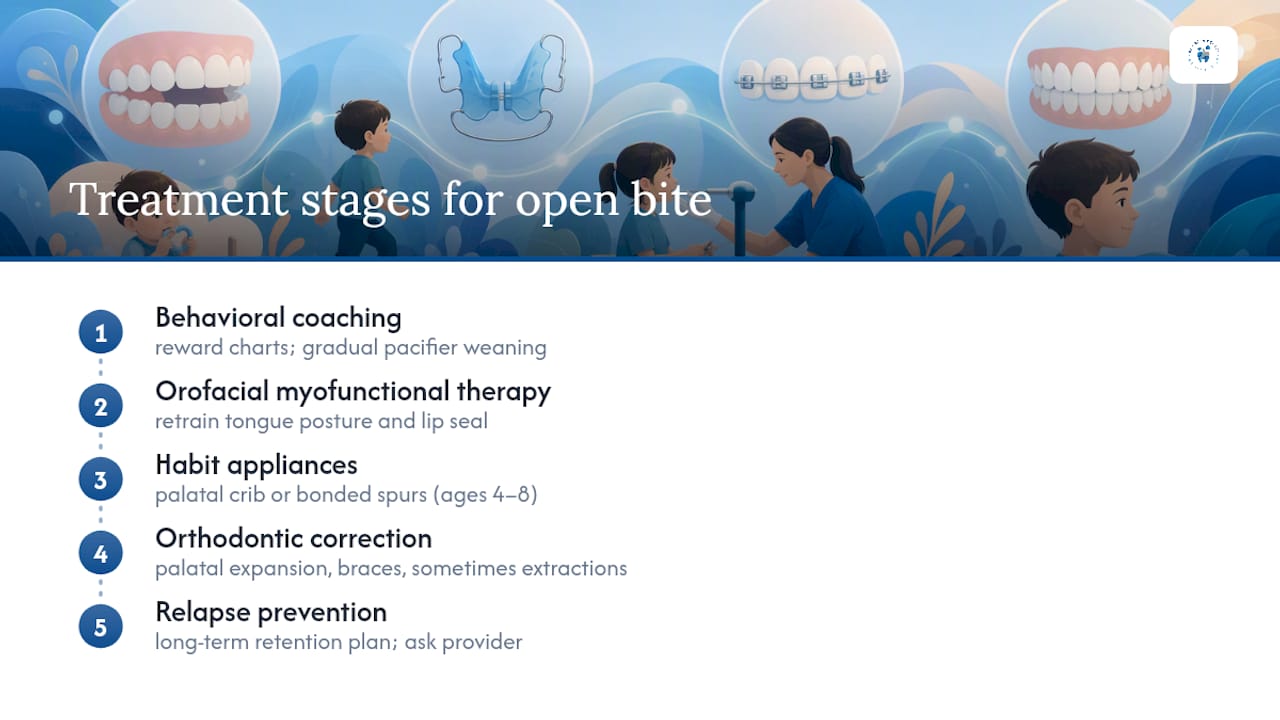
If behavior changes alone aren’t enough, or a resting tongue posture is the main driver, orofacial myofunctional therapy (OMT) often comes next. OMT retrains tongue position and lip seal through targeted exercises, and studies show it can improve muscle activity and tongue posture-0125), though it’s usually paired with other treatment rather than used alone.
For children who need a physical reminder, habit appliances like a palatal crib or bonded spurs sit behind the upper front teeth and make sucking or thrusting uncomfortable or impossible. These typically go in around ages 4 to 8 and work well specifically because they remove the option rather than relying on willpower.
More complex cases move into orthodontic territory: palatal expansion, braces, and occasionally extractions when the bite has a genuine skeletal component. A documented case combined a tongue crib with premolar extractions to correct a severe anterior open bite, with long-term retention built into the plan specifically to prevent the habit from relapsing after treatment ended.
It’s worth being honest about the evidence here: reviews of open bite interventions note that trial quality varies a lot, and few large randomized studies compare one appliance against another head to head. That’s part of why treatment plans get tailored rather than templated, and why relapse prevention, not just initial correction, gets so much attention.
Pro Tip: Ask any provider proposing an appliance what the retention plan looks like after treatment ends. Correction without a relapse plan is only half the job.
Practical Steps to Reduce Habit-Related Risk at Home
Not every habit needs intervention. An infant sucking for comfort is normal and self-limiting for most kids. The line to watch for is a habit that continues daily past age 3, especially with visible pressure on the front teeth.
- Identify the trigger, boredom, sleep transition, anxiety, and address that directly rather than just the habit.
- Use positive reinforcement (sticker charts, small rewards for habit-free stretches) instead of punishment, which pediatric guidance consistently advises against.
- Adjust the bedtime routine if sucking is a sleep-onset habit, since that’s often the hardest window to break.
- Offer a substitute comfort object, a stuffed animal or blanket, especially when weaning off a pacifier.
| Situation | Suggested action |
|---|---|
| Infant sucking for comfort, no daily pattern | Leave it alone; revisit at age 2 to 3 |
| Daily habit past age 3, no visible bite change | Start behavioral strategies at home |
| Daily habit past age 3, front teeth not meeting | Schedule a pediatric dental evaluation |
| Mouth breathing, snoring, or nasal congestion | Raise it with a pediatrician; consider ENT referral |
| Habit persists despite behavior changes | Discuss habit appliances or myofunctional therapy |
How an Airway-Focused Clinic Evaluates a Child’s Bite
Some clinics treat open bite as more than a spacing problem. A first visit typically starts with a detailed habit history, how often, how intense, since when, followed by an oral exam and 3D imaging when the picture needs more detail than a visual check provides.
From there, the plan branches based on what’s actually driving the bite. A child with airway concerns may get an ENT referral alongside dental care. One with a tongue posture problem may be routed toward myofunctional therapy. A child ready for structural correction might discuss palatal expansion or airway-friendly clear aligners rather than jumping straight to traditional braces.
The goal is a plan built around cause, not just the visible gap between the front teeth.
The Part of This Advice Most Parents Get Backwards
Most articles on this topic treat “stop the thumb sucking” as the whole story. It isn’t. The research is fairly clear that duration and resting pressure, not the mere presence of a habit, drive most of the risk. A child who sucks a thumb for ten minutes at bedtime is not the same clinical picture as one who does it for hours with the thumb wedged against the palate, and treating both the same way wastes parental energy on the wrong cases.
The bigger blind spot is tongue posture. Parents fixate on visible habits like thumb sucking because they’re easy to catch a child doing. A tongue that rests low and forward all day is invisible in casual observation, yet it can undo the benefit of quitting a sucking habit entirely if nobody checks for it.
If there’s one thing to prioritize, it’s this: don’t just stop the habit and assume the job is done. Ask whoever evaluates your child’s bite to check resting tongue posture and breathing pattern, not just count teeth. That’s the piece conventional advice skips, and it’s often the difference between a bite that self-corrects and one that needs years of orthodontic work later.
— Admin
Getting a Bite Evaluation That Looks at the Whole Picture
Bay Area Dental, Airway & Sleep treats open bite as a whole-child issue rather than a checklist of teeth to straighten. Where a typical dental visit checks for spacing and schedules braces, an evaluation here also looks at tongue posture, breathing pattern, and habit history, the same factors this article just walked through as the real drivers of relapse.

That matters most for families who’ve already tried the reward charts and pacifier weaning and still see a gap that isn’t closing. The practice offers pediatric dental care, myofunctional therapy, and orthodontic options including palatal expansion and airway-friendly aligners, all coordinated rather than handled by separate providers who never talk to each other. For families in the local area, that means care focused on tracking whether the habit, the tongue, or the airway is the actual cause, instead of guessing.
If your child’s front teeth still aren’t meeting, or a habit has outlasted the age where it should have faded, book an evaluation with Bay Area Dental, Airway & Sleep to get a plan built around the actual cause instead of just the visible gap.
This article is general information, not a substitute for advice from a qualified doctor. Consult a qualified healthcare professional about your own circumstances before acting on anything here.
Sources
- Prevalence and factors associated with anterior open bite in 2 …
- Association between Non-nutritive sucking habits and Anterior open bite: A systematic review and meta-analysis | BMC Oral Health
- Thumb Sucking and Other Nonnutritive Sucking Habits in Children – StatPearls – NCBI Bookshelf
- Treatment of severe anterior open bite by using tongue crib and teeth extraction: a case report
FAQ
How Do You Fix an Open Bite in Kids?
Treatment starts with stopping the causal habit through behavioral strategies, then escalates to myofunctional therapy or a habit appliance like a palatal crib if the habit persists. More complex or skeletal cases may need palatal expansion, braces, or in rare situations extractions, as shown in documented case treatment.
What’s the Difference Between an Open Bite and an Overbite?
An open bite means the front teeth don’t touch at all, leaving a vertical gap when the back teeth close together. An overbite means the upper front teeth overlap the lower ones too much vertically, which is the opposite spacing problem.
What Happens if Malocclusion Goes Untreated?
Untreated open bite can lead to ongoing speech difficulty, uneven chewing, and increased dental wear from teeth that never properly contact. In cases tied to airway issues, unaddressed mouth breathing can also carry over into sleep and breathing problems beyond the mouth.
What Does a Correctly Aligned Bite Look Like?
A well-aligned bite has the upper front teeth slightly overlapping the lower ones with light contact, back teeth meeting evenly, and a tongue that rests behind the upper front teeth rather than pushing against or between them. It’s less about a single dramatic feature and more about even, functional contact across the whole arch.
At What Age Should I Worry About My Child’s Sucking Habit?
Most children stop thumb or pacifier habits between ages 2 and 4 without any lasting effect. If the habit continues daily past age 3, clinical guidance recommends dental evaluation, particularly once permanent front teeth start coming in.