

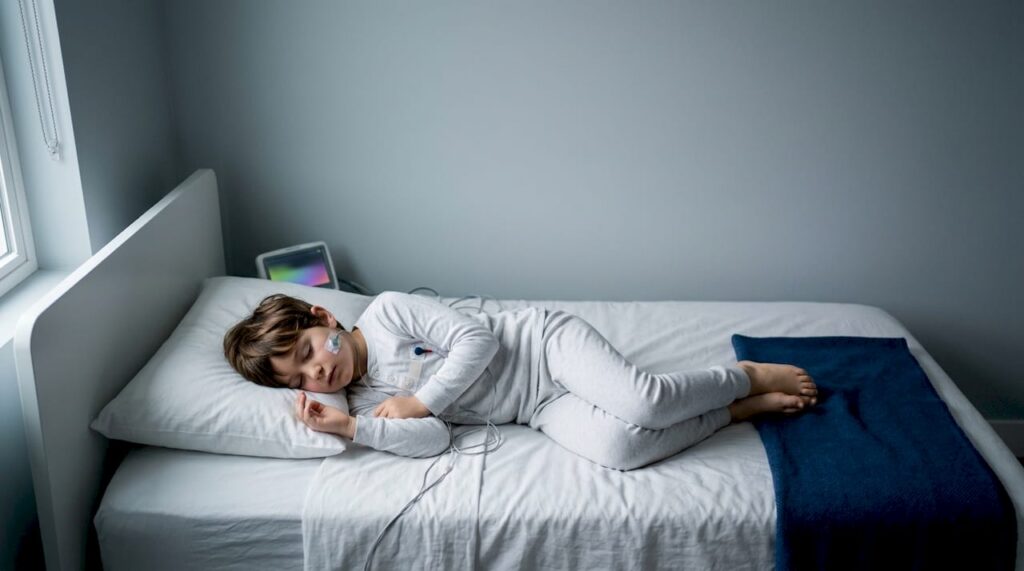
Sleep-disordered breathing, including obstructive sleep apnea, is linked to a meaningfully higher risk of nocturnal enuresis, and treating the airway problem often reduces or resolves the bedwetting. If your child (or you) snores heavily, mouth-breathes, or seems restless at night alongside ongoing bedwetting, that pattern is worth a clinician’s attention rather than dismissal as a “phase.” The first move is simple: get a targeted sleep and voiding evaluation before trying anything else.
TL;DR:
- Sleep-disordered breathing nearly triples the risk of bedwetting in children, with a pooled odds ratio of about 2.85, regardless of severity.
- Adenotonsillectomy reduces bedwetting in roughly half of children with sleep apnea and enuresis, but it is not a guaranteed cure.
- Signs like loud snoring, gasping, night sweating, or mouth breathing, along with bedwetting, warrant a sleep evaluation rather than delay.
- A two-week sleep and voiding diary helps identify patterns like snoring and nocturnal urine overproduction that merit professional assessment.
- Early multidisciplinary coordination between pediatricians, ENT, sleep specialists, and airway dentists improves diagnosis and treatment outcomes.
Table of Contents
- What Parents and Adults Need to Know Right Now
- How Does Sleep Apnea Cause Bedwetting?
- What Does the Research Actually Show?
- Signs That Point to a Breathing-Related Cause
- What Happens During a Diagnostic Workup?
- Treating the Airway Often Improves the Bedwetting
- Your Two-Week Action Plan Before the First Appointment
- How an Airway-Focused Dental Practice Fits Into This Picture
- A Clinician’s Note on Families Living This Every Morning
- Ready to Evaluate Airway Health Alongside Bedwetting Concerns?
- Sources
What Parents and Adults Need to Know Right Now
The connection between sleep apnea and bedwetting is not a fringe theory. It is supported by a growing body of clinical research that pediatricians and sleep specialists increasingly use to guide workups.
- A 2026 meta-analysis found sleep-disordered breathing carries a pooled odds ratio near 2.85 for nocturnal enuresis, meaning affected kids are nearly three times more likely to wet the bed than peers without breathing issues.
- The mechanism involves two things happening at once: extra urine production overnight and a brain that’s too deeply asleep to notice a full bladder.
- Adenotonsillectomy, the surgical removal of enlarged tonsils and adenoids, improves bedwetting in roughly half of children who have both conditions.
- Loud snoring is a red flag, but its absence doesn’t clear a child of OSA. Mouth breathing, night sweats, and daytime crankiness count just as much.
- If bedwetting shows up alongside these breathing signs, an evaluation with a pediatrician, ENT, or sleep specialist is the logical next step, not a wait-and-see approach.
Pro Tip: Track two weeks of nights before your appointment. Note snoring, gasping, sweating, and wet mornings side by side. A pattern that takes you months to notice on your own becomes obvious to a clinician in a single glance at your notes.
How Does Sleep Apnea Cause Bedwetting?
The link runs through two separate systems that both break down when breathing is obstructed at night: how much urine the body makes, and how deeply the brain sleeps through the signal that the bladder is full.
The hormone pathway: more urine, less warning
When the airway partially or fully collapses during sleep, the chest has to work harder to pull air in. That effort creates unusually negative pressure inside the chest cavity, which distends the heart’s chambers more than normal. The heart responds by releasing atrial natriuretic peptide, a hormone that tells the kidneys to produce more urine. Researchers describe this cascade, from obstructed breathing to ANP release to overnight urine overproduction, as one of the clearest physiological bridges between OSA and enuresis.
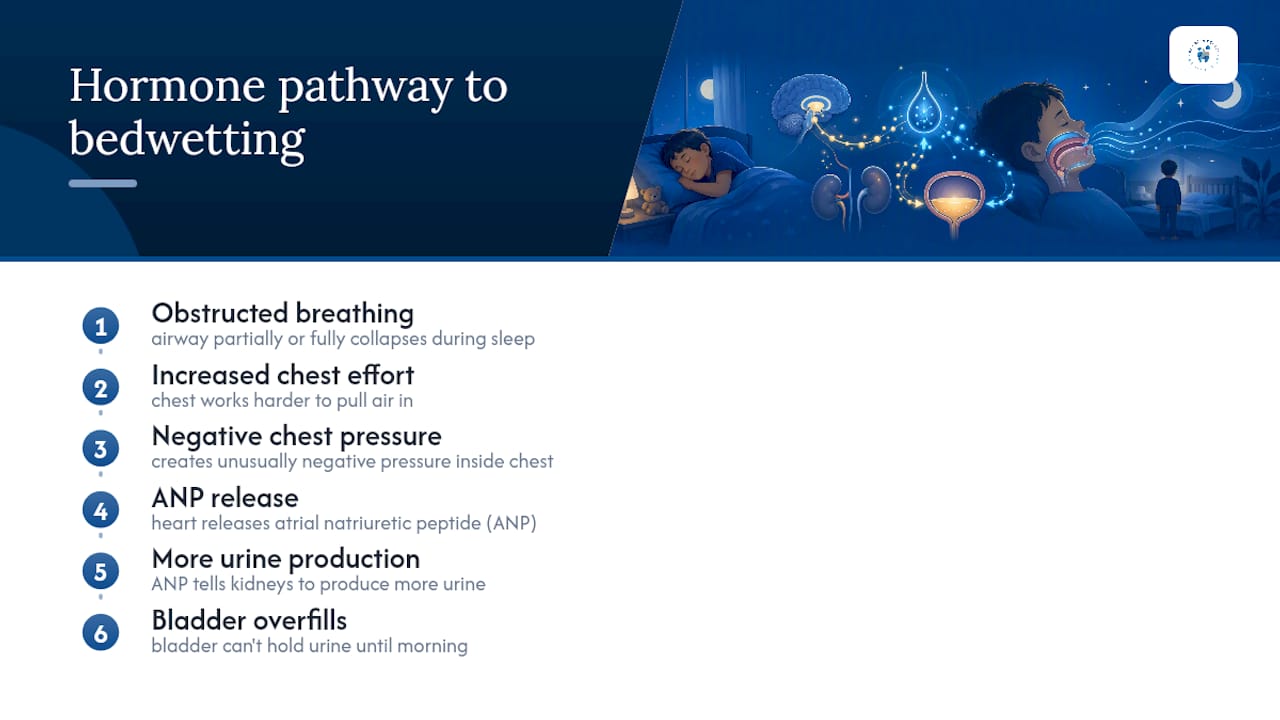
This is why a child with sleep apnea can wet the bed even with a normal-sized bladder. The problem isn’t capacity. It’s volume, produced at a rate the bladder can’t hold until morning.
The arousal problem: too deep asleep to wake up
The second half of the equation is arguably more important day to day: sleep apnea fragments sleep into repeated micro-awakenings, but it also raises what’s called the arousal threshold, the amount of signal needed to actually wake someone up. Clinical reviews describe some children as “deep but poor” sleepers, a phenotype where the brain stays too deeply asleep to respond to a full bladder even as sleep itself is constantly disrupted by breathing pauses. It sounds contradictory, but it isn’t: fragmented sleep and a high arousal threshold coexist because the brain compensates for constant micro-interruptions by suppressing the very arousal signals a full bladder would normally trigger.
- Nocturnal polyuria (excess overnight urine) frequently overwhelms bladder capacity in children with untreated SDB.
- A raised arousal threshold means the “bladder full” signal competes with a brain that’s already working overtime to manage disrupted breathing.
- Circadian antidiuretic hormone (ADH) rhythms, which normally concentrate urine at night, can be disrupted by fragmented sleep, compounding the polyuria problem.
- Some clinicians now describe this cluster under the broader label of “sleep-related urologic dysfunction”, reflecting how tightly sleep architecture and bladder control are intertwined.
Kids and adults don’t experience this identically. In children, adenotonsillar hypertrophy (enlarged tonsils and adenoids) is usually the driver of airway obstruction, and enuresis tends to be primary, meaning it’s been present since early childhood without a long dry stretch in between. In adults, sleep apnea is more often tied to weight, airway anatomy, or muscle tone, and bedwetting is rarer and typically secondary, appearing after years of nighttime dryness. Adult nocturnal enuresis tied to OSA is real but understudied. Most of the strongest data comes from pediatric cohorts, and applying those findings directly to adult patients risks overstating what’s actually been proven for that group.
What Does the Research Actually Show?
The strongest current evidence comes from a 2026 systematic review and meta-analysis that pooled multiple pediatric studies and found a statistically significant association between sleep-disordered breathing and nocturnal enuresis, with a pooled odds ratio of approximately 2.85. That same analysis reported that even relatively mild sleep-disordered breathing, not just severe apnea, showed elevated bedwetting risk, and that the association held whether the SDB was mild or moderate to severe. A separate abstract presented at the International Continence Society echoed this, noting that primary snoring alone (without confirmed apnea) still correlated with higher enuresis rates.
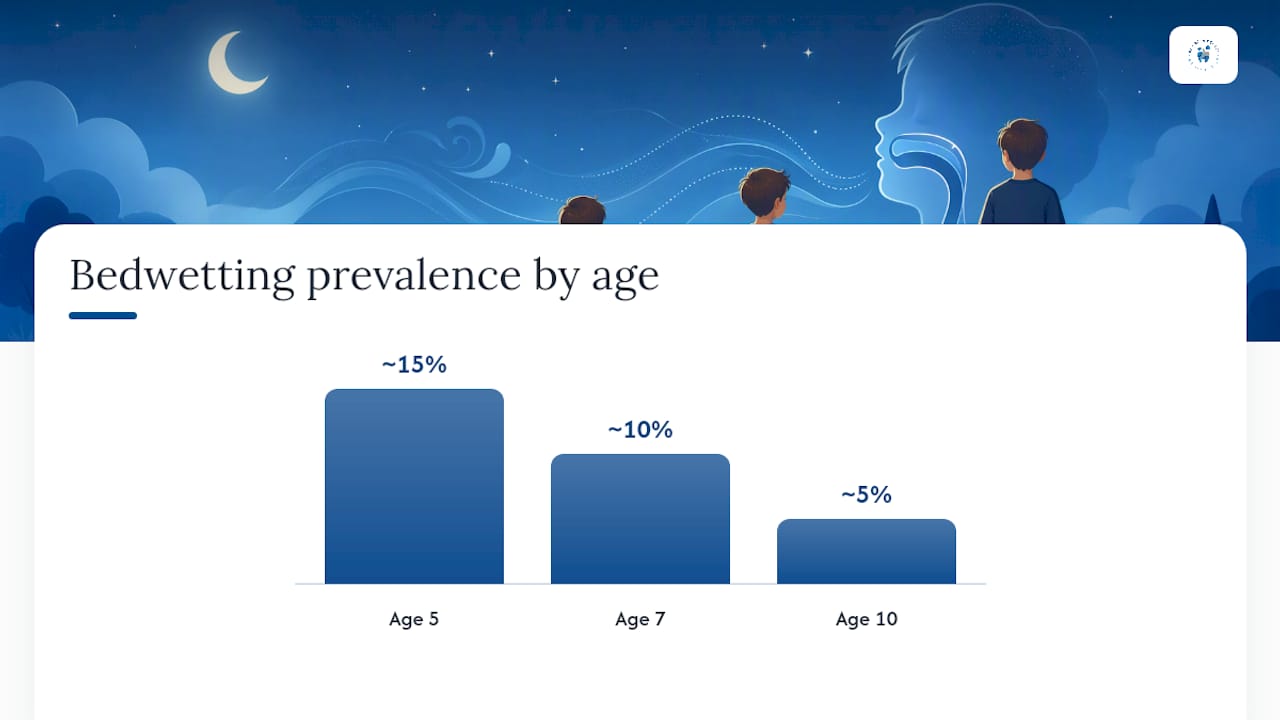
For context, bedwetting on its own is common. Pediatric reviews put prevalence at around 15% at age five, dropping to roughly 10% by age seven, and about 5% by age ten, largely tracking normal bladder and neurological maturation. Genetics play a real role too. Many children simply have a family history of late nighttime dryness. The point of citing these baseline numbers isn’t to dismiss ordinary bedwetting as unimportant. It’s to show that when SDB is present, the risk multiplies well above that background rate.
On the treatment side, cohort studies tracking children before and after adenotonsillectomy report improvement in enuresis in roughly half of affected children. That’s a meaningful effect, but it also means close to half see no change or only partial improvement, and clinicians describe adenotonsillectomy as reducing enuresis in a substantial subgroup rather than functioning as a guaranteed cure.
Here’s how the main study types stack up:
| Study type | What it measures | Strength | Main limitation |
|---|---|---|---|
| Polysomnography (PSG) | Objective sleep architecture, breathing events, oxygen levels | Gold standard for diagnosing OSA severity | Expensive, limited access, single-night snapshot |
| Overnight oximetry | Oxygen saturation dips overnight | Useful low-cost screening tool | Misses events without desaturation; not diagnostic alone |
| Parent/patient questionnaires | Reported snoring, sleepiness, enuresis frequency | Cheap, scalable, good for large cohort studies | Subjective, recall bias, heterogeneous across studies |
| Pre/post surgical cohort studies | Enuresis rates before and after adenotonsillectomy | Shows real-world treatment effect | Rarely randomized; other factors (age, maturation) can confound results |
Study heterogeneity is a genuine limitation across this research. Sample sizes vary widely, some studies rely on parent-reported snoring instead of confirmed PSG diagnoses, and follow-up periods after treatment differ from a few months to a couple of years. None of that erases the association. It does mean the exact size of the effect, and how well pediatric findings translate to adults, still needs more direct study.
Signs That Point to a Breathing-Related Cause
Not every case of bedwetting has a respiratory root. But certain patterns raise the probability enough that a sleep evaluation stops being optional and starts being the obvious next step.
Prominent signs are the ones most parents already notice, even if they haven’t connected the dots to enuresis:
- Habitual loud snoring, most nights of the week, not just during colds
- Witnessed breathing pauses or gasping sounds during sleep
- Mouth breathing, both at night and during the day
- Heavy nighttime sweating, even in a cool room
Subtler signs get missed far more often, partly because they look like ordinary childhood moodiness or attention problems:
- Daytime sleepiness or unusual fatigue, especially in a child who “should” have energy
- Behavioral shifts, including irritability, hyperactivity, or a drop in school performance
- Morning headaches, which can signal overnight oxygen dips
- Restless, thrashing sleep with frequent position changes
Pro Tip: Absence of loud snoring does not rule out sleep apnea. Some children with significant airway obstruction snore quietly or not at all, particularly if the blockage is more about tissue structure than vibration. Clinical guidance is explicit on this point: mouth breathing, restless positioning, and night sweating deserve just as much weight as snoring when you’re deciding whether to ask for a referral.
Red flags that warrant a faster referral include witnessed choking or gasping, cyanosis (a bluish tint around the lips during sleep), severe daytime sleepiness that affects school or work, or bedwetting that starts suddenly after a long dry period in an older child or adult. Secondary-onset enuresis, meaning it starts after months or years of nighttime dryness, tends to get overlooked in routine bedwetting workups even though it’s specifically the pattern that should prompt a sleep-disordered breathing assessment.
What Happens During a Diagnostic Workup?
Getting from “my child wets the bed and snores” to an actual diagnosis follows a fairly predictable sequence, and knowing the steps ahead of time makes the process far less intimidating.
- Start with a detailed history. A pediatrician or family doctor will ask about snoring frequency, breathing pauses, bedwetting patterns (primary vs. secondary, frequency per week), daytime behavior, and family history of either condition. Clinical reviews on enuresis management list this targeted history as an essential first step, not an afterthought.
- Keep a voiding and sleep diary. Two weeks of data on fluid intake, wet versus dry nights, and observed sleep behavior gives the clinician something concrete to work from instead of relying on memory.
- Screen for lower urinary tract symptoms (LUTS). Daytime urgency, frequency, or holding behaviors point toward a bladder-focused workup running in parallel with any airway investigation.
- Use validated screening questionnaires when snoring or breathing concerns are present. These flag which children need further sleep-specific testing rather than sending everyone straight to a sleep lab.
- Consider overnight pulse oximetry as an accessible screening step. It’s far cheaper and more available than a full sleep study, though a normal result doesn’t fully exclude OSA.
- Refer for polysomnography when clinical suspicion remains. PSG is the diagnostic gold standard for pediatric OSA, measuring breathing events, oxygen saturation, and sleep stages directly. The Apnea Hypopnea Index (AHI) it generates means something different in children than in adults: even a low AHI can be clinically significant in a child, while adult diagnostic thresholds are generally higher.
- Involve specialists based on findings. An ENT typically evaluates tonsil and adenoid size for surgical candidacy, a sleep medicine physician interprets PSG results and manages ongoing care, and a pediatric urologist gets involved when bladder-specific issues (capacity, overactive bladder) appear alongside the breathing problem.
The referral trigger that matters most: if snoring or breathing signs coexist with bedwetting that hasn’t responded to first-line enuresis measures, that’s the point to ask directly for a sleep evaluation rather than cycling through enuresis treatments alone.
Treating the Airway Often Improves the Bedwetting
Once sleep-disordered breathing is confirmed, treatment choice depends on age, severity, and anatomy, but the honest answer for most families is that airway treatment helps a lot of children, not all of them.
Adenotonsillectomy is the most studied intervention for children whose OSA stems from enlarged tonsils and adenoids. Multiple cohort studies show enuresis improving in roughly 40 to 50% of children after surgery. The children who don’t improve often have additional contributors at play, such as small bladder capacity, developmental delay in bladder control, or a family history of prolonged bedwetting that surgery alone may not fix.
CPAP (continuous positive airway pressure) is standard for OSA that isn’t caused by tonsil size, more common in adults and in children with craniofacial or neuromuscular factors. It works well when used consistently, but adherence is the real obstacle, especially with kids who resist wearing a mask all night. When adherence is solid, reduced nocturnal polyuria and fewer wet nights are a plausible benefit, though this is less rigorously studied than the surgical outcomes.
Myofunctional therapy and orthodontic airway interventions address tongue posture, nasal breathing, and jaw development, factors that can contribute to airway obstruction over time. These approaches are generally considered supportive rather than standalone fixes for moderate to severe OSA. Evidence specifically tying them to enuresis resolution is still limited compared to the surgical literature.
- Weight management matters more in adults and older children, where excess tissue around the airway is a bigger driver than tonsil size.
- Timelines for improvement after airway treatment typically run weeks to a few months, not overnight.
- Follow-up bedwetting tracking after treatment is how you find out whether the airway fix was enough on its own.
Pro Tip: Don’t wait for airway treatment to fully resolve the bedwetting before starting enuresis-specific therapy. The enuresis alarm and desmopressin are established, well-studied treatments that can run in parallel with airway care rather than after it. Many clinicians use both tracks at once: fix the breathing, and support the bladder training simultaneously, rather than treating them as sequential steps.
If bedwetting persists three to six months after successful airway treatment, that’s the signal to loop in a pediatric urologist and consider enuresis-specific therapy as the primary focus going forward.
Your Two-Week Action Plan Before the First Appointment
Walking into a pediatrician’s office with vague concerns (“he wets the bed and seems tired”) gets you a much slower workup than walking in with two weeks of specific notes.
- Log every night for two weeks. Record whether the bed was wet or dry, approximate time of any waking, snoring loudness, witnessed breathing pauses, mouth breathing, and sweating.
- Note daytime patterns too. Track energy levels, mood, school or work focus, and any complaints of morning headaches.
- Call your pediatrician first, not a specialist directly. Primary care can order initial screening and route referrals appropriately based on what your log shows.
- Ask targeted questions at that visit: “Should we screen for sleep-disordered breathing given the snoring and bedwetting together?” “Does this warrant a referral to ENT, sleep medicine, or both?” “Should we start enuresis treatment now or wait on airway results?”
- Prioritize referrals based on dominant symptoms. Loud snoring with witnessed pauses points toward ENT and sleep medicine first. Daytime urgency or frequency alongside bedwetting points toward urology involvement as well.
Pro Tip: If the snoring and breathing signs are mild but the bedwetting is frequent and long-standing, it’s reasonable to start standard enuresis measures (bedwetting alarm, limiting evening fluids, bladder training) while the sleep referral is pending. You don’t have to choose one track and abandon the other.
How an Airway-Focused Dental Practice Fits Into This Picture
Airway health doesn’t begin and end in a sleep lab. Dental structure, jaw development, and tongue posture all influence whether a child breathes freely at night, which is why practices built around airway dentistry can add a useful layer to the evaluation. An airway-focused exam typically includes 3D imaging to assess airway space and jaw structure, a physical airway and bite evaluation, and myofunctional screening to check tongue posture and breathing patterns during waking hours.
This kind of exam doesn’t replace polysomnography or an ENT consult. It complements them. A dentist trained in airway issues can spot structural clues, a narrow palate, a tongue tie, or restricted nasal breathing, that support a referral to a pediatrician, ENT, or sleep medicine specialist for formal diagnosis. Coordinated care matters here: a family working with both a medical sleep team and an airway-focused dental practice gets a fuller picture than either provider alone would offer. If your child’s evaluation flags dental or structural airway concerns, ask your pediatrician whether a referral to airway dentistry makes sense alongside the sleep workup.
A Clinician’s Note on Families Living This Every Morning
Families dealing with nightly bedwetting are usually exhausted, and often quietly ashamed on their child’s behalf, long before anyone mentions sleep apnea as a possible cause. That reaction is understandable, but it’s also worth saying plainly: this is a physiological problem with a traceable mechanism, not a discipline failure or a laundry inconvenience to just tough out.
What I’d push back on is the instinct to treat bedwetting and snoring as two separate complaints to mention at two separate appointments. They’re often the same story told through two symptoms. The evidence linking sleep-disordered breathing to enuresis is strong enough now that a sleep history belongs in a routine bedwetting workup, not as an afterthought once the standard bladder-focused approaches have already failed.
The realistic expectation to set with families is this: airway treatment helps a meaningful share of children, not every single one, and multidisciplinary coordination, sleep medicine, ENT, urology, sometimes airway dentistry, tends to outperform any single specialist working in isolation.
— Admin
Ready to Evaluate Airway Health Alongside Bedwetting Concerns?
If you’ve read this far because the snoring, mouth breathing, or restless nights sound familiar, the next move is an airway-focused evaluation, not another round of guessing. A practice focused on airway and sleep dentistry offers a structural alternative to going straight to a crowded sleep clinic waitlist: a 3D-imaging airway exam and myofunctional screening that can be scheduled directly, with findings that give your pediatrician or ENT concrete information to work from rather than a vague “seems tired lately.”
Airway and sleep dentistry services are built for exactly this kind of coordinated case, kids or adults with breathing signs and bedwetting who need a full picture rather than a single specialist’s narrow view. If your family fits that description, schedule an airway evaluation with Bay Area Dental, Airway & Sleep or ask your pediatrician for a referral to get the sleep and structural pieces assessed together.
Sources
For readers who want to go deeper or bring research directly to a specialist appointment:
- Severity-related association between sleep-disordered breathing and nocturnal enuresis (BMC Pediatrics, 2026)
- Study showing prevalence and effect of adenotonsillectomy on enuresis (PMC, 2024)
- Evaluation and management of enuresis in the general paediatric setting (Clinical review, 2023)
This article is general information, not a substitute for advice from a qualified doctor. Consult a qualified healthcare professional about your own circumstances before acting on anything here.